Review: One Love by Cedella Marley

one love

One Love by Cedella Marley, illustrated by Vanessa Brantley-Newton

Marley has adapted her father Bob Marley’s famous song into this picture book.  The book follows the same arc as the song, but is simplified considerably.  Fans of the song will definitely try to sing along with the words since they are so iconic.  Children who don’t know the song will discover a vibrant picture book where the words give the emotion, but the pictures tell the story.  It’s the story of a community coming together to turn a vacant lot into a park, One Love Park.

This simple picture book owes much to the original song.  It’s where the book gets its heart.  The words are pulled directly from the song and in picture book form read aloud well.  Just like the song, the emphasis is on community, love, and creating a new world together.

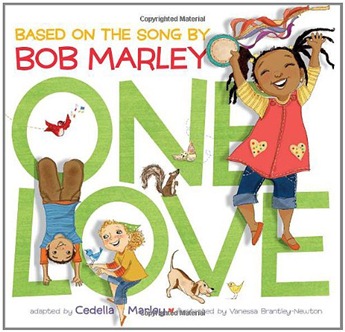
Brantley-Newton’s illustrations add so much joy to this book.  They are full of color and movement, the multicultural cast of characters are vibrant and glowing.  Readers can also keep an eye out for visual references to Bob Marley.

Simple, lovely and powerful, this book is definitely worth celebrating.  Appropriate for ages 2-4.

Reviewed from copy received from Chronicle Books.

Here’s the book trailer:
Review: The Unforgotten Coat by Frank Cottrell Boyce

unforgotten coat

The Unforgotten Coat by Frank Cottrell Boyce

Frank Cottrell Boyce has done it again, creating a book that surprises, amazes, and twists.  This is the story of what happens when two Mongolian boys join a class in England.  They appear out of nowhere, suddenly there in school.  The two brothers refuse to be separated, so the younger boy, Nergui, stays in his older brother’s class.  The two wear large coats and fur hats.  They immediately capture the imagination of Julie, one of their classmates, who is thrilled to be selected as their “Good Guide.”  She wonders where they live, trying for days to follow them home, but they elude her.  Chingis, the older boy, has photographs of Mongolia that he shares with everyone.  The entire class learns more about Mongolia than they had ever known.  But everything is not as it seems, and Julie discovers the truth too late to be of any help in the end.

The book is short, under 100 pages, with most of it being told in a flashback by an adult Julie.  The design of the book adds much to the story, with lined pages that resemble a notebook and Polaroid photographs that capture Mongolia and England, perhaps a mix of both.  The photographs in particular are cleverly done, hiding the truth and then revealing with equal success.

This is a powerful story that seems easy.  It reads as a simple story about two unusual children joining a classroom, and then twists and turns.  It speaks to community and acceptance throughout, showing a class that is eager and willing to embrace the new children, much to my delight.  Then the story takes on a more serious subject, about immigration, fear and deportation.  There is no didactic message here that is too heavy handed, instead it is kept serious but not message driven. 

The book also dances along an edge of imagination and reality where children who pay close attention will realize that even in the end there are questions about what has happened and what truly was.  This dance strengthens the novel even more, making it a powerful choice for discussion.

Highly recommended, this book may just be his best, and that is definitely saying something.  The short length, powerful subject and complex storyline all combine to make a package that is approachable for young readers, discussable by classes, and pure delight to experience.  Appropriate for ages 9-12.

Reviewed from library copy.

Also reviewed by:

Review: One Little Chicken by Elka Weber

one little chicken

One Little Chicken by Elka Weber, illustrated by Elisa Kleven

When Leora finds a chicken has wandered into their house, her mother reminds her that finders aren’t keepers.  When her father returns from work, he agrees.  But it is their duty to take care of the chicken until its rightful owners claim it.  So, they build a chicken coop.  When the hen lays eggs, they do not eat them but the eggs hatch into chicks.  Soon there are chicks everywhere.  So they take them to market and sell them for coins that they use to purchase a little goat.  They milk the goat, turn the milk into cheese, but again do not eat it, because it is not their cheese.  They sell the cheese for coins and buy another goat.  Soon they have a family of goats who are often causing mischief, creating odors, and wreaking havoc.  Finally, Leora’s mother has had enough and runs off down the road with the goats chasing after her.  And who do you think she meets on the road?

This is the retelling of a story from the Talmud and retains the feel of a classic story.  The story is not only about “finders aren’t keepers” but also speaks to the responsibility of community to care for one another.  Weber’s writing incorporates small details that add to the depth of the story.  For example, when Leora and her father are building the chicken coop: “Sawdust flew, wood shavings scattered, nails bent.”  It reads aloud with a lovely rhythm and ease.

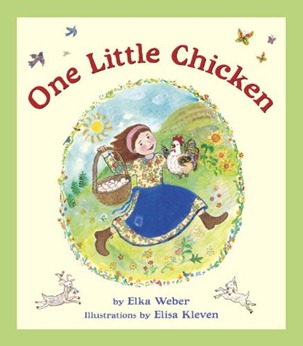
Kleven’s illustrations are done in mixed-media collage using watercolors, ink, pastels and colored pencils.  They have a detail that is very engaging.  Some of the panels are framed in flowing flowers, others have interesting textures, and all have a warmth that is welcoming.

A great addition to units on cooperation or community, this book will also be a good pick for chicken story times.  Appropriate for ages 4-6.

Reviewed from copy received from Tricycle Press.

Also reviewed by Journey of a Bookseller.

Review: Pie by Sarah Weeks

pie

Pie by Sarah Weeks

When Alice’s Aunt Polly dies, the entire community of Ipswitch feels the loss.  Polly, the Pie Queen, left behind quite a void, one that had been filled by her pie shop and her incredible gift for baking pies.  Every resident had a favorite and with her death, they knew they would never taste them again.  But for Alice it is much worse, she has lost one of her dearest friends as well as the shop where she spent much of her time.  Her Aunt Polly left the recipe for her award-winning pie crust to Lardo, her ornery cat, and she left Lardo to Alice.  No one is really sure how someone can leave a recipe to a cat.  As the days pass, strange things start happening, but only Alice seems to notice.  She knows there is someone out there trying to get their hands on the recipe.  With her new friend, Charlie, Alice is determined to solve the mystery.

Weeks has written a book as light as meringue but that has plenty of depth as well.  The story is great fun to read.  It has the tang of a mystery combined with the sweetness of pie.   The pie recipes shared at the beginning of each chapter will have you drooling and determined to see if you could maybe be the next Blueberry Award winner.

Notice how that rhymes with Newbery Award winner?  Weeks has a lot of fun with her brief description of how the Blueberry Award is announced.  It closely resembles the Newbery Award process and had me giggling.  It’s a great insider joke to have in a children’s book.

Alice is a strong character, struggling with the loss of her aunt.  She is determined, creative and imaginative, singing little songs to herself all the time.   These are the things her aunt supported in her, but that her own mother doesn’t understand.  The family dynamic is an important piece of the entire book and is written with great honesty.

A delicious, fun read, this book of pie and mystery is a treat whether read with alamode or alone.  It’s an ideal book for classroom sharing as well, after all who doesn’t like pie?  Appropriate for ages 9-12.

Reviewed from ARC received from Scholastic Press.

Also reviewed by:

Review: Lucky for Good by Susan Patron

lucky for good

Lucky for Good by Susan Patron

This conclusion of the Lucky trilogy will be bittersweet for fans of the series.  Happily, there is one more book with the vivacious Lucky and the intriguing extended family of Hard Pan.  Sadly, it is the final one.  In this book, Lucky struggles with the unknown.  Brigitte’s new café is closed due to a violation of a county ordinance, her best friend is headed to England for the summer, and she even punches a boy.  That ends up with her in serious trouble and she is forced to do a family tree.  That brings up even more questions for Lucky, who doesn’t know how she will handle researching the side of her estranged father.  But nothing keeps Lucky down for long and soon all is heading towards solutions, but not without a few more bumps in the road to keep it all interesting.

Patron does not shy away from difficult topics in this final book.  She deals with the universal themes of family and community as she has in her previous novels.  And what a community it is!  I think all readers of the Lucky series hope to move to Hard Pan, despite the dried out sandwiches.  But Patron explores religion in this novel in a very frank and honest way, voicing the questions that children (and adults) have when they meet someone who believes in a more judgmental universe.  I applaud the courage and bravery of Patron in being so open about these questions, something that young readers will love as well.

Patron also excels at creating characters and all of your favorite characters return in this novel, plus a few new ones.  Lucky is a heroine with real spunk, with her own world view, and a strong sense of self.  Even in her moments of doubt, Lucky never shies away from being exactly who she is. 

An impressive conclusion to the Lucky trilogy, fans of the series will have to have this one.  And for me, I can’t wait to see what world Patron will create for us next.  Appropriate for ages 8-12.

Reviewed from copy received from Atheneum Books for Young Readers.

Review: Because of You by B. G. Hennessy

because of you

Because of You: A Book of Kindness by B. G. Hennessy, illustrated by Hiroe Nakata

This book speaks to the power of people in two distinct ways.  It speaks in pairs of lines that have similar themes but look at them from different points of view.  So the world is better for having a new person to love and care for, but also the world is better because there is a new person who will love and care for others.  This pairing happens throughout the book, strengthening the message that each person has value and impact in the world.  The book ends with the breaking of the pattern where it is expanded to include the impact of people around the world helping and caring.   “It is called peace.”  And then the book turns it once again and tells the reader that peace starts with individuals and it may happen “because of you.”

This book is written with conviction that radiates throughout it.  It also has a very strong format with the repetition of form.  It reads aloud effortlessly, celebrating the impact that each of us can have.  Nakata’s illustrations are quiet and sweet, a feeling that is helped by the small size of the book.  They include children and families of different ethnicities making the message even more universal.

While this will be enjoyed by children, it would also make a great gift for adults.  Appropriate for ages 4-6.

Reviewed from copy received from Candlewick Press.

Amazing Faces

Amazing Faces, poems selected by Lee Bennett Hopkins, illustrated by Chris Soentpiet

This book is a great collection of poems that really reflect diversity and America.  Diversity in race as well as the range of emotions in human experience, both are on display in this collection.  The collection moves gracefully from one poem to the next, each fitting next to the other to make a cohesive whole.  This is helped by Soentpiet’s art which celebrates emotions, humanity and community in the faces he depicts.

Hopkins has created a collection that really meshes well.  Each poem and poet has a distinct voice and point of view.  The differences are celebrated here, the poems just as diverse as the world they share.  The first poem, Amazing Face by Rebecca Kai Dotlich, welcomes readers with open arms into the collection.  It is closed just as effectively with a Langston Hughes poem, My People

Soentpiet’s art captures moments in the world that we all want to grasp and hold onto a bit longer before they pass.  There is the smile of a baby, the power of a storyteller, the evening sky, and that moment that loneliness disappears.  All are illustrated with great detail, making those moments ever so real.

Highly recommended, this collection of poetry will help you celebrate what America is all about: the diversity of its people.  Appropriate for ages 5-9.

Reviewed from copy received from Lee & Low Books.

The Can Man

The Can Man by Laura E. Williams, illustrated by Craig Orback

Tim wants a skateboard for his birthday but his family can’t afford to buy him one right now.  So when Tim sees the Can Man collecting cans to earn money, Tim realizes that he can do that to earn money for his skateboard.  Tim gathers cans with great energy, finally getting seven bags which should be more than enough for his skateboard.  On the final day he can collect cans, it is pouring rain.  The Can Man is out with his grocery cart collecting too, though he admits to Tim that he hasn’t found many cans lately.  Time explains that he is going to use the can money for a skateboard.  When he asks the Can Man what he’s collecting for, he learns that he needs the money for a warm coat.  The Can Man helps Tim bring the bags of cans to the redemption center.  After redeeming the cans for money though, Tim sees the Can Man walking away and knows just what he should do.  He runs outside and gives the Can Man all of the money he made.  On his birthday, Tim finds a package outside his door.  Inside is a skateboard.  Not a brand new one, but one that will work just fine and even has a fresh coat of paint, thanks to the Can Man.

Williams has taken what could have been a didactic moral tale and turned it instead into a fresh story about kindness and community.  Her text has a warmth to it that makes the story relatable, bringing the issue of homelessness and poverty directly into a child-eye view.  Orback’s illustrations reflect the same honesty as the words.  His paintings glow with a warm light and offer a realistic view of the neighborhood the story is set in. 

Bravo for a book that brings social concerns to children without lecturing!  Appropriate for ages 4-8.

Reviewed from copy received from Lee & Low Books.

Also reviewed by A Psych Mommy and  BookDragon.

A Seed Was Planted

A Seed Was Planted by Toulla Palazeti, illustrated by Pamela Barcita

From a single seed being planted, people share shoots of the plant.  With friends, neighbors and family members who each take it in turn, plant it and then pass on a shoot to another person.  The book uses the refrain of “It grows,” as each person plants their shoot.  In the end, the small plants grow and grown until they are trees large enough to climb.  The book speaks to the wonder of seeds, the power of sharing and the way that one small idea can lead to transformation.

Author Palazeti keeps the text very simple with only one sentence per page.  This makes it ideal for new readers of both English and Spanish.  This simplicity of language belies the depth of the story and its gentle and powerful message.  Barcita’s illustrations are realistic and very friendly.  Readers get to see each sharing of the tree along with a framed image of the newly potted shoot.  The different pot styles and settings speak firmly to our differences as well as our commonalities. 

Recommended for new readers in either English or Spanish, this book is universal in its message and appeal.  Appropriate for ages 3-5.

This book comes in both English and bilingual English/Spanish.  I reviewed from an ARC of the bilingual version that I received from the publisher.