3 New Biographies of Great Women

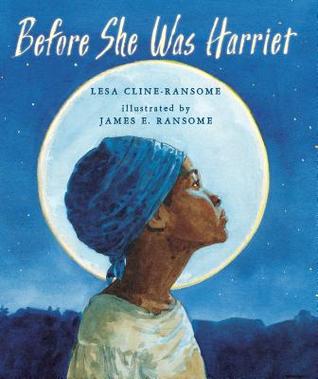
Before She Was Harriet by Lesa Cline-Ransome

Before She Was Harriet by Lesa Cline-Ransome, illustrated by James R. Ransome (9780823420476)

Told in reverse chronological order, this picture book biography of Harriet Tubman is stunning. The verse walks readers through her life, from her work with runaway slaves to her speeches as a suffragist. The book touches on other parts of her life that readers may not be aware of such as her work as a Union spy and a nurse. The book moves all the way back to Harriet saving her family from slavery and then her own time enslaved on a plantation when her father taught her about the woods and the stars, creating an opportunity for Harriet to become the amazing woman she was. The poetry of this book is beautiful and spare, it moves from one important moment in Harriet’s life to another, spooling out her life’s story. The illustrations by Ransome are beautiful, playing with light and dark. The images stop readers just to gaze when the page is turned as they capture one moment after another. An important and lovely book about Harriet Tubman that belongs in all libraries. Appropriate for ages 6-9. (ARC provided by Holiday House.)

Grace Hopper Queen of Computer Code by Laurie Wallmark

Grace Hopper: Queen of Computer Code by Laurie Wallmark, illustrated by Katy Wu (9781454920007)

This picture book offers a friendly and approachable look at the life of Grace Hopper, one of the most important and influential computer geniuses of history. Even as a child Grace spent her time figuring out how things worked and designing devices. She attended Vassar College where she studied math and physics and also found adventures like going up in a plane. She attended graduate school in Yale, one of two women in her class. When World War II came, Grace wanted to help and tried to join the Navy. At first they would not accept her, but after a year she convinced them. She wrote programs for the first computers, coining the term “computer bug” when a moth flew in and stopped the computer from working. She created the way that computers can be programmed using language rather than 1s and zeroes.

Wallmark also shares a timeline of Hopper’s life at the end of the book that shows even more of her accomplishments over her long career. She also makes sure to share Hopper’s personal verve for life and her approach to creativity, moving the book away from what could have been too distant and factual into one that children can relate to easily. Wu’s illustrations capture that feeling as well, showing Hopper hard at work and yet enjoying daredevil time and teamwork. A great picture book biography that will add a lot to STEM collections. Appropriate for ages 6-9. (Reviewed from library copy.)
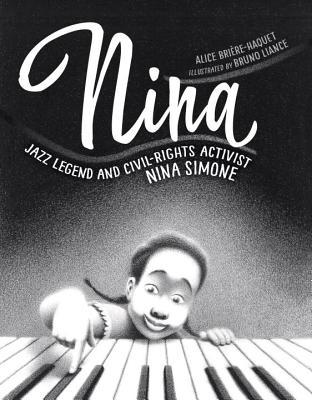
Nina Jazz Legend and Civil-Rights Activist Nina Simone by Alice Briere-Haquet

Nina: Jazz Legend and Civil-Rights Activist Nina Simone by Alice Briere-Haquet, illustrated by Bruno Liance (9781580898270)

This picture book is a completely engrossing look at the life of Nina Simone. Done in a way that welcomes even small children to hear her story, the book opens with a greeting and a lullaby. Using piano keys as an allegory for race, the book looks at the keys through the eyes of a young Nina, who notices that white keys are whole notes while black keys are half notes. She sees something similar in society as well. Nina used music as a way to unite and to protest. Inspired by Martin Luther King, Jr., her music spoke to people of all color and united them. While the story follows a linear path in time, the information shared focuses on important events in Nina’s life rather than feeling like a chronological list of accomplishments or dates. Instead readers get to see what influenced her and how she grew into her voice as an activist. The illustrations are particularly compelling. Done in black and white, the image of people who arranged as piano keys and the one of dandelion seeds floating downward are particularly compelling. Smart and beautifully designed. Appropriate for ages 4-7. (Reviewed from library copy.)
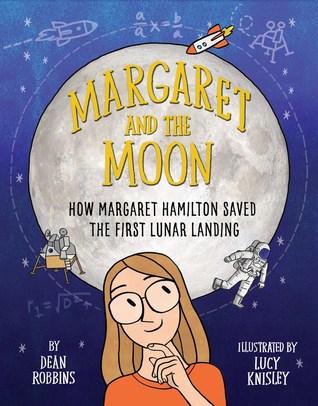
Margaret and the Moon by Dean Robbins

Margaret and the Moon by Dean Robbins.jpg

Margaret and the Moon: How Margaret Hamilton Saved the First Lunar Landing by Dean Robbins, illustrated by Lucy Knisley (9780399551857, Amazon)

This nonfiction picture book tells the story of Margaret Hamilton and her work on computers. When Margaret was a girl in the 1930s and 1940s, she wondered why girls weren’t studying science and math, so she did. She went to MIT and started working on computers back when they required handwriting code and the computers filled entire rooms. She eventually went to NASA where she programmed computers to help astronauts travel to the moon and connect to one another in space. When Apollo 11 came and astronauts were going to land on the moon, Margaret wrote the programs to get them there and back safely. In fact, when disaster struck it was Margaret’s programming that kept everyone safe and accomplished the goal.

Robbins writes with a celebratory tone in this biographical picture book. His appreciation for Margaret’s ability to ask tough questions and figure out answers is clear. Throughout, he keeps the tone playful and light, showing the hard work behind the accomplishments, and her inquisitive nature as the keys to her success.

It is great to see graphic novelist Knisley illustrating children’s books. Her illustrations match the tone of Robbins’ writing, keeping the entire book light and celebratory. The amount of work done by Margaret is staggering and is shown by Margaret next to a pile of papers that showed the length of her code. That same image is repeated as a photograph at the end of the book.

A wonderful example of women in STEM, this picture book speaks to the power of brains and determination. Appropriate for ages 6-9.

Reviewed from e-galley received from Edelweiss and Knopf Books for Young Readers.

Ada Byron Lovelace and the Thinking Machine by Laurie Wallmark

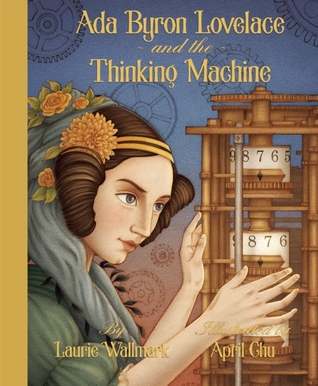
Ada Byron Lovelace and the Thinking Machine by Laurie Wallmark

Ada Byron Lovelace and the Thinking Machine by Laurie Wallmark, illustrated by April Chu (InfoSoup)

Ada Lovelace was born the daughter of the famous poet, Lord Byron. But she was more like her mother and interested in numbers rather than words. As a young woman, Ada invented a flying machine that she did all of the mathematics for. She spent time experimenting with wind and sails to inform her calculations. Despite a health scare that left her blind and paralyzed for some time, Ada continued to learn math and love numbers. When she met Charles Babbage, the inventor of the first mechanical computer, she found a person she could talk to about her love of numbers. It was his machine that inspired her to write the first computer program ever so that others could understand this amazing computer he had built. This makes Ada the first computer programmer.

It is inspiring to see a girl from such an early time period who was clearly a mathematical genius. She had a mother who was also interested in math and supported her daughter’s education and love of numbers throughout her life. This book shows the power of mathematics to inspire new ideas and inventions. It also demonstrates that women in computing goes back to the very beginning.

Chu’s art is done with pencil on paper and then as the copyright information says “colored on an Analytical Engine” also known as a computer. The illustrations are rich and lovely. They have interesting perspectives like looking down on Ada in the bath with her muddy boots on the floor nearby. Ada is shown as an active person, a youthful presence among older people, and shines on the page as she must have in life.

A powerful and inspirational read for children interested in math and science, this picture book will show young readers a heroine that they may never have met before. Appropriate for ages 7-10.

Reviewed from library copy.