Is That Wise Pig? by Jan Thomas

is-that-wise-pig-by-jan-thomas

Is That Wise Pig? by Jan Thomas (InfoSoup)

Cow, Pig and Mouse are all making soup together. Mouse adds one onion, Cow adds two cabbages, but Pig tries to add three umbrellas! The other two ask Pig if that is wise. Then Mouse adds four tomatoes, Cow adds five potatoes, and Pig tries to add six galoshes. Is that wise? More ingredients go in and Pig even adds nine carrots! Then Pig reveals that she asked ten friends to join them, something that probably was not wise. Suddenly Pig’s galoshes and umbrellas make a lot of sense as the soup flies!

As always, Thomas completely understands the farcical humor that toddlers adore. Children will be so engaged in laughing at Pig’s ingredients that they won’t see the ending coming until the reveal. There is also a counting component to the book that is subtly done and the book feels much more like a story than one teaching numbers. Thomas’ illustrations will work well with a crowd, projecting easily even to those in the back thanks to their strong black lines and simple colors.

Expect lots of requests for seconds of this silly book. Appropriate for ages 2-4.

Reviewed from copy received from Beach Lane Books.
 

Review: Minette’s Feast by Susanna Reich

minettes feast

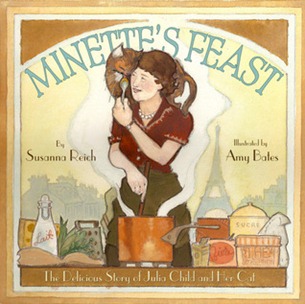
Minette’s Feast: The Delicious Story of Julia Child and Her Cat by Susanna Reich, illustrated by Amy Bates

Minette was most likely the luckiest cat in the world, since she was owned by Julia Child.  Adopted by Julia Child and her husband during their time in Paris, she was just as discerning about her food as her owner was.  She spurned canned food, eating only fresh mice and bird.  Julia would bring home marvelous fish heads just for Minette and also give her leftovers from her cooking.  Still, Minette preferred her own hunted food.  Julia began to cook more and more, taking classes as Le Cordon Bleu.  Minette honed her own hunting skills at the same time, practicing on her toys.  It would take something very special to lure Minette away from the mice.  But then again, her owner was Julia Child who was certainly up to that challenge.

Taking on a famous cook and personality through her finicky cat is a wonderful approach.  We get to see a younger Julia Child, figuring out how to cook French food in her own small kitchen.  We are there to see her arrive in Paris, find her footing in the culture, and then through her learning process until her cooking inspires even her cat to turn away from mice.  It’s a genuine way to approach the subject that has a real child-appeal.

Bates’ illustrations are done in pencil and watercolor.  There is a seriousness and also a playfulness in her illustrations that remind me of Julia herself.  The lanky woman is shown at her full height throughout the book as she is celebrated in both image and text.  Minette appears early in the book, long before Julia adopts her.  It’s a nice touch for sharp-eyed children.

A warm and energetic glimpse of Julia Child that celebrates her on the year of her 100th birthday.  Simply delicious!  Appropriate for ages 6-8.

Reviewed from copy received from Abrams.

Book Review: The Cazuela That the Farm Maiden Stirred by Samantha R. Vamos

cazuelafarmmaiden

The Cazuela That the Farm Maiden Stirred by Samantha R. Vamos, illustrated by Rafael Lopez

This is a fresh, fabulous cumulative tale that is made spicier and more interesting thanks to the Spanish sprinkled liberally throughout.  It is the story of a farm maiden who stirred a pot.  Once she started stirring, all of the animals wanted to help with what she was cooking.  The cow gave milk, the hen gave eggs and zested the lime which was picked by the donkey who was carrying the duck to the market.  Eventually everyone is waiting for the treat to be finished until they started playing music and dancing.  Then no one was watching or stirring the pot!  Thank goodness that they returned just in time to enjoy the arroz con leche that they had all cooked together.

When I read this book to myself silently it really didn’t work, but read aloud it merrily dances along, even with my very imperfect Spanish pronunciation.  For classes in our community, the blend of Spanish and English is very desirable.  Happily, the Spanish here forms the real foundation of the story rather than just being extra words that are thrown in.

Lopez’s art is so vibrant and warm.  The sun shines when you open the book, thanks to the use of a beautiful yellow for the majority of the background.  Add to it the purple clouds tinged with red, the orange ground, and the vibrant green of the plants, and you have a book where the colors are filled with heat and spice.

A rollicking picture book that celebrates Spanish and English mixed together sweetly, just like the perfect arroz con leche.  Appropriate for ages 3-5, and in language classes for older children.

Reviewed from copy received from Charlesbridge.

Check out the book trailer to get a feel for the book and the illustrations:

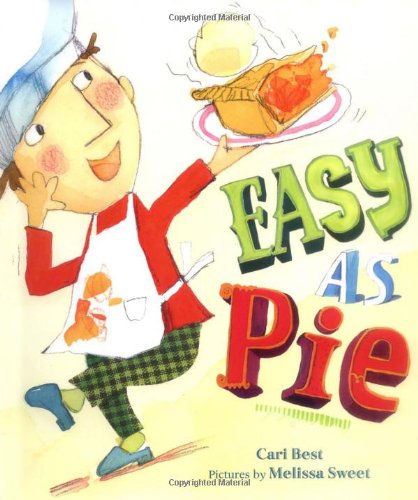
Easy as Pie

Easy as Pie by Cari Best, illustrated by Melissa Sweet

Jacob’s favorite TV show is Baking with Chef Monty, so when Jacob sets out to bake his first pie, he knows all of Chef Monty’s rules by heart.  He knows that: a happy baker makes a happy pie.  He finds all of his ingredients in the kitchen and sets to work.  When his sister Charlotte comes to get him ready to go out for dinner and celebrate their parents’ anniversary, Jacob makes sure he keeps working because one of the rules is: Concentrate on what you’re doing – no matter what.  He rolls out the dough, fixing his mistakes like Chef Monty advises.  He flutes the edges of the pie and pricks holes in the top crust, slightly larger than Chef Monty would have recommended.  Soon the pie is in the oven, though his family is getting tired of waiting for Jacob to be ready to go.  But there is one solution to that!  Dessert first!

So many children’s books about cooking have the child making a horrible mess, combining strange and unappetizing ingredients together, all resulting in an inedible creation.  This turns that formula on its head with a child who is confident and capable, creating a pie that makes the parents’ anniversary even more special. 

Best’s writing is a pleasure to read aloud with the sprinkling of Chef Monty quotes throughout, great asides of noises, and plenty of action.  Sweet’s art is light-hearted and funny, filled with peach-colored splashes and funny touches like the titles of the books on the shelves.  The writing and text go together like ice cream and warm pie.

A great read aloud for any classroom starting a cooking project or any story time where food will be featured.  Guaranteed to be a favorite around Thanksgiving too.  Appropriate for ages 4-7.

Reviewed from copy received from Farrar, Straus and Giroux.

Nobody

Nobody by Liz Rosenberg, illustrated by Julie Downing

Released May 25, 2010.

A charmer of a book about a boy and his imaginary friend, Nobody.  This allows for plenty of wordplay in the book with Nobody telling the boy to do anything, Nobody helping him, and Nobody cleaning up.  George woke up early in the morning and with Nobody’s advice decided to make a feast!  So he and Nobody raid the refrigerator, mix all sorts of things together including eggs, chocolate syrup and dog biscuits.  Not allowed the turn on the stove, the two friends had to wait.  So they played cards.  Nobody won.  George then invented his own game which he won.  When his parents woke up, they were surprised by the mess.  As they took the matter in hand, Nobody began to shrink and disappear until George called him back to help make pancakes for breakfast.

I’ve always loved wordplay and we don’t see enough of it in books for preschoolers.  Especially this kind of subtle playing where it can be ignored without losing the story, or enjoyed as another dimension of the book.  Rosenberg’s text is great fun to read aloud.  Children will love the concoction the two create together and will immediately understand that Nobody is imaginary.  I also appreciate the parents’ reaction to the morning mess.  They take it in stride and with humor. 

Downing’s illustrations have a soft quality that works well in this early morning story filled with imagination.  She uses sploshes and drips of paint to great effect as the kitchen becomes messier and messier.  George is quite a small child in the illustrations, which will make it inviting to young children to join in the adventure.

Recommended, this is a great book to share when doing story times on cooking or messes.  Nobody makes a mess quite like this one!  Appropriate for ages 2-5.

Reviewed from copy received from Roaring Brook Press.

Cora Cooks Pancit

Cora Cooks Pancit by Dorina K. Lazo Gilmore, illustrated by Kristi Valiant

Cora always got stuck with the kid jobs when her mother cooks like licking the spoon and drawing in the flour.  So when her older siblings head out of the house, Cora asks her mother to make pancit.  Cora’s mother gives her the red apron that belonged to her grandfather who was a cook.  After washing her hands, Cora gets to help with grownup jobs like shredding chicken, checking the soaking noodles, and stirring the hot pan.  When the family sits down to dinner, Cora is nervous.  Will her pancit taste good?

This is a very warm book with a bustling, busy family.  It really speaks to the relationship of a mother and daughter, the way that traditions and foods are handed down to the next generation, and the pleasure children get from being part of creating and learning.  Gilmore’s text is joyful as it explains Filipino foods and heritage, giving us glimpses of the family history along the way.  Valiant’s art with its warm, deep colors show us a family that is familiar but has its own particular culture. 

A glowingly friendly look at a loving Filipino family, this book will have you hungry for your own family recipes and offers a great venue to discuss everyone’s particular family heritage through food.  Appropriate for ages 4-7.

Reviewed from library copy.

Interview with Kristi Valiant at Elizabeth Dulemba’s blog.

Also reviewed by Paper Tigers, The Picnic Basket, Jama Rattigan’s Alphabet Soup, and BookDragon.

Applesauce Season

Applesauce Season by Eden Ross Lipson, illustrated by Mordicai Gerstein

A perfect book to ease into autumn!  A little boy and his family make applesauce every year just around the time school starts.  They go to the farmer’s market and pick out all sorts of apples for sauce and for eating.  The little boy is in charge of washing the apples when they get home and then his mother and grandmother cut them into pieces.  Into the pot they go with just the right amount of liquid.  When they soften, the little boy gets to help put them through a food mill.  Then a bit of butter, a pinch of salt and just the right amount of cinnamon sugar are added.  The father in the family doesn’t help with the applesauce, instead he makes things to go with it and applesauce cake to use the last of it up.  Throughout the fall, the family makes applesauce together with the color and taste of it changing as the season moves on.

The details of the making of the applesauce is the bulk of this story, though it is about not only the process but a family that cooks together and enjoys it immensely.  Lipson has just the right touch with the text which is explanatory and simple, allowing children to see how it is done.  One delightful part is how much the little boy is allowed to do.  Children will see themselves as part of the action rather than observers.  Gerstein adds the beaming faces of the family as they cook together, the bright colors of the apples, and the changing faces of the applesauce.  His illustrations are just as comforting and welcome as a warm spoonful of applesauce.

This is a lovely celebration of food and family with just the right sweetness and spice.  Highly recommended for apple story times and units, especially for those classrooms and libraries that create applesauce with the children.  Appropriate for ages 4-6.

Reviewed from library copy.

Mr. Putter & Tabby Spill the Beans

Mr. Putter and Tabby Spill the Beans by Cynthia Rylant, illustrated by Arthur Howard

As a huge fan of the Mr. Putter and Tabby series with their gentle and very funny humor, I was delighted to see that there was a new entry in the series!  In this latest book, Mr. Putter and Tabby (his cat) join their friends Mrs. Teaberry and Zeke (her dog) on a new adventure, a cooking class.  To be specific, a cooking class that offers one hundred ways to cook beans.  At first the worry is that Tabby and Zeke won’t stay below the table, but the two animals are capable of causing plenty of trouble from right under there.

Rylant has a special gift for writing text at a beginning reader level that is not only accessible for new readers but also great fun to read aloud.  She writes in a way that belies the difficulty of a smaller vocabulary.  Howard’s art offers additional humor and great facial expressions from Tabby.  Both author and illustrator delight in naughtiness, making this ever so much more approachable for children because of it!

This entire series is highly recommended.  Fans of the series can rejoice in yet another book that meets the high standard of the series.  Appropriate for ages 3-6.

Reviewed from library copy.

Sopa de Frijoles / Bean Soup

Sopa de frijoles / Bean Soup by Jorge Argueta and Rafael Yockteng

A winner of a bilingual book, this picture book is a poem about making bean soup.  Lovingly filled with great ingredients and metaphors, the poem works well.  It follows a young boy through the steps of making sopa de frijoles, from sorting the beans to chopping onions to peeling garlic, and adding salt.  An adult in near in the illustrations, but the boy does the work himself, adding to the joy of the book.

Without any overly-sweet taste, this book offers a poem for children that is respectful and delightful.  It is distinctly a poem rather than prose chopped into stanzas.  The language alone puts it into that category:

The water boils and sings.

The beans dance

together.

The water has turned brown

the color of Mother Earth.

Your house

smells wonderful

like the earth

after the first

winter rains.

That is just one of many passages that capture a sensory experience with tangible images that children can understand but that also ask children to imagine.

Highly recommended, this book would be ideal for a bilingual story time.  But it is also wonderful in a single language program as well.  Appropriate for ages 4-8.

Reviewed from library copy.

Also reviewed by La Bloga and Poetry for Children.