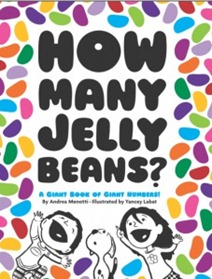
Review: How Many Jelly Beans? by Andrea Menotti

how many jelly beans

How Many Jelly Beans? by Andrea Menotti, illustrated by Yancey Labat

Released in April 2012.

I cannot count how many dismal number and math books I have read over the years.  I’m lucky enough to have a mathematical kid, but finding books that he would enjoy was painful.  Many math books are a lot more about concept than about being fun to read.  Well, not this one!  This one winningly mixes math with candy, so that even non-mathematical kids will give it a try.  Aiden and Emma are just like most siblings, they are trying to get more than each other.  So when Emma asks for 10 jelly beans, Aiden asks for 20!  And the number just keep climbing from there.  Soon, they are up to 500 jelly beans, which may be way too many to eat.  But how about 1000 or 5000 or 10,000 in a year?  The jelly beans get smaller and smaller until the final number of 1 million is reached only be an enormous fold-out page. 

This visual sweet treat will get children able to truly visualize what the difference between thousands, tens of thousands, hundreds of thousands and a million are.  The art by Labat done in black and white with only the jelly beans for tantalizing color really works.  The focus is on the candy and the number.  Menotti nicely inserts division into the conversation too, when the children debate how many jelly beans they could eat in a year. 

I can see this over-sized book inspiring lots of counting, adding, dividing and multiplying in families, or it is also a very sweet book to share with your number-loving kid.  Appropriate for ages 5-7. 

An aside just for librarians, please don’t put this in the remoteness of the nonfiction section with your math books.  Let it enjoy being taken home as a yummy picture book with a jelly bean and math center.

Reviewed from copy received from Chronicle Books.

Board Book Reviews

American Modern Books shared two new board books that are coming out in September.  Both have a modern art vibe that is captivating:

colors harper counting in the garden

Colors by Charley Harper

This is the third board book by Harper and follows his alphabet and counting books.  Here the colors correspond to animals and natural colors in the illustrations.  There are red birds, blue water, orange leaves, and a yellow moon.  There are also some more man-made items in the book like fire hydrants, cars and hats.  The design here is very successful with the small size of the board book format creating a very nice frame around the illustrations.  There is also a lot of variety in the images, though all are thoroughly modern.

Counting in the Garden by Emily Hruby, illustrated by Patrick Hruby

This counting book counts visually as well as in the text of the book.  Steadily count from 1 to 12 with items from the garden.  After each new number is counted, readers turn the page to see that item added to the garden.  What starts as a green and brown, but fairly open and plain field becomes robust and crowded with plants.  The illustrations are strong with plenty of color and lots of energy.  They have modern lines and are very clean and clear.

These two books are sure to please parents looking for books that they too will enjoy reading again and again. 

Reviewed from copies received from AMMO.

Let’s Count Goats!

4caf6b5f82235.preview-300

Let’s Count Goats! by Mem Fox, illustrated by Jan Thomas

A manic and very funny counting book that will have readers laughing at the antics of the goats that they are trying to count.  Can you count the single seaside goat?  How about the goats buzzing by in airplanes?  How about the loud trumpet goats?  Or the ones in the snow?  The talents of Mem Fox and Jan Thomas are delightfully displayed here in one of the top counting books of the year.

Some counting books suffer from trying to maintain counting on each and every page.  Part of the success of this book is that Fox has written other silly goats into the book that do not needed to be counted.  So the book has a nice flow that really works well.  It feels much more like a picture book than a counting book.  Fox’s rhymes are simple, offering Thomas a grand place to build from with her illustrations.  Thomas takes innocent words and transforms them into scenes where her goats munch on the props.  The book is filled with goats doing all sorts of things, drawn in Thomas’ wonderfully simple style that children will immediately relate to. 

Highly recommended, this is a counting book that could be used very successfully in a story time.  The illustrations are large enough to work with a group and the text is readable as well.  Appropriate for ages 2-4.

Reviewed from copy received from Beach Lane Books.

Also reviewed by A Year of Reading.

One Drowsy Dragon

One Drowsy Dragon by Ethan Long

One sleepy dragon wants to get some sleep, but his little dragons are making too much noise.  In this rhyming counting book, readers will find one dragon after another making all sorts of noises.  There is marching, dancing, screaming, jamming in a band, and much more.  Throughout, the adult dragon becomes more and more frazzled and exhausted until the end of the book when the ten little dragons are tired too and ready for bed.  But then the adult dragon is making so much noise snoring that they can’t get to sleep!

Filled with great sounds to make when reading aloud, this book is ideal for a pajama party.  It has a jaunty rhyme with plenty of shouting from the frustrated dragon adding to the frenzy.  The illustrations add even more appeal to the book with their bright colors and humor.  Just the look on the adult dragon’s face will having readers giggling as well as how oblivious the young dragons are to the situation. 

Bright and funny, this is a great counting book combined with dragon appeal and a bedtime theme.  Appropriate for ages 2-4.

Reviewed from copy received from Scholastic.

One Pup’s Up

One Pup’s Up by Marsha Wilson Chall, illustrated by Henry Cole

Count along to ten with adorable puppies in this picture book.  It all starts when one puppy wakes up, then more puppies join in on the fun.  They tumble, roll, drink, piddle, chase, and much more.  Another puppy joins in the fray with each new activity until dinner time.  Then they slowly head to sleep, one at a time, counting down until they are all asleep.  Of course, then it starts again the second one pup is up.

A very simple premise and simply told story, this book is filled with toddler appeal.  The ease of the story along with its galloping rhyme and rhythm make it irresistible.  Chall’s grace with so few words is evident on each page, allowing the images to tell the story.  Cole’s puppies are playful balls of fun, that young readers will be drawn to and relate to.  The illustrations are wonderfully large and bright with plenty of white space, making them ideal for use with a group.

Get those toddlers counting with these puppies and be ready for giggles when the piddle line appears.  A delightful, light-hearted counting book appropriate for ages 2-4.

Reviewed from copy received from McElderry Books.

Cat’s Night Out

Cats’ Night Out by Caroline Stutson, illustrated by J. Klassen

A clowder of cats fill the pages here, counted up one by one all the way to twenty.  (Don’t you love the term “clowder" for a group of cats?  It’s very appropriate here because it sounds so much like “louder.”)  On each page, the cats appear in different dance costumes and a different type of dance is shown.  Line dancing with rhinestones, tangoing in red capes, and polkaing in flip-flops are just some of the great matchups of costume and dance.  The cats dance until the people in the apartment buildings can’t take the noise anymore. Readers will love dancing to dawn with these delightful felines.

Stutson has created a counting book that is a pleasure to read aloud.  Her rhymes are unforced and natural, with the vowels rhyming but rarely the full word, creating a more flowing verse.  The illustrations take this book to another level.  Done in subtle browns and grays, the setting is clearly urban and has the feel of an intimate club that morphs into an almost Broadway show effect as the cats become more numerous.  Klassen evokes a timeless feel with her illustrations but they are definitely modern with a hip, suave tone perfect for these confident dancers. 

Highly recommended, this book is one of the hippest counting books to come along.  Appropriate for ages 3-5.

Reviewed from copy received from Simon & Schuster.

Frankie Works the Night Shift

Frankie Works the Night Shift by Lisa Westberg Peters, illustrated by Jennifer Taylor

Frankie the cat, works during the night at the hardware store.  Counting from one to ten, he cleans counters, waters plans, climbs ladders, and then spots a mouse!  Dashing headlong through the store, he wakes up the entire family who are trying to sleep.  By the time he has chased the mouse off the premises, it is almost morning.  He may work the night shift, but he naps during the day.  So the book ends with ten huge yawns.

Peters writing is straightforward and easy to read aloud.  She has created a counting book with plenty of action which is unusual.  Additionally, her writing keeps the book from becoming sing-songy because each counting page is phrased differently.  Nicely done.

Taylor’s illustrations really take this book to another level.  The first pages of the city street had me hunkered over the page and delighting in the small details.  Then I had to know what medium she used to create the photographically clear but whimsically created images.  Her use of digital photography has created an intriguing look and feel that is never disjointed.  Beautifully rendered, I hope to see more from this debut book illustrator.

A counting book filled with gorgeous images and friendly text, this book with its furry and busy main character will delight young readers.  Appropriate for ages 3-5.

Reviewed from library copy.

Zoo Day Ole!

Zoo Day Ole!: a counting book by Phillis Gershator, illustrated by Santiago Cohen.

Abuelita takes her two grandchildren to the zoo where they count the animals from uno to diez.  They see bears, seals, monkeys, parrots and many more animals.  Gershator’s text is simple with Spanish counting words woven in.  Cohen’s art is thick-lined. His use of large blocks of color make it very child-like and friendly.

The mix of English and Spanish is nicely done, though I would have liked to have seen the names for the various animals done in both Spanish and English as well.  As a counting book, this one works well because readers have the option of counting or not counting since it isn’t built into the text. 

An ideal book for toddlers who love Dora the Explorer or Sesame Street with their mix of Spanish and English.  It would also work well for children learning Spanish in Kindergarten.  Appropriate for ages 2-5.

Reviewed from copy received from publisher.

Zero Is the Leaves on the Tree

Zero Is the Leaves on the Tree by Betsy Franco, illustrated by Shino Arihara

There are many, many counting books published every year, but this book focuses on one number that is often ignored: zero.  The absence of items is rendered here in verse and paintings.  Children are shown the many places that there is zero in everyday life:  no balls left in the bin during recess, no sleds on the hills when snow is melted. 

Franco’s simple and brief poetry, done so subtly that many won’t notice that it is a poem, nicely necklaces the instances of zero together.   Her examples of zero are simple, everyday occurrences that are made poignant by her focus on the transient nature of time.  These glimpse of zero change, replenish, refill.  Arihara’s gouache illustrations have small details but also an expansive view, matching the tone of the poem perfectly. 

Recommended for use in elementary math classes, this book will get children talking about where they see zero in their lives.  It will inspire with the beauty of the language as well.  Appropriate for ages 3-6.

Reviewed from book received from publisher.

Also reviewed by A Patchwork of Books and PlanetEsme.