Hamish Takes the Train by Daisy Hirst

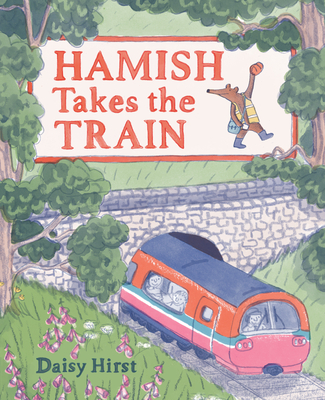
Hamish Takes the Train by Daisy Hirst (9781536216592)

Hamish the bear and Noreen the goose love to watch trains together. Hamish longs to take a train to the city, but Noreen isn’t interested. So Hamish set off, following the train tracks on foot. When he got to the station though, he found he needed a ticket, so he just kept on walking. As night fell, he came to a railroad yard and discovered a caboose all lit up inside. There he found Christov who was sick with the flu and too ill to go to work in the morning and run a big crane. So Hamish offered to help. He borrowed Christov’s hat and jacket and headed into the city on the train. When he got to the building site though, he didn’t have any boots, luckily he was able to find some nearby. Then it was time to run the huge crane. Hamish worked hard, running the crane from the cozy cabin. He did it for the five days that Christov was sick and was offered a job himself by the end. But Hamish was missing Noreen and took a train home, to share his adventures with her, and maybe have some new ones together.

Hirst tells a charming tale of Hamish, a bear with a taste for adventure and trying new things. He is also a very helpful and thoughtful character, helping out where he can and finding unique solutions to problems he encounters along the way. I was most impressed that Hamish was a success as he tried to help. It became a celebration of trying new things, learning and succeeding rather than what is often seen in children’s books like Curious George where helping becomes failing in a funny way.

The art is simple and friendly, capturing both the expanse of the countryside and the bustle of the city streets. Some of the pages are fully colored while others use white space and smaller images that move the story ahead. Throughout there is a sense of happy positivity.

A glorious adventure full of trains and cranes. Appropriate for ages 2-4.

Reviewed from e-galley provided by Candlewick Press.

Review: Hello, I’m Here! by Helen Frost

Hello, I'm Here by Helen Frost

Hello, I’m Here! by Helen Frost, illustrated by Rick Lieder (9780763698584)

This book looks at a family of sandhill cranes as an egg hatches and a chick is born. The little hatchling is soon standing covered in dry fuzz next to their mother. As the day progresses, the chick discovers their brother who has already hatched. They go for a swim in the water and flee from snapping turtles back to the nest where they are now damp and muddy. They have a snack of an insect and a snail. Then they are tired enough for a rest next to their mother.

Frost writes invitingly brief rhyming couplets that accompany the brilliant photographs in this picture book. Her story emphasizes the gentle care of the parent cranes as well as the ability for the newly-hatched chicks to do a bit of exploring on their own. It’s a lovely mix of freedom and protection. The photographs echo that with their focus on the large cranes that dwarf their fuzzy offspring, the beauty of the natural setting, and the adorable pairing of the sibling baby cranes.

Another winner from Frost and Lieder, this one is just right for spring. Appropriate for ages 2-4.

Reviewed from Candlewick Press.


The Crane Girl by Curtis Manley

the-crane-girl-by-curtis-manley

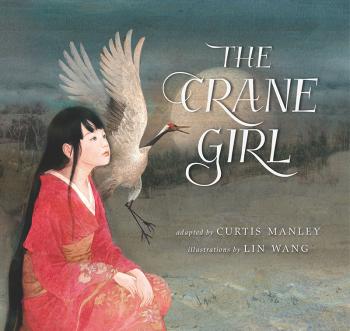
The Crane Girl by Curtis Manley, illustrated by Lin Wang (9781885008572)

Released March 15, 2017.

Yasuhiro discovered an injured crane caught in a trap and freed it, the crane pressing its red crest to his cheek before flying away. The next night a girl came to his home where he lived with his father. She asked to stay with them and work for them. His father, Ryota, agreed to let her stay though they aren’t rich and have little to share. The girl, Hiroko, noticed the loom in one of the rooms and was told that it belonged to Yasuhiro’s mother who had died. Hiroko offered to weave silk for them to sell as long as they never opened the door while she was working. They agreed. She soon returned with fine silk that Ryota was able to sell for a nice sum, enough to stop him from having to look for work for awhile. Soon though, he needed more silk and then still more, faster and faster each time. As the demands grew, Hiroko was unable to recover between weavings, making each time take longer and longer. When Ryota finally opened the door, there was Hiroko as a crane, weaving on the loom and using her own feathers. Hiroko finished the weaving and then flew off, but it was up to Yasuhiro to decide what life he was going to choose going forward.

This picture book version is based on several versions of the traditional Japanese crane folktales. One theme in these stories is the concept of a debt that needs to be repaid. This version has a father who plays the impatient villain in the story, allowing real love to blossom and grow between the human boy and the crane girl. The writing here is superb. It is simple enough to be shared aloud well and yet rich enough that the story really comes to life. Manley uses haiku inserted throughout to speak the characters’ deepest feelings that they don’t share aloud in the story. This use of brief poetry embraces the Japanese setting of the tales in another way, enriching them further.

The illustrations are enchanting. They have a light to them, one that shines from the silk the girl creates and emanates from her body and feathers. Done in watercolor, they are filled with fine details, small touches of steam rising from a teapot and snow on shoulders draw readers further in.

A rich retelling of the Japanese crane folktale, this version offers great writing combined with wonderful illustrations. Appropriate for ages 4-7.

Reviewed from e-galley received from Edelweiss and Shen’s Books.

Review: Gobble You Up! by Sunita

gobble you up


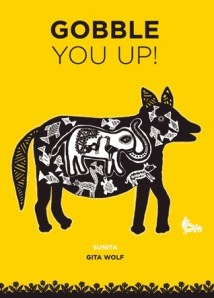
Gobble You Up! by Sunita, text by Gita Wolf

Based on a Rajasthani folktale, this picture book is a work of art.  Jackal’s best friend is Crane, but then one day he was too lazy to hunt for food.  Jackal challenged Crane to catch twelve fish all at once.  Crane managed to do the feat, and then Jackal quickly gobbled down all twelve fish.  Crane protested and then Jackal ate Crane too.  Tortoise witnessed this, so Jackal had to eat Tortoise as well.  Squirrel dared Jackal to eat him too, and Jackal managed.  One by one, more animals get eaten and Jackal’s belly stretches and stretches.  The elephant was more difficult to swallow, though Jackal managed.  Then Jackal got very thirsty from eating all of those animals one after another.  And you will just have to read the book to see how it all ends!

The first thing that you notice about this book is that it feels different in your hands.  It has a different weight, a different balance.  It smells different.  The pages have a texture to them and the ink has body on the page that your fingers can feel.  Inside, the story is told rapidly and with wonderful sounds and reactions.  This is a story that comes from an oral tradition and you can hear it as you read it aloud.  It flows and moves.  If you are a librarian who does storytelling, get your hands on this book.

Sunita’s art is the center of the book.  Called Mandna, this art form is practiced only by women and taught from mother to daughter.  It is used to decorate the mud walls of homes and done without brushes.  The art is beautiful, richly detailed and unique.  Make sure to read the information at the end of the book for more facts about the art and how the book was made.

Unique and lovely, this is a rich folktale from a region of India that will delight and amaze.  Appropriate for ages 4-8.

Reviewed from library copy.