Review: Mouse Bird Snake Wolf by David Almond

mouse bird snake wolf

Mouse Bird Snake Wolf by David Almond, illustrated by Dave McKean

From the author and illustrator who brought us The Savage comes this new book.  Three children, Harry, Sue and Little Ben, live in a world that is calm and lovely, but also incomplete.  They look around and see gaps where objects or things could be, but are not.  Up above, the gods are sleeping.  They are quite proud of the world they have created and spend lots of time bragging about what they have already done.  None of them are interested in creating anything new or filling any of the empty spaces.  The children though do have the drive to do just that.  So they create creatures out of twigs and leaves and dirt.  Their ideas start small but quickly grow to a frightening level.  Can anything be done once a thing is created?

Almond is not afraid to head right to the strangeness that keeps others at bay.  In fact, that’s right where he takes readers: to those dark and dangerous spots that others steer from.  Here he comes at that place through a mythological tale of bored gods and sparklingly intense children.  From the title alone, you know there is danger ahead, but what a ride it is! 

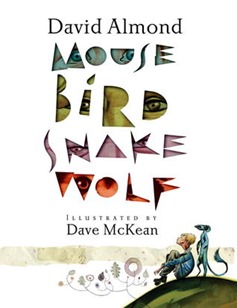
McKean takes those dark ideas and makes them visible to all.  Lest we think that Almond is speaking in broad terms and using metaphors, McKean’s art makes it all completely real and tangible.  Done in sharp angles and lean faces, there is a marvelous hunger throughout these images that shows in the eyes and postures.  It’s such an ideal fit for the story. 

Dark and dangerous, this book is not for everyone.  Fans of Almond and McKean though should cheer this new book from the team.   And once you start, I dare you to be able to look away!  Appropriate for ages 8-12. 

Reviewed from library copy.
Review: The Day the Crayons Quit by Drew Daywalt

day the crayons quit

The Day the Crayons Quit by Drew Daywalt, illustrated by Oliver Jeffers

Published June 27, 2013

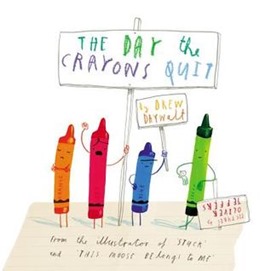
Duncan is all set to color, but when he opens his crayon box he finds all sorts of letters written to him by his crayons.  And they are all letters of complaint!  First, Red wants to complain about being overworked because of all of his work on apples and fire engines.  He even works holidays like Christmas and Valentine’s Day!  Other crayons like Beige are complaining about not being used enough.  Then there is the feud between Orange and Yellow about how is the real color of the sun, since Duncan uses them both.  Peach crayon is upset about having his wrapper peeled off leaving him naked and unable to come out of the crayon box.  Purple scolds Duncan for coloring outside the lines and Pink complains about not being used except by Duncan’s little sister.  Luckily, Duncan has a great solution to all of their complaints.

Daywalt has created a book that is such fun to read aloud.  Each crayon’s letter really has its own voice, making it a pleasure to give new voices for each crayon character.  This mix of tones and voices also results in a very robust story, much more than one might expect for such a simple concept.  The entire book is cheerful and has laugh-out-loud moments throughout.

Jeffers’ art is as always playful with his own particular whimsical touches.  His crayons come to life with just a few lines that convey emotion through eyes, mouth and arms.  Simple and completely convincing.

A colorful look at crayons, personalities and ultimately creativity, this picture book should be shared aloud with plenty of paper for coloring on.  Appropriate for ages 4-6.

Reviewed from copy received from Philomel.

Review: Windblown by Édouard Manceau

windblown

Windblown by Édouard Manceau

Scraps of paper blow across the page, first one then several appear.  But what are they and whose are they?  First the chicken insists they are his since he found them.  Then the fish says that he cut them from the paper.  Then the bird, the snail and the frog explain that they are theirs as well.  Each animal fits them to their body to demonstrate why they belong to them.  Then the wind itself speaks about blowing the pieces around and offers them to the reader, “What will you do?” 

Superbly simple and entirely engaging, readers will be playing along with the book before they even open the pages.  Manceau has cleverly selected shapes that fit together in many different ways.  He demonstrates this over and over again, then turns it all over to the reader to continue. 

This is also a book that would make a great art project for little ones.  Share the book, then give each child the pieces shown in the story to make their own picture.  An ideal way to end a creative story time.  Appropriate for ages 2-4.

Reviewed from library copy.

Review: The Bird King by Shaun Tan

bird king

The Bird King: An Artist’s Notebook by Shaun Tan

This book opens the curtain to Tan’s creative process, allowing readers to view art from stories that have not yet been full formed, art from books that have been completed, and beautiful illustrations that may not be stories at all.  The courage this book took to produce is to be applauded.  Allowing readers and other artists to see a process of creativity is raw and soul baring. 

This book is stellar.  One turns the pages slowly, lingering in worlds undreamed of, wondering at ideas, and pausing to allow a particular image to sink in more deeply.  It is a journey, specially designed for a young creative to see that mistakes can be joyous, that creation is messy, and that works in progress are breathtaking.

This is a book to get in the hands of teens who enjoy art and writing, for it is a look at the unformed and the just formed.  It is a book of pure creativity and the creative process.  Beautiful.  Haunting.  Inspiring.  Appropriate for ages 10-18.

Reviewed from copy received from Scholastic.

Review: Dog Loves Drawing by Louise Yates

dog loves drawing

Dog Loves Drawing by Louise Yates

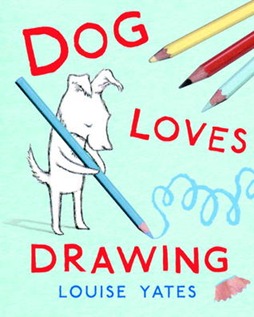
The charming dog from Dog Loves Books returns in this second story.  When dog receives a blank book in the mail, he’s not sure what to do with it.  Then he sees the note from his Aunt Dora that told him it was a sketchbook and wished him wonderful adventures.  The first thing that Dog drew was a door, he walked through it and then drew a stickman and a duck.  The duck drew an owl and the owl drew a crab.  Then everyone started drawing until they wondered what else to do.  Dog then drew a train and they all hopped aboard, entering into an adventure on the page that they created themselves. 

This jaunty picture book celebrates both creativity and art.  Yates embraces the flow of consciousness story creating, merrily showing us how very freeing and fun it can be.  Doodles are celebrated and there is no erasing and perfecting, just an acceptance of the art being done.  I enjoyed the addition of the monster at the end of the book, giving that little extra jolt of energy at the end of the adventure. 

The illustrations are colorful and done mostly in simple lines.  Dog himself is sketched in black and white, but others have a looser feel of being quickly drawn.  The addition of real-seeming paintbrushes and pencils adds to the feeling of being inside a sketchbook. 

A welcome sequel to the first book, this is a lovely book that will have you doodling in your own sketchbook.  Appropriate for ages 3-5.

Reviewed from copy received from Knopf Books for Young Readers.

Review: Drama by Raina Telgemeier

drama

Drama by Raina Telgemeier

The author of the award-winning Smile returns with another graphic novel that captures the turmoil and thrill of being a teen.  Here the focus is on high school theater.  Callie loves theater, but not being an actress, instead her passion is set design and working behind the scenes.  This year she gets her big chance with the production of Moon over Mississippi as the main set designer.  She has a big vision, the question is whether she can pull it all off.  In particular, the cannon scene proves very challenging, but Callie knows she just has to have the cannon really fire on stage.  In the meantime, Callie is getting to know two handsome twins who are also interested in theater, enjoying her friendship with the other stage crew members, and dealing with lots of drama onstage and off. 

Telgemeier has created a graphic novel that both actors and those behind the scenes will love.  It is great to see a book focus on the efforts that it takes to really get a show running, rather than just who gets to be in the spotlight.  The story is welcoming and inclusive, just like any great theater crew.  There are gay characters, crushes on both the right and wrong people, mistakes on stage, and much more to love.  She has captured high school without being fanciful at all.

As with her previous book, Telgemeier’s art has a combination of empathy and humor.  She laughs along with her characters and never at them.  It’s a crucial difference that makes her books all the more laudable and readable. 

Highly recommended, this is one for the Glee fans and also for all of those teens who work behind the scenes rather than dreaming of time on stage.  Appropriate for ages 13-16.

Reviewed from ARC received from Scholastic.

Review: Georgia in Hawaii by Amy Novesky

georgia in hawaii

Georgia in Hawaii: When Georgia O’Keeffe Painted What She Pleased by Amy Novesky, illustrated by Yuyi Morales

In 1939, the Hawaiian Pineapple Company commissioned two painting by Georgia O’Keeffe.  This picture book is the story of her trip to Hawaii funded by the company.  O’Keeffe spent time on each of the Hawaiian islands.  Her first stop was Oahu where she saw pineapples in the fields.  She wanted to spend time close to the plants as they grew, but the company did not approve.  They gave her a pineapple that had been picked, but that was not the same for O’Keeffe.  She next went to Maui where she spent time near a rainforest and waterfalls.  She painted what she wanted, when she wanted.  On the island of Hawaii, she saw volcanoes, rare red coral and lots of flowers. Finally, she went to Kauai and visited with the local artists as the air was filled with the scent of burning sugar.  But when she returned to the mainland, she didn’t have a single picture of a pineapple.  The company was upset, and so was O’Keeffe, who hated being told what to paint.  So how could they resolve this?

Novesky brings the Hawaiian island to lush life in this picture book.  Her words tell of the beauty and diversity of the islands.  They also show how the islands impacted the work of Georgia O’Keeffe.  The story is told on a level that children will enjoy, giving examples of what inspired O’Keefe to paint and what did not.  It is a strong story about how creativity and inspiration work.

Morales’ art is so lovely.  As she says in her illustrator’s note at the end of the book, she took inspiration for the illustrations not only from the twenty paintings that O’Keeffe created in Hawaii, but also from works throughout O’Keeffe’s lifetime.  The illustrations have something that I can’t put into words.  It’s a kinship or a closeness with the original work. 

This is a gorgeous and striking picture book about a dynamic, one-of-a-kind artist.  Appropriate for ages 6-8.

Reviewed from library copy.

Review: The Hueys in The New Sweater by Oliver Jeffers

hueys in the new sweater

The Hueys in The New Sweater by Oliver Jeffers

All of the Hueys are the same.  They are all white ovals with skinny, stick legs and arms.  They even acted and thought the same, until one day when Rupert knitted himself a sweater.  It was a bright orange sweater with zig-zags and it made him stand out from all of the other Hueys.  Rupert was very proud of his sweater, but the other Hueys often reacted in shock and horror at it.  Rupert went to talk with Gillespie, who was also intrigued by being different.  Gillespie knitted himself a sweater just like Rupert’s and that way they could both be different together!  Slowly, the other Hueys started to accept that Rupert and Gillespie were different.  In fact, they embraced it, and everyone knitted themselves orange sweaters just like Rupert’s.  Now everyone was the same again, until Rupert decided to try a hat!

There is something completely winning about these little creatures that Jeffers has created.  So much of this book depends on the images, the style, and the feel.  Jeffers manages to create a community that is completely homogenous but not cult-like or frightening.  Instead it’s a community that has tea, hangs pictures, and seems very friendly.  Even their reaction to Rupert’s sweater is never angry, more one of disbelief, shock and even some tears. 

The writing is light and merry, keeping the entire book positive.  Jeffers has cleverly created a book that speaks to creativity and being your own person, not being afraid of leaving the crowd, but also one about what happens when your idea is taken over by the crowd.  The answer?  Do something else!

A great pick for a bedtime read, the book is a smaller format than many picture books and will not work well with a large crowd.  Appropriate for ages 3-5.

Reviewed from copy received from Philomel Books.

Review: Virginia Wolf by Kyo Maclear

virginia wolf

Virginia Wolf by Kyo Maclear, illustrated by Isabelle Arsenault

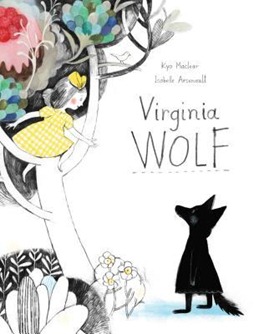
This picture book is loosely based on the life of Virginia Wolf and her sister.  Adults will enjoy the tie-ins, but they are not necessary for children to understand in order to enjoy the book.  It is a story told from Vanessa’s point of view.  Virginia was having a “wolfish” sort of day where nothing pleased her and any sort of noise bothered her.  Vanessa tried to talk with her and discovered that Virginia was dreaming of a far-away perfect place to be.  So Vanessa snuck away and found art supplies and paper to create that world for her sister.  Soon her walls were covered in birds, butterflies, flowers and color.  There was even room for a wolf to wander.  Virginia’s mood lifted and she was ready to play once again. 

This book takes a direct look at depression but can also be used for more transient moods of children.  The author’s writing is rich and beautiful.  When Virginia first gets depressed, she explains it this way: “The whole house sank.  Up became down.  Bright became dim.  Glad became gloom.”  When Vanessa paints the garden it is described this way: “I painted leaves that said hush in the wind and fruit that squeaked and slowly I created a place called Bloomsberry.  I made it look just the way it sounded.”  This is a book that not only has art as a solution and an escape, but also has art in the writing itself.

Arsenault’s illustrations have a wonder to them that is astonishing.  Done in mixed media of ink, pencil, watercolor and gouache, the images play with darkness and light with a fearlessness.  Color is used sparingly at first, then when the art appears it is lush and vibrant.  One completely understands the way that art can lift a person.  Perhaps my favorite small detail is that the art at first when seen through Vanessa’s eyes is adult, lush and fine lined.  Later when glimpsed in retrospect, it has a childlike quality to it instead. 

This picture book is a small work of art that speaks to the power of creativity and art to lift moods.  Appropriate for ages 5-7.

Reviewed from copy received from Kids Can Press.