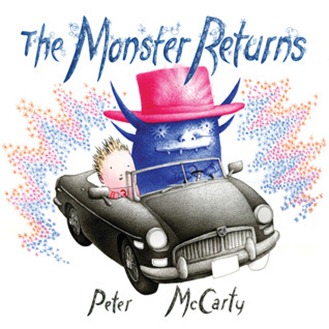
Review: The Monster Returns by Peter McCarty

monster returns

The Monster Returns by Peter McCarty

This sequel to Jeremy Draws a Monster continues the story of Jeremy, who is continuing to draw up in his room alone.  Then he got a note from his monster saying that he should draw a compass and a telescope and look out the window.  When he looked through the telescope, he saw his monster!  The monster immediately called on the phone and announced he was bored and headed over to Jeremy’s house.  Jeremy had to think quickly.  He invited all of the children playing outside up to his room, gave them each a fancy pen, and had them each draw their own monsters.  When Jeremy’s monster arrived, he was met with a big SURPRISE!

McCarty turns this book into one about making friends, whether through inviting them over to play or by creating them.  It is also a book about creativity where the act of creation is also one of making friends and connections. 

The delicate lines of McCarty’s illustrations add up to bright colors and plenty of fun.  The mix of the human characters done in one style and the single-color monsters done in a different style make for a clever and memorable combination. 

A stylish and fun book about friends, creativity and monsters.  This will have children drawing their own monsters, so make sure to provide plenty of fancy pens and paper.  Appropriate for ages 3-5.

Reviewed from copy received from Henry Holt and Company.
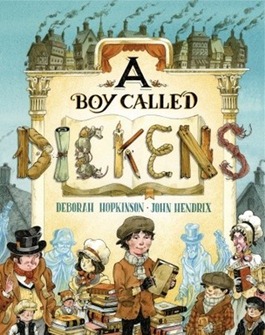
Review: A Boy Called Dickens by Deborah Hopkinson

boy called dickens

A Boy Called Dickens by Deborah Hopkinson, illustrated by John Hendrix

Enter the world of Charles Dickens’ childhood in this picture book.  The fog and cold of London will enfold you, along with the smoking chimneys and the dankness of the Thames.  Twelve-year-old Dickens worked in Warren’s blacking factory, wrapping bottles of blacking for sale.  He entertained the boy next to him with his stories when they could get away with it.  Dickens worked ten hour days and when work is finally completed, he headed home to his tiny attic room where he lived alone.  His family was in the debtors’ prison with only Dickens bringing in any money at all.  When his father and family is released from prison, Dickens’ life changes and he is finally allowed to go to school.  This book celebrates the 200th anniversary of Dickens’ birth in a way that will resonate with children.

Hopkinson’s story begins with an invitation into London and into understanding the world at that time better.  It is actually like entering a novel by the great writer.  Readers will chase after the fast-moving Dickens until they figure out where he is headed.  There is an element of play and fun from the get-go, even though the subject here is very serious. 

Hendrix’s illustrations show the gritty world that Dickens grew up in.  Yet all is not fog and work, there is the beauty of story, the world of imagination.  It’s an impressive mix of historical accuracy and a more whimsical take on creativity. 

Picture book biographies of historical figures can be tricky, since so much information needs to be shared.  Here the balance of story telling and imagery is deftly done, creating a book that is noteworthy.  Appropriate for ages 6-9.

Reviewed from library copy.

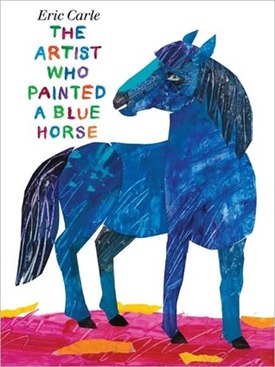
Review: The Artist Who Painted a Blue Horse by Eric Carle

artist who painted a blue horse

The Artist Who Painted a Blue Horse by Eric Carle

A young artist paints a blue horse running against a yellow sky, then continues to paint animals in amazing colors.  There is a red crocodile, a yellow cow, a pink rabbit, and an orange elephant.  The book speaks powerfully and simply to the spirit of creativity, the ability to change the world through art, and the right to express yourself.  This becomes even more clear as the book ends with Carle’s own childhood experiences in Nazi Germany where he first saw the forbidden work of Franz Marc who painted Blue Rider.  This is not a picture book biography, but rather a statement of support for all artists who see the world in unique ways.

Carle’s art is really the center of the book with the words just naming the color and animal.  As I read it, I could see it being used very nicely in elementary art classes to encourage children to break away from the norm.  In toddler story times, it could also be used to learn colors and animals perhaps even with some animal noises thrown in to add to the fun. 

This is a book that will speak to many ages, adapt well to projects and conversation, or simply be used as a color and animal book.  It is infinitely flexible, wonderfully expressive, and makes a powerful statement.  Appropriate for ages 2-8.

Reviewed from copy received from Philomel Books.

You can also check out the auction of art by artists and celebrities that was inspired by this picture book.

Review: Page by Paige by Laura Lee Gulledge

page by paige

Page by Paige by Laura Lee Gulledge

Paige has just moved with her family to New York City.  She is having trouble relating to her mother and had to leave her best friend behind.  Now she has to find people in the big city who can understand her.  But before she can do that, she has to start to understand herself.  Is she the quiet girl or can she become an extroverted artist?  As Paige struggles to find herself and to find her voice as an artist, readers are treated to an extraordinary look at the process of art combined with the process of finding friends and love.

Gulledge has created a graphic novel where the visuals are powerful and speak volumes.  She turns the comic format into one that is strongly artistic and very visual.  Here we see the emotions of Paige brought to visual life from her self-doubts to her most self-aware.  Paige is a character that readers with artistic interests will relate to easily.  Her yearning to create combined with her doubts and worries make for a book with plenty to inspire other young artists to take the risk of creation.

Get this in the hands of tween and teen artists and step back.  A truly inspiring read.  Appropriate for ages 12-15.

Reviewed from library copy.

Also reviewed by:

Check out the trailer that gives a sense of the great art:

Book Review: The Queen of France by Tim Wadham

queenoffrance

The Queen of France by Tim Wadham, illustrated by Kady MacDonald Denton

When Rose woke up in the morning, she was feeling royal.  So on went the crown, jewelry and skirt that turned her the Queen of France.  The Queen of France walked up to Rose’s mother in the garden and asked if she had seen Rose.  Rose’s mother explained that she hadn’t but that she hoped that Rose would remember to clean up her room.  The Queen of France was also interested in the ugly rose bushes that Rose’s mother was planting, but the queen’s finger was pricked by a thorn, so she had to find the Royal Physician.  The queen found Rose’s father, but not the Royal Physician.  The queen then took off her crown, and became Rose again.  She bandaged her finger and cleaned her room.  She then dressed as the queen again and headed to Rose’s mother.  The queen asked if Rose’s mother would be fine with the queen switching places with Rose.  Rose’s mother considered the idea, but explained that she would miss Rose very much if she left.  The queen left and Rose returned to herself for dinner.  Until that evening, when Rose felt scary…

Debut author, Wadham has created a picture book that celebrates imaginative play in a very charming way.  Rose is supported by her parents in her play, both of them happily participating as Rose changes characters.  The parents remain supportive and kind throughout, never questioning that Rose is playing rather than cleaning her room, just giving broad hints that it should be done. 

The illustrations add to the charm of the book, with their soft palette of pinks and blues and a lovely mix of modern and old fashioned feel.  Yes, this is a pink book with glitter on the cover, but it is a book that both boys and girls will enjoy thanks to its quality.  Rose’s body language changes as she becomes the queen, her nose high in the air and her feet prancing high.  I particularly enjoy the small clutter in the rooms: toys on the ground, bowls on the counter. 

Highly recommended, let’s hope Tim Wadham continues to create books like this with their deep understanding of childhood.  Appropriate for ages 4-7.

Reviewed from library copy.

Also reviewed by:

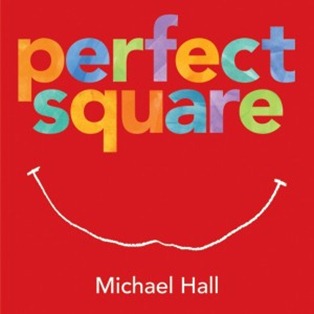
Book Review: Perfect Square by Michael Hall

perfectsquare

Perfect Square by Michael Hall

One perfect square is transformed again and again into something surprising and new.  On Monday, the square had holes poked in it and was cut into pieces, so it became a fountain.  On Tuesday, the square was torn into scraps, so it became a garden.  Shredded strips became a park.  Shattered shards became a bridge.  Ribbons with curves became a river.  Wrinkles and crumples became a mountain.  Until finally, the square was just a square again and had to find a way to change within its four sides.  The result?  Triumphant!

This very simple premise offers small children a glimpse at art and inspiration.  It celebrates creativity, creating something new from something ripped, crumpled or sliced.  Hall sets the perfect tone with his brief text, allowing the images to do most of the work in the book.  My favorite part of the text is that the square is the one reinventing itself rather than an outside force doing the creativity.  It changes the dynamic of the book entirely.

I can see so many art project emerging from this book.  Get it into the hands of elementary art teachers in your school district!  If you enjoy crafts with your preschool story times, share some squares of paper in a variety of colors, offer scissors, hole punches, markers and more.  You just wait to see what those children create!  Appropriate for ages 3-6.

Reviewed from library copy.

Also reviewed by Fuse #8 and There’s a Book.

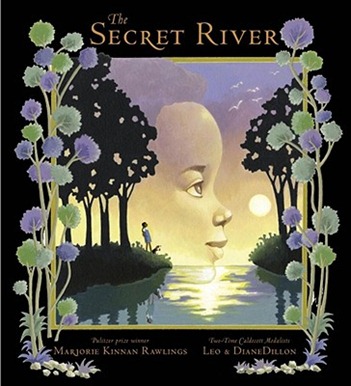
The Secret River: Luminous Loveliness

secretriver

The Secret River by Marjorie Kinnan Rawlings, illustrated by Leo and Diane Dillon

Luminously illustrated by the Dillons, this new version of a classic children’s book truly shines.  The only children’s book written by the author of The Yearling, this story is about Calpurnia, a young girl who is a poet.  She woke up one gorgeous morning and found that she had a journey ahead of her.  Her father told the family that he had no fish to sell in his fish market.  So Calpurnia decided to catch some fish herself.  She made roses out of crepe paper for bait and then headed to get advice from Mother Albirtha, the wisest person in the forest.  When Calpurnia asked Mother Albirtha where she could catch big fish, Mother Albirtha told her of the secret river that was full of fish and advised Calpurnia to follow her nose.  So off Calpurnia went with her dog at her side to find the river.  Eventually, Calpurnia found the river and caught some large fish to help her father.  But that was just the start of her adventures in the forest, because she had to get back home.

Rawlings’ writing is filled with such depth here.  While the story is written for children, it will ask them to stretch, to imagine and to dream.  The writing is filled with small touches, turns of phrase that add such beauty to the text.  Rawlings also had a poet for a main character, so Calpurnia’s poems are throughout the book.  One of my favorite passages happens early in the book where Calpurnia creates a poem and after her mother criticizes one of the phrases turns right around and creates a new poem that focuses on that phrase.  Just that one piece is a testament to writing and creativity, as is the entire book.

Dillons’ illustrations take the book to an even higher level.  They are illustrations that are celebrate the beauty of light on skin, the depth of dark in a forest, the shine of wisdom on a face, and the blackness of animal fur.  The illustrations vary in size, ranging from full page images to smaller illustrations in the margins of the text.  There are illustrations so lovely here that one lingers on the page long after the words have been read, just absorbing the image.  It is simply beautiful.

This is a treat of a new version of a classic.  It is a perfect marriage of illustration and writing that celebrates both.  Appropriate for ages 6-8.

Reviewed from copy received from Simon & Schuster.

Shadow: Simple and Sparkling

9780811872805_large

Shadow by Suzy Lee

This book is all about the power of imagination and creativity.  A little girl heads up to the attic where the light creates shadows.  She starts out with just her own shadow, then creates a bird with her hands. As she plays, a jungle grows in the shadows with a sharp-toothed wolf.  Other animals appear and so does a princess until an entire shadow world is created.  Then the wolf escapes from the shadow world and jumps at the little girl.  But the other animals work together to teach him how to play nicely.  At the end, a voice calls that dinner is ready and everything returns to normal, or does it?

Lee’s illustrations tell this almost wordless story.  Her use of fine lines for the objects in the attic, thicker lines for the little girl, and deep blackness for the shadows is particularly effective.  The book is done in just two colors: black and yellow.  The yellow is particularly spectacular, showing the color of imagination at work.  Lee uses the middle gutter of the book to separate the shadows from real life, so the book is read sideways, just as the cover is shown. 

This book is simple and very evocative.  It is a stunning, sparkling example of a wordless book that children everywhere with relate to effortlessly.  Appropriate for ages 3-5.

Reviewed from copy received from Chronicle Books.

Bridget’s Beret:

9780805087758

Bridget’s Beret by Tom Lichtenheld

Bridget loved to draw as much as other kids love ice cream.  She had a lot of art supplies, but her most important one was her beret that made her feel like a real artist.  But one day, her beret was caught by the wind and flew away.  Bridget searched for her beret, reported it missing and even offered a reward for its safe return, but it was not found.  Unfortunately, along with her beret, Bridget lost her ability to do art.  She did try other hats to see if they would inspire her, but none of them did.   Bridget was left unable to do art at all; she had artist block.  A few days later, her sister asked her to make a sign for their lemonade stand.  Bridget tried to refuse, but was reminded that it was a sign, not art.  So she started making a sign.  And once she started, she couldn’t stop.  She made sign after sign, several in the styles of famous artists.  Bridget was back to being an artist, beret or no.

The text here is laugh-out-loud funny at times with a charming wit.  There are several series of illustrations that really add humor, including the series of images of Bridget trying different hats.  Her paintings that reference more famous works are also very funny.  Nicely, there is an appendix that shows the original works.  Bridget is an engaging character, reacting to the loss of her beloved hat in an honest and childlike way.   Watching a young person genuinely work through a crisis is great, as is the fact that she did it herself without adults offering the solution. 

A clever take on artist block and the power of art, this book will appeal to adults as well as children.  Appropriate for ages 4-8.

Reviewed from copy received from Henry Holt.