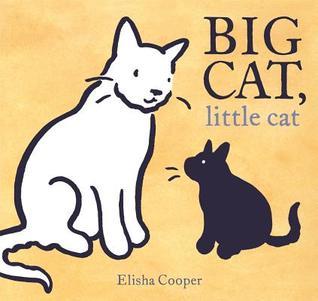
Big Cat, Little Cat by Elisha Cooper

Big Cat, Little Cat by Elisha Cooper

Big Cat, Little Cat by Elisha Cooper (9781626723719, Amazon)

Master picture book crafter, Cooper tells the gentle and poignant story of the friendship between two cats. The white cat lived alone for some time in his home until a new little black cat came. The older white cat helped the little cat learn what to do, how to use the litter box, when to rest, when to eat and drink. As the days and months passed, the black cat grew to be just as big as the white cat. Then one day, the white cat was gone and doesn’t ever return. Still, life continues and brings a new surprise.

Cooper excels at simple stories and illustrations with profound implications. Here there is a gentle message of death and life that is just right for little ones. There is a quietness here, a stillness that resonates throughout as well, the sense that a life well lived is the important thing and the connections made along the way. This is there, but subtle, a book filled with deep thought that is there to find but not projected at you. It’s a book of quiet insight.

Cooper’s illustrations are just as simple and discerning as the story itself. The use of black and white cats is a smart choice that allows the illustrations to stay simple and yet speak to differences and connections clearly and deeply. As the little cat grows, the two are different only in color and then the circle of life becomes all the more definite.

Simple and insightful, this book is solid and true. Appropriate for ages 2-4.

Reviewed from copy received from Roaring Brook Press.
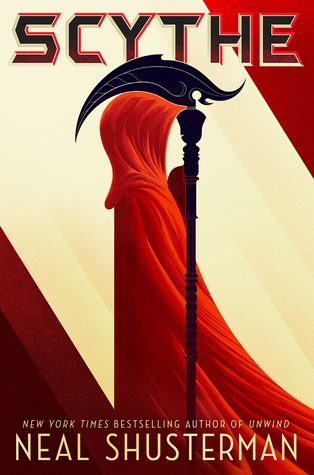
 

Scythe by Neal Shusterman

scythe-by-neal-shusterman

Scythe by Neal Shusterman (InfoSoup)

Released November 22, 2016.

Set in a future where death no longer exists for humans, the only way to die is to be selected at random to be gleaned by a Scythe. Scythes live separately from other people and want for nothing though they usually live minimally. When Scythe Faraday appears in Citra’s home, her life changes even though he is only there for a meal and not to glean anyone in her family. Faraday also visits Rowan’s school where he gleans the school’s football star. Faraday then selects Citra and Rowan to serve as his apprentices and compete for the honor of becoming a scythe. However, there are forces at work in the scythe web of power that will set Citra and Rowan truly against one another and call into question everything that the scythes have been built upon. Citra and Rowan must figure out how to maneuver through the political and personal intrigue and survive.

Shusterman has created a future that many of us would say is a utopia, one where no one dies. Against that vivid and bright wonder he has created killing machines, people who glean or  murder with a personal touch that is horrifying, unsettling and all too real and logical. Shusterman has built a world that is striking and vivid. He has teens who kill themselves just to be restored to life again. He has elderly people who can reset their age back to their twenties again and again, so no one knows how old people actually are. It is a society both free from death and still obsessed with it.

Shusterman at the heart of the novel is also asking what makes us human. And could it be that mortality itself is a vital part of our lives? Is that what makes us musicians, artists and lifelong learners? It is against this dearth of art and knowledge that Citra and Rowan are growing up, looking forward to nothing in life other than its inevitability and endlessness. Then they are made scythe apprentices and the world shifts to something dark and dangerous. Suddenly though, they are alive.

Brilliant and complex, this novel asks real questions about life, death and the ability to murder for society. Appropriate for ages 14-17.

Reviewed from ARC received from Simon & Schuster.


Benny and Penny in How to Say Goodbye by Geoffrey Hayes

benny-and-penny-in-how-to-say-goodbye-by-geoffrey-hayes

Benny and Penny in How to Say Goodbye by Geoffrey Hayes (InfoSoup)

Benny and Penny return in another graphic novel perfect for new readers. In this story, the two mouse siblings start the story by jumping in piles of leaves. Penny worries that Benny will hurt the leaves, but Benny explains that the leaves are already dead. Then Penny discovers a dead salamander in the yard. Penny wants to bury the salamander but Benny gets angry and tries to stop her over and over again. As Penny moves ahead with burying the salamander with the help of another friend, Benny listens in and then starts feeling sad rather than angry about the little dead creature.

Hayes speaks to the experience of death for young children in a gentle and understanding way. He captures the movement from anger at loss to grief in a way that is organic and natural, allowing Benny the ability to feel his emotions and contrasting those with the way his sister is reacting. Both reactions are supported by the book, allowing children to think about their own emotions.

Hayes sets the book in autumn, showing seasonal aspects throughout the story. There are fallen leaves, bare trees, and a sense of change throughout the book. As always, Hayes beautifully illustrates his graphic novels, allowing them to be an ideal bridge between picture book and chapter book.

A lovely look at a child’s first experience with death, this graphic novel is gentle and filled with kind understanding. Appropriate for ages 5-7.

Reviewed from copy received from TOON Books.


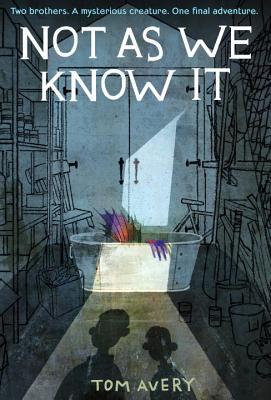
Not As We Know It by Tom Avery

Not as We Know It by Tom Avery

Not As We Know It by Tom Avery (InfoSoup)

Jamie and Ned are twins growing up together on a tiny island in the English Channel. They love to do things as a pair, from scouring the beaches for treasures that wash up from the sea to watching Star Trek on DVD. But Ned is not well. He is fighting cystic fibrosis and the most recent treatments don’t seem to be working. Then one day, the brothers find a strange creature on the beach. It is hurt and they carry it to their garage where they fill a tub with saltwater and care for it. It’s like nothing they have ever seen before with its scales and gills combined with arms and legs. As the boys care for the creature, their grandfather tells them tales of mermen and mermaids. Jamie starts to hope that the creature can work a miracle for Ned, though Ned sees it very differently.

This novel for middle grade readers is riddled with sorrow and the drain of watching a loved one slowly decline. Yet Ned is also a ray of light himself, refusing to let his disorder rule his life. Still, the book is clearly headed for Ned to go where Jamie can’t follow, a journey he has to take on his own. As the creature brings hope to Jamie, it also brings him distress as he recognizes that his hope may be futile and readers will see it as a natural way to keep from facing his brother’s approaching death.

Both boys are strongly written characters. Jamie is pure heart, trying to be there for his brother and leaving school to be homeschooled alongside his brother. Jamie is a source of adventure and normalcy for Ned, something that keeps them close and also buoys up Ned’s moods and health. Ned is unwilling to do anything but face the truth of his situation and yet that doesn’t limit his activities. Instead it seems to fuel his desire to be more than just a dying boy. The pair of them together are pure radiance.

A powerful, tragic and hopeful book about brotherhood and death with more than a touch of magic. Appropriate for ages 9-12.

Reviewed from e-galley received from Schwartz & Wade and Edelweiss.


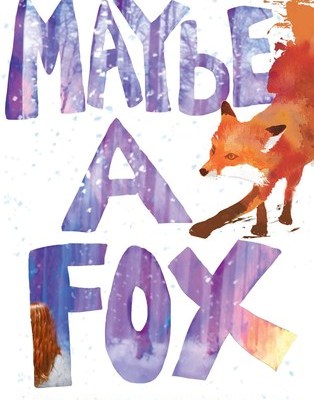
Maybe a Fox by Kathi Appelt and Allison McGhee

Maybe a Fox by Kathi Appelt and Allison McGhee

Maybe a Fox by Kathi Appelt and Allison McGhee (InfoSoup)

Jules and Sylvie are sisters, just one year apart. They live with their father in a house that backs onto a woods with a river. There is one part, the Slip, where the girls are forbidden to go, since it’s so dangerous, where the river goes underground. When the girls awaken to late spring fresh snow, Sylvie just has to run down to the river to make a wish. Her wishes are always the same, to run faster. Jules is left behind at home after the two make their snowman family together. Jules waits and waits, but Sylvie does not return. That’s when Jules discovers that Sylvie has disappeared into the river. It’s also when a pregnant fox feels a spirit enter her female cub, a special spirit that has a connection to humans, specifically Jules. Two young females, a fox and a girl, both searching for what is missing and both unable to turn away from their shared bond.

Appelt and McGhee have written a blazingly beautiful novel that pairs adept writing with a powerful connection to nature. The book begins on a spring day filled with snow, a magical time. But even at the beginning there is foreshadowing that something is going to happen, there is the danger of the Slip, the speed of running, a certain desperation, a dead mother. It all adds up gracefully and powerfully to danger and then death. It’s the glorious writing that allows that to be both shocking and also entirely expected too.

The part of the story with the fox brings a richness to the story, another piece that falls into place of animals that have connections and even responsibilities. It too is written with a beauty and a combination of real understanding of foxes and wild animals and then also a haunting connection to death. The entire book also relies on its setting that is shown from human point of view and then again with different terms in the fox viewpoint as well. That element helps to sew the two halves of the book tightly together into a whole. A whole that sings about death, about loss, about grief, and about the power of nature to heal.

Incredibly moving and richly detailed, this novel is a powerful read. Appropriate for ages 9-12.

Reviewed from copy received from Atheneum.


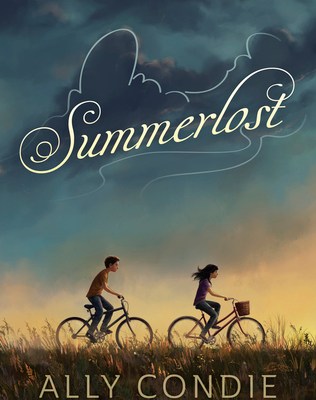
Summerlost by Ally Condie

Summerlost_BOM.indd

Summerlost by Ally Condie (InfoSoup)

Cedar’s family is much smaller than it once was. Her father and brother were killed in a car accident and now Cedar, her mother and her other brother are returning to the small town of Iron Creek for the summer where they have purchased a new house. Cedar soon notices a boy riding his bike past their house dressed in costume. Cedar follows him to Summerlost, a local and renowned theater festival. There, Cedar meets the boy on the bike, Leo and finds herself a summer job too. Leo and Cedar have soon created a tour together about a famous local actress who performed at Summerlost and died in Iron Creek. Cedar’s summer is filled with small mysteries like who is putting items on her windowsill that her dead brother would have loved that help distract her from the loss she has so recently experienced, until she can’t ignore it any longer.

Condie, author of the Matched series, has created a beautiful middle grade novel here that rings with honesty. She manages to keep both the reader and Cedar aware of the loss that was experienced but also moving forward and towards other things. The book is haunted with those deaths, appearing out of nowhere in the middle of beautiful summer days, but also hiding at times and almost disappearing with the busyness of work. It’s an intelligent balance written very cleverly.

Condie’s writing is superb throughout the novel. In Summerlost, she creates an entire world of theater that is intoxicating and memorable. Early in the novel, Condie through Cedar’s voice explains what it is like to have a family shrunk by tragedy:

Sometimes I thought of the three of us as pencils with the erasers scrubbed down to the end, and the next swipe across the paper would tear through the page and make a scree sound across the desk.

This approachable and yet deep writing runs throughout the novel, exposing grief in unexpected and tangible ways.

A strong and outstanding novel for middle grades, this book takes a courageous look at grief and the resilience it takes to continue to live. Appropriate for ages 10-13.

Reviewed from ARC received from Dutton Books for Young Readers.

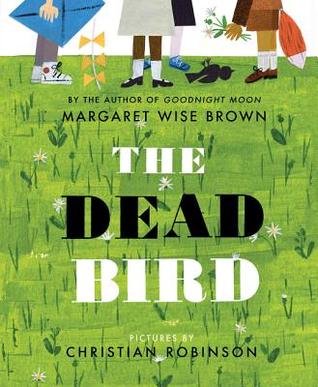
The Dead Bird by Margaret Wise Brown

The Dead Bird by Margaret Wise Brown

The Dead Bird by Margaret Wise Brown, illustrated by Christian Robinson (InfoSoup)

This is a reillustrated edition of the classic picture book by Margaret Wise Brown. In the story, a group of children find a dead bird in the park. They check for a heartbeat but don’t find one. They are very sorry the bird has died and decide to have a funeral for it. So they dig a hole and fill it with sweet ferns and flowers. The sing a song and cry a bit too. Then they head off to play. They do visit for awhile, bringing fresh flowers to the little grave, and they slowly stop remembering to come.

This is such an honest book about death and grief. It captures that intense wave of sorrow upon finding a dead animal, the immediate connection children have to that creature and the importance of following through in a process of loss. The writing is superb, capturing these complex feelings but also not endowing them with too much weight. There is also a feeling of time passing and life moving on, even though the sadness was so large at first.

Robinson’s illustrations are engagingly simple with whimsical touches. One of the children wears butterfly or fairy wings as they play and another is in a fox mask and tail. They have a large dog along with them and a kite to fly. The children have the friendly expressions of Fisher Price dolls, a curve of smile and dot eyes. The illustrations show the same kind of frankness that marks the text as well.

Refreshingly honest and forthright, this picture book is a smart reworking of a classic story that will resonate with today’s children. Appropriate for ages 3-5.

Reviewed from library copy.

Beatrix Potter and the Unfortunate Tale of a Borrowed Guinea Pig by Deborah Hopkinson

Beatrix Potter and the Unfortunate Tale of a Borrowed Guinea Pig by Deborah Hopkinson

Beatrix Potter and the Unfortunate Tale of a Borrowed Guinea Pig by Deborah Hopkinson, illustrated by Charlotte Voake (InfoSoup)

Published to celebrate the 150th anniversary of Potter’s birth, this picture book tells the true story of an event in Potter’s childhood. Beatrix loved animals from a very young age. In fact, she and her brother had quite a collection of animals over the years from a family of snails to rabbits trained to walk on a leash. Beatrix also loved to draw and paint her animals. One day, she wanted to paint a guinea pig so she borrowed one from a neighbor. The guinea was a magnificent specimen named Queen Elizabeth. Beatrix promised to return Queen Elizabeth the next morning “unharmed.” Unfortunately though, she would not be able to keep that promise!

Hopkinson adopts a wonderfully wry tone throughout this picture book where readers know that something horrible is going to befall Queen Elizabeth. There is lovely foreshadowing from the title but also from the demise of other creatures in Beatrix’s care, including the family of snails who simply dried out and lizards eaten by birds. The pacing here is delicately balanced, allowing plenty of time for the dread to creep in as Beatrix takes the guinea pig home.

Voake’s illustrations are done in pen and watercolor, showing the world of Victorian England as well as the myriad pets owned by the Potter family. Voake includes parts of Potter’s own diaries in the illustrations, showing her detailed look at her pets and also illuminating how some of them died.

This picture book offers a humorous look at young Beatrix Potter who would become known for her images of animals living through what many children do when they care for others pets or even their own. Appropriate for ages 4-6.

Reviewed from copy received from Schwartz & Wade.

Review: A Song for Ella Grey by David Almond

A Song for Ella Grey by David Almond

A Song for Ella Grey by David Almond

The Greek myth of Orpheus and Eurydice is transformed into a tale of modern English teens in this masterful novel. Claire and Ella are the closest of friends, in fact Claire is in love with Ella. The two spend all of their time together and with their larger group of friends. When Ella is forbidden to go on the trip with all of the friends to the beaches of Northumberland, Claire goes without her. Throughout though, Claire is longing for Ella. Then she meets Orpheus, a strange and handsome musician whose music is so powerful that all of nature seems to stop when he plays. She calls Ella and holds the phone out so that Ella can hear the music too. That one impulsive moment sets in motion a story of profound love, deep loss, death and beyond.

Almond’s own writing is like the music of Orpheus. It creates an intoxicating blend of timeless Greek myth and wild modern teens. The girls become legends, their longing the desire of ages, their love the love to last all time. Orpheus is directly from myth, a wanderer who is captured in a love that seems to have been in existence for all time. There is such beauty here, not only in the myth itself but in the characters too. This book speaks to the power in each of us to live a story, a legend, a myth and to love in that way too.

Almond’s language is exquisite. His writing flows around the reader, inviting them into the magic that is happening on the page. He focuses on small things, showing how the tiny things in life are the most profound from falling rain to trees in the wind to sand drifting by. It is Orpheus’ music that brings these things to life for his listeners. And the reader falls in love with him alongside Ella, never having heard the music itself but having felt its impact to their bones.

Beautiful, mystic, and mythical, this book is a love song for young people, capturing the tumultuous feeling of tumbling into love and the tenuous nature of life and death. Appropriate for ages 14-17.

Reviewed from ARC received from Delacorte Books for Young Readers.