Book Review: Slog’s Dad by David Almond

slogsdad

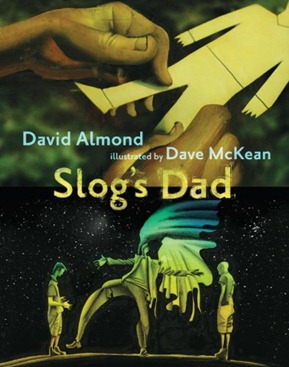
Slog’s Dad by David Almond, illustrated by Dave McKean

Originally a short story, this small book is eerie, haunting and achingly sad.  Slog’s father is dead and he knows it.  But when he sees the scruffy man outside the butcher shop, he knows that it is his father who has returned to see him.  But Davie, his best friend, is just as convinced that this man is a fake.  The story explores the way that Slog’s father died, slowly and by tangible steps.  It is a story of grief but also one of hope that asks unanswerable questions and allows readers to stay in the in-between world where hope thrives but so does doubt.

Almond and McKean paired up for The Savage, an amazing work of fiction.  This story is gentler and hopeful.  It quietly explores grief, allowing the poignant moments to live, hover and hope.  It is a story of dreams and beauty, of the unexpected and the amazing.  Almond’s writing is at times so blunt that it is traumatic and unblinking.  At other times, it is eerie and bizarre.  And at still others it is haunting, hopeful and trembling.

McKean’s illustrations help bring the story to a new level.  From the almost photographic detail of some of them, where the warped faces are the only clue that you are not looking at a photograph to the line drawings that soar with greens and blues hovering above heads.  These are illustrations that explore the emotions of the book.  They are not concerned with a unified look and feel, but with the look and feel that is right for that moment in the story. 

A gorgeous work of writing and art, this book is a testament to grief, hope and wonder.  Appropriate for ages 9-12.

Reviewed from library copy.

Also reviewed by:

City Dog, Country Frog

City Dog, Country Frog by Mo Willems, illustrated by Jon J. Muth

I was a little concerned about a book by Willems that he didn’t illustrate himself, but I shouldn’t have.  This book is a rich exploration of friendship.  A dog who has never lived in the country before runs out through the fields and comes upon a frog sitting on a rock near the water.  The frog immediately invites the dog to be his friend and the two play frog games together that spring.  When summer comes, the dog and frog play city dog games together, including fetch.  In the fall, the frog is growing old and tired.  So the two play remembering games together, thinking of spring and summer and the games they played.  Then winter came and when the dog headed to the rock, the frog wasn’t there.  Then spring came again, and this time the dog was the one sitting on the rock waiting for a friend.  And guess who came?  A new and unexpected friend.

This book is about friendship, that deep and abiding type of friendship that is about connection.  It is also about loss and it captures it so vividly that children will immediately understand the gravity of winter and exactly what the dog is experiencing.  It is a very powerful moment, depicted in deep blues of winter cold and silence in the text.  Beautifully captured.  At the same time though, it is a book about friendship continuing, new friends arriving, and the ability to move on and resume.  Willem’s language is simple and adept, he says things is so few words yet captures feelings perfectly.  Muth’s illustrations really capture the seasons. One can almost smell the grass of spring, the autumn leaves, and the crisp snowy air.  He also imbues the animals’ faces with deep emotions yet makes sure that they are still dogs and frogs. 

Highly recommended, this pairing of author and illustrator has created an amazing story that is deep and moving.  Appropriate for ages 4-8.  Make sure when you share this with a child that there is time to talk afterwards, it is sure to start a conversation.

Reviewed from library copy.

Check out the trailer that Mo Willems created for the book:

Also reviewed by:

Remembering Crystal

Remembering Crystal by Sebastian Loth

Zelda is a young goose who adores her friend Crystal who is an aging turtle.  Despite their age difference, the two of them enjoy many of the same things.  They love reading books, swimming together, taking trips and talking about life.  But one day when Zelda goes to the garden, Crystal is not there.  The other geese try to explain that she was old and is gone, but Zelda doesn’t believe them.  She searches for Crystal and when she can’t find her begins to remember what Crystal taught her about art and the world.  After some grieving, Zelda realizes that Crystal will be with her always.

A warm, sweet book that speaks to the impact of losing a friend, pet or a grandparent. Though short sentences, Loth slowly exposes readers to the special friendship of the two characters.  It is this lingering pace and tone that makes the book work so well as you have time to think and appreciate while reading.  Loth also keeps the illustrations simple.  They are pleasingly presented on paper that is marked, creased and aged.  Beautifully and gently presented.

Books on death can verge on the saccharine at times.  This book manages to be sweet and fresh thanks in part to the humor of the book and the illustrations.  Appropriate for ages 3-6.

Reviewed from copy received from NorthSouth.

The Last Summer of the Death Warriors

The Last Summer of the Death Warriors by Francisco X. Stork

Released March 2010.

Stork returns with his second teen novel after Marcelo in the Real World.  D.Q. and Pancho could not be more different except for their focus on life and death.  D.Q. is dying of cancer and trying to understand how to hold onto life.  Pancho is healthy but everyone in his family has died, and he is now planning to murder someone.  When Pancho meets D.Q., he wants nothing to do with him.  But he gets paid to help D.Q. and when D.Q. is sent for treatment to Albuquerque, Pancho is eager to go along because the man he is hunting for lives there.  As he spends time with D.Q. and Marisol, a girl at the recovery facility, Pancho finds himself changing but will it be enough to prevent him from taking a life?

As with his first book, Stork excels at character development and the creation of people who are damaged, fascinating and vividly human.   Pancho is a boy filled with anger and denial who has so much going for him, but is unable to see it.  D.Q. is reaching the end of his battle to live but seizes every day with a fierceness and vigor.  This book is an exploration of two boys and their unique friendship that ends up changing them both.  It is a celebration of life, an honoring of death, and a tribute to faith in the broadest sense.

Fans of his first book will adore this second book.  This is another novel to linger in, dwell with and savor.  Appropriate for ages 13 and up.

Reviewed from Advanced Reader Copy received from publisher.


Reblog this post [with Zemanta]