Hans Christian Andersen by Heinz Janisch

Hans Christian Andersen: The Journey of His Life by Heinz Janisch, illustrated by Maja Kastelic (9780735843882)

A little girl takes a coach ride with Hans Christian Andersen. As they head to Copenhagen, the author answers her questions and then tells her a fairy tale. It’s the story of a boy who learned to fly, the story of his own life. Born on a Danish island, Hans’ father was a cobbler who mended shoes. In the evening though, he would read to Hans from a big book of fairy tales. He also built Hans a puppet theater and performed shows for his son. Then Hans’ father was sent to war and returned tired and sick. He died when Hans was eleven. As Hans grew up, he was inspired to try to join the theater as an actor but his voice broke at age fifteen and he had to find a different way. Hans truly loved writing and was sent to school tuition free. Now Hans was on his way, a boy who grew up to be famous by sharing parts of himself in his fairy tales.

First published in Switzerland, this translated version is a rich look at a famous author who has captivated children for generations. Framing his life with questions from a small child is a clever device to allow the character to answer questions about his life and his stories. Allowing Andersen to tell his own life story as a fairy tale is also a believable format that invites readers to really get immersed in the life of this amazing figure in literature.

The illustrations by Kastelic are dreamy watercolors that move from realistic colors on the carriage ride to sepia tones as Andersen tells his personal story. They really burst from the page though when Andersen talks of his fairy tales, becoming rich and vibrant, the colors fantastical and wild. These changes beautifully show just as the story does, the power of story.

A superb picture book biography. Appropriate for ages 4-6.

Reviewed from e-galley provided by NorthSouth.
When Mischief Came to Town by Katrina Nannestad

When Mischief Came to Town by Katrina Nannestad

When Mischief Came to Town by Katrina Nannestad (InfoSoup)

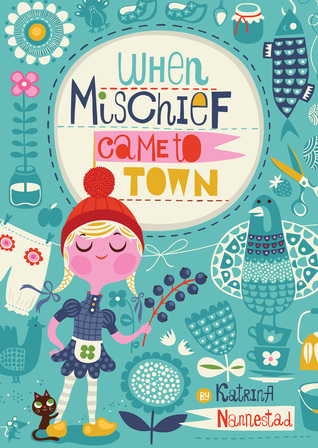
Inge arrives at the small island town of Bornholm, Denmark via boat. She hasn’t eaten since the morning of the day before, thanks to missing her mother and the fish guts on the boat. Inge has never met her grandmother before, but now the two of them will be living together at her small farm. Inge brings with her plenty of laughter and trouble, but her grandmother does not seem amused by any of it. Over and over again, Inge gets into mischief, whether it is in a kicking contest with the donkey, learning how to walk in wooden shoes, or insisting that in 1911, girls can play on the grass at school too. Inge’s vibrant personality never stays down for long, but can this small island community survive her?

This book is pure silly and shimmering perfection. Inge is a marvelous protagonist, filled with life and the ability to get into great trouble even on a small farm on a tiny island. Inge is the real reason this book works so well, but so is her grandmother who proves the perfect foil for the rambunctious child. While I don’t want to spoil the book, it is the grandmother’s reaction to Inge that makes this book so special by the end.

The setting of the small Danish island also plays a huge role in the book. Set in 1911, the strict community rules rub Inge entirely the wrong way. Though some areas are moving in a more modern way, the small town keeps things traditional. With a strong focus on food, children will enjoy the changing menagerie of gingerbread creatures, the question of how thick a piece of cake should be, and the way that the grandmother feeds Inge with a beautiful determination held together by lots of cream.

A gem of a book, this would make a great read aloud for a classroom thanks to the large amounts of guffaw-level humor throughout as well as a winning young female protagonist. Appropriate for ages 8-11.

Reviewed from library copy.

Review: The Whispering Town by Jennifer Elvgren

whispering town

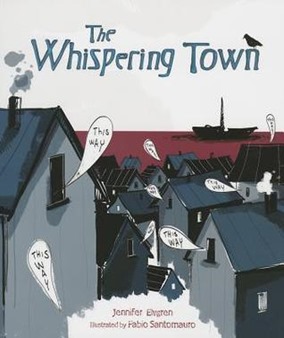
The Whispering Town by Jennifer Elvgren, illustrated by Fabio Santomauro

In Nazi-occupied Denmark, Anett and her family are hiding a Jewish woman and her son in their cellar.  They must wait for a night with enough moonlight to see the boat in the harbor that will take them to safety in Sweden.  Anett works with their neighbors to get extra food to feed them and extra books from the library for them to read.  On her errands, Anett notices solders questioning her neighbors and she heads home quickly to warn her parents who in turn knock on the cellar door to alert the people they are sheltering.  Eventually, the soldiers come to Anett’s house but no one is home except Anett who manages to keep calm and turn them away.  But how will the woman and her son escape with no moon that night?  It will take an entire town to save them.

Elvgren tells a powerful story based on actual history in this picture book.  Presenting that history from the perspective of a participating child makes this book work particularly well.  The support of the town is cleverly displayed as Anett moves through town, informing people that they have “new friends” and the others offer extra food and support.  That is what makes the resolution so very satisfying, knowing that these are all people standing up to the Nazis in their own special way, including Anett herself.

Santomauro’s illustrations have a wonderful quirky quality to them.  Done with deep shadows that play against the fine lines, the book clearly shows the worry of the Danish people and also their strength as a community. 

This is a story many may not have heard before and it is definitely one worth sharing.  Appropriate for ages 6-9.

Reviewed from digital copy received from Kar-Ben Publishing.

Review: Alek by Bodil Bredsdorff

alek

Alek by Bodil Bredsdorff

This final book in The Children of Crow Cove series has Doup as the main character.  Doup came to Crow Cove as a child with the Crow-Girl.  He has lived there all of his life but misses his older brother Ravnar who has moved away.  Doup reclaims his birthname of Alek and heads off with his father to town to find Ravnar.  They discover his empty home that is dirty and dank. Ravnar only appears when his boat is in harbor, otherwise he is out fishing for a living.  Alek’s father leaves him with Ravnar and returns to Crow Cove.  But one night, Alek witnesses a shipwreck on the beach where the sailors were tricked into beaching the boat.  He then sees a man murdered and discovers a young girl hiding away from the beach.  Alek takes the girl home with him, though she doesn’t speak his language.  Young Alek has to figure out what happened and then what to do about it.

I’ve adored this series for some time.  The writing is so natural and easy.  It is steeped in its seaside setting and filled with small details that bring their world to life.  This final book has plenty of action to move the story along, but it still remains a book about everyday life and creating a family out of the people who are with you.  From the small details of hunting and farming to information on meals and shopping, this book like the others in the series is a small book filled with the largeness of a life well led.

Definitely start with the first in the series.  As the series moves forward, the characters grow and age, offering a look at the results of their decisions in earlier books.  The strength of these books are in the complex characters, the fine details and the glory of the natural setting.

This is a fittingly strong final volume in a delight of a series.  Appropriate for ages 10-12.

Reviewed from copy received from Farrar Straus Giroux.

Eidi

Eidi by Bodil Bredsdorff

This second book in The Children of Crow Cove series begins years after the first.  This book focuses on Eidi, the daughter of Foula who has just had a baby, Eidi’s half-brother.  The house feels to crowded with the baby and Eidi decides it is time that she heads off to help the shepherd Rossan by spinning his wool into yarn.  When she reaches his home, Rossan is about to head off to town to sell his wool, so she accompanies him.  Eidi acclimates to the town, which is the largest community she has ever seen.  While she is there, she gets work with a man to knit shawls and discovers a beaten and underfed boy.  She befriends the boy but is soon in a situation where she has to take drastic action to save him.

Bredsdorff’s language is so simple that it is poetry.  Her writing matches the simple lives of the people, their hard work, and the Danish landscape where there is beauty and harshness.  Reading this second book was like returning to a place you never knew you had been missing.  The book is without pretense as the story is told matter-of-factly but with such attention to detail that it is like living it.  Here is one lovely example from Page 15:

Eidi got out of her settle bed and put on her clothes.  When she stepped outside, she could see everything plainly in the dawn twilight, but it was all gray.  The houses were light gray, the roofs dark gray, the sky overcast, without a star.  It as a world where color didn’t exist.  She sat down on the stone steps and waited, without knowing what she was waiting for.

The passage continues as the sun rises and color returns to the landscape.  This is writing that speaks volumes without being verbose.  Haunting, beautiful and skillfully done.

Characters in the book are complex.  Bredsdorff is not afraid of having villains be human, heroes make bad choices, or having people who are both hero and villain at once.  Though simple, her book has layers of meaning.  Lessons are learned with no preaching, children are not cosseted but are seen as capable, strong and vital. 

Highly recommended, this book is a great sequel to the first.  Read both of them to have the full experience of Crow Cove.  Appropriate for ages 10-12.

Reviewed from library copy.