The Science of Breakable Things by Tae Keller

The Science of Breakable Things by Tae Keller

The Science of Breakable Things by Tae Keller (9781524715663)

With Mr. Neely as her very enthusiastic science teacher, Natalie can’t get out of asking a scientific question and exploring it using the scientific method. But Natalie would much rather get answers about her family, about why her mother won’t leave her bedroom anymore and how her father can stop being in therapist mode all the time. So when Mr. Neely encourages Natalie to compete in an egg drop competition, she knows that if they can win, things will change. Natalie’s best friend Twig is on their team, offering creative solutions for the egg drop and they also become friends with the new kid, Dari. As the three become closer, Natalie continues to try to figure out how to help her mother, putting together a plan for the prize money that they hope to win that will inspire her mother and get her back to normal. But life doesn’t always go to plan and neither do science experiments as Natalie soon discovers.

Keller writes with a lovely mix of humor and science throughout this novel. She looks directly at the subject of a parent’s chronic depression and shows the impact of that on a child and a family. Natalie steadily learns to find her voice in the novel and express her own pain about the situation. Science is used throughout the novel as a bridge between people, a way forward and a solution to problems.

Natalie as a character is beautifully conflicted. While she yearns to have her mother back she is also very angry about the situation, something that she has trouble expressing. Even with the friends she has, she worries about Dari joining her and Twig at various times particularly as Twig and Dari seem to have a special connection with one another. None of this is overly dramatized, but feels natural and emerges as convincing times of emotional stress.

Smartly written and filled with glowing characters living complicated lives, this middle grade novel unbreakable. Appropriate for ages 9-13.

(Reviewed from copy provided by Random House Children’s Books.)
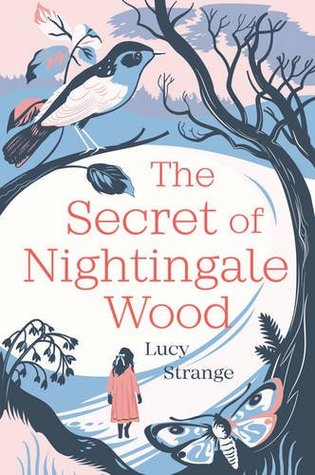
The Secret of Nightingale Wood by Lucy Strange

The Secret of Nightingale Wood by Lucy Strange

The Secret of Nightingale Wood by Lucy Strange (9781338157475)

This British debut is a riveting look at mental illness after the First World War. Henry and her family have moved to Hope House, but Henry’s mother isn’t herself and soon is prescribed absolute bed rest, medicated to keep her asleep most of the time and her door is locked so Henry can’t see her. Henry is left in the rented house with her new baby sister and their nanny who also cares for Henry’s mother. Her father has left to work out of the country. Meanwhile, Henry is drawn to the woods on the property and there she meets a woman who lives on her own in a rundown caravan. She also starts to see and speak to the ghost of her dead brother. As Henry works to figure out what is happening to her mother and how she can reach her, doctors begin to threaten to take her mother to an asylum and hint at the kinds of treatments they might do. Henry soon becomes the only one able to rescue them all.

Strange writes with an eye for detail and a flair for metaphors that create a deep and lush mood throughout this novel. Her writing invites us all to explore darkness, the drama of woods at night and to make friends with those haunting us. The historical setting in Britain is particularly well drawn. The invasive treatments for depression are hinted at, just enough for young readers to understand the threat but not enough for them to be truly frightened.

Henry is a grand heroine. She finds herself far out of her depth in this novel and yet navigates dealing with adults with grace and a certain style. She understands more than the adults in the novel give her credit for and in the end she figures out how best to fix the problems herself, with some help from her grownup friends.

This British import will be enjoyed by fans of classics who will enjoy the historical setting and call for one girl to be the hero. Appropriate for ages 9-12.

Reviewed from ARC provided by Scholastic.


Some Kind of Happiness by Claire Legrand

Some Kind of Happiness by Claire Legrand

Some Kind of Happiness by Claire Legrand (InfoSoup)

Finley’s parents are having trouble, so they decide that it is best that she spend the summer with her grandparents even though Finley has never met them before. Something happened that made her father leave the family and not speak to his mother again. Finley struggles with “blue days” where she can barely get out of bed and doesn’t have any energy at all. Other days, she spends writing about Everwood, an imaginary land that has parallels to the real world. When she arrives at her grandparents’ home, she realizes that Everwood is a real place and it is right behind their house, complete with a half-destroyed house, villainous pirates, and a trustworthy knight to share her adventures. As Finley and her cousins go deeper into the fantasy world, the truth begins to surface about what happened years ago to their parents and grandparents.

Legrand has created an intensely gorgeous book here that is complex and multi-layered. Finley’s writing about Everwood is interspersed throughout the book so readers can see the detailed and wondrous world she has created. Readers will also clearly see the ties between Finley’s life and what is happening in Everwood. The whole book is a testament to writing that balances strength of vision with a delicacy of execution that allows those ideas to grow and come alive. The relationships of the adults in the book also supports this with various personalities stepping out at different times. There is a humanity to the adults here, a fragility that lets young readers glimpse the truth in pieces before it is revealed.

Finley’s depression and anxiety in particular are captured with sensitivity and grace. It is shown as a part of her personality, not the only characteristic and not one that overwhelms her constantly. Rather it is a factor in her life, one that doesn’t stop her from bonding with her cousins or being creative and imaginative. This is a book that shows that mental illness may impact your life but not destroy it and that there is power in honesty and getting help.

A deep book filled with the magic of imagination, new-found family and one large woods. Appropriate for ages 11-13.

Reviewed from copy received from Simon & Schuster.


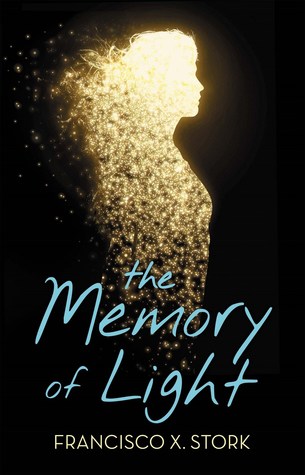
The Memory of Light by Francisco X. Stork

The Memory of Light by Francisco X. Stork

The Memory of Light by Francisco X. Stork

Released January 26, 2016.

From the outside, Vicky’s life looks perfect. Her father is wealthy, her step mother loves to take her shopping, and her sister is a high achiever. But Vicky can’t get over the loss of her beloved mother, whom she cared for during her last months. So Vicky turns to the only solution she can see and tries to commit suicide. When she wakes up in a mental disorders ward, she starts the process of putting her life back together. She meets three other teens who have lived very different lives from her and yet they all are part of each others recovery. Slowly Vicky starts to see that she suffers from depression and what it will mean to return to her life after her time in the hospital.

Stork has once again created a book for teens that will speak directly to them. He takes on mental illness here in a forthright way, showing the way that depression can creep up on a person and change the way they perceive things. He also shows how a person’s life can be glamorous and yet stifling and not fulfilling. It is a book that speaks to the importance of support from a therapist, of medication and of creating a group of people who understand you in your life. It’s a brilliant novel that is complex and deep with plenty to explore and feel.

Vicky could have been a very different character in a lesser writer’s hands. With Stork’s skill, he hints at a superficial look at Vicky’s wealthy life and then goes much more deeply into why she is experiencing life in the way she is. She is a poetic soul caught in a capitalistic family, driven by high achievement but in ways that she cannot relate to. With the loss of her mother, her father changed, her sister distanced herself, and Vicky had no one to turn to for support any more.

Organic and real, this novel has a diverse heroine and cast of characters that will appeal to a wide range of readers and deals with a serious subject in an uplifting way. Appropriate for ages 13-17.

Reviewed from ARC received from Arthur A. Levine Books.


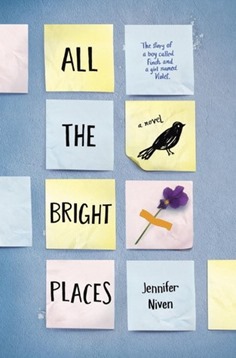
Review: All the Bright Places by Jennifer Niven

all the bright places

All the Bright Places by Jennifer Niven

Finch and Violet go to the same high school but don’t move in the same social circles.  So when they both find themselves at the top of the school’s bell tower one day, it’s a chance for that to change.  Finch is a boy who flirts constantly with death, thinking about different ways to kill himself and researching suicide statistics.  He’s known as “Theodore Freak” by his classmates and has a couple of close friends but that’s it.  Violet moves among the popular kids at school, but lost her older sister in a car accident the year before, something she’s having problems coping with.  The two of them start working on a school project together since Finch tricks Violet into agreeing.  For the project, they travel the state of Indiana finding unique places to visit and leaving small things behind.  As they travel, the two become closer and more honest with one another about what they are going through.  Violet begins to come out of her grief and live more, but something different is happening to Finch.

Niven creates a movie-like novel here with scenes that comes to life complete with cinematography in your mind.  There are iconic moments throughout the book, thanks to the plot of them moving from one unique spot to another.  Moments that stand out as important and vital even as they are happening, moments that disguise but also highlight what is happening to the two main characters.  There is a moment in the middle of the book where things switch and change starts to happen for both characters, but in opposite directions.  There is a sense of loss at that moment, of being unable to save someone that echoes suicide right then and there.  It is beautifully done.

The two main characters are brilliantly written as well.  The sorrowful Violet who can’t see her way towards trying at school or connecting with others at all and who finds her light in Finch that moves her forward.  The clever and sarcastic Finch who steeps himself in dark thoughts but flares alive, sleepless and awake, desperate never to fall into the trap of sleeping for days or months again.  He is a deep character, fighting being bipolar on his own. 

Niven writes with a simple beauty that will appeal to teens, especially as they explore these complicated subjects.  Appropriate for ages 15-18.

Reviewed from ARC received from Knopf.

Review: Nest by Esther Ehrlich

nest

Nest by Esther Ehrlich

11-year-old Chirp has grown up in the 1970s exploring the coasts and woods of Cape Cod and particularly watching the birds and learning all she can about them.  Her home life has been stable and warm, but now things are shifting.  Her dancer mother is no longer able to dance because of the pain in her leg.  She’s also having balance problems.  The family tries to continue as normal but when her mother is diagnosed with MS, it throws her mother’s mental state into chaos.  Unable to deal with the diagnosis, her mother falls into a deep depression.  Through it all, Chirp is slowly making friends with the boy who lives in her neighborhood, someone she had always feared in the past.  As their friendship grows, her family falls further and further into distress while Chirp fights to keep her own personal equilibrium.  Unable to cope any longer, Chirp and her new friend form a desperate plan.

Ehrlich captures a family both on the brink of crisis and then moving fully into complete dysfunction.  Through it all, the characters react as humans rather than stereotypes.  Readers will be caught up in the turbulence of these lives, the hope as things seem to improve, and the devastation as they continue to fail.  Ehrlich guides the story with a steady hand, allowing the characters to come to life on the page and react as honestly as they can.  She also makes sure that this is shown through Chirp’s point of view, something that both protects young readers but also allows the sudden changes to be even more powerful.

Chirp and her humor and unique point of view keep this book from sliding too far into tragedy.  She is inventive, creative and has her own passions for birds and nature that crop up throughout the book.  Joey, her new friend, has a complicated family life and also a spirit all his own.  He is a male character we rarely see in books, a boy who turns away from becoming a bully to become a friend, all on his own without adult intervention.  Her family is complexly drawn too, from the older sister who wants to escape to a different family to her father who is desperate to keep his family together and continues to be loving in the most difficult of times.

Written with a strong new voice, this debut novel is filled with rich characters who come together just to survive.  Appropriate for ages 9-12.

Reviewed from copy received from Random House Children’s Books.

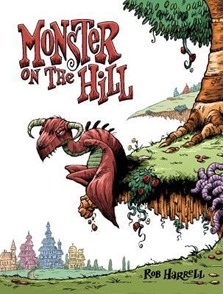
Review: Monster on the Hill by Rob Harrell

monster on the hill

Monster on the Hill by Rob Harrell

In 1860s England, each little town has its own monster that terrorizes its population.  And they love it!  In fact, there is money to be made if your town has a popular monster.  It brings in tourism and you can sell merchandise too.  However, the monster at Stoker-on-Avon was not a popular monster.  He barely left his cave anymore, sulking on the hill above the town.  Rayburn was one depressed monster.  It is up to Dr. Charles Wilkie, an inventor whose workshop was shut down by the town and who is willing to do almost anything to get it back, and Timothy, a street urchin who snuck along, to get Rayburn back in fighting spirit again.  This graphic novel is packed with new friends, old pals, big battles, and amazing monsters. 

Harrell took this graphic novel quickly out of any stereotypical themes very quickly by having the populations appreciate their monsters so thoroughly.  The mix of delight and monsters is great fun, adding a real unexpected twist to the story.  Rayburn is a wonderful character with a gloomy perspective that plays nicely off of the enthusiasm of the human characters.

Harrell’s art is filled with color and dynamic movement.  He brilliantly captures monster battles and is equally successful at creating friendship bonds between characters.  The art welcomes children to enter the world of the book, where they will find a great mashup of modern art and humor with a historical fantasy setting.

Fun, vivid and filled with action, this graphic novel will prove popular in every library.  Appropriate for ages 8-12.

Reviewed from library copy.

Review: Forgive Me, Leonard Peacock by Matthew Quick

forgive me leonard peacock

Forgive Me, Leonard Peacock by Matthew Quick

No one remembers Leonard’s 18th birthday, not even his mother who is busy with her new French boyfriend in New York City.  Leonard has big birthday plans.  He has presents for four of his closest friends.  He also has a present for his ex best friend, a bullet.  Specifically, a bullet right in his face.  Then Leonard will finish his birthday night by killing himself too.  First though, Leonard has to hand out his presents.  There is one for Walt, his next-door neighbor with whom Walt watches Bogart movies.  One for Lauren, the Christian homeschooler who tried to convert Leonard but only got him to lust after her more.  One for Baback, the gifted violinist whose practice sessions Leonard finds solace in.  And finally, one for Herr Silverman, the only teacher Leonard finds inspiring at all.  The story takes place all in one day filled with tension, hope and honesty.

Quick has created such a great character in Leonard.  Leonard is often arrogant, violently depressed, isolated, completely lonely, and yet infinitely human as well.  While he looks down on his classmates and most of his teachers, as his motivation is slowly revealed to the reader, it all makes sense.  Leonard is a puzzle that the reader gets to solve, and yet he remains complicated still. 

A book like this can be so dark there is not even a glimmer of light, but Quick shines light throughout if you are watching for it.  By the end of the book, you know that Leonard can be alright, if he just allows himself to believe it.  Quick has also written a great character who is a testimony to the role of teachers in teens’ lives.  Herr Silverman puts his own career in jeopardy to help Leonard, making him a hero in every sense of the word.  He is selfless and courageous, and it is clear from the first time he enters the book that he will either save Leonard or Leonard is beyond saving entirely. 

Harrowing, frightening and astonishingly hopeful, this book is a strong and passionate look at a boy willing to destroy everything, especially himself.  Appropriate for ages 14-17.

Reviewed from ARC received from Little, Brown.

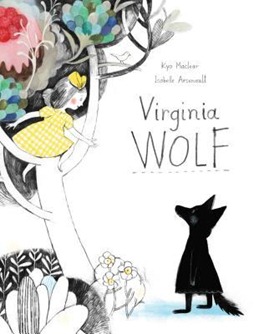
Review: Virginia Wolf by Kyo Maclear

virginia wolf

Virginia Wolf by Kyo Maclear, illustrated by Isabelle Arsenault

This picture book is loosely based on the life of Virginia Wolf and her sister.  Adults will enjoy the tie-ins, but they are not necessary for children to understand in order to enjoy the book.  It is a story told from Vanessa’s point of view.  Virginia was having a “wolfish” sort of day where nothing pleased her and any sort of noise bothered her.  Vanessa tried to talk with her and discovered that Virginia was dreaming of a far-away perfect place to be.  So Vanessa snuck away and found art supplies and paper to create that world for her sister.  Soon her walls were covered in birds, butterflies, flowers and color.  There was even room for a wolf to wander.  Virginia’s mood lifted and she was ready to play once again. 

This book takes a direct look at depression but can also be used for more transient moods of children.  The author’s writing is rich and beautiful.  When Virginia first gets depressed, she explains it this way: “The whole house sank.  Up became down.  Bright became dim.  Glad became gloom.”  When Vanessa paints the garden it is described this way: “I painted leaves that said hush in the wind and fruit that squeaked and slowly I created a place called Bloomsberry.  I made it look just the way it sounded.”  This is a book that not only has art as a solution and an escape, but also has art in the writing itself.

Arsenault’s illustrations have a wonder to them that is astonishing.  Done in mixed media of ink, pencil, watercolor and gouache, the images play with darkness and light with a fearlessness.  Color is used sparingly at first, then when the art appears it is lush and vibrant.  One completely understands the way that art can lift a person.  Perhaps my favorite small detail is that the art at first when seen through Vanessa’s eyes is adult, lush and fine lined.  Later when glimpsed in retrospect, it has a childlike quality to it instead. 

This picture book is a small work of art that speaks to the power of creativity and art to lift moods.  Appropriate for ages 5-7.

Reviewed from copy received from Kids Can Press.