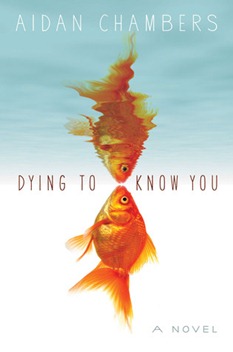
Review: Dying to Know You by Aidan Chambers

dying to know you FINAL

Dying to Know You by Aidan Chambers

When Karl’s girlfriend Fiorella asks him to write down his feelings about their relationship and answer a list of questions, he turns for help to a famous writer who lives in their town.  Karl is dyslexic which makes writing very difficult for him, as was the author who suffered as a child from minor dyslexia.  The author agrees to help Karl as much out of loneliness as a willingness to help.  He is drawn to Karl, who is similar in many ways, bright and eager.  He insists that Karl meet with him and give his own answers to the questions which the writer will in turn polish into something worthy of Fiorella’s attention.  As the two spend time together, their relationship deepens slowly into a true friendship.  When Fiorella finds out about the truth of the letters, it impacts the relationship not only of her and Karl but also of Karl and the author.

Chambers has created an amazing book here.  I found it nearly impossible to summarize because so much of the book is the growing connection between the two male characters.  It happens slowly and believably during fishing, quiet moments of driving, and conversation.  It is a look at how we choose connections in our lives and how they impact the life we lead.  While the book may be a quiet one, it also is daring in its own way, revealing the inner world of a young adult, written with truth and honesty.

The two men both face previous losses that have colored the way they face the world.  Karl lost his beloved father at a young age, and still struggles with his connection to his father and with disconnecting from that loss.  The author has recently lost his wife.  The two of them both struggled with depression and grief, sinking lower into a dangerous place with thoughts of suicide. 

Chambers also weaves in the role of art in our lives, the power of that to connect us to the world and the drive to create and be imaginative.  With Karl, who is a plumber, this connection to art is not an obvious one.  It takes time, just like their budding friendship, for the reader to come to understand Karl more deeply. 

I wish I could easily capture this book in paragraphs, since I feel like I have danced around the edges and not captured its heart here.  Let me say that this is a book that is powerful, quiet and filled with revelations about life.  It is honest, beautifully written and deep.  It is a book where you miss the characters for days after finishing it, because you too have befriended them.  Appropriate for ages 16-18.

Reviewed from ARC received from Amulet Books.

The Winds of Heaven

The Winds of Heaven by Judith Clarke

An amazing book that takes a deep look at love, depression, sisterhood, and life.  Clementine and Fan were opposites in many ways, but that just drew them closer.  They were more sisters than cousins, pulled together over the summer they spent at Fan’s house in Lake Conapaira.  Clementine was dull and regular next to the wild and amazing Fan.  But Fan’s life was not good, living alone with her abusive mother now that both her father and older sister had left.  Fan longed to head to the blue hills that she could see from her room, knew that there was something special out there waiting for her.  As time went on, both young women faced decisions that would change their lives, fears that would overwhelm them, and responsibilities that weighed upon them.  This is a book about the two very different friends, who both relied on each other despite their distance from  one another and the small choices that forced them even further apart.

Clarke’s writing is incandescent in this novel.  My book bristles with bookmarks, marking passages where the writing is astounding and staggeringly lovely.  Here is one of my favorites from early in the book where Clementine is describing how different Lake Conapaira is from her home:

You could even smell the difference: a mixture of sun and dust, wild honey and the smoky tang from the old kerosene fridge on the back veranda.  And you could smell feelings, too – Clementine was sure of it: you could smell anger and hatred and disappointment and jagged little fears.  The anger smelled like iron and the disappointment smelled like mud.

Clarke moves from dense writing like this that truly brings a reader into the scene and makes it real to lighter moments, dwelling on certain thoughts for awhile.  And beautifully, those are the moments that the reader carries with them, importantly through the book, the moments that must be remembered at the end.

This is an Australian novel that is steeped in Australia.  Readers will feel the red dirt in the pages, thanks to the vivid descriptions that Clarke offers us.  The sense of place is not only strong, it is inherent to the story.  Clarke set this book in modern time but the bulk of the story takes place in the 1950s and 1960s as Clementine and Fan grow up.  The time is important here too, reflected in the story.

The two characters, Fan and Clementine, are drawn with great care.  Readers learn about how they think, how they approach the world, and the way the world has shaped them in turn.  Though both girls are very different, they struggle with similar things.  They both have moments of weakness and shame, paired with moments of strength and empowerment.  They both see the other person as the strong one, the intelligent one, the beauty.  It is what brings them together and also what drives them apart.

This is a book about our journey through life and the choices we make.  It is a powerful book, one where even though the ending does not surprise is shockingly brutal at times.  Yet with the brutality comes a beauty as well.  Highly recommended, this is a book appropriate for good readers who will enjoy the prose.  Appropriate for ages 15-17.  Make sure you have some tissues around when reading the end.

Reviewed from copy received from Henry Holt.

How I Made It to Eighteen

How I Made It to Eighteen: a mostly true story by Tracy White

Based on the author’s experiences, this book takes a straight-on look at depression and self-destruction.  Seventeen-year-old Stacy Black checked herself into a mental hospital to help deal with her anger and depression.  She had just put her fist through a glass window.  Stacy hated the hospital but knew that she had to be there to survive, so she stayed.  As she spent time there, she developed new friends who helped her in her recovery and in being honest with herself.  Told in graphic novel format that is more like a journal than manga, this book is honest, blunt and intelligent.  Teen readers will easily see themselves in Stacy whether they are struggling with similar issues or not.

This book appears to be a regular novel until you open it and see all of the illustrations.  Done in line drawings, the illustrations are quirky and have the unedited feel of a real journal.  Readers get to know Stacy as well as her friends both in the hospital and from outside.  This perspective shift, done at the end of each chapter is a welcome view of how outsiders view a teen who enters a hospital.  While they express confusion and concern, all of them realize that it was a necessary step.  It is a brilliant and subtle way to tell teens that they will not be vilified if they get the help they need.

Though heavily illustrated, White’s writing is also a large part of the story.  Stacy is a sarcastic and caustic character.  Readers will realize immediately that she is putting on a front, but it takes time for readers and Stacy to acknowledge what exactly has brought her to the hospital and to this place in her life.  The slow unveiling of the basis of her problems mirrors the steps in her counseling.  This makes the entire book feel organic and honest.

A book that teens will enjoy and relate to, this graphic novel will appeal to a much broader audience than graphic novel readers.  Appropriate for ages 14-17.

Reviewed from copy received from Roaring Brook Press.

Also reviewed by: