Six Dots by Jen Bryant

six-dots-by-jen-bryant

Six Dots: A Story of Young Louis Braille by Jen Bryant, illustrated by Boris Kulikov (InfoSoup)

Louis Braille lost his sight at age five from an accident and a resulting infection. His family helped him learn to cope, making him a cane that he could use to explore a little farther from home each day. His brothers taught him to whistle and his sisters made him letters out of straw. He could play dominoes, knew trees by touch, flowers by their smell and could listen to books being read aloud. But there were no books for blind children like him. Even when he got into a school for the blind in Paris he had to work very hard and become one of the best students to be able to access their books. When Louis achieved that though, he found that the books were done in large raised wax letters so thick books were actually quite short. Then there was news that a French army captain had created a way to send secret messages that was read by touch. Louis worked to make the system readable by the blind, creating his own alphabet system as a teenager!

Bryant writes in first person from Braille’s point of view. She explains how Louis lost his sight with just enough detail to make it understandable how tragic it was but doesn’t overly linger there. When Louis’ sight is gone, the text changes to become filled with noises and other senses than sight. Bryant moves the story forward using Braille’s desire to read for himself, that drives both the story and Braille’s own life. As each opportunity proves to be disappointing, Braille does not give up hope, instead developing throughout his life a tenacity to find a solution.

Kulikov’s illustrations play light against dark. When Braille loses his sight, the pages go black with shadowy furniture forms only. Color is gone entirely. The reader is not left there, but moves back into the world of color unless the story is speaking about Braille’s blindness specifically, so when Braille finally gets to try reading the wax lettering, the page goes dark again, also showing his disappointment in the solution.

Intelligently designed and depicted, this is a warm and inspiring look at the life and achievements of Louis Braille. Appropriate for ages 6-9.

Reviewed from copy received from Knopf Books for Young Readers.


Maxi’s Secrets by Lynn Plourde

Maxis Secrets by Lynn Plourde

Maxi’s Secrets by Lynn Plourde

Timminy is not looking forward to starting a new school, particularly one where his father is Assistant Principal. Now he won’t be able to disguise from his parents how bullied he has been at school due to his small size. But his parents try to make the move more palatable by giving him a puppy, Maxi, who is a huge white furry ball of energy and love. Eventually, they discover that Maxi is deaf and have to figure out how to keep her safe in their woodsy new home. Meanwhile Timminy is busy worrying about school, dodging bullies who put him in lockers. When he meets his neighbor, Abby, she doesn’t put up with his whining about his size. After all, she doesn’t let her blindness slow her down at all. It is up to Timminy to realize that his size doesn’t define him any more than Abby’s or Maxi’s disabilities do. It’s time for them all to stand tall.

Plourde has created one of those dog books. You know, the ones where the dog dies. But at least she admits it right up front, warning readers that Maxi is one to be adored and loved but that she will be gone before the story is done. The book happily is about much more than that. It is about bullying and the ability to keep strong in the face of being different and unique. It is also about everyone being more than they seem on the surface, even those who may appear to be bullies at first.

The writing here is heartfelt and fast. Timminy is a great protagonist and though he can whine at times, it is always justified. The fact that he learns a lot from those around him is to his credit. He is also someone who offers second chances to others and seeks them himself when he does something wrong. This is a book about friendships and allowing people into your lives even if they are different in ways other than hearing and sight and size.

A tearjerker of a book, this is one with a huge heart to go along with the huge white dog. Appropriate for ages 8-12.

Reviewed from ARC received from Nancy Paulsen Books.


Save Me a Seat by Sarah Weeks and Gita Varadarajan

Save Me a Seat by Sarah Weeks

Save Me a Seat by Sarah Weeks and Gita Varadarajan (InfoSoup)

Joe and Ravi could not be more different. In fact, the only things they seem to have in common is they are in the same class and they could each use a new friend. Ravi has just moved to the United States from India and is discovering how very different school in a new country is. Joe’s two best friends have moved away and now he is left at the mercy of the class bully who also has Ravi in his sights. Joe has to attend special classes to deal with the way that he gets overloaded by sights and sounds. Ravi’s teacher has trouble understanding his English with his Indian accent and may be sent to special classes as well. Ravi is eager to befriend the class bully, who is also from an Indian background. How can these two very different boys figure out that there is a friend right there who needs them just as badly.

The book is divided into the perspectives of Ravi and Joe, each boy written by one of the authors. Beautifully, the two voices meld together into a cohesive whole. The two boys have distinct personalities and points of view that go far beyond their different cultures. The book speaks directly to stereotypes, particularly first impressions of people before you get to know them as a person. It illustrates this without a lecturing tone, instead demonstrating it in the ways the two protagonists interact with one another throughout the novel.

This is a very approachable book, one that invites readers to explore and see what is happening. It has a light tone, yet reaches deeper meanings and explores real issues that children today face no matter what their background or culture. Adding to the depth of the book are glimpses of the boys at home, showing how they spend their free time and the way their parents and families interact. It’s a way to further show both their differences and their similarities and works particularly well.

A perfect lunchtime read, this one is worth saving a special spot for on your shelf. Appropriate for ages 8-11.

Reviewed from ARC received from Scholastic.


On the Edge of Gone by Corinne Duyvis

On the Edge of Gone by Corinne Duyvis

On the Edge of Gone by Corinne Duyvis (InfoSoup)

The author of Otherbound returns with a stunning science fiction novel for teens. Denise and her mother are ready to leave their apartment, but her mother won’t move fast enough. She is trying to wait for Denise’s sister, Iris. Now they are not going to reach the shelter in time and that means that they probably won’t survive the comet hitting Earth. As they drive the empty streets to their temporary shelter, desperately late, a chance encounter leads them on another path. Instead of a temporary shelter, they are offered shelter in a generation ship that will wait out the comet hit and then leave earth. Now it is up to Denise to figure out how to fix everything, to find her sister in destroyed and flooded Amsterdam, and even more importantly get them all a spot on the generation ship before it takes off. But who is going to take Denise who is autistic and her mother who struggles with drug addiction?

Duyvis set this book in her native Amsterdam and throughout the novel, one can see her love for her nation and her city. Yes, she destroys much of it, but the spirit of the people is clear on the page as is the beauty of the city even through its destruction. The science here is done just right, with a clear connection to today’s technology but also taking it leaps ahead, allowing readers to truly believe it is 2035. This book is not afraid of asking difficult questions about disabilities and addiction and whether only the perfect deserve to survive in this situation.

The book is beautifully written, with an impressive protagonist who shows that disabilities are no reason that you can’t be a survivor and even more so, a heroine. Denise is a beautiful mixture of autistic behaviors when she is pushed but also bravery and resilience. The book is an intelligent mix of adventure and survival with a compelling question of what could make Denise worthy enough to stay. There are additional ethical questions throughout, including how far one would go to save a loved one.

A brilliant science fiction novel that offers diversity and a powerful story. Appropriate for ages 12-15.

Reviewed from ARC received from Abrams.


2016 Dolly Gray Children’s Literature Award

Dolly Gray Children's Literature Award

The winners of the 2016 Dolly Gray Children’s Literature Award have been announced. The award is given by The Division on Autism and Developmental Disabilities of the Council for Exceptional Children in collaboration with the Special Needs Project. The award recognizes “effective, enlightened portrayals of individuals with developmental disabilities in children’s books.” The award is presented in even years only. Here are the winners:

CHAPTER BOOK AWARD

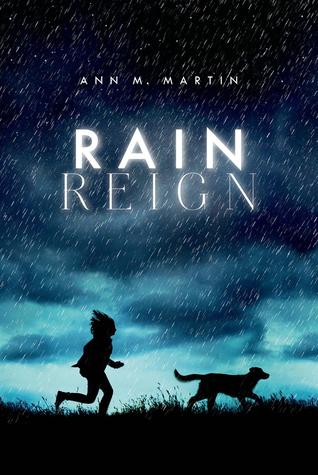
Rain Reign

Rain Reign by Ann M. Martin


PICTURE BOOK AWARD

My Friend Suhana

My Friend Suhana by Shaila Abdullah and Aanyah Abdullah


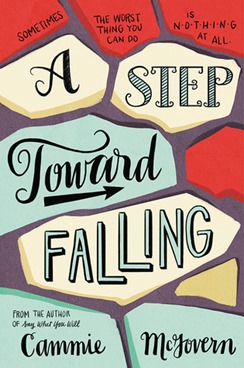
Review: A Step Toward Falling by Cammie McGovern

A Step Toward Falling by Cammie McGovern

A Step Toward Falling by Cammie McGovern (InfoSoup)

Emily prides herself on being a leader in a group at her high school that promotes good causes and explains larger issues. So she is very ashamed when she freezes in the middle of a crisis. When she witnesses Belinda, a developmentally disabled classmate, being assaulted at a football game, she does nothing to intervene. Now she and Lucas, a boy who also failed to come to Belinda’s rescue, have to do community service at a center for people with disabilities. As work at the center, they start to realize the damage that they did through their silence. They search for ways to also directly help Belinda, but Belinda is no longer at school. It will take one big idea that will stretch all of their abilities to start to see serious healing.

McGovern has written an amazing book here. The narration in the novel switches between Emily and Belinda, so readers are able to see the true impact of the assault on Belinda as well as the repercussions in Emily’s life. The book moves readers from the drama of the assault to focus much more on the aftermath and the need for understanding and advocacy.

Belinda is a great character. Her point of view is such an important piece of this novel, showing a bravery after taking time to simply disappear into Pride and Prejudice and Colin Firth for awhile. Her disability is never hidden and yet also not exploited in any way. The way she is shown honors the way her brain works and the intelligence that she clearly has. I also appreciate that Belinda is far from perfect. She is demanding of others, often rudely criticizing them in public, and is not subtle at all. Again, this rings very true and honest. She is not a victim but a survivor.

An important teen novel about stepping up and taking action and responsibility but also about the lives of people with disabilities and the place they deserve in our communities. Appropriate for ages 13-16.

Reviewed from ARC received from HarperCollins.

Review: The Last Leaves Falling by Sarah Benwell

Last Leaves Falling by Sarah Benwell

The Last Leaves Falling by Sarah Benwell (InfoSoup)

Sora has ALS, a disease that will slowly ravage his muscles and eventually kill him. There is no cure and no slowing the disease’s progression. Sora’s mother takes care of him and he spends his days at home, unwilling to leave and expose himself and his mother to the pitying gazes of strangers as she pushes him in his wheelchair. Then Sora joins an online chat room for Kyoto teens and after lurking for awhile, accidentally posts a very big scream to one of the rooms. Some people reach out to him and he becomes online friends with two of them, Mai and Kaito. His mother thinks they are friends from school, and she insists that she meet them too. But Sora hasn’t revealed his diagnosis to them at all, pretending instead to be a regular school-attending teen online. What will happen when they discover his illness? Will be begin to treat him differently just like everyone else?

Benwell has written a stunning read in this teen novel set in Kyoto, Japan. The setting is beautiful and a sense of Japan runs through the entire novel, making sure that western readers will never lose the sense of the setting. Benwell grapples with many issues here and yet the book is intently focused on Sora and his journey. Sora wants answers to questions that have none, like why people treat those with disabilities differently and what happens to you after you die. With those issues weaving throughout the book, Benwell also offers up a look at a devastating disease and its effect but also still reminds us all the it is each day that matters and the small things that delight.

The three teen characters are very well drawn. There is Sora, the central character and a boy who is serious and studious. He searches for deep answers and has lots of time alone to think. Yet he is still approachable, friendly and caring, never becoming a stereotype of any kind. Mai is a girl who loves art but is unable to explain to her mother that she’d rather be an artist than a lawyer. Through her reaction to meeting Sora for the first time, Benwell offers one view of courage and the willingness to try again. Kaito is a boy who loves coding and computers, but struggles to do it as well as he would like. He is impatient and clever. The two teens learn much from Sora, but not right away allowing them the time and space to be truly motivated by Sora.

This is a powerful novel that speaks to the beauty of life and calls teens to make the most of their dreams. Have your tissues ready! Appropriate for ages 12-16.

Reviewed from copy received from Simon & Schuster.

Review: Red Butterfly by A. L. Sonnichsen

red butterfly

Red Butterfly by A. L. Sonnichsen

Kara was abandoned as an infant and taken in by an American woman living in China. Her Mama never leaves the apartment they share and Kara doesn’t attend school. Kara does get to leave the apartment each day to run errands on her bicycle, her favorite time of day. In China where the one-child limit is in effect, parents leave infants who have physical challenges like Kara who was born with one hand with only two small fingers on it. Mama longs to return to the United States, but she can’t without abandoning Kara, who has no identification papers and has not been formally adopted. When Mama’s American daughter comes to visit, Kara finds their entire lives turned upside down and their secret exposed. Will Kara be able to bring their family back together again?

Told in lovely rich verse, this novel is elegantly written and conceived. It shows the results of the one-child policy in China and the children who were abandoned because of it. Yet it is far from a condemnation of China or the United States. It is a portrait in contrasts and complexity, showing that there is good and bad in both systems. It is also the story of one very strong young girl who has already lost one family and is determined not to lose another.

Kara is the voice of the book with the poems told from her point of view. She is unique in many ways, including being able to speak English better than she Chinese due to her upbringing. Kara’s disability is handled in a matter-of-fact way for the reader. While she is profoundly ashamed of it, her hand and disability do not label her at all in the novel. Kara’s situation is complicated by the politics of adoption and identity. In her journey to a resolution of where she will live, there are episodes in an orphanage and then later in a home in the United States. These are all deftly and clearly drawn, showing both the universal nature of family and love but also the differences in cultures.

Radiant verse and a very strong young protagonist make this verse novel a treat to read. The unusual subject matter of an older orphan from China makes it a unique read. Appropriate for ages 9-12.

Reviewed from copy received from Simon & Schuster Books.

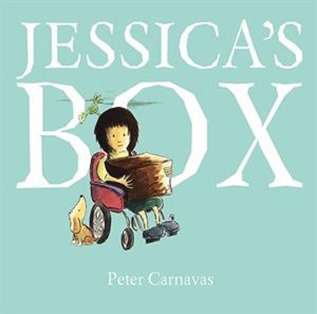
Review: Jessica’s Box by Peter Carnavas

jessicas box

Jessica’s Box by Peter Carnavas

Released March 1, 2015

Jessica can’t sleep, it’s the day before her first day of school.  The next day her parents assure her that she will make lots of friends, and Jessica had a plan to make sure that happened.  In a box on her lap, she carried her teddy bear to school, but when she revealed it later in the day, kids laughed at her or just walked away.  The next day, Jessica put something else in her box and headed to school.  But the cupcakes in the box disappeared quickly without so much as a thank you from the kids.  The third day of school, Jessica snuck her dog into class.  Doris was very popular, but dogs weren’t allowed at school.  By the fourth day, Jessica was dejected.  She dragged her box to school empty and then put it over her head.  And that’s when Jessica figured out exactly what she should have had in her box all along, something very special indeed.

Carnavas tells a very successful story here.  I love that the main character is in a wheelchair and yet the story is not about her disability.  It’s a first-day-of-school story and a making-friends story instead.  Also throughout the book she is shown as entirely capable and not needing help, except for a little encouragement of different sorts from her family members that any child would want and need.  The use of the box is smartly done, using it both as a metaphor and also as a way to build suspense for the reader about what is being taken to school that day.

The art is friendly and colorful, also helping build suspense with page turns that lead into the reveal of what’s in the box.  Carnavas shows loneliness very nicely on the page, isolating Jessica clearly on the white background.  He also shows connections in a gentle way, displaying a subtlety that is particularly nice on the page with Jessica and her father being quiet together.

A very inclusive book about school jitters and making friends, this will be a nice read aloud to share with kids about to enter school.  Appropriate for ages 4-6.

Reviewed from digital copy received from Kane Miller.