Review: The Hueys in The New Sweater by Oliver Jeffers

hueys in the new sweater

The Hueys in The New Sweater by Oliver Jeffers

All of the Hueys are the same.  They are all white ovals with skinny, stick legs and arms.  They even acted and thought the same, until one day when Rupert knitted himself a sweater.  It was a bright orange sweater with zig-zags and it made him stand out from all of the other Hueys.  Rupert was very proud of his sweater, but the other Hueys often reacted in shock and horror at it.  Rupert went to talk with Gillespie, who was also intrigued by being different.  Gillespie knitted himself a sweater just like Rupert’s and that way they could both be different together!  Slowly, the other Hueys started to accept that Rupert and Gillespie were different.  In fact, they embraced it, and everyone knitted themselves orange sweaters just like Rupert’s.  Now everyone was the same again, until Rupert decided to try a hat!

There is something completely winning about these little creatures that Jeffers has created.  So much of this book depends on the images, the style, and the feel.  Jeffers manages to create a community that is completely homogenous but not cult-like or frightening.  Instead it’s a community that has tea, hangs pictures, and seems very friendly.  Even their reaction to Rupert’s sweater is never angry, more one of disbelief, shock and even some tears. 

The writing is light and merry, keeping the entire book positive.  Jeffers has cleverly created a book that speaks to creativity and being your own person, not being afraid of leaving the crowd, but also one about what happens when your idea is taken over by the crowd.  The answer?  Do something else!

A great pick for a bedtime read, the book is a smaller format than many picture books and will not work well with a large crowd.  Appropriate for ages 3-5.

Reviewed from copy received from Philomel Books.

Review: The Pirates Next Door by Jonny Duddle

pirates next door

The Pirates Next Door by Jonny Duddle

This book first came to my attention when it won the Waterstone’s Children’s Book Prize in the UK.  It is the story of a girl living in a neighborhood where all of the lawns are neat and tidy, until the pirate family moves in next door.   They arrive complete with pirate ship, treasure chests and barrels of grog.  There is a pirate boy named Jim Lad, his parents, his grandfather, and his little sister, Nugget.  Jim Lad and the girl quickly became friends, but the rest of the community was not as welcoming to the pirate family.  Rumors spread quickly about all the nasty things the pirates were up to and the fear was that if one pirate family lived there, then more would come.  But this pirate family is only there while their ship is being repaired, so soon Jim Lad is off again, leaving behind a touch of pirate treasure for everyone.

Duddle has written a child-friendly book about segregation without ever using the word or focusing on that concept.  It is a book about people who are different from you moving into your neighborhood.  Happily, the pirates expect to be shunned to a large degree, and just live their lives the way they always would.  They are unapologetic, make no efforts to fit in, and then disappear, but not without making a real impact and changing people’s minds. 

The illustrations in this book really set it apart.  They have that lush feel of cinematic animation.  Each character has a unique feeling to them, effortlessly distinct and interesting.  That’s true of the pirate family and also of the many elderly neighbors who gossip about them.  The effect is rich and striking.  The illustrations also use the color palette of cinema, with the dramatic lush colors, deep blues of night, and often playing with light and dark. 

This exceptional book takes the appeal of a pirate story and weaves in social commentary with great restraint.  Appropriate for ages 4-6.

Reviewed from library copy.

Review: Kali’s Song by Jeanette Winter

kalis song

Kali’s Song by Jeanette Winter

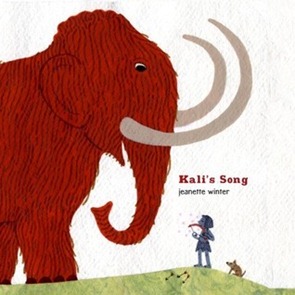
Kali’s mother painted amazing paintings of animals on their cave walls.  Soon Kali would be a man and so he started practicing with a bow and arrows.  But on his first session of practice, he discovered that he could do something else with the bow:  he could make music!  Soon he was making music instead of practicing his shooting at all.  When the day of the big hunt came, his bow was taut and his arrows sharp.  The men and boys approached the huge mammoths, that were far larger and more impressive than Kali had ever expected.  Kali forgot all about the hunt and just felt that he had to play the music he was hearing in his head.  As he played, the mammoths gathered closer around him and the other hunters laid down their bows.  Everyone realized that Kali must be a shaman to charm animals in this way.  Even as Kali grew much older, he continued to play music on his bow.

Winter has created such a remarkable story here.  It is a story without modern judgment about killing animals, which would be out of place in this book.  Yet Winter does not turn entirely away from modern sensibilities either with this book about a young shaman who does not kill, but instead charms.  It is a book that celebrates innate talents of people, relishes in inventiveness, and demonstrates a large heart for acceptance too.  Kali is not shunned for being different, but instead embraced for it. 

Winter’s illustrations are also very special.  Framed with torn edges, the illustrations are filled with the texture of papers that mimics that of cave walls.  The characters are roughly painted, just as his mother’s cave paintings are with additional fine details drawn on in ink.  The result is a book that is a winning combination of rough and fine. 

This picture book embraces differences, celebrates art and music, and does it all surrounded by stars and mammoths.  Appropriate for ages 4-6.

Reviewed from copy received from Schwartz & Wade Books.

Review: Laundry Day by Maurie J. Manning

laundry day

Laundry Day by Maurie J. Manning

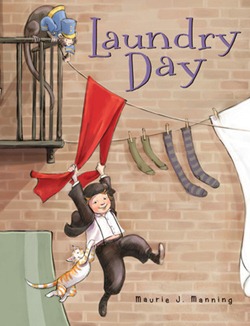
A young boy tries to sell shoe shines on the streets of New York City in a time before cars, when the streets are crowded with horses and carts.  Suddenly, a red cloth drifts down from above.  The boy looks up to see rows and rows of laundry drying above the street, so he starts to climb with the red cloth around his neck and his small cat following behind.  As he searches for the owner, he meets people from all over the world.  There is the Chinese woman who offers him a mooncake after he helps fold some laundry.  A Ukranian woman with a wailing baby suggests he check with the Italian organ grinder who lives above her.  A family of Polish little girls try to get him involved in their games.  When he finally finds the owner, he has traveled the world in just a few buildings, sharing in treats, hearing a few words of their language.  His high-wire antics add a little spice to the story and a wonderful play off of old films.  This is an old-fashioned treat of a picture book.

Manning adroitly wraps international content in a comfortable package.  The various cultures shown in tiny tastes here are done with a gentle hand and an eye to history.  There is a feeling of merriment throughout this book, with never a fear that the boy will injure himself or that he will find anyone unkind on his adventures.  

The illustrations too have a playful vintage quality about them.  There is a freshness mixed with a timeless feel.  The freshness comes from the cartoonish lines of the art and the comic-like panels used on some pages.  It’s an inventive mix of modern and timeless.

This picture book mixes vintage and new, international and American into one wonderful diverse story.  Appropriate for ages 3-5.

Reviewed from library copy.

Review: Marshall Armstrong Is New to Our School by David Mackintosh

marshall armstrong

Marshall Armstrong Is New to Our School by David Mackintosh

Marshall Armstrong is the new kid at school and he is very different from everyone else.  His things are different.  He looks different with his birdseed freckles and ears like shells.  His arms are white with red bumps that he says are mosquito bites.  He even eats “space food” for lunch!  He can’t play during recess.  He stays out of the sun.  He doesn’t watch any TV.  So when Marshall Armstrong has a birthday party, everyone is sure that it is going to be awful.  But guess what, Marshall Armstrong’s house is different too!  Different in some great ways!

Mackintosh has created a picture book that speaks to what makes someone different from the rest of the class.  I really enjoyed the fact that while Marshall is different, so are all of the other kids in the class.  This is not a homogenous student body, but even in a diverse group Marshall is certainly unique.  Mackintosh reveals much in his illustrations which are quirky and modern, a striking mix of playful lines and bright colors. 

The story is straight forward but also filled with humor.  There are signals throughout that Marshall is a geeky kid (and I mean that in the best possible way, as mother to two geeks, married to another) and very modern.  He may be in a class of more normal kids, but some of us more geeky parents will also see ourselves in Marshall, our stuff, our obsessions.  It’s a lovely inside joke for those of us who were perpetually different like Marshall.

This picture book about being different takes the discussion beyond diversity and into a place where we are all different, just like Marshall.  A great pick for sharing at the start of a new school year. Appropriate for ages 4-6.

Reviewed from library copy.

Review: Chocolate Me! by Taye Diggs

chocolate me

Chocolate Me! by Taye Diggs, illustrated by Shane W. Evans

The main character of the book, who goes unnamed, is teased because he is different than the other boys in the neighborhood.  Compared to the white kids, his skin is darker, his hair more poofy, his nose is wider, and his teeth shine brighter.  He returns home in tears, because he wants to fit in.  His mother talks to him, telling him how special he is and how perfect he is.  She tells him that his skin is like “velvet fudge frosting mixed in a bowl.”  She gives him a t-shirt that says “Chocolate me!” and he starts to rethink things as do the other kids.

The focus of this book is self-acceptance and self-love.  The universal theme of trying to fit in and feeling different than others will speak to all children.  Diggs writes with a smoothness and natural rhythm.  The book reads as confident poetry, though it does not rhyme.  Evans’ illustrations have a great organic feel as well.  They are bright colored, rough lined, and filled with motion. 

Share this with a group of children discussing self-esteem or diversity.  It will also be one of those books that children pick off the shelves thanks to the sunshine bright cover.  Appropriate for ages 3-5.

Reviewed from copy received from Feiwel and Friends.

Review: Same, Same but Different by Jenny Sue Kostecki-Shaw

same same but different

Same, Same but Different by Jenny Sue Kostecki-Shaw

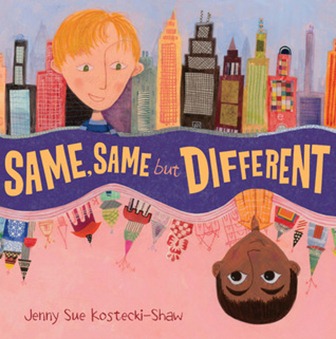
Elliot and Kailash are new pen pals.  As they share letters, they share the differences and similarities of their lives in Elliot’s America and Kailash’s India.  Both boys like to climb trees.  Their families are very different with Elliot living with his mother, father and baby sister and Kailash living with an extended family of 23.  They both have pets, but the pets are different.  Both boys take a bus to school, but the communities are very different except for the traffic.  The boys discover that they can be friends despite their obvious differences by looking to see how much they are actually they same.

Kostecki-Shaw writes with a very positive tone here.  Through the two boys, she demonstrates how we are all so much more similar than we may realize.  At the same time, she rejoices in the differences between the two characters, allowing us to see the different cultures side-by-side.

Her art is very effective as well, rendering both cultures with bright colors, plenty of motion, and a natural energy that captures the eye.  She makes the differences between the cultures quite compelling. 

A perfect book to share in a class along with a pen pal unit, this book is also a good pick for sharing when discussing differences since it takes such a positive approach.  Appropriate for ages 5-7.

Reviewed from copy received from Henry Holt & Company.

Book Review: The Great Big Book of Families by Mary Hoffman

great big book of families

The Great Big Book of Families by Mary Hoffman, illustrated by Ros Asquith

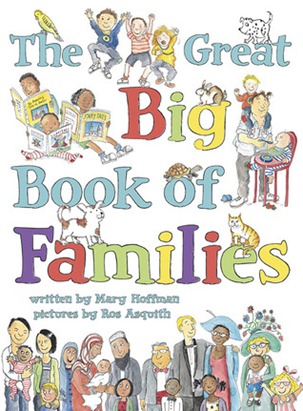
This book celebrates all of the different sorts of families there are.  It starts with a stereotypical family of blonde, white mom and dad, two kids (a boy and a girl), a dog and a cat.  They even come complete with the picket fence and apple tree.  Turn the page and you are in reality with families of different colors, single parents, grandparents, two mothers, two fathers, and adoptive families.  The book then moves on to family sizes, different homes, different ways to go to school, different ways parents work, the holidays families take, the food we eat, clothes, pets, hobbies, and much more.  The book ends by expressing a very important message that families change.  So what does your family look like today?

Another facet of this book is the celebration of families of different incomes and wealth.  Nothing is put down, just mentioned as different from one another.  Children may not notice the differences, but if you are a child struggling with poverty, it is good to see yourself represented here matter-of-factly and honestly.  Hoffman’s entire text is written in this straight forward way, she is inclusive, expansive and above everything non-judgmental. 

Asquith’s illustrations have a nice sense of humor that keeps the book from being too earnest.  They have a quirky feel, a silliness that makes the book a pleasure to read.

Every library needs a copy of this warm, welcoming book where all children will see parts of themselves represented.  Appropriate for ages 4-7.

Reviewed from copy received from Dial Books.

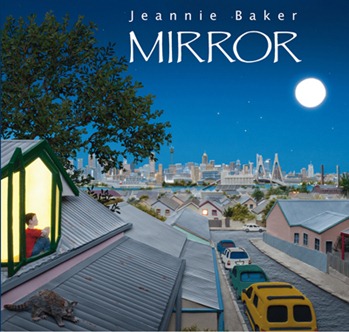
Mirror: A Reflection of All of Us

mirror

Mirror by Jeannie Baker

This book tells two stories at the same time from two distinctly different cultures.  Each story focuses on a family and a day in their lives.   One story is set in Sydney, Australia where a boy lives with his family and baby sibling.  They drive a minivan to the hardware store to get more materials to renovate their home.  The other story features a family in Morocco.  Here too a boy lives with his family and his little sibling.  They travel to the market by donkey to sell a rug, some sheep and some chickens.  That same rug is the one picked out by the Australian family at a rug store to have in their home.  The entire book is a celebration of the interconnected nature of our lives no matter what nation we live in.

The book can be read in several ways, either both stories at the same time, or each one completely separately.  It opens with the Australian story with an English introduction on the left which is read from left to right.   The Moroccan story is on the left with an introduction in Arabic.  The entire Moroccan section is read right to left just like Arabic.  Each story has its own separate pages bound together with a shared spine and cover, which I see as very symbolic of the entire book concept.

After the introductions, the bulk of the book is wordless.  Through Baker’s incredibly delicate and detailed collage illustrations, readers will discover the universal nature of the two cultures and also their differences.  Baker shows different foods, different pets, different transportation, different lands but the stories are so similar, the families so alike, that the focus is never on the differences but on the similarities.

This is a masterpiece of a picture book.  While not appropriate for a story time, it is a book that should be shared for its celebration of diversity, multiculturalism, and humanity.

Reviewed from library copy.

To get a better sense of the structure of the book, take a look at the video below:

Also reviewed by: