Review: Emily’s Blue Period by Cathleen Daly

emilys blue period

Emily’s Blue Period by Cathleen Daly, illustrated by Lisa Brown

An intriguing mix of subjects, this picture book combines art with divorce and it works gorgeously.  Emily really likes the work of Picasso and the way that he put body parts in odd places in his cubist work.  It reflects the way that Emily feels about her own family life, with her father now living in a different home than the rest of them.  Emily tries to help her father pick out furniture for his new home, but it’s not easy and her little brother quickly becomes problematic at the store and has to be carried out.  Even art becomes less fun for Emily.  She feels blue a lot of the time and not like using any other colors.  Then her art teacher shows her about collage, and Emily finds a way to express her feelings through her art and depict her family in their own unique style.

Told in short chapters, this picture book is just right for elementary students.  The unique combination of subjects works particularly well, each supporting the other and allowing them to be explored in more depth.  Daly manages to use art to show the emotions of children experiencing a divorce and the divorce to show the importance of art in expressing yourself when you can’t find the words. 

Brown’s art is light-handed and friendly.  She captures Picasso’s art with that same light touch and creates Emily’s blue time with plenty of blue but no darkness.  The result is a book that is filled with light, despite it’s more somber subjects.  It keeps the book from being too serious and allows the emotions to surface nicely.

A striking combination of art and real life, this picture book truly shows the power of art in one’s life.  Appropriate for ages 5-8.

Reviewed from library copy.

Review: Monday, Wednesday, and Every Other Weekend by Karen Stanton

monday wednesday and every other weekend

Monday, Wednesday, and Every Other Weekend by Karen Stanton

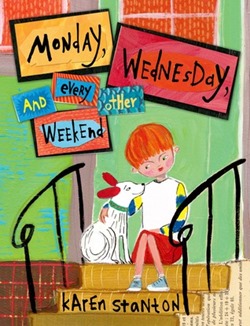
Henry and his dog, Pomegranate, live in two different houses.  On Mondays, Wednesdays and every other weekend, he lives with his mother on Flower Street.  On Tuesdays, Thursdays and every other weekend, he lives with his father two blocks away on Woolsey Avenue.  The two houses are very different.  They smell different, look different, sound different and even taste different.  Pomegranate though is never truly happy at either house.  He wants to be somewhere else.  Then one day, Pomegranate gets out and runs away.  Henry and his father head to Flower Street to see if he is with Henry’s mother, but no Pomegranate.  Then Henry realizes where Pomegranate must be and heads straight to the house where his family used to live all together.  Now a little girl lives there and she has Pomegranate with her! 

This book has such a strong heart.  Stanton clearly shows the differences between the two homes that Henry lives in.  The different neighborhoods, the different foods, the different sounds.  Both homes are beautiful, both are filled with love for Henry.  Stanton’s clever use of Pomegranate as the expression of the emotions involved in a divorce is well done.  She manages to allow Henry to be well adjusted and happy while still dealing with the complex emotions that divorce elicits.

The art is charming and wonderfully loud.  Done in collage mixed with painting, the colors shine on the page.  She makes sure to show the elements that make up life in each house, showing again the differences but also the similarities in the homes.

A memorable book on divorce for children, even children who have not experienced divorce themselves will enjoy this engaging title.  Appropriate for ages 3-5.

Reviewed from copy received from Feiwel & Friends.

Review: Living with Mom and Living with Dad by Melanie Walsh

living with mom and living with dad

Living with Mom and Living with Dad by Melanie Walsh

This picture book takes a look at divorce in a way that is appropriate for very young children.  It focuses on living in two separate homes and what happens to the things a child holds dear and to their family.  Using flaps to invite young listeners to participate in the story, children will be able to explore the differences, including different nightlights, changes in how a child is picked up from school, and trips with each parent.  Nicely, the book also explores what happens for special events and birthdays and how the parents attend but separately.  There is no negative emotion here, just a matter-of-fact book that answers the questions that children will have about their every day life. 

Walsh has created a book that will be of particular help in both families going through a divorce and for children who have questions in general about divorce.  The lack of emotion gives the book some distance from the situation, yet it manages to answer all of the nuts and bolts details that children fret about. 

Walsh’s art is flat and friendly.  The book is populated by bright colors, cheery flaps and a friendly outlook.  All of this in a book about divorce.  And it manages to work and work well.

A good choice for the youngest of children who are thinking about divorce, this book is a welcome addition to library shelves.  Appropriate for ages 2-4.

Reviewed from library copy.

Review: Lexie by Audrey Couloumbis

lexie

Lexie by Audrey Couloumbis

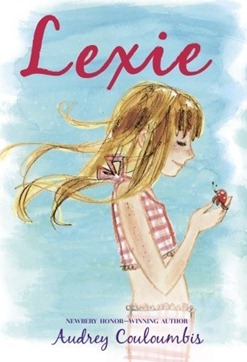
The shore has always been one of ten-year-old Lexie’s favorite places in the world.  She would spend the summer there with her parents, playing on the beach, finding treasures in the sand, and reading picture books.  Now though, her parents are divorced.  So her mother isn’t going to be going to the shore at all.  Lexie is spending a week there with just her dad.  Or so she thinks!  On the way there, her father announces that his new girlfriend will be joining them, and her two sons too.  Lexie is pushed out of her usual bedroom into one that is as tiny as a closet.  Teenage Ben is also not enthusiastic about being stuck together.  Little Harris is messy and doesn’t even want to head outside at first.  As the two families try to live together, Lexie discovers that connections can be created over the smallest things and that there is still room for everyone even if the house is a lot more crowded.

This is a book that takes a moment in time, a week at the shore, and creates a world out of it.  Couloumbis writes with a voice that celebrates the small things, yet doesn’t wander.  The characters are real, each written with an honesty that is surprising.  The adults have faults, make mistakes.  The young people are struggling with this new situation, facing it with various emotions that all read as true.

Lexie is child who can see past her love for her father and see him through the others’ eyes.  At the same time though, she has to spend time with the others to understand them as deeply.  It all works well as the reader is also learning about these characters.  When truths are revealed is a crux of the story.  Throughout the book, honesty is explored.  Lexie struggles with trying to be kind and then finding herself in situations where it may have been better all along to tell the truth.  The situation with the adults mirrors this as well.

This is a radiant read that explores deep issues of divroce and truth while never losing the sunshine of the shore.  It would make an intriguing pairing with Junonia by Kevin Henkes which is for a similar age and also is set on the beach. Appropriate for ages 8-11.

Reviewed from copy received from Random House.

Also reviewed by:

The Dancing Pancake

The Dancing Pancake by Eileen Spinelli, illustrated by Joanne Lew-Vriethoff

Bindi is facing a lot of changes in her life.  First, her father has left their family to find a job in another city.  A few months later, she learns that her parents have separated.  Now her mother and her aunt are starting a restaurant called The Dancing Pancake.  They will be moving into the apartment above the restaurant and out of their house.  As all of these changes hit, Bindi finds herself feeling sad and angry about them.  People at the restaurant and her extended family help her deal with her feelings and show her the positive in her life. 

This verse novel features a full cast of interesting characters.  The poems are written from Bindi’s point of view.  She is a protagonist who is open and honest about her feelings, even when she is struggling with them.  She offers readers a clear view of what children deal with when parents separate and life changes.  At the same time, she is uniquely Bindi, a girl who loves to read, worries about what sort of friend she is, and tries to help others whenever she can. 

Spinelli’s verse is short and sweet.  It has a clarity and understated feel to it that makes it very easy to read.  Lew-Vriethoff’s illustrations have a breezy, effortless quality to them.  They are simple line drawings that capture the moments in the book.  The verse format and the illustrations throughout the book will make this a very inviting title for young readers.

Highly recommended, this book strikes just the right balance between a girl’s life falling apart and a family ready to catch and hold her.  Appropriate for ages 7-10.

Reviewed from copy received from Knopf.

Oliver at the Window

Oliver at the Window by Elizabeth Shreeve, illustrated by Candice Hartsough McDonald

Not only have Oliver’s parents separated, but he has started preschool.  He spends most of the day hugging his stuffed lion and looking out the window watching for one of his parents to come and take him home.  But home isn’t the same either.  He is never quite sure which house he is going to that night.  As the days pass, Oliver gets more involved in his class, painting his mother’s house and drawing his father’s.  By the end of the book, he is able to help a new little girl who is standing by the window and crying.

Shreeve sets a delicate tone with this book that manages to tackle very serious issues without bogging down into didacticism.  In just a few short pages, Oliver experiences real, tangible and believable growth as he works through the changes in his life.  McDonald’s color pencil art is simple and almost child-like.  Both artist and author use Oliver’s lion as a symbol of his growth to great effect. 

Recommended for any child going through changes in their life.  This is a book filled with hope and ringing with honesty.  Appropriate for ages 3-5.

Reviewed from copy received from publisher.  Book will be placed in library collection.

My Parents Are Divorced, My Elbows Have Nicknames, and Other Facts about Me

My Parents are Divorced, My Elbows Have Nicknames, and Other Facts about Me by Bill Cochran, illustrated by Steve Bjorkman.

Ted’s parents are divorced, but that is just one aspect of this kid.  His parents may live separately, may not watch his games together, and he may still be sad whenever he thinks about the divorce, but that definitely doesn’t mean that Ted is weird.  What makes Ted weird are the other parts of his life:  eating cold spaghetti sauce out of the jar, naming his elbows, and wearing soap Mohawks.  When taken all together, Ted is the sum of many things and being the son of divorced parents is a big part but only a part of him.

This book takes divorce and makes it normal.  It talks about the feelings, the confusion, the pain of divorce but offsets it with the humor and silliness of Ted’s other interests.  In this way, Cochran makes it into more than a simple book on divorce.  It becomes a book that any child, from a divorced family or not, can see themselves in, and see themselves celebrated.  Yes, it is a book about divorce, but just like Ted, that is only a part of what it is.

Bjorkman’s illustrations gleefully add to the silliness of the story.  Nicely, the pages about the divorce are not darker or different.  They are just as bright and colorful as the rest.  In the most poignant illustration, Ted sits between his parents as they tell him about the divorce.  He is snug up against his mother with his hand and arm reaching toward his father on the other side of the couch.  A lovely illustration that encompasses the feel of divorce in a single image.

Highly recommended as a book on divorce that will not depress children but will encourage moving through it and beyond.  Appropriate for ages 5-8.

Reviewed from copy received from publicist.

Also reviewed on Book Dads, Young Readers, and A Chair, a Fireplace and a Tea Cozy.