2 Nifty Nonfiction Picture Books about Animals

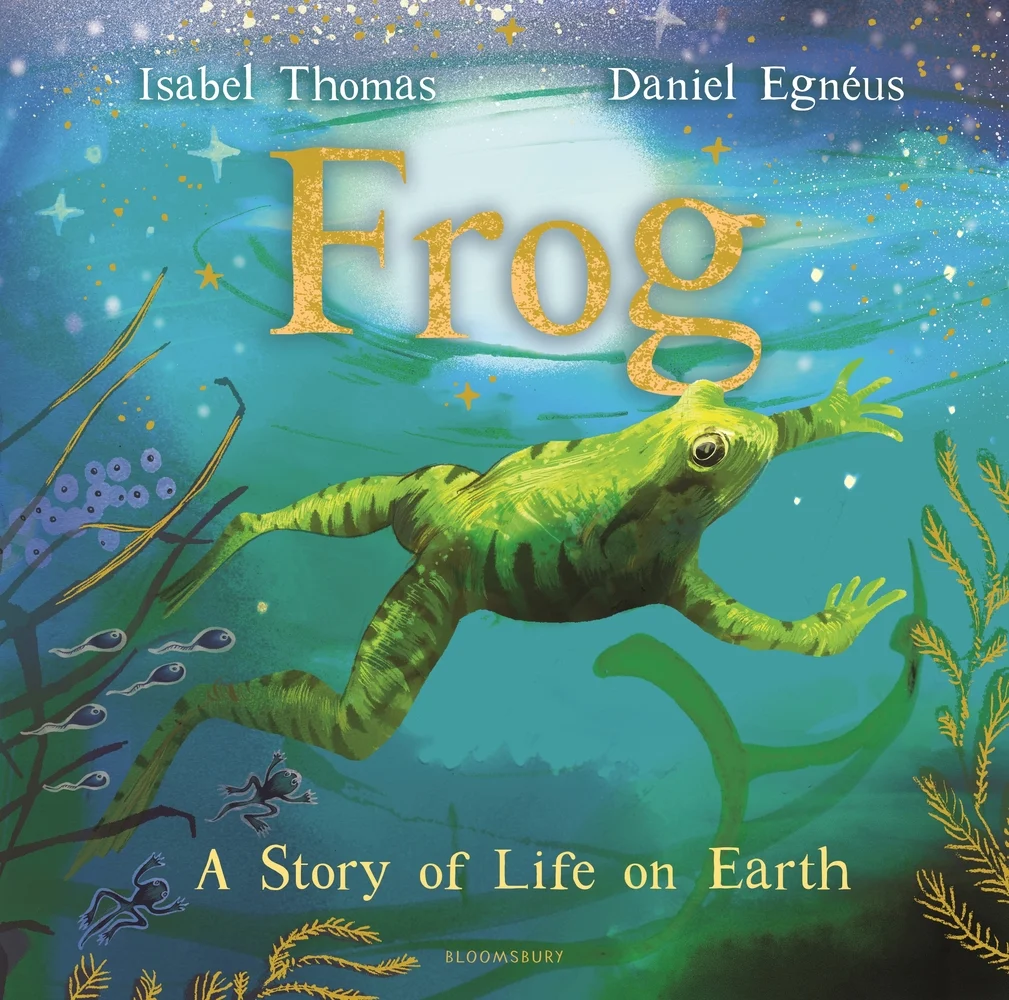
Frog: A Story of Life on Earth by Isabel Thomas, illustrated by Daniel Egnéus

  • Publisher: Bloomsbury Children’s Books
  • Publication Date: January 13, 2026
  • Reviewed from Edelweiss e-galley
  • ISBN: 9781547618200

A child discovers frog eggs in a pond. Eggs will become tadpoles and eventually frogs. But where did the very first frog come from? Well, the picture book merrily takes children way back in time to the Big Bang where the first atoms were just forming. Stars formed and exploded, atoms moving across the universe. 8 billion years later, our solar system formed around the sun. Earth was perfectly positioned to create living things, but it took time. Cells formed, became creatures, lived in water and eventually on land. Amphibians rule the land for 100 million years, evolving and eventually frogs started hopping.

This is the third book by this creative pair, offering a book both about frogs and about the universe and life itself. The text is engaging and interesting as it suddenly veers from pond life to all life and then back again to frogs. It’s a journey in time and space that is definitely worth taking as the book explains the process simply for young children to understand. The illustrations also change from watery blues and greens of frogs and ponds to the dynamic colors of the universe as it is born and grows. 

A book about frogs that hops in new directions. Appropriate for ages 4-7.

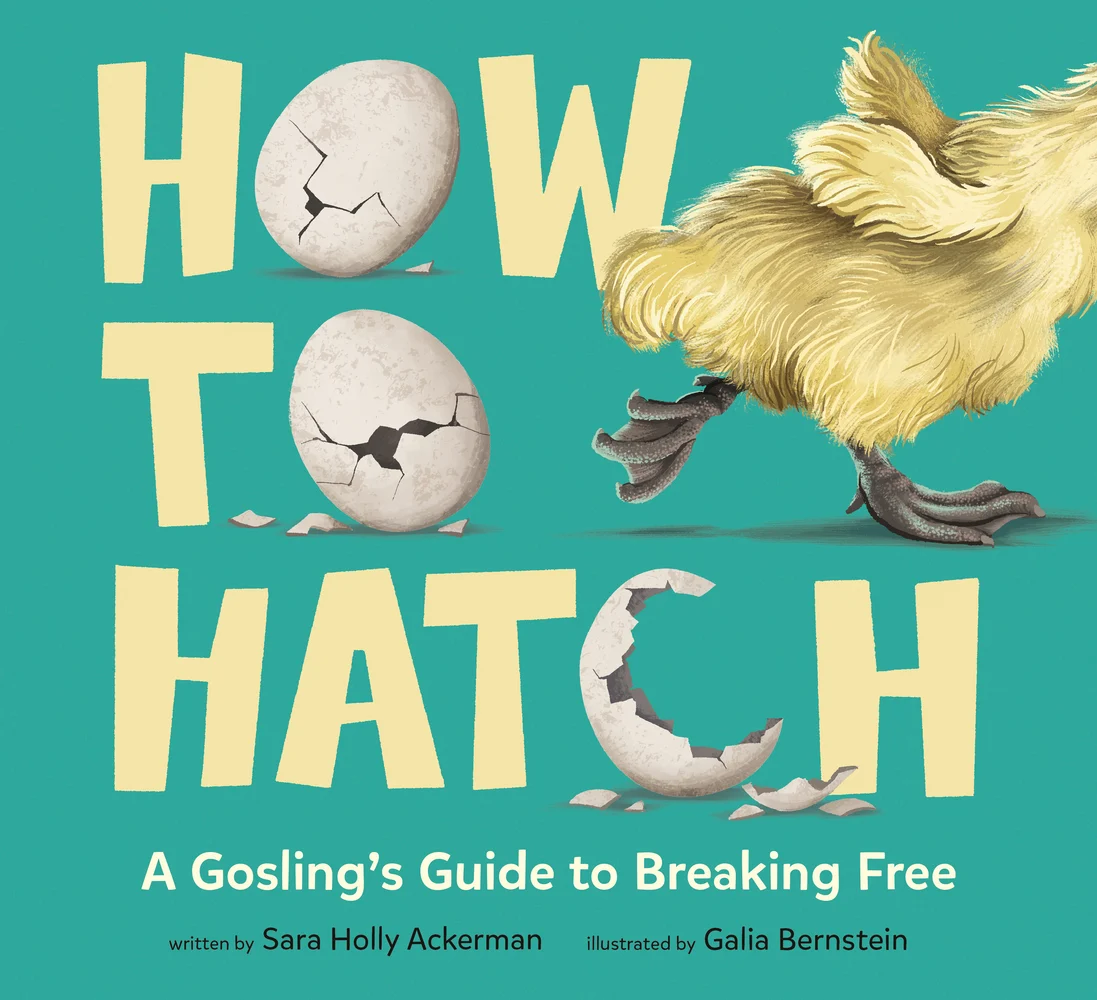
How to Hatch: A Gosling’s Guide to Breaking Free by Sara Holly Ackerman, illustrated by Galia Bernstein

  • Publisher: Knopf Books for Young Readers
  • Publication Date: January 13, 2026
  • Reviewed from Edelweiss e-galley
  • ISBN: 9780593811061

Beginning with a gosling snug in his egg, the book tells it that it is time to hatch! Step one is finding and pricking the air cell in the egg so that the gosling can breathe. Step two is tapping away with its egg tooth to break that shell. Perhaps a quick nap, since that was hard work. Now on to cutting the shell and using wings and legs to exit. Find a warm spot to dry off and then you are set to head out with your mother and siblings. 

Alongside the jaunty hatching story that can be shared aloud, there are in-depth facts on each page turn so that readers can learn more. It’s a great way to share information with children who are interested and still have a fast-paced read aloud for a crowd. The facts are written in an engaging style too, full of answers to natural questions. The art in this picture book is a lovely mix of cartoon and science, making for a book that will show well to a group and also read well snuggled close.

A cracking good book. Appropriate for ages 4-7.

Ergo by Alexis Deacon

Cover image for Ergo.

Ergo by Alexis Deacon, illustrated by Viviane Schwarz (9781536217803)

This philosophical picture book explores one chick’s world. Ergo wakes up not realizing she is inside an egg and thinks that she has discovered her entire world. She has eyes to see, toes that wiggle, wings that flap, a beak to peck and legs that kick. Perhaps, she thinks, she is the world and she had found everything. That’s when she discovers the wall of the egg around her. She pushes the wall, rolls the egg over, and realizes that she can move the entire world! That’s when she feels the bumps coming from outside the egg and realizes that she is not the entire world. Now she must decide whether to leap (or peck) her way into the unknown or stay safe in her small universe of the egg.

Deacon and Schwarz follow I Am Henry Finch with this picture book that plays with Plato. The book works on multiple levels, allowing adults to recognize the philosophy while also really working well as a picture book for young children that asks big questions about our world and our place within the universe. The use of the little chick and an egg serve a clever purpose here. Ergo asks the big questions while the simple style of the writing supports the ideas being shared.

The illustrations are simple and bold. Done in a sunshine yellow, Ergo fills the page. Often surrounded by a cool blue-gray, the illustrations show Ergo and her world, egg-sized and then larger.

Clever and inquisitive, this book will egg on children’s thinking about the world. Appropriate for ages 2-6.

Reviewed from copy provided by Candlewick Press.

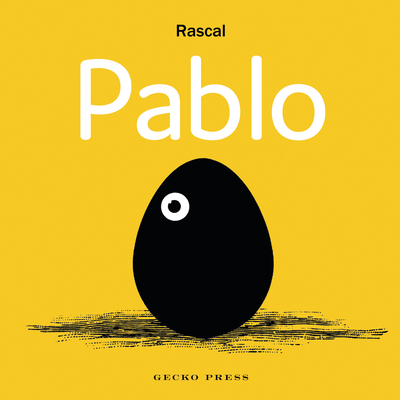
Pablo by Rascal

Cover image.

Pablo by Rascal (9781776573240)

Highly stylized, this picture book focuses on Pablo, a baby bird who is ready to leave the egg. But Pablo is going to do it in his own unique way. After a breakfast of croissant and hot chocolate, he gathers his strength. He is too big for his egg now, so he must break out. First, he creates one hole, just the right size for his eye. He looks all around and then creates a second eye hole so he can really see out. He pecks two holes, one on each side of the shell so that he can hear what is happening around him. Then one hole for his beak so he can smell soil and flowers. The sixth and seventh holes are for his legs so he can wander. Then holes eight and nine are just right for his wings to come out. Pablo is entirely free of the shell, but he saves a piece just in case.

Visually arresting, this Belgian picture book features a pure black egg on a white background. Subtle shading and clouds move past, but the focus and each page center around Pablo himself as he steadily frees himself from the egg shell. The book steadily counts the number of holes that Pablo makes and is marvelously absurd has he continues far longer than most readers might think, staying in the shell and creating holes.

The art is simple and very funny. Perhaps most delightful is the final reveal of Pablo freed from the black egg, looking nothing like what one might have expected.

For the toddler, preschooler or parent who appreciates a bit of the surreal. Appropriate for ages 2-4.

Reviewed from copy provided by Gecko Press.

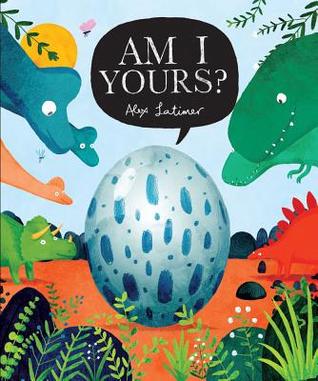
Review: Am I Yours? by Alex Latimer

Am I Yours by Alex Latimer

Am I Yours? by Alex Latimer (9781682630440)

When an egg is blown out of its nest by the wind, different dinosaurs try to figure out who it belongs to. As each kind of dinosaur walks past, the egg asks if it belongs to them. The stegosaurus asks the egg if it has spikes under its shell, but it doesn’t. The brachiosaurus wonders about a long neck. Perhaps it has horns or a crest? Or maybe sharp teeth like the T Rex? But nothing matches what is hidden under the eggshell. When the sun sets though, the dinosaurs can see the silhouette of what sort of dinosaur is in the shell!

Latimer uses rhyme and a strong pattern structure to create a book that will be a winner with dinosaur fans. So many dinosaur books don’t read aloud well, but this one is a treat to share aloud. Latimer’s rhymes are skillfully done, creating just the right rhythm to move the story ahead at a brisk pace. Children who know their dinosaurs will love naming the different kinds and trying to guess what is inside the shell before it is revealed.

The illustrations are just as playful as the story with bright colored dinosaurs of red, green, blue and orange. Done in strong colors throughout, the book has a graphic appeal that will work well when shared with groups of children.

Add this to your next dinosaur-themed storytime. It is sure to please! Appropriate for ages 3-5.

Reviewed from library copy.


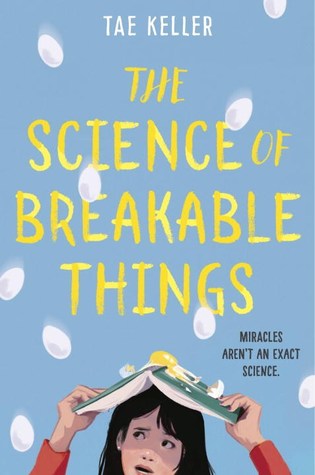
The Science of Breakable Things by Tae Keller

The Science of Breakable Things by Tae Keller

The Science of Breakable Things by Tae Keller (9781524715663)

With Mr. Neely as her very enthusiastic science teacher, Natalie can’t get out of asking a scientific question and exploring it using the scientific method. But Natalie would much rather get answers about her family, about why her mother won’t leave her bedroom anymore and how her father can stop being in therapist mode all the time. So when Mr. Neely encourages Natalie to compete in an egg drop competition, she knows that if they can win, things will change. Natalie’s best friend Twig is on their team, offering creative solutions for the egg drop and they also become friends with the new kid, Dari. As the three become closer, Natalie continues to try to figure out how to help her mother, putting together a plan for the prize money that they hope to win that will inspire her mother and get her back to normal. But life doesn’t always go to plan and neither do science experiments as Natalie soon discovers.

Keller writes with a lovely mix of humor and science throughout this novel. She looks directly at the subject of a parent’s chronic depression and shows the impact of that on a child and a family. Natalie steadily learns to find her voice in the novel and express her own pain about the situation. Science is used throughout the novel as a bridge between people, a way forward and a solution to problems.

Natalie as a character is beautifully conflicted. While she yearns to have her mother back she is also very angry about the situation, something that she has trouble expressing. Even with the friends she has, she worries about Dari joining her and Twig at various times particularly as Twig and Dari seem to have a special connection with one another. None of this is overly dramatized, but feels natural and emerges as convincing times of emotional stress.

Smartly written and filled with glowing characters living complicated lives, this middle grade novel unbreakable. Appropriate for ages 9-13.

(Reviewed from copy provided by Random House Children’s Books.)

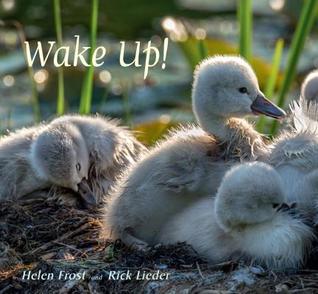
Wake Up! by Helen Frost

Wake Up by Helen Frost

Wake Up! by Helen Frost, photographs by Rick Lieder (9780763681494, Amazon)

This is the fourth collaboration of poet Helen Frost and photographer Rick Lieder. Once again, there is a focus on nature and its wonder. In this book, spring is the subject with new eggs, newly hatched animals, and babies galore. Frost’s poetry is simple and skillful, filled with rhymes and rhythm that carry the book forward inviting investigation. Lieder’s photography is wonderful, capturing that same love of the wild.

Frost’s poetry is particularly deft. She invites readers to explore the outside world, look up into the sky and the trees. She looks below the water and at seeds on the breeze. The photography follows these invitations, capturing eggs, tadpoles and baby deer in their natural habitat. The book ends with more in-depth information on the animals featured in the images.

Another delightful success by this pair, this picture book deserves a place in every library to help celebrate spring. Appropriate for ages 2-4.

Reviewed from library copy.

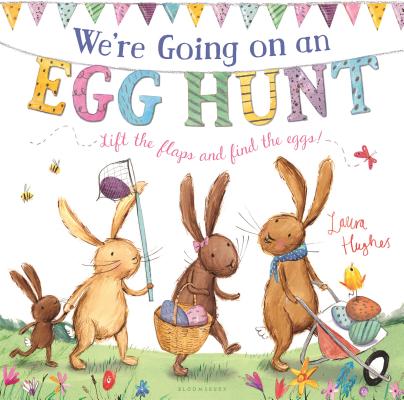
We’re Going on an Egg Hunt by Laura Hughes

were-going-on-an-egg-hunt-by-laura-hughes

We’re Going on an Egg Hunt by Laura Hughes (9781681193144)

This lift-the-flap picture book is a riff on the beloved We’re Going on a Bear Hunt reworked with an Easter theme. Here a family of rabbits head out to find eggs on a lovely spring day. There are ten hidden eggs on the pages and not every flap has an egg hidden behind it. Along the way, the rabbits encounter a series of obstacles and how to navigate things like lambs, bees and ducks. The final very large egg hides a wolf and the rabbits and the reader have to work together to foil him.

Hughes has done a nice job of incorporating the rhythm and structure of the original book into this springy Easter version. Even the obstacles themselves have a springtime theme. The wolf at the end makes for a delightful twist that creates the joy of rushing back through the obstacles in reverse order and returning home just in the nick of time.

The use of flaps is particularly enjoyable when combined with an egg hunt. Children will enjoy lifting the flaps which are fairly sturdy and should survive small hands well. There are surprises underneath some of them and the chance to count upwards to ten as well.

Great for sharing with a small group of children or one-on-one, there will be lots of demand to be the one to lift the flaps because it is such fun. My guess is you will be reading this one again and again. Appropriate for ages 3-5.

Reviewed from copy received from Bloomsbury.

Egg by Kevin Henkes

egg-by-kevin-henkes

Egg by Kevin Henkes

Henkes returns with another winner of a picture book. This time he uses a graphic novel format ideal for preschool picture book fans. The book is utter simplicity, using repetition to show each of the four eggs: one pink, one yellow, one blue and one green. At first they are whole, then three begin to crack. Soon three chicks have emerged! Still, the green egg stays whole and quiet. There is lots of waiting and the three chicks return to help the final egg start cracking open. Then they are the ones who get a surprise when the egg hatches!

Simple and completely wonderful, this picture book graphic novel is great fun to read. Children can help by repeating the phrases the right number of times along with the adult reader. There is a lovely rhythm created by the repetition, almost swinging along with the beat. The limited vocabulary is also welcome for new readers.

The art by Henkes stays simple as well. With firm lines and soft pastel colors, the book is ideal for springtime (or those of us dreaming of spring). Even the illustrations get in on the repetition, using similar panels to repeat as the different eggs wait, hatch and then wait once more.

Clever and warm, this is a very welcome addition for emergent readers and springtime story times. Appropriate for ages 2-4.

Reviewed from copy received from HarperCollins.


Review: Mother Bruce by Ryan T. Higgins

Mother Bruce by Ryan T Higgins

Mother Bruce by Ryan T. Higgins (InfoSoup)

Bruce is a bear who likes very little in life. But he loves eggs. He finds complicated recipes on the internet that he tries out. When he discovers a recipe for goose eggs, he immediately heads into the forest to source the items. Back home, he puts the eggs in water but then has to run out for firewood. Returning home, he finds that the eggs have hatched into four goslings. He considers eating them with butter, but loses his appetite. He tries to return them, but Mother Goose has left for the winter. So he is stuck with the four little goslings who follow him everywhere. He tries to make the best of it, but it’s very challenging for one grumpy bear to suddenly be a mother to four little birds.

Higgins has created a laugh-out-loud funny picture book about a bear who finds himself unable to say no to parenting four goslings. The humor is wonderfully silly, from the way that Bruce “shops” and “locally sources” his ingredients in the forest to the attempts to get the geese to migrate south. The book shows that this grumpy bear has a heart of gold as he cares deeply for the geese and allows his entire life to be changed by them without getting overly mushy at all. The ending too was a surprise, one that fits perfectly but I didn’t expect at all.

A lot of the humor of this picture book is carried in its illustrations which have a real attitude of their own and a point of view. Readers will fall for Bruce despite his grumpiness thanks to the illustrations alone. The little goslings too are a delight as they imitate Bruce, drape themselves around, and explore the world. The illustrations of the goslings as teens is perfection.

Funny, perfect to read aloud, and a surprise of an autumnal read, this picture book is great fun. Appropriate for ages 3-5.

Reviewed from library copy.