Review: P. Zonka Lays an Egg by Julie Paschkis

p zonka lays an egg

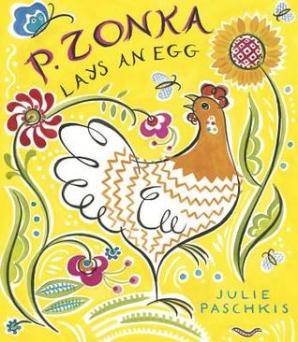
P. Zonka Lays an Egg by Julie Paschkis

P. Zonka isn’t like the other chickens on the farm. The other chickens lay eggs each and every day, but P. Zonka never lays a single egg. She’s busy walking around the farm noticing nature and the beauty of flowers and moss. The other hens call her lazy, but she doesn’t pay them any mind. Finally, after they cluck at her for a long time, P. Zonka agrees to try laying an egg. After clucking and delays, she lays an egg that isn’t anything like the brown and white eggs the other hens lay. P. Zonka’s egg is spectacular and shows in colors and design all of the beautiful things she has been seeing in nature. P. Zonka’s eggs are art, pure and simple.

Paschkis takes her inspiration from Ukrainian eggs designed with bright colors and intricate designs. A Ukrainian decorated egg is called a pysanka, giving P. Zonka her unique name. The story is written with the rhythm and structure of a traditional folktale. The complaining hens and rooster create the chorus of the book, the repetitive feature. This more formal structure contrasts wonderfully with P. Zonka’s daydreaming and wandering. Those parts of the book are filled with her descriptive words and the pacing shifts and changes.

Paschkis carries her Ukrainian inspiration directly into the art in the book, filling it with the colors and shapes of traditional art. The bright yellows, deep reds, clear blues and crisp greens echo the traditional art as do the sweeping lines and free flowing plants. Yet this is distinctly modern too with the lines having a looser feel and the animals feeling more life like.

This book is a winning blend of traditional and modern, folktale and new story. Appropriate for ages 4-6.

Reviewed from library copy.

Review: Oliver and His Egg by Paul Schmid

oliver and his egg

Oliver and His Egg by Paul Schmid

Oliver from Oliver and His Alligator returns in a second book.  While on the playground, Oliver finds an egg, really a large smooth rock, that he imagines will hatch into a big orange-polka-dotted dinosaur.  He would have a new friend and they would go on adventures together.   As Oliver dreams of their adventures, the other children find that he is sitting on the “egg” waiting for it to hatch.  So he tells them of his enormous dinosaur-sized dream and they all have to find eggs of their own.

Schmid’s picture book is simple and cheery.  Oliver is a creative little boy, inventing his own worlds.  The book also shows that all children can be creative and use their imaginations.  Just as in the first book, the text is minimal, offering less than a sentence on each page.  It suits a book that is about imagination to have so much left unsaid.

The illustrations are simple too.  Clearly drawn characters are done in simple lines with small touches of color.  They are combined with the rock “eggs” that are photographed stones, giving them a weight that the light illustrations don’t have.  It’s a dynamic combination on the page.

A cheerful follow-up picture book, this second outing for Oliver is great fun for toddlers.   Appropriate for ages 2-4.

Review: Mama Built a Little Nest by Jennifer Ward

mama built a little nest

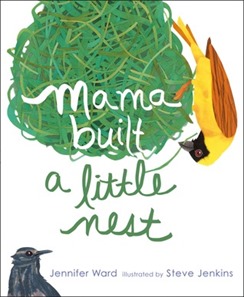
Mama Built a Little Nest by Jennifer Ward, illustrated by Steve Jenkins

Told in rhyme, this book explores the many different ways that birds create nests for their eggs and babies.  The jaunty rhyme is accompanied by informational text on each species and their habitats and nest building style.  Bird species range from penguins to falcons to flamingos.  There are also more unusual birds like weaverbirds as shown on the cover of the book. 

Ward’s rhyme works well here, offering a playful feel to a book filled with scientific information.  She has also selected a great mix of species with familiar birds mixed in with more exotic ones.  Each has its own unusual way of creating a nest, making this a book where turning the page is part of the adventure.

As always, Jenkins’ cut paper art is spectacular.  He manages to create so much life with textured paper and different colors.  From the subtle colors of a cactus plant to the feathers on an owl’s wing, this art is lovely and makes this book very special.

Intelligently and beautifully presented, this nonfiction picture book will entice young readers to learn even more about birds.  Appropriate for ages 5-8.

Reviewed from copy received from Beach Lane Books.

Review: I Hatched! by Jill Esbaum

i hatched

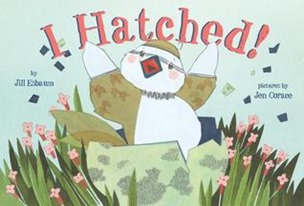
I Hatched! by Jill Esbaum, illustrated by Jen Corace

An exuberant chick hatches from an egg and merrily dashes through his first day in this spring picture book.  The chick quickly discovers that it has long legs and can really run.  While running, he discovers a frog, water, worms and many other things in his environment.  He learns to sing as well as poop as his day continues.  In the evening after returning to the nest, he gets a surprise when another egg cracks open.  Now he can be the expert and show his new sister everything!  Maybe.

This book is pure bottled joy.  The little chick is wildly positive and vivacious.  He captures the delight of babies in their world and invites readers to see things with fresh eyes as well.  Esbaum makes it clear that he is a killdeer with his long legs, his song and the way he acts.  It’s a pleasure to see a book about a bird in a nest on the ground, running fast that is not about learning to fly but more about being an individual and safely learning new things.

Corace’s illustrations reflect the same cheery delight.  They celebrate the little bird’s markings, the challenge of hatching from an egg, and happily show all that he explores in his first day.  They have a lightness and humor about them too.

Toddlers will enjoy this book that mirrors their own enthusiasm.  Perfect for spring story times with little ones.  Appropriate for ages 1-3.

Reviewed from copy received from Dial.

Review: Goose the Bear by Katja Gehrmann

goose the bear

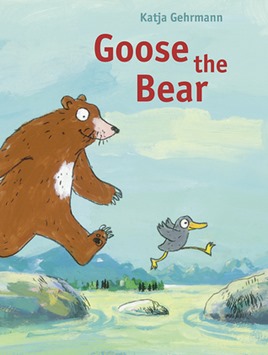
Goose the Bear by Katja Gehrmann

In a Canadian forest, Fox stole an almost-hatched goose egg, planning to eat roast goose very soon.  But he is so proud of himself that he forgets to watch where he’s going and runs right into Bear.  Bear picked up the egg from the ground after Fox ran off and wondered what it is.  Then the gosling hatched and called him “Mama!”  Bear tried to explain that they were not the same type of animal, but the gosling did not understand.  So Bear decided to show the little goose just how different they were.  Bear demonstrated how well bears climb trees, but the gosling could reach the top too.  Bear showed how fast bears can run, but the little goose ran just as quickly.  Finally, Bear jumped in the river and the little goose followed him in.  Then Bear got very worried.  Would the little creature survive the fall into the water?

Gehrmann has created a picture book that stands out from the many books about foxes chasing smaller animals.  Her addition of a bear as a main character adds a clever twist and throughout the book she continues to surprise the reader.  The writing has been done to create a read-aloud that will also keep young readers guessing about what is going to happen next.  With the theme of a tiny creature who can do just what a big bear can do, this book has strong kid appeal.

The premise of the book is quite unique and so is the artwork.  First published in Germany, the book has a European feel, particularly in the art.  It is humorous and bold with changing colors throughout.  Gehrmann’s depiction of the natural world around the characters is particularly rich and layered.

Fresh, vibrant and full of fun surprises, this book is an exceptional take on fox and goose (and bear) stories.  Appropriate for ages 4-6.

Reviewed from library copy.

Review: Nest by Jorey Hurley

nest

Nest by Jorey Hurley

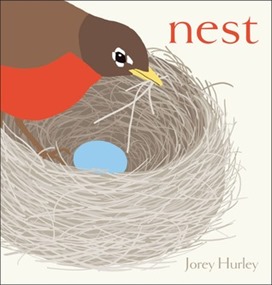
This simple and elegant picture book takes a look at a year in the life of a robin.  It begins with an egg in a nest and two proud parents.  By the next page, the egg has hatched into one very hungry baby bird.  As the tree flowers, the little bird is fed by its parents.  Then comes the first flight as a speckled robin chick.  There are berries on the tree to feast on and when autumn comes the green leaves have turned orange and yellow and started to fall.  The last of the berries are eaten while snow flies in the sky.  As spring returns, the young robin meets another young robin and they build their own nest together.  All of this is told in images since the text of the book is simple single words on each double-spread picture.  This is a beautiful and impressive book for the youngest children.

Hurley’s illustrations are strong and clear.  Done in PhotoShop, the illustrations have the feel of cut-paper collage in their simplicity.  They will project well to a group of children.  The storyline is far more than the words on the page, and children will want to discuss what is happening throughout the book. 

A wonderful pick for spring units, this book is a celebration of nature and seasons.  Appropriate for ages 1-3.

Reviewed from copy received from Simon & Schuster.

Review: Ten Eggs in a Nest by Marilyn Sadler

ten eggs in a nest

Ten Eggs in a Nest by Marilyn Sadler, illustrated by Michael Fleming

Released January 28, 2014.

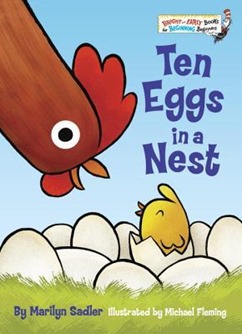
Gwen the Hen laid eggs and Red Rooster was very excited to be a father.  Gwen refused to let him count the eggs before they hatched because it was bad luck.  So Red just had to wait.  When one egg hatched, he marched off to the market to buy the new chick one worm.  But when he returned home, there were two more new chicks!  He hurried back to the market after adding 1+2.  Then when he returned there were three more chicks.  1+2+3=6 newly hatched chicks and off Red hurried.  I bet you can guess what happened next!

This beginning reader nicely mixes counting and addition into the story.  Young readers will enjoy the bustling pace of the book and the tension of what Red will find upon his return to the nest.  The entire book has a warmth and sense of community that is tangible.  Simple text includes lots of numbers and remains simple for new readers throughout.

Fleming’s art is cartoon-like and very child friendly.  The colors pop on the white backgrounds, especially Red who is really a rainbow of colors including orange, purple and blue.  The oval chicks are bouncy and cute as can be. 

To sum it up, this is a great “addition” to new reader collections.  Appropriate for ages 4-6.

Reviewed from digital galley received from Edelweiss and Random House.

Review: Hank Finds an Egg by Rebecca Dudley

hank finds an egg

Hank Finds an Egg by Rebecca Dudley

This debut picture book started life as a self-published work.  As such, it was the cream of the crop, because it is also one of the best wordless picture books of the year, bar none.  Hank is a little bear, or some sort of bear-like creature, who happens upon an egg on the ground in the forest.  Looking around, he locates the nest that it must have fallen from, but even though he tries several different ways, is unable to reach the nest to return the egg to safety.  Night falls and Hank keeps the egg warm at his campsite all night long.  In the morning, he returns to the nest and finds the mother bird there.  An ingenious solution gets the egg up to the nest and before long, Hank is rewarded for his kindness. 

This wordless picture book has a charm that is hard to put into words.  Dudley has handcrafted all of the items on the page, from the brown leaves that blanket the floor of the forest to the unfurling green fronds of fern that add to the hopeful feeling of the book to Hank and the trees that surround him.  All are photographed with a great sense of detail and also a wonderful depth of field that make it all seem real and true. 

Beautiful and charming, this little book is sure to become a favorite.  Time to curl up with your own little bear and enjoy.  Appropriate for ages 2-4.

Reviewed from library copy.

Review: What Will Hatch? by Jennifer Ward

what will hatch

What Will Hatch? by Jennifer Ward, illustrated by Susie Ghahremani

This simple little book builds tension through the use of a guessing game and the wonder of waiting for an egg to hatch.  On one page, the habitat and a little description of the eggs are given, with the question of “What will hatch?”  Take a guess, turn the page and find out the answer.  There are lots of surprises along the way.  The clever use of die cuts in the pages that peek through in egg-shaped holes adds to the fun.

Eight different animals are shown here with basic information.  Nicely, there is more information at the end on each of the animals as well as information on chicken egg development.  Ward’s text is particularly simple, just a few phrases with a skip of repetition.  It is the illustrations here that really make the book.  Done in gouache on wood, the images have a lovely texture to them that combines beautifully with the swirling nature of the art.  The texture also reinforces the natural subject matter in a subtle way.

A great pick for toddlers, this book  will keep them guessing as the pages turn.  Expect to have to share it again and again.  Appropriate for ages 2-4.

Reviewed from library copy.