Review: The Conductor by Laetitia Devernay

conductor

The Conductor by Laetitia Devernay

This wordless picture book is tall and narrow, just like the trees featured within.  A man enters a forest of trees that are shaped like lollipops with long trunks and round tops.  He climbs to the very top of one tree and raises his hands.  Suddenly, birds start to appear, formed from the leaves of the trees.  They fly off leaving holes in the tree leaves shaped like them.  The leaf patterns are on their wings and they fly above the conductor in a variety of formations.  Until eventually they are gone, and all that are left are the blank trees.  The man climbs down and plants a seed that quickly grows into a tree.  As he is planting, the birds return to the trees, covering them once again in leaves.  The man leaves the forest just as he has found it, but with one more small trees.  It’s a beautiful look at the environment and the impact humans can have if they choose.

The art here is wonderfully done.  It has a limited palette of just yellow, green, black and white.  The juxtaposition of tree leaves and flying birds is spectacular visually and surprising at first.  It lifts the book to a more surreal place, a world where you are unsure what could possibly happen next.  The fine lined art, the scale of the book and the gentle theme all work well together, creating a memorable whole.

A surprising wordless picture book that is a work of art, this book would work well in art curriculum or as a quiet, beautiful book to share.  Appropriate for ages 3-5.

Reviewed from copy received from Chronicle Books.

Review: The Cloud Spinner by Michael Catchpool

cloud spinner

The Cloud Spinner by Michael Catchpool, illustrated by Alison Jay

This is the story of a boy who could weave cloth out of clouds.  The color of the thread would change throughout the day, as the clouds’ colors shifted with the changing light.  There was gold in the morning, white in the afternoon, and crimson in the evening.  The boy had learned from his mother to only use as much as he needed, nothing more.  But when the boy’s amazing scarf caught the eye of the king as he rode through town, the boy was ordered to create a scarf for the king.  The king was pleased with the scarf and immediately ordered the boy to create a cloak and also dresses for the Queen and the Princess.  The boy spun and spun, pulling the clouds from the sky until there were no clouds left at all.  Then the rain stopped falling and a terrible drought hit the country.  It will take two children to figure out how to fix it.

Catchpool has written a very enjoyable tale with a strong environmental heart.  The story is structured as a traditional folktale, rather than a modern one.  It has lines that repeat, a medieval setting, and the play of rich and powerful against poor subjects.  The book reads aloud well, thanks not only to the structure, but also to the writing being clear yet filled with lovely little details such as the colors of the thread from the clouds.

Jay’s illustrations are done in her signature crackle glazed style.  That lends a sense of history and time to the entire work.  Her pictures are filled with light and color.  Keep an eye out for the smiling hills that dot the countryside, a jaunty little touch.

A timely picture book about conservation, the environment and using just what you need and no more, this picture book would make a great addition to Earth Day or green programming.  Appropriate for ages 4-6.

Reviewed from copy received from Alfred A. Knopf.

Review: The Humming Room by Ellen Potter

humming room

The Humming Room by Ellen Potter

When Roo’s parents are murdered, it’s her ability to hide that saves her, as she retreated to her favorite spot under their trailer.  There she can look at the items she has “collected” or stolen, and she can press her ear to the ground to hear the tiny movements of animals, worms and roots.  After spending some time in foster care, Roo is taken to live on an island with her wealthy uncle who looks very similar to Roo’s father but with none of the carefree spirit her father had.  The island is on the St. Lawrence and the house used to be a tuberculosis sanatorium.  Now Roo is left there with little attention from her often-away uncle, and two servants.  The island is filled with life, including tantalizing glimpses of a wild boy who seems to live on the river.  Roo has to discover the truth of the strange house and the many secrets it holds.

Potter has stated that this is a novel inspired by The Secret Garden, and readers familiar with that work will definitely see it woven into this story.  At the same time, this book stands on its own beautifully.  It is a delightful blend of character and setting.  Roo is a prickly child, one who would be difficult to relate to except for her connection to nature.  That small piece of her character alone makes her human and accessible for the reader.  She is also prickly for very good reasons, including her parents’ death but also her misery of a life before their death.  The reader understands Roo deeply.   The secondary characters are all quirky and fascinating as well, especially the wild boy.

Then there is the setting.  Potter brings the St. Lawrence, the island, and this house to life.  This story could not be set anywhere else, as the setting is so closely married to the story.  The river is a large part of the book, including Roo’s growing understanding of its moods and the isolation of the island.  The house is central to the story as well, brooding and huge, its very walls hiding secret doors to wonders.  Then there is the garden itself, because of course there is a secret garden, and its rebirth that echoes Roo’s. 

Haunting and lovely, this book unfolds like the petals of a flower as each new discovery is made.  Environmentalism permeates the book in a gentle, green way that leaves readers wanting to connect with nature and preserve it without ever being preached to about the issue.  This is a delicate, wondrous read that is sure to be a hit with fans of The Secret Garden or those of us who are already fans of Ellen Potter.  Appropriate for ages 9-12.

Reviewed from copy received from Feiwel & Friends.

Review: The Camping Trip That Changed America by Barb Rosenstock

camping trip

The Camping Trip That Changed America: Theodore Roosevelt, John Muir, and Our National Parks by Barb Rosenstock, illustrated by Mordicai Gerstein

Teddy Roosevelt and John Muir had little in common growing up except for one thing: they both loved the outdoors and the wilderness.  So in 1903, when President Roosevelt read a book by John Muir that pleaded for people to save the trees, he couldn’t stop thinking about losing all of the trees in the mountain forests.  Roosevelt set out to meet with Muir in Yosemite.  After a few pictures, the two men rode off together with no entourage or photographers along.  Roosevelt got to see the giant sequoias, listen to Muir’s stories, see valleys carved by glaciers, and awaken under inches of snow.  Together the two men dreamed a new dream for the United States and its wild areas, one where they were protected for generations to come.

Rosenstock tells this story with a wonderful joy that permeates the entire work.  She captures the differences between the two men clearly but binds them together through their love of the outdoors.  The natural parts of the story are also captured in imagery and distinct moments where the men connect with each other and with the wilderness itself. 

Gerstein’s illustrations have a depth to them that nicely captures both the men and the natural beauty.  The quiet of Roosevelt’s life is shown in deep colors and stillness.  It contrasts powerfully with the blues, golds and greens of the natural world that is light filled and also full of action. 

This is a celebration of two men and the difference they made in our lives by creating the National Parks.  It is also an invitation to head out and explore the parks for yourself, looking for your own moments of connection to the wilderness.  Appropriate for ages 7-10.

Reviewed from copy received from Dial Books.

Book Review: The Mangrove Tree by Susan L. Roth

mangrove tree

The Mangrove Tree: Planting Trees to Feed Families by Susan L. Roth and Cindy Trumbore

This book tells the true story of Dr. Gordon Sato in picture book format.  The village of Hargigo in the African country of Eritrea was dry and the animals could not find enough to eat.  Dr. Sato had the idea of planting mangrove trees on the shore of the salty Red Sea.  The trees can survive the salt and would give women in the village a way to earn money close to home from planting the trees.  The trees also help by giving off oxygen too.  The goats and sheep ate the leaves from the trees and grew stronger, living longer and having healthier babies.  The mangrove trees also changed the habitat along the shore, creating hiding places for sea creatures that helped the fish grow larger and the fishermen improve their catch.  This is the story of Dr. Sato, who through science changed the lives of people not only in Hargigo, but around the world.

Trumbore has written a clever dual story here.  On one side of the page, a simple cumulative story is told of the mangrove trees by the sea.  On the other side, readers get much more detailed information about the science and impact of the planting of the trees.  Finally, at the end of the book, readers can see photographs of the actual villagers, the trees and Dr. Sato. 

Roth’s illustrations are eye-catching and inventive.  Using collage, she has created such texture, color, and natural feel.  Her illustrations have depth, showing the people at work, giving individual coats to the sheep and goats, and celebrating the bright colors the people wear.  It is a very rich illustration that celebrates the setting and the work that went into the project.

Highly recommended, this book is a beautiful mix of nonfiction and picture book that is ideal for elementary science about the environment.  It celebrates the impact that one man can have on the world, inspiring youth to think about what they can contribute too.  Appropriate for ages 5-8.

Reviewed from library copy.

Also reviewed by BookDragon.

Book Review: All the Water in the World by George Ella Lyon

All the Water

All the Water in the World by George Ella Lyon and Katherine Tillotson

“All the water in the world is all the water in the world” is the sentence that starts this picture book.  It tells the story of water through a poem, explaining where water comes from, the water cycle, and the importance of water for life on earth.  This is a celebration of water, from the puddles on the ground, to the grand storms, to the rivers and the clouds. 

Lyon’s words match the subject matter, which is delightful.  They drip from faucets steady and slow, they clump as clouds and fall as rain, they flow and dance.  Throughout the poem, the reader is referred to as “honey” which gives the poem a personal and homey feel where it could have been cool and remote.

Tillotson’s illustrations are done digitally and have the feel of watercolor mixed with collage.  Natural splashes of color mix winningly with straight edges.  The illustrations of the desert are also very successful, offering a clear contrast from the blues of water with the yellows of sand. 

Celebrate water and the environment with this refreshing book that explains the science clearly and also lifts it into poetic beauty.  Appropriate for ages 4-6.

Reviewed from copy received from Atheneum Books.

Also reviewed by

Book Review: Dorje’s Stripes by Anshumani Ruddra

dorjesstripes

Dorje’s Stripes by Anshumani Ruddra, illustrated by Gwangjo and Jung-a Park

In a small Buddhist temple in the Himalayas, the monks have an unusual visitor, a Royal Bengal tiger named Dorje.  Dorje is very unusual himself, because his coat has no stripes.  In the two years since he arrived at the monastery, they disappeared one by one.  One evening, the youngest monk noticed that Dorje had one stripe again!  One of the monks tells the story of when he entered Dorje’s dreams and saw that as Dorje lost each stripe, a tiger had died.  Now there was a new tiger in the wilderness, a female tiger, who seemed to have taken a liking to Dorje.  Soon perhaps, his coat will fill again with stripes.

Inspired by the tragic loss of tigers in India, this story vividly tells of the loss in a way that children will easily relate to.  The story is quietly told through Dorje himself and the voices of the monks.  It is a story that speaks gently about horrors beyond children’s comprehension, making them tangible and understandable. 

Ruddra’s tone is one of respect and awe for this creature.  He takes his time to tell the story to its fullest, offering inspiration along the way.  The illustrations are glowing with bright colors that capture the coat of Dorje and the world of the monastery.  The watercolors have been allowed to bleed a bit, creating auras around things.  At other times, the painting is tight and controlled.  The two play against each other, showing the wild next to the tame.

This is a lovely and inspiring book about threatened species.  It captures the plight, the loss and the recovery in one beautiful story.  Appropriate for ages 5-7.

Reviewed from copy received from Kane Miller EDC Publishing.

Book Review: Meadowlands by Thomas Yezerski

meadowlands

Meadowlands by Thomas F. Yezerski

This nonfiction picture book tells the story of the history of the wetlands that are now known as the Meadowlands in New Jersey.  From hundreds of years ago, when the wetlands had 20,000 acres of marshes through to the 1800s when the land was drained and filled in with dirt to the 20th century when the industries came to surround the Meadowlands with their factories.  The wetlands were used as a garbage dump, filled with waste and filth.  It became a problem area in New Jersey until the state decided that it needed to be cleaned up.  By 1985 with the clean up and then the developers, there was less than 7000 acres of wetlands left.  But the wetlands began to recover, with time the lack of pollution and the rivers and tides cleaned the water and allowed plants, birds, fish and animals to return.  This is a celebration of wetland recovery and the strength of the ecosystem as well as a stirring call to action.

Yezerski offers just the right amount of information here for an elementary-aged audience.  From the brief history of when the wetlands were unchanged, readers see how steadily the impact of humans deteriorated the size and quality of them.  The garbage portion of the story is startling, stark and brief, indicating the small amount of time it took to do such extensive damage.  When the book turns to the recovery of the Meadowlands, the tone lifts and the text turns to celebrating the nature returning to the area.

The pages of the book are bordered with objects pulled from that illustration.  So the two-page spread of the 1800s is bordered with a knife, musket, scythe, trap, kettle, muskrat and more.  This adds to the feeling of time changing and the area changing along with it.  The watercolor illustrations are often looking at the wetlands from above, showing the devastation and changes.  Beautifully, as the wetlands recover, the illustrations become more close and intimate with the wetlands and the animals.

Get this one on your elementary nature and ecology shelves.  It is a readable and very successful look at wetland renewal for children.  Appropriate for ages 7-10.

Reviewed from copy received from Farrar, Straus & Giroux. 

Family Pack: Poetic Nature

familypack

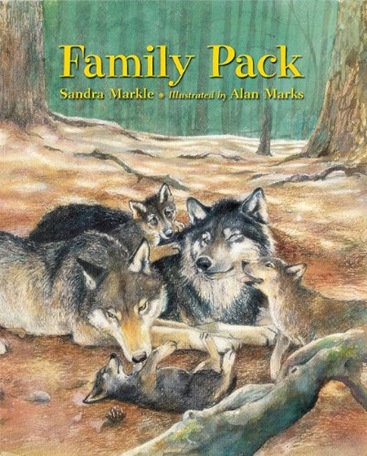
Family Pack by Sandra Markle, illustrated by Alan Marks

This book captures the real-life story of wolves being reintroduced to Yellowstone National Park.  The focus of the story is one young female wolf who finds herself suddenly separated from her pack and alone in a new place.  Her tracks are the only wolf tracks she sees, she is the only wolf she smells.  Without a pack, she cannot hunt the way she is used to, so she survives mostly on mice.  As she becomes an adult, she discovers another wolf, a male.  The two of them become a mated pair and eventually have a family in Yellowstone.  One lone wolf has created her own pack.

Markle’s verse in the book really shines, illuminating the loneliness of this young wolf’s new life, her troubles with hunting larger game, and her growth into an adult wolf.  The poetry is filled with imagery that enlivens the book, making the cold and loneliness tangible to readers. 

Marks’ illustrations are equally successful.  He captures the setting beautifully from the towering trees to the wide open spaces.  In his illustrations, Yellowstone becomes just as real as the wolf herself, almost another character in the story.  The vistas and close-ups he has created here give readers a very unique perspective on the life of this wolf.

Highly recommended, this book will work well for slightly older children because of the depth of the verse.  It will work well in units about preservation and ecology.  Appropriate for ages 6-8.

Reviewed from copy received from Charlesbridge.