Review: Eye Spy: Wild Ways Animals See the World by Guillaume Duprat

Eye Spy Wild Ways Animals See the World by Guillaume Duprat

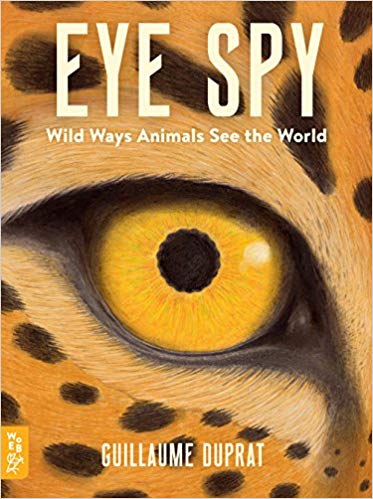
Eye Spy: Wild Ways Animals See the World by Guillaume Duprat (9781999802851)

This science-focused nonfiction picture book takes a close look at animal eyes and the ways that different animals see the world. Incorporating flaps to lift, readers can lift the eyes of the animals on the pages to see the way that they do. What does it look like to only see things clearly that are a few inches away? How does it change things to only be able to see three colors instead of five? What happens when a bird can see all the way around in a 360 view? How do insect eyes work to form a full image of what they are perceiving? All of these questions and more are answered in this engaging nonfiction picture book.

Beautifully designed, this picture book offers an engaging format combined with fascinating facts. While reading about how other creatures see the world is interesting, being able to actually see what that means in a visual way is incredible. The book includes mammals like cats, dogs, horses, and cows and then moves on to other types of animals like reptiles, insects, and birds. Each page turn brings a new animal with a new flap to peek behind.

The art here is vital. The flaps to lift offer a hidden view into the way these animals perceive the world. The art invites us to look right at the creature and then look at the world through their eyes. It is beautifully done, with all of the animals looking at the same scene so that readers can see the differences clearly.

An eye-opening look at the science of vision and animal eyes. Appropriate for ages 5-9.

Reviewed from copy provided by What on Earth Publishing.
Review: The Queen’s Shadow by Cybele Young

queens shadow

The Queen’s Shadow by Cybele Young

Released March 1, 2015.

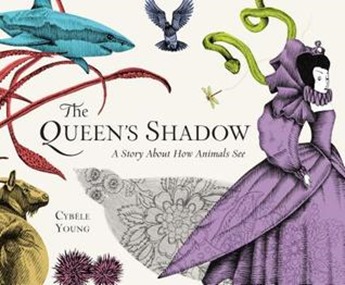
This fascinating and unique nonfiction picture book takes a mystery and turns it into information about how various animals see.  At the Queen’s Ball, several different animals have gathered.  Then there is a flash of lightning and a moment of darkness.  When the lights come back on, the Queen’s shadow has been stolen!  Who stole it and how can they prove it?  One by one, each animal offers testimony to what they witnessed “colored” by the way they are able to see the world.  There are the eyes of the chameleon who can look in two directions at once but only shoot out his tongue when both eyes are focused on the same thing.  The shark excels at seeing contrast more than anything and notices patterns of light and dark. Pit viper sees in heat and cool. Dragonfly offers perspective from compound eyes. It will take each of their ways of seeing the world to solve this mystery. 

Young creates an entirely abstract and amazing world here. There is a strong sense of decorum throughout the book, no animals attacking each other and the human queen unafraid of any of her more predatory guests. She combines information for the mystery about what was witnessed through that specific set of eyes and then shares strictly scientific information in offset text boxes too. The result is a book that keeps you turning pages not only to solve the mystery but to continue seeing the world in such unique ways and learning more.

The illustrations have a feel of vintage illustrations with finely detailed ink drawings washed with color. This style is reworked though when seeing through other animals’ eyes so that with each turn of the page, the art is ever-changing and fascinating.

Peculiar in a delightful way, this nonfiction picture book is one that will appeal to children wanting to “see” more of the natural world.  Appropriate for ages 6-9.

Reviewed from digital galley received from Netgalley and Kids Can Press.

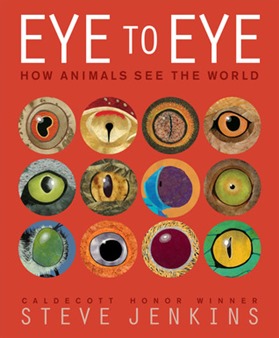
Review: Eye to Eye by Steve Jenkins

eye to eye

Eye to Eye: How Animals See the World by Steve Jenkins

Explore different types of animal eyes in this gorgeous nonfiction picture book by the amazing Steve Jenkins.  In this book, Jenkins not only talks about the different kinds of animals eyes, explaining them in just the right amount of detail, but also looks at specific animals and their unique eyes.  Jenkins shares lots of facts, carefully chosen to be fascinating and fun.  One never knows what will be found on the next page and whether it will be looking right at you.

Jenkins makes sure that children will learn about evolution in this picture book.  His emphasis throughout is on the evolution from simple light-sensitive eyespots to the complex camera eyes of humans and hawks.  As always, his information is well-chosen and interesting.  It is accompanied by large-format images that are paired with smaller images that show the animals entire body.  This is science information at its best.

The eyes have it!  This is a book that belongs in all public libraries.  Appropriate for ages 6-9.

Reviewed from library copy.