Review: Goldilocks and the Three Dinosaurs by Mo Willems

goldilocks and the three dinosaurs

Goldilocks and the Three Dinosaurs by Mo Willems

Willems never seems to miss with his books and this one is a real treat.  Think of chocolate-stuffed little girl bonbons sort of treat!  Here the story of Goldilocks and the Three Bears is changed so that you have three dinosaurs instead.  But there’s another really big difference, the three dinosaurs are most certainly NOT setting a trap for Goldilocks.  And those three huge bowls of chocolate pudding are just a coincidence, as well as the open front door.  The ladder to help her reach the pudding is not part of the trap either.  All of those noises in the woods are also not dinosaurs arguing about when to pounce, they are the wind.  Even Goldilocks, who never notices anything, starts to realize that something odd is going on in her story, but not before the trap is sprung!

The tone of this book is really what makes it work so very well.  It’s the narrator explaining what is happening by using a sarcastic tone and explaining what is not happening.  Thanks to the tone, children will immediately understand that something is afoot, though the book is insisting that nothing at all is wrong.  It’s a delight to read aloud, because as always Willem’s books have the perfect pacing for sharing.

The illustrations are classic Willems as well.  Pigeon and Piggie would be right at home in these pages too.  The illustrations too have small touches.  Make sure you read the welcome mats and the end pages. 

Another fantastic read from Mo Willems.  Add this to your dinosaur story times or units on twisted fairy tales.  Appropriate for ages 4-6.

Reviewed from copy received from Balzer + Bray.

Review: In a Glass Grimmly by Adam Gidwitz

in a glass grimmly

In a Glass Grimmly by Adam Gidwitz

A companion novel to A Tale Dark & Grimm, this book continues to celebrate the darkness and horror that is part of real fairy tales.  This time the focus expands beyond The Brothers Grimm to also include Hans Christian Andersen and Christina Rossetti among others as inspiration.  This is the story of Jack and Jill and their adventures.  Yes, there is a broken crown and also a beanstalk to climb.  There is also a talking frog to be kissed, a goblin market to explore, and monsters to either battle or befriend.  There is plenty of blood, anger, misery, hunger and torment too.  Sound like the sort of book you’d enjoy?  I thought so!

Gidwitz has continued with his narrator who warns readers about what is about to happen, most of the time.  There is a wonderful playfulness in this approach that lightens the sometimes very grim storylines.  The interwoven tales, some of them original and all of them slightly twisted, make for a great read.  The writing is strong and vibrant and a joy to read.

The characters of Jack and Jill are both wrestling with different issues, but both come down to the same thing.  The two of them need to focus more on what they themselves think and not about what others think of them.  Jill struggles with her mother’s focus on beauty, resulting in her walking the street naked in a spin on The Emperor’s Clothes.  Jack wishes he was a leader rather than a follower, and is tormented by the other boys.  He’s even mocked with a version of “Mary Had a Little Lamb.”  The two children start out very likeable and relatable but turn out to be true heroes in the end.

This engaging story and pair of books is one that will get reluctant readers reading with its promises of gore and disgusting content, but is will be most enjoyed by children familiar with the original tales.  Appropriate for ages 9-12.

Reviewed from ARC received from Dutton Children’s Books.

Review: The Secret of the Stone Frog by David Nytra

secret of the stone frog

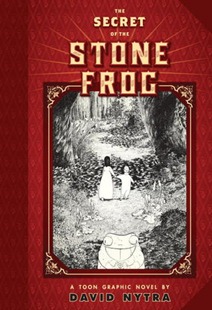
The Secret of the Stone Frog by David Nytra

Released September 11, 2012.

Upon opening this graphic novel, I was surprised.  Fine-lined black and white images that invite readers into an equally surprising story.  Leah and Alan wake up in an enchanted forest, not knowing how they got there or where they are.  Luckily, there is a stone frog to tell them which way to head and not to leave the path.  When they spot a house off of the path though, they just have to see if the people who live there will give them some food.  At the house, they discover huge bees in the garden and a woman with an enormous head who does invite them in for some cookies.  But the bees are not normal bees, and they start to collect the words that Alan is saying, leaving him unable to speak.  Leah manages to save his voice, but they are forced to flee.  Of course, they leave the path again, this time to discover lions who speak and rabbits as mounts.  There are more stone frogs, dark caves, unusual subways, and a strange city to explore.  This graphic novel is a tribute to traditional fairy tales but has its own magic to work too.

I am very taken with this book.  It is a modern version of an Alice in Wonderland story, complete with strange adult characters, an entire society that is warped and unusual, and discoveries around every corner.  Nytra seems to delight in the peculiar in his book, which also delighted me.  There are no explanations to this dreamy tale that sometimes verges closely to nightmare territory.

The art is unusual for a graphic novel, hearkening back more closely with old-fashioned tales than with a modern graphic novel.  While Nytra does use panels throughout, the art itself is fine-lined, detailed and worthy of reader exploration too.  It has a welcome surreal quality as well that suits the book well.

There is nothing better than a book that will surprise and delight you.  That’s guaranteed in this graphic novel.  Appropriate for ages 7-9.

Reviewed from copy received from Toon Books.

Review: Lies, Knives and Girls in Red Dresses by Ron Koertge

lies knives and girls in red dresses

Lies, Knives and Girls in Red Dresses by Ron Koertge, illustrated by Andrea Dezso

Just for teens, Koertge has created subversive poems based on fairy tales that look at what happens after “Happily Ever After.”  You will meet a Little Red Riding Hood who wanted to be swallowed whole just to see what it felt like inside a wolf.  There’s also a Beast who longs for the days of wild abandon rather than being a prince again.  What happens when the boy who said the emperor had no clothes is pressured to fit in with the crowd?  Hansel and Gretel may just have been a lot closer and a lot more disturbed than readers thought.  And could Rapunzel long for the days when the witch thought only of her rather than her prince who is distracted?  Koertge plays with the idea of “ever after” and works in the same darkness and sexuality that is already in the stories if you just look at them differently.

This is not a poetry collection to hand to younger readers who are interested in fairy tales.  Rather, this is a dark delight for teens who remember the stories.  There are more obscure tales included in the book, a couple of which I had never read.  I enjoyed those poems as well, since Koertge works in backstory in his poems.  In most of the poems there is an adroit twist about them, sometimes involving the modern world and other times looking at the story in a new and twisted way.

Deszso’s illustrations are done entirely in black and white.  They are paper cutouts that have astonishing details cut into them.  The mood of the illustrations matches that of the poetry, there is a playfulness about them but also a terrific darkness too.

This entire book was like a box of the darkest chocolates.  They held surprises inside and you simply can’t stop reading them.  Appropriate for ages 14-17.

Reviewed from library copy.

Fairytales Are Too Scary?!


A study sponsored by the television channel Watch shows that modern parents are resistant to sharing traditional fairy tales with their children. 

It doesn’t surprise me at all that one in five read modern books rather than Hans Christian Andersen and the Brothers Grimm.  But in the list that follows, the reasons are bizarre to me:

1. Hansel and Gretel – Storyline about two abandoned kids is thought likely to scare children

2. Jack and the Beanstalk – Deemed too ‘unrealistic’

3. Gingerbread Man – Parents uncomfortable explaining gingerbread man gets eaten by fox

4. Little Red Riding Hood – Deemed unsuitable by parents who must explain a girl’s grandmother has been eaten by a wolf

5. Snow White and the Seven Dwarves – The term ‘dwarves’ was found to be inappropriate

6. Cinderella – Story about a young girl doing all the housework was considered outdated

7.Rapunzel – Parents were worried about the focus on a young girl being kidnapped

8.Rumpelstiltskin – Parents unhappy reading about executions and kidnapping

9.Goldilocks and the Three Bears – Parents say it sends the wrong messages about stealing

10.Queen Bee – Deemed inappropriate as the story has a character called Simpleton

Out of the 2000 parents polled, one quarter of them would not “consider reading a fairytale to their child until they had reached the age of five, as they prompt too many awkward questions.” 

Here is where I begin to tear my hair out.  The entire point of fairy tales and folk tales is that they touch on darkness and evil just enough to get a good scare going but not enough to terrify.  A good chase by a giant down a beanstalk and the frantic chopping to save yourself.  Rapunzel’s incredible hair and then the blinding of the prince in the thorny bushes below.   Hansel and Gretel shoving that witch into her own oven and then the final step of latching the oven door. 

I love all of it.  I used to read my book of Grimm’s stories over and over again, and it had stories that were even more strange and alarming that I loved even more.  I adored The Goose Girl with its grizzly ending.  Snow White and Rose Red was another favorite that I loved because of the circular nature of the story and the blooming roses.  The strange Clever Elsie and other tales about wisdom and foolishness, I found captivating.  Thumbelina was one I turned to many times with its enchanting flowers and fairies counterpointed with the mole and darkness.

So what do you think?  Are the stories too dark for our modern children?  Was I just a rather strange young child to adore them so?  And if you too have a love for Grimm and Andersen, what were your favorite stories?

Review: The Princess and the Pig by Jonathan Emmett

princess and the pig

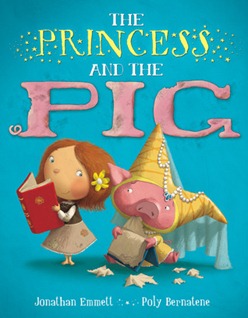
The Princess and the Pig by Jonathan Emmett, illustrated by Poly Bernatene

I have to admit, I came to this book with a lot of reservations.  It’s ANOTHER princess book in a time filled with sparkly pink books.  But if you are as sick of the regular princess books as I am, then this is just the book for you!   A farmer had a little pig in the back of his hay cart.  He decided to name it Pigmella.  At the same time, in the tower high above, a queen picked up her baby daughter and decided to name her Priscilla.  But the queen dropped the baby out of the window without noticing and up flew the piglet in her place.  Soon the piglet was being treated as a princess and the princess was happily adopted by the farmer and his wife.  After all, this sort of thing happens all the time in books!  The princess was happy at the farm, growing up and making everyone happy.  Unfortunately, the same thing can’t be seen of the piglet, who grew into a pig, could not learn to read, and refused to wear her finery.  But what is to happen when the mix-up is discovered and the young woman is told she is a princess?

Emmett has inundated his book with references to other fairy tales that the characters in the book use to rationalize what has happened.  They blame things on evil fairies and magic, which is why the mix-up is not discovered for so long.  The writing is merry and filled with humor.

That same humor is carried out to great effect in the illustrations.  They are filled with the funny things that would happen if a pig were a princess, the pomp and ceremony that would still be attempted, and the gentle, loving family of farmers raising a real princess.  The illustrations are done so that the characters pop on a softer background.  The jolly nature of the book is embraced in full here.

Exactly the antidote to children who have read too many princess books, this is a shining example of what a twisted fairy tale book can be.  Great fun and very satisfying.  Appropriate for ages 4-7.

Reviewed from library copy.

Also reviewed by:

Review: The Gingerbread Girl Goes Animal Crackers by Lisa Campbell Ernst

gingerbread girl goes animal crackers

The Gingerbread Girl Goes Animal Crackers by Lisa Campbell Ernst

This second Gingerbread Girl book continues the story of the sister of the Gingerbread Boy who is much more clever than her poor brother.  She survived the fox and now has gotten a box of animal cracker pets for her birthday.  But before she can warn them about the dangers out in the world, they run off chanting: “We’re wild Animal Crackers, hear our fierce roar.  You can’t catch us, we’re off to explore!”  Soon enough, the animal crackers have attracted a parade of people and animals chasing after them.  Waiting near the river is the fox, who is eager to offer all of the crackers a ride across.  Luckily, the Gingerbread Girl is still clever and figures out a way for them to save the day.

Ernst’s story is a rousing success with clever rhymes, fast moving prose, and plenty of action and suspense.  The Gingerbread Girl is a sweet heroine who is creative and smart.  The update to the story is in keeping with the traditional tale, but fractures it just enough to be modern and fresh. 

Ernst’s art has a timeless feel to it.  With the gingham backgrounds to the textual pages, there is a country feel to the entire book that works well with its rural setting. 

A pleasing update to a traditional tale, this book calls for sharing animal crackers while reading.  But don’t save any for the fox!  Appropriate for ages 3-5.

Reviewed from copy received from Dutton Children’s Books.

Review: The Orphan by Anthony L. Manna

orphan

The Orphan: A Cinderella Story from Greece by Anthony L. Manna & Soula Mitakidou, illustrated by Giselle Porter

This story of Cinderella has a distinct Greek twist to it.  In the author note at the beginning of the book, they state that the tale is drawn from two Greek versions of Cinderella.  One change that was made from the traditional stories is that Cinderella takes a more modern and active stance than she had in previous versions.  It is the story of a girl who loses her devoted mother and then has a stepmother and two stepsisters who take her father’s attention, love and money.  She weeps at her mother’s grave and is encouraged by her mother’s spirit to have hope and wait for blessings to appear.  They arrive in the form of Mother Nature and her children, who give Cinderella the Evening Star as a headpiece, dresses, and shoes.  Instead of a ball, this Cinderella meets her prince in church and in disguise, riding there on a white mare made of clouds.  She loses her shoe when leaving the church after the prince tries to capture her by making the threshold sticky.  All is revealed when the shoe fits.

This is a very satisfying version of the story with a spiritual tone that is not in the more familiar version.  Cinderella’s connection with her dead mother is much stronger here as well, having her turn to that guidance rather than a fairy godmother deepens the story considerably.  Also connecting her dresses, shoes and crown to nature is an adroit move. 

Porter’s illustrations have a folktale feel to them with a traditional grounding in the style.  At the same time, they have a rather ethereal quality as well, a lightness and wonder that infuses them.  It is a pleasing combination.

While we don’t really need more versions of the Cinderella tale, this one has a unique appeal and a very different feel.  Appropriate for ages 5-7.

Reviewed from copy received from Schwartz & Wade Books.

Review: The Three Little Aliens and the Big Bad Robot

three little aliens

The Three Little Aliens and the Big Bad Robot by Margaret McNamara and Mark Fearing

The story of the Three Little Pigs heads to outer space in this fractured fairy tale.  Here there are three little aliens, who must find a new planet to live on.  Their mother advises them to stick together, but two of the little aliens don’t listen.  When Bork sees the space rover on the red planet, she just can’t resist living there.  Gork is drawn in by the satellite circling around a planet surrounded by rings.  Nklxwcyz went deep into space until he found a planet that he thought was perfect.  It was blue with nice breezes.  When the Big Bad Robot arrived in the galaxy, there is no where for Bork and Gork to hide, because they had been too busy playing with their new toys to build homes.  So both of them fled to Nlkxwcyz’s house deep in space.  And you will just have to read the book to see how the Big Bad Robot is defeated.

While this is a light-hearted fiction book, it is also one that has some science mixed in.  The planets that the three aliens travel to are the planets in our galaxy.  They start out at home at Mercury.  Bork settles on Mars, Gork on Saturn and Nlkxwcyz on Neptune. This adds a nice dimension to the book. 

McNamara’s prose is a pleasure to read aloud.  The noises of the Big Bad Robot add much to the book’s fun and build the tension up.  The illustrations by Fearing are quirky and fun.  The backdrop of stars and the familiar planets make for a winning setting for the pictures. 

A fun, fractured fairy tale, this book will be popular with children who enjoy space and robots.  Appropriate for ages 4-6.

Reviewed from copy received from Schwartz & Wade Books.

Also reviewed by: