Review: The Princess and the Peanut by Sue Ganz-Schmitt

princess and the peanut

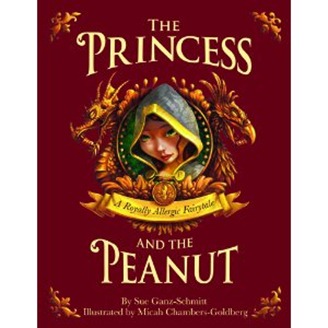
The Princess and the Peanut by Sue Ganz-Schmitt, illustrated by Micah Chambers-Goldberg

Food allergies are booming in children today with nearly six million children in the U.S. suffering from food-related allergies.  Here allergies are merged into a fairy tale world to nice effect.  When a prince despairs of finding his perfect princess, a princess appears on his doorstep looking for shelter from the storm.  To test to see if the princess is indeed real, the queen places a peanut between her tower of mattresses.  But this princess doesn’t have trouble sleeping, instead she awakens with an allergic reaction!

Following the storyline of The Princess and the Pea, this book skillfully and with effective humor tells the story of having an allergic reaction and what should be done.  It is a book that reflects what children today are dealing with and also supports children who have allergies.  The book also has a question and answer section on allergies for adults and a glossary for kids.

The illustrations have the feel of an animated film with dramatic lighting, interesting perspectives, and touches of humor.  They will be an inviting style for children, who will enjoy the juxtaposition of modern allergies and fairy tale themes.

Make sure to check out Ganz-Schmitt’s first book that was about diabetes: Even Superheroes Get Diabetes.  Both books have a charm and an honesty about medical situations that children are dealing with.  Appropriate for ages 4-7.

Reviewed from copy received from Raab Associates.

Review: Rapunzel by Sarah Gibb

Rapunzel

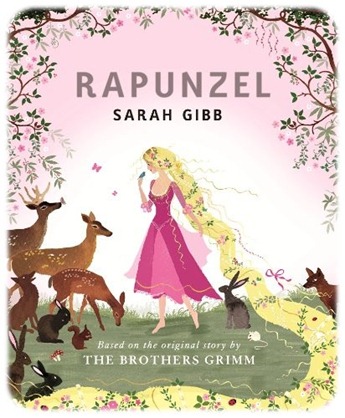
Rapunzel by Sarah Gibb

I must admit that I usually mentally shrug when new versions of classic fairy tales are released.  There are so many versions out there, that it takes something special to get my attention.  Well, Gibb’s new Rapunzel is special indeed.  She takes the classic story and simplifies it without losing any of the romance or drama of the original.  There are no parts of the story that will be missed, somehow she edited and simplified without any loss of plot points.  That alone is rather brilliantly done.

But then add in the remarkable illustrations that are delicate, romantic and simply lovely.  They create a world that readers are happy to enter and to linger in.  They include small details that are very engaging.  I found myself looking at tiny details with the book up close to my face, just absorbed by the world Gibbs created in this book.  The illustrations move from pink and rosy to dark and mysterious, even threatening.  Gibbs uses colors very effectively as well as silhouettes.  Just when readers get used to the silhouette illustrations, you turn the page for an airy illustration of Rapunzel’s tower.  Turn the page again, and you are journeying through an amazing forest with the prince.  It’s a world that embraces, changes, and creates such moods.

Highly recommended.  If you are going to read one new version of a fairy tale this year, choose this one.  Remarkable.  Appropriate for ages 5-8, and older romantics.

Reviewed from library copy.

Also reviewed by

Book Review: Fairly Fairy Tales by Esme Raji Codell

fairly fairy tales

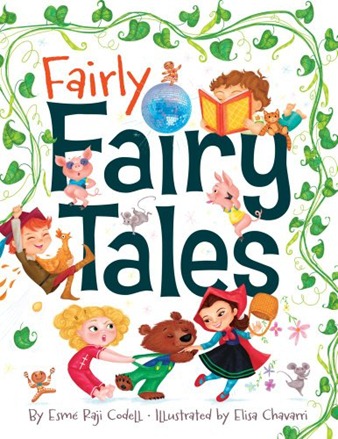
Fairly Fairy Tales by Esme Raji Codell, illustrated by Elisa Chavarri

A child does not want to go to bed even after a kiss and some water.  So begins this quick and charming look at the elements of fairy tales.  Three elements of a classic story are given along with a fourth element that does not belong.  But then, maybe, it actually does!  Turn the page and that outside element has been combined with the story to create a wild mashup twist.  The stories include The Three Little Pigs with solar panels added, Little Red Riding Hood with shampoo, Jack and the Beanstalk with spaghetti, Cinderella with a disco ball, Hansel and Gretel with a piñata, and Goldilocks with a TV.  It’s a fun surprise for children familiar with the classic stories to see them mixed with the modern world.

Codell’s writing here is very simple, offering the elements of the stories and then the surprise.  Each real element is followed with a “yes” and the surprise element with a “nooooo” that then turns into a “well, maybe.”  This pattern is followed throughout the book which works well.  It leaves the emphasis of the book on the twist and the illustrations.

Chavarri’s illustrations were done digitally and have that smooth digital feel to them.  They are colorful and very funny.  The elements of the story are done on a white background but when the page is turned to combine them, the illustration fills the page with color and action.  It makes a nice visual contrast between old story and new.

If you are looking for a fractured fairy tale feel with fewer words and that is more accessible for younger children, this is a great pick.  Appropriate for ages 4-6, especially for those familiar with the stories.

Reviewed from copy received from Aladdin.

Also reviewed by:

Book Review: Rapunzel and the Seven Dwarfs by Willy Claflin

rapunzelsevendwarfs

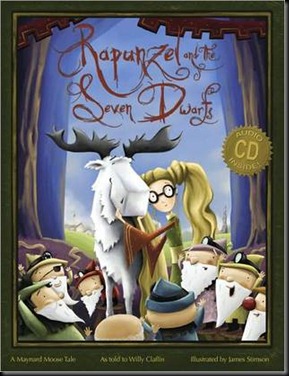
Rapunzel and the Seven Dwarfs by Willy Claflin, illustrated by James Stimson

This book is a Maynard Moose tale just like The Uglified Duckling.  This fractured fairy tale takes Rapunzel and Snow White and the Seven Dwarfs and mixes them wildly together into quite a story.  Readers who know both stories will enjoy this most, because of the silliness of the mash up.  Here Rapunzel is a girl who has trouble keeping her long tresses clean, so a helpful witch puts her in a tower.  She is discovered by a portly knight who attempts to climb her hair, but instead due to his bulk, launches her out of the tower and into a pond.  Enter the seven dwarfs, who rescue her from the water and solver her hair issues by shaving her head bald.  Meanwhile, the witch heads to the home of the dwarfs dressed as a kindly rhinoceros (yes, you read that right) and tempts her to each poisoned watermelon.  I’ll leave the final twists of the tale for you to discover, and my there are plenty of twists!

When I first started reading this book, I tried it silently to myself.  Told by Maynard Moose, the story has some odd language twists in it and some words that are new but will make sense.  The book doesn’t work read silently.  Happily, I tried it aloud and the elements all fell into place.  If you are wondering as someone who will read it aloud how to do it, there is a CD with the book where you can hear Maynard’s voice. 

The humor here is broad and great fun.  There are particular lines that had me laughing out loud.  I enjoyed the “eight or nine seven dwarfs” and the series of misunderstandings as the prince calls out to Rapunzel to lower her hair.  It all adds to the zaniness of the story.  The writing is crafted to be read aloud, giving any reader plenty of opportunity to shine.

Stimson’s art plays along with the humor of the book.  The homemade rhino costume, the Sleeping Punzel Museum, the rotund little prince, and the issues of long hair.  The art is computer smooth and sleek.

This will read aloud well to older elementary-age children who will really enjoy the humor.  Recommended for ages 7-9, though completely appropriate for younger listeners.

Reviewed from library copy.

Also reviewed by

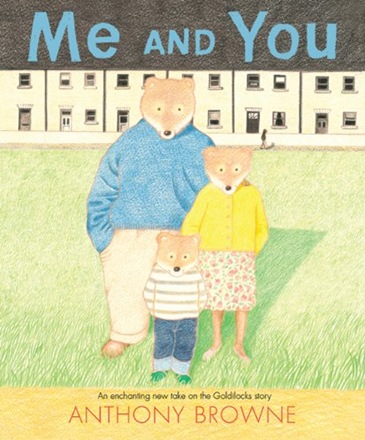
Me and You: A Glorious Goldilocks

518fiHZWXbL

Me and You by Anthony Browne

This is a version of Goldilocks that is sure to make readers think.  The story of Goldilocks is told opposite that of the Bear family.  Goldilocks comes from a rough part of town, complete with broken windows and graffiti.  After chasing a balloon that gets away, she finds herself in front of the Bears’ home.  It’s a pretty yellow home, obviously comfortably middle class.  The Bears have headed out for a walk in the neighboring park, chatting about work, the home and the car.  When they return, they find that their house has been disturbed.  From here the story continues in the traditional way.  Goldilocks flees the house, finding her way home to the arms of her mother.  This is a Goldilocks tale that will have readers thinking.

Browne has created a book that emphasizes the differences between Goldilocks and the Bears.  The Goldilocks story is told in wordless format with a very realistic feel and muted colors.  In many of the images the only bright color is Goldilocks’ hair.  Contrasted with that are the images of the Bears.  Shown in pastels done in a much softer line, the images are comfortable and bright.  But readers’ eyes are sure to wander back to the darker side of the page and Goldilocks.

Is Goldilocks the villain that has been portrayed in the past?  Is she a greedy little girl who wants the items of some poor bears?  Not here.  Here Goldilocks may be homeless, is definitely in need of warmth, and is lost.  This book turns the tale on its head, creating a heroine out of a lost girl and questioning the motives of the comfortable bears.

This is an important look at a fairy tale that asks modern questions.  I’d recommend using it with other versions of the same story and saving this one for last.  It is certainly a book that will have young listeners talking.  Appropriate for ages 4-6.

Reviewed from copy received from Farrar Straus & Giroux.


The Story of Little Red Riding Hood: Dark and Luminous

9780811869867

The Story of Little Red Riding Hood by the Brothers Grimm, illustrated by Christopher Bing

This is the classic story of Little Red Riding Hood, complete with them filling the wolf’s belly with stones at the end and killing him.  The text here has an easy flow for reading aloud, never becoming too verbose.  The moments with the wolf are studies in darkness and danger, with the tension palpable on the page.  The star in this book are the illustrations which are rich and radiant.  The entire book is an homage to the Grimm brothers, their story, and yet has paid attention to the needs of modern children as well.

In his illustrations, Bing works with light and darkness.  On the path, the wolf is bathed in sunlight, almost haloed with it.  But when he has eaten the grandmother and is in disguise, he is in shadows, and it is Little Red Riding Hood that the rays of light reach for.  When the stones are being fetched to kill the wolf, the play of light and shadow on each person’s face is beautiful with the dancing dust motes from the first scenes returning again. 

Bing has also framed his illustrations with pressed flowers and leaves, as if you have found an old book that someone has used and loved.  He has also built a frame for the book itself, which shows the dogeared pages of a much larger book, giving it a sense of age and depth.  My favorite use of the pressed flowers comes on the page where the wolf attacks Little Red Riding Hood and objects are tossed around and towards the reader.  The pressed flowers become part of that, whirling on the page along with the objects in the picture.  Brilliant.

A virtuoso rendition of the classic tale, this version belongs in every library thanks to its ease of reading aloud and the exceptional illustrations.  Appropriate for ages 4-7. 

Reviewed from copy received from Chronicle Books.

A Tale Dark and Grimm: And Very Funny Too

taledarkgrimm

A Tale Dark & Grimm by Adam Gidwitz

I was very hesitant to start this book, because I love the original tales so very much.  I still have my faux-leather copy of the Grimm’s tales that I read when I was little.  In this debut novel, Hansel and Gretel serve as the uniting characters in a series of stories inspired by the Grimm tales.  Written with a narrator who interrupts, gleefully warns of upcoming bloodbaths, thrillingly cautions to get small children out of the room, and generally makes the book tantalizing, readers will find themselves unable to stop turning pages just to see what in the world the excitement is all about next.  And excitement there is, with stories that involve cutting off fingers, chopping off heads, battling dragons, and turning into a wolf creature.  Hansel and Gretel do a lot more than find a house made of candy here, though that story is part of this book too.  Get ready for a wild read that is sure to surprise and delight.

OK, so I tend to not like books with narrators who insert their opinions or foreshadow upcoming scenes.  It bugs me that the author had to resort to that rather than skillfully telling the story.  But here, that narrator actually adds a lot to the book.  The narrator tells readers that it’s OK to be thrilled with being frightened.   The narrator teases the reader with endings, merrily romping through the book and adding to the mayhem and fun.  This is a narrator who has become a character himself. 

Gidwitz has taken liberties with the stories.  While some bear close resemblance to a Grimm tale, others are very different.  Delightfully, without a book of Grimm at hand, the stories all work side-by-side, a testament to the skill of the author. 

Best of all, this is a book for older elementary children that needs to be read aloud.  It needs to be shared, laughed aloud at, gasped together at, and delighted in with someone else.  So grab a kid, cuddle up and get ready for a great wild read.  Appropriate for ages 8-12, or whenever you think a child is ready for such grisly and grand fare.

Reviewed from copy received from Dutton.

Beauty and the Beast: Popping Up Near You

Beauty & the Beast by Robert Sabuda

Sabuda has outdone himself with this pop-up rendition of the classic Beauty and the Beast story.  Each double-page spread opens with a large pop-up that is amazing in its complexity.  Also on each page behind smaller pages, the story is told through text and smaller pop-ups that may be more diminutive but are just as lovely as the larger ones.  Sabuda’s retelling of the tale reads aloud well, offering a sturdy structure to build from.  While it may not be particularly poetic in tone, the text will carry readers happily from one gorgeous illustration to the next. 

There are some particularly wonderful moments in the book.  In the first set of pages, Sabuda has rigged long hallways that the reader stretches out and directly up to the eye.  The halls are detailed and even populated, giving a real depth and wonder to the Beast’s home.  Another winning moment is when the Beast transforms back into a man.  Sabuda does not let that happen off-page, instead turning it into a small and magical moment that readers can relish again and again.

Highly recommended, this is a book for home use rather than library use.  A perfection of a present, give this to any Beauties or Beasts in your life.  Appropriate for gentle five-year-olds through adults.

Get a great sense of the book from this video:

Reviewed from copy received from Simon & Schuster.

Enhanced by Zemanta

Chicken Big: Huge Laughs

63861436

Chicken Big by Keith Graves

A fractured version of the classic Chicken Little story, this book is big on chickens and big on humor too.  A huge chick is born on a tiny farm in an itty-bitty coop.  When the chick hatches, the chickens try to figure out what in the world it is.  It’s big, even enormous, so it must be an elephant!   That theory only lasts until an acorn falls on the head of one of the chickens and the big chick eats it up rather than running in fear.  If it eats acorns, then it must be a squirrel!  When rain starts to fall and the chickens panic again, the big chick lets them shelter under his wings.  Well, if he keeps them dry in the rain, he must be an umbrella!  Their theories get more and more outrageous as the book continues.  It culminates with a showdown with a sneaky fox that finally convinces the foolish chickens what the big chick actually is. 

Graves writes with such great comedic timing and wonderful surprises that children will be in stitches listening to it.  The very silly chickens are a treat to read aloud, because they are so very idiotic.  The smallest chicken is the really funny one, who offers the various guesses as to the chick’s identity.  Always with a stout and definitive declaration. 

Graves’ illustrations add to the hilarity.  He uses a mix of frames and full page illustrations.  The combination is dynamic and modern.  Often the chickens and the big chick speak in speech bubbles, lending asides that are very clever and funny.  This is a book that has a feeling of mischief and mayhem about it.  It reads wonderfully aloud and will be sure to capture attention that may be wandering in story time.  It’s a perfect final story time book to get them hooked again.

A hilarious take on a classic, this book is perfectly designed and vibrantly original.  Appropriate for ages 5-10.

Reviewed from copy received from Chronicle Books.

Also reviewed by: