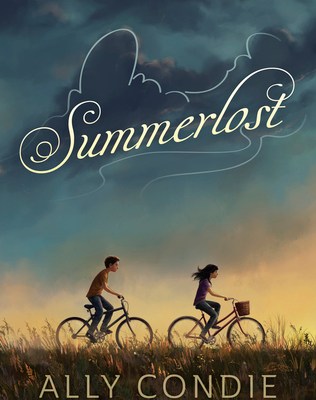
Summerlost by Ally Condie

Summerlost_BOM.indd

Summerlost by Ally Condie (InfoSoup)

Cedar’s family is much smaller than it once was. Her father and brother were killed in a car accident and now Cedar, her mother and her other brother are returning to the small town of Iron Creek for the summer where they have purchased a new house. Cedar soon notices a boy riding his bike past their house dressed in costume. Cedar follows him to Summerlost, a local and renowned theater festival. There, Cedar meets the boy on the bike, Leo and finds herself a summer job too. Leo and Cedar have soon created a tour together about a famous local actress who performed at Summerlost and died in Iron Creek. Cedar’s summer is filled with small mysteries like who is putting items on her windowsill that her dead brother would have loved that help distract her from the loss she has so recently experienced, until she can’t ignore it any longer.

Condie, author of the Matched series, has created a beautiful middle grade novel here that rings with honesty. She manages to keep both the reader and Cedar aware of the loss that was experienced but also moving forward and towards other things. The book is haunted with those deaths, appearing out of nowhere in the middle of beautiful summer days, but also hiding at times and almost disappearing with the busyness of work. It’s an intelligent balance written very cleverly.

Condie’s writing is superb throughout the novel. In Summerlost, she creates an entire world of theater that is intoxicating and memorable. Early in the novel, Condie through Cedar’s voice explains what it is like to have a family shrunk by tragedy:

Sometimes I thought of the three of us as pencils with the erasers scrubbed down to the end, and the next swipe across the paper would tear through the page and make a scree sound across the desk.

This approachable and yet deep writing runs throughout the novel, exposing grief in unexpected and tangible ways.

A strong and outstanding novel for middle grades, this book takes a courageous look at grief and the resilience it takes to continue to live. Appropriate for ages 10-13.

Reviewed from ARC received from Dutton Books for Young Readers.

Allie, First at Last by Angela Cervantes

Allie First at Last by Angela Cervantes

Allie, First at Last by Angela Cervantes

Released March 29, 2016.

Allie has never won anything in her life. Her entire family though has a shelf of trophies. Her older sister is a national debate champion. Her brother is a star soccer player. Even her little sister is a rising star as an actress. Allie is almost certain she is going to win the science fair, but it ends up a disaster instead of a win. That’s thanks to “help” from Victor, a new boy at school. When another opportunity to win an award comes up, Allie knows that she has to try hard. She decides to do a photo essay on her great-grandfather who is a decorated World War II veteran. But her ex-best friend who won at the science fair has also decided to use Allie’s grandfather as the subject of her entry. When is it going to be Allie’s turn to shine?

This is a very accessible book, written with a light hand and a friendly tone. That lightness allows this book to deal with deeper truths without getting caught up in darkness. It is a book that speaks to the importance of doing well, healthy competitiveness and the pleasure of a job well done. It also looks deeply at how that healthy competition can twist and become something that is no longer positive in one’s life. Allie’s entire family tries to teach her this in different ways, some by being more competitive and others speaking to her intrinsic worth whether she has trophies or not.

While Allie was a great protagonist, two secondary characters really stand out in this book. First is Victor, a boy who is from a poor family and someone that Allie assumes is being tutored. It turns out that Victor is incredibly smart and is doing the tutoring. Victor though is less concerned with acclaim than with his future. Allie’s great-grandfather is another amazing character. He offers sage advice and a point of view that is particularly filled with grace and compassion. The fact that almost all of the characters in the novel are Hispanic and offer a wide array of points of view about life makes this book all the more winning.

A charming story with strong characters and a clear message that winning is not everything. Appropriate for ages 9-12.

Reviewed from ARC received from Scholastic.

The Land of Forgotten Girls by Erin Entrada Kelly

The Land of Forgotten Girls by Erin Entrada Kelly

The Land of Forgotten Girls by Erin Entrada Kelly (InfoSoup)

When Sol and her little sister Ming moved from the Philippines to the United States, they knew their lives were going to change. But they didn’t realize that they would be abandoned by their father and stuck living with Vea, their mean stepmother in a tiny apartment in Louisiana. Now five years later, Sol manages to escape her stepmother’s cruelty by escaping into stories, particularly when she is sent to the closet when she has done something wrong. She shares the stories with her little sister and Ming has now started to believe in their mythical Aunt Jove and expects her to arrive to rescue them. As Ming’s hope grows, Sol despairs of their lives ever improving at all, but friendship comes from unexpected places and may be the answer to their hopes and dreams.

Kelly, author of Blackbird Fly, has created another great novel for children. In this book, she beautifully captures the complexity of the lives of some children where their families have been turned upside down through death and abandonment and they are left with those who don’t love them at all. It is a book about hope as well, about the power of stories to create new realities and the radiance of hope even in the bleakest of times.

Particularly notable in this novel is Kelly’s willingness to tell a very sad story, one filled with loss and betrayal and still one that is very appropriate for children. Sol herself reflects on the sadness of her story and her new friend:

What gloomy tales we had, I thought. I wondered what we’d look like to someone passing by. Two twelve-year-old girls – one so white she looked like a ghost and the other so dark she looked like the fields – sitting on milk crates and telling sad, sad stories in the hot, hot sun.

These are stories of poverty, of spending time on the streets to get out of the misery of your home. The novel dazzles with its truth and honesty of children who shine despite the darkness in their lives.

A powerful novel of stories and hope and how they can be used to overcome the darkness that life contains. Appropriate for ages 10-12.

Reviewed from copy received from HarperCollins.

Hour of the Bees by Lindsay Eager

Hour of the Bees by Lindsay Eager

Hour of the Bees by Lindsay Eager (InfoSoup)

Carol is missing out on what all of her friends are doing this summer, because she has to head out with her family to the New Mexico desert and move her grandfather off of his farm and into a home for people with dementia. Carol has never really met her Grandpa Serge and tries to avoid him at first because he is so prickly and all he will talk about is a wild story about bees returning to the desert. As the summer goes ever so slowly by, Carol connects with Serge and discovers his ability to weave a great story. It’s a story that is about her grandparents, about a magical tree that granted everlasting life and about bees too. Carol begins to understand her grandfather’s connection to the dried out land and the small home just as the summer ends and they are forced to leave it behind but the story has not reached its end yet.

This magical realism book is enticingly radiant. It shimmers with desert heat, itches with dust and dirt, aches with the loss of loved ones, and dances with the voice of a great storyteller. The writing is lush and lovely with distinct tone differences between Grandpa Serge’s stories and the prose of the novel. Even that prose though is written with such poetry:

I want to tell her how Serge’s eyes glow, how they are cat’s eyes, wide as a newborn’s, ringed like an ancient tree trunk.

A large theme of the novel is connection to one’s heritage and roots. In this book about a magical tree, those roots have many meanings. Carol is urged to connect more with her Hispanic heritage and also to the land itself. She does over the course of the novel in a believable and organic way that really works well. This book is about those slow changes, about becoming yourself and honoring who you are and where you come from.

Beautiful and haunting, this novel deserves a wide audience and plenty of buzz. Appropriate for ages 9-12.

Reviewed from ARC received from Candlewick Press.


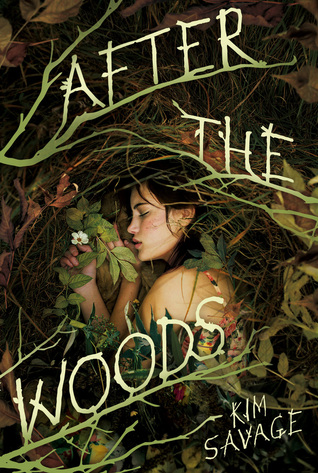
After the Woods by Kim Savage

After the Woods by Kim Savage

After the Woods by Kim Savage (InfoSoup)

Julia can’t remember what happening in the woods except in brief flashbacks. She knows that she saved her best friend from an attacker and then was taken by the man for 48 hours. A year later, Julia is still trying to understand what happened to her in the woods. Liv, her best friend, is urging her to forget and move on. Then a girl’s body is found in the same woods, triggering more memories that Julia had suppressed. Liv too is caught up in what happened, seemingly intent on her own destruction by dating a dangerous boy and participating in other risky behavior. As Julia starts to recreate what really happening in the woods, the incredible truth will lead to understanding what makes someone a hero.

Savage’s writing is dark and gorgeous. Early in the novel as the two friends enter the forest, the writing shows the danger coming:

Despite the desolation  – no one runs at four p.m. in November after weeks of rain – the woods pulse. The canopy shatters fast-dropping light into glittering shards. A chipmunk skitters close to my foot and ducks into a hole.

Throughout the novel, Savage offers clues of what happened in her language. It’s a wrenching combination of what Julia is discovering herself and also allowing the reader to see a bit farther ahead towards the conclusion without revealing all quite yet. The tempting and seductive mixture makes this book an especially great read.

Julia is a jagged character, covered in the pain of what happened to her, striking out at those who protected her, reaching out to those who wronged her. At the same time, she is very bright, looking at the world and this mystery as something that logic can solve. And she is funny and sarcastic too. She’s a survivor, a hero and everything that that complexity brings is shown on the page.

A brilliant novel for teens about heroism, survival and what bravery it takes to keep on going. Appropriate for ages 14-18.

Reviewed from digital galley received from Farrar, Straus & Giroux and Edelweiss.

Titans by Victoria Scott

Titans by Victoria Scott

Titans by Victoria Scott

Astrid’s family has been destroyed by the Titans, mechanical horses raced at a track near her Detroit neighborhood. Her father lost everything betting on the horses and now they may lose their home. Yet Astrid also finds herself drawn to the Titans and spending time figuring out the math to create the best approaches to turns. So when Astrid meets a strange old man who has a Titan of his own, the first generation ever made, Astrid knows that she just has to try to ride it. It is up to Astrid now to secure the future for her family if she can only prove that a poor girl and an old horse can win.

Scott has written such a rip-roaring story. It is a book that will hook those who love horses as well as those who love racing. It’s a book that is science fiction, but a near future that is all too possible, where the division between rich and poor is even more strong than today and where impossibly complex robotic horses come to life. Even better, it is a world that makes sense for the reader, one with great appeal and a strong heroine to cheer for.

Astrid is an amazing heroine. She has a brain that thinks in mathematics and physics, naturally bounding ahead of others. And she uses it not just to ride differently than the others but also to face the horrible traps set into the race track that change from one race to another.  Astrid is complex. She is deeply loyal to her family, yet does not tell them what she is doing. She also takes longer than the reader to fall for her Titan, something that works very nicely so that the reader is cheering them on together.

A riveting read that is compulsively readable, this teen novel has great appeal and will set anyone’s heart racing. Appropriate for ages 12-15.

Reviewed from ARC received from Scholastic Press.

My Dog’s a Chicken by Susan McElroy Montanari

My Dogs a Chicken by Susan McElroy Montanari

My Dog’s a Chicken by Susan McElroy Montanari and Anne Wilsdorf (InfoSoup)

Lula Mae really wants a puppy, but her mother tells her that times are hard and she will just have to make do. So Lula Mae takes a look around and decides that maybe a chicken could be a good dog. She finds the most likely chicken, one that is confident, and grabs it. She names the “dog” Pookie and puts a hair ribbon on its head. Her mother insists that whatever Lula Mae calls it, she’s not to bring it into the house. Soon Pookie is starting to act like a dog. She shepherds the other chickens around. She acts like a guard dog when Cousin Tater threatens Lula Mae and the baby with a garter snake. Pookie even manages to perform a search and rescue when Baby Berry goes missing.

This fanciful picture book is brimming with down home warmth. The book’s premise is wonderfully quirky, the substitution of a chicken for a dog. Readers will expect it to go very badly, but this book takes a more positive spin. Even as Pookie starts to act like a dog, she is still clearly a chicken reacting the way a chicken would in that situation. The humans interpret it differently, adding to the fun of the entire story.

Wilsdorf’s illustrations are done in watercolor and ink. They are filled with bright colors and show a vibrant rural lifestyle filled with chickens, woodpiles, and crops. Some of the illustrations show the paths of people (and chickens) running around and convey the panic of trying to find Baby Berry. Sharp-eyed children will spot him by following Pookie’s path.

Funny and entirely individual, this picture book is about making do and following your own heart. Appropriate for ages 4-6.

Reviewed from digital galley received from Penguin Random House and Edelweiss.

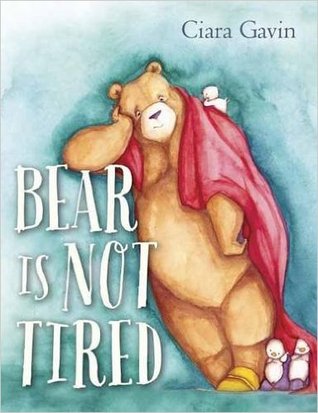
Bear Is Not Tired by Ciara Gavin

Bear Is Not Tired by Ciara Gavin

Bear Is Not Tired by Ciara Gavin (InfoSoup)

This is the second book featuring Bear and his adopted family of ducks. In the first book, the bear and ducks had to figure out a home that worked for all of them. In this follow up, bear is getting steadily more and more sleepy as winter approaches. But ducks don’t hibernate and Bear worried about missing out on things throughout an entire season. So Bear decided not to sleep, but the ducks started to notice that Bear was acting differently. Bear tried and tried to stay awake, but nothing seemed to work. Finally Mama Duck pulled Bear aside and promised that if he slept through the winter, he would not miss a thing. And it was true!

Gavin has written another winning picture book about the unusual pairing of a family of ducks and a solitary bear. Here the story focuses on Bear and his unique need to sleep through the cold months. It’s a story that will speak to families who have people who respond differently to things, who like different activities, but still want to be with one another. Perhaps the ducks’ ways of including Bear in everything despite him being asleep will inspire new ways of thinking for human families to stay close even when they are doing different things.

Gavin’s art work has a lovely gauzy quality to it, giving Bear his huge softness. Meanwhile the little ducks are done in firmer lines. All of them have personalities that brighten the page and enhance the story. The little ducks are all characters, and it is clear through their body language alone how much all of the animals love one another.

A lovely winter read, perfect for curling up on a cozy couch or snuggled at bedtime. Appropriate for ages 3-5.

Reviewed from library copy.

When Mischief Came to Town by Katrina Nannestad

When Mischief Came to Town by Katrina Nannestad

When Mischief Came to Town by Katrina Nannestad (InfoSoup)

Inge arrives at the small island town of Bornholm, Denmark via boat. She hasn’t eaten since the morning of the day before, thanks to missing her mother and the fish guts on the boat. Inge has never met her grandmother before, but now the two of them will be living together at her small farm. Inge brings with her plenty of laughter and trouble, but her grandmother does not seem amused by any of it. Over and over again, Inge gets into mischief, whether it is in a kicking contest with the donkey, learning how to walk in wooden shoes, or insisting that in 1911, girls can play on the grass at school too. Inge’s vibrant personality never stays down for long, but can this small island community survive her?

This book is pure silly and shimmering perfection. Inge is a marvelous protagonist, filled with life and the ability to get into great trouble even on a small farm on a tiny island. Inge is the real reason this book works so well, but so is her grandmother who proves the perfect foil for the rambunctious child. While I don’t want to spoil the book, it is the grandmother’s reaction to Inge that makes this book so special by the end.

The setting of the small Danish island also plays a huge role in the book. Set in 1911, the strict community rules rub Inge entirely the wrong way. Though some areas are moving in a more modern way, the small town keeps things traditional. With a strong focus on food, children will enjoy the changing menagerie of gingerbread creatures, the question of how thick a piece of cake should be, and the way that the grandmother feeds Inge with a beautiful determination held together by lots of cream.

A gem of a book, this would make a great read aloud for a classroom thanks to the large amounts of guffaw-level humor throughout as well as a winning young female protagonist. Appropriate for ages 8-11.

Reviewed from library copy.