Review: The Mermaid and the Shoe by K.G. Campbell

mermaid and the shoe

The Mermaid and the Shoe by K.G. Campbell

King Neptune’s 50 daughters are all special and talented in their own ways.  All except for Minnow who tries to be like her sisters, but only manages to ask lots and lots of questions about things.  Minnow did not fit in with her sisters at all, often drifting alone on her own.  Then one day, she found a remarkable object in the water, a red shoe.  She tried asking her sisters what it was for, but none of them knew, so Minnow headed out to answer her own questions and find out what the red object was for.  Minnow swam closer and closer to shore, discovering answers to some of her other questions like why crabs don’t have fins.  Then she found out exactly what shoes were for and headed home to tell the others.  In the end, Minnow not only discovers the answers she is looking for, but she discovers exactly what her special talent is too.

Campbell, author of the uproarious Lester’s Dreadful Sweaters, returns with a quieter book that shows the same sort of depth as the first.  This book beautifully wrestles with deep questions about one’s purpose in life and how to remain true to oneself rather than give in to external pressure.  Disney’s The Little Mermaid comes to mind throughout the story, but in the end this is a unique mermaid story that holds up well against the Disney version.

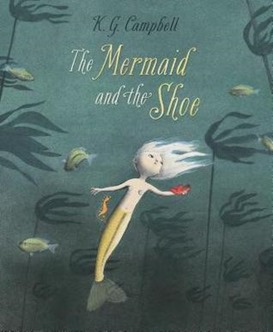
The illustrations are rather haunting.  They pair the darkness of the deep water with a near glowing brightness of the mermaids.  The mermaids have drifting white-blonde hair that moves with the currents, fish tails that look like real fish, and small seashells to cover their chests. 

Beautiful, quiet and deep like the ocean, this book will find readers in Little Mermaid fans who may just have found a new favorite mermaid to adore.  Appropriate for ages 4-6.

Reviewed from copy received from Kids Can Press.

Review: The Night Gardener by Jonathan Auxier

night gardener

The Night Gardener by Jonathan Auxier

A book sure to create some shivers, this is a thrilling gothic horror book for children.  Molly and Kip are two Irish children abandoned by their parents as their family fled to England due to the Great Irish Potato Famine.  No one will hire Molly as a servant until a man hires them to work for his family at their isolated and decrepit mansion.  It quickly becomes apparent that things are not what they seem in this family.  Molly finds a painting done of the family a year earlier, and they have changed considerably with their hair turning black and dull to their skin losing all color.  Perhaps it has something to do with the locked green door in the house, a door that Molly yearns to find out what is behind.   But opening that door unleashes a terrible force, one that answers your wants but destroys you in the process.  How can two children stand up to a centuries old curse?

Auxier’s storytelling skill is incredible.  He weaves a world of darkness, creeping misery and despair so cleverly that readers will feel the chill on their skin before it reaches their thoughts.  The children are steadily drawn into the strangeness surrounding the house and family, succumbing to the temptation of safety, the illusion of a home, and not seeing the proof around them of what is happening.  For the reader, this is a book that steadily builds and builds as the tension mounts and the nights get more frightening.  It is a wonderfully creepy read, one that simply can’t be put down.

The themes of the book are beautifully crafted.  The book speaks to the importance of love and family, but even more so it is about what happens when greed becomes consuming, literally.  It also is about the power of storytelling and stories, the way that they can teach, terrify and soothe.  And finally about the terror when a story comes to life right in front of you. 

An extraordinary horror novel for children, this book will be enjoyed by young readers but maybe not right before bed.  Appropriate for ages 10-13.

Reviewed from ARC received from Amulet.

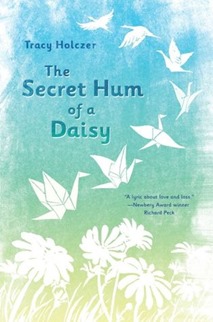
Review: The Secret Hum of a Daisy by Tracy Holczer

secret hum of a daisy

The Secret Hum of a Daisy by Tracy Holczer

Grace can’t stand being near the river, because that’s where she found her mother’s body.  It was right after they had argued about moving once again.  Grace wanted to stay where she finally felt at home, but her mother wanted to move again.  Now Grace has been sent to live with her mother’s mother, a grandmother she has never known.  She only wants to return to the family she and her mother had been staying with last, but she has to come up with a plan to escape.  In the meantime, Grace starts to find clues to a treasure hunt, similar to the ones her mother did for her every time they moved to a new town.  Is it her mother creating a final path for her daughter to find a home?  Or could it be that Grace is just seeing patterns where there are none?

Holczer shows great depth and richness in this her first book.  In this character-driven novel, she excels at the relationships she builds between her vividly drawn characters.   Grace is a character in search of a place to call home, but unable to see a home when it is right in front of her and unable to register the love being shown her.  She is complicated in a very organic way, her reactions honest and true.  The same is true of the grandmother character who radiates frankness but also regret for what happened over the years with her daughter.  She is a very complex adult character, particularly for a book for middle grade students. 

Holczer’s writing itself is straight-forward, allowing a sturdy framework for these character to relate to each other within.  The writing rings with confidence and Holczer asks deep questions about death, what dead people can communicate to the living, and what makes a family.  The answers are not simple and are not easily arrived at.  They come about very naturally and one must wait to see what the truths are and where the characters will arrive in this beautifully paced novel.

Rich, organic and special, this middle grade novel offers us all a view of what a second chance at family can be.  Appropriate for ages 9-12.

Reviewed from copy received from Penguin.

Review: How to Cheer Up Dad by Fred Koehler

how to cheer up dad

How to Cheer Up Dad by Fred Koehler

Little Jumbo’s dad is having a very bad day, but Little Jumbo can’t figure out why.  When Little Jumbo spits his raisins at the ceiling, his dad should have remembered not to put them in his oatmeal since Little Jumbo doesn’t like them.  His dad also should have remembered that Little Jumbo doesn’t like his brown overalls, but he didn’t so Little Jumbo ran out of the house naked.  Little Jumbo had to figure out how to cheer up dad, especially after getting a time out when it seemed like Dad needed one himself.  So Little Jumbo sets out to make the perfect cheering-up afternoon with Dad, and it works.  Maybe.

Koehler tells one story with his words and another in the pictures.  This makes for great fun especially with his dead-on sense of timing for humor.  The story is told in Little Jumbo’s voice, but the images show the point of view of the father quite clearly and the mishaps that Little Jumbo has all morning long.  The blissful afternoon together makes this book a little deeper and less madcap, much to the book’s credit.  But the final twist at the end brings the laughter right back again.

Koehler’s art will appeal to fans of Mo Willems with its clear lines, silly humor and a strong relationship between the two characters.  Little Jumbo and his father are two charming characters who related together with a mix of frustration and love. 

Filled with laughs, this is sure to cheer up bedtime at any house but particularly if shared by a dad.  Appropriate for ages 4-6.

Reviewed from copy received from Dial.

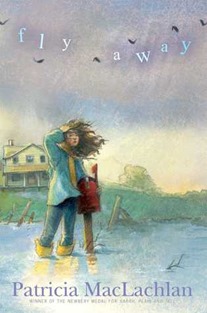
Review: Fly Away by Patricia MacLachlan

fly away

Fly Away by Patricia MacLachlan

Every year Lucy and her family head to North Dakota to help Aunt Frankie on her farm.  This year the farm is being threatened by a flood, and they are heading to the farm even though Frankie told them it was dangerous.  On the way, Lucy’s family stops and camps, listens to opera, and sings.  But Lucy can’t sing at all and she knows it.  Her little brother is a different story, no one else believes Lucy but Teddy can sing perfectly and even talks a bit, though he refuses to do so except with Lucy.  Though she can’t sing, Lucy loves to write and she is trying to create a poem to prove to her father that a poem can be just as nice as a cow.  Her father had dreamed of being a poet himself, but became a farmer instead.  As the family gets to North Dakota, they face a dangerous river and Lucy has to find her own strength to save her little brother.

Told in a strong and clear voice, this novel invites readers into a family that is pure joy to spend time with.  All of the family members have their own specific gifts and quirks, they communicate effortlessly with one another, and the entire book feels like you have entered someone’s home and are spending time with them.  MacLachlan creates dialogue that feels real, but even more so she has created characters that are alive and honest on the page.

Thanks to the larger font and short chapters, this book will be welcoming for newer readers who may be trying their first chapter book without pictures.  The warmth of the characters, the riveting danger of the river, and the thrilling ending will keep young readers fascinated until the end.  This is also a great pick for sharing aloud with an elementary class.

MacLachlan has created a simple book that contains bountiful riches in setting, character and voice.  It is a stellar read.  Appropriate for ages 6-8.

Reviewed from copy received from Margaret K. McElderry Books.

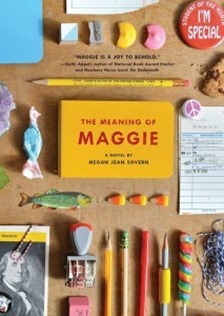
Review: The Meaning of Maggie by Megan Jean Sovern

meaning of maggie

The Meaning of Maggie by Megan Jean Sovern

Everything changed in Maggie’s life when she turned eleven.  She was one year closer to college and one year closer to finding out the things that her father said he’d explain in ten years.  Though she knew she’d never be closer to understanding her two gorgeous, leggy older sisters who were mostly interested in boys and ignoring Maggie.  But something else happened that year too.  Maggie’s father had arms and legs that were falling asleep, and now his arms and legs were starting to stay asleep for longer and longer periods of time.  Then Maggie’s mother got a job and her father stayed home.  Now Maggie’s mother was always tired and not around and her father was always around but not able to help with much.  As Maggie steadily figures out what is really happening to her father, this book reveals the impact a serious medical condition can have on even the strongest of families. 

Sovern has written a smart and intriguing heroine into the heart of her book.  Maggie is very bright, gets nearly perfect grades, asks for Coca-Cola stock for her birthday present, and loves to study ahead in her classes.  But she is also wonderfully flawed with her addiction to sugar and her ability to look past what is right in front of her until she is forced to see it.  Sovern excels at family dynamics.  Refreshingly, Maggie relates to each of her parents very differently and the two older sisters in different ways as well.  There is room in this brief book for all of the family members to be individuals.

Sovern also makes sure that though the book deals with serious issues to inject just enough humor into the story.  Maggie doesn’t manage to get everything she wants in the classroom or in life.  She has to learn that there is much outside the scope of her own determination to solve it.  Throughout the book there is clear and organic growth in both Maggie and in her entire family as they all come to terms with her father’s illness.

A book about having a parent with multiple sclerosis, this is also a book about one amazing young woman and her strong family that is filled with love.  Appropriate for ages 8-12.

Reviewed from ARC received from Chronicle Books.

Review: Bad Bye, Good Bye by Deborah Underwood

bad bye good bye

Bad Bye, Good Bye by Deborah Underwood, illustrated by Jonathan Bean

On a rainy day, a boy and his family are packing up the moving van and heading to live in a new town.  The little boy pulls at the boxes, tugs at the movers, and cries as they drive away leaving a friend behind.  As they head to their new home, gray clouds clear from the sky and the sun comes out.  Maps are pulled out, naps are taken, and the day brightens.  Night is spent at a motel with a pool and then the next evening they pull into their new town.  Everything is different and new, a new room with new views.  But there’s also a new kid, fireflies and the stars are out too. 

In only the briefest of rhyming couplets, Underwood paints a clear picture of the fear of moving and the emotional upheaval for children.  In their long drive though, the mood shifts to one of possibilities rather than grief.  Even the journey itself is a form of coping and healing that makes the happy ending feel like a natural result of the entire process. 

Bean’s art works so well here.  He uses a translucent feel to evoke the dreary rainy misty day that they move on.  But that same effect is used for the fumes of the traffic on the road, the speeding truck on a steep downhill slope, and the bluesy evening that they arrive.  The effect offers a lot of depth to the images, creating layers to explore visually.

A book on moving that shows that moving on with your life is also part of a major family move.  Appropriate for ages 4-6.

Reviewed from library copy.

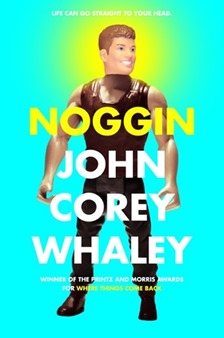
Review: Noggin by John Corey Whaley

noggin

Noggin by John Corey Whaley

Travis died five years ago.  Now he’s alive again.  But not the same and nothing else is the same either.  Travis’ head is now attached to a different body, a healthy body, one not dying of cancer.  You see, when Travis was dying of cancer, he and his parents took a huge risk and had his head severed from his body and frozen.  Now Travis is one of two survivors of the cryogenic procedure and he has returned to the same home, the same parents, the same friends, but not the same life.  His girlfriend is now engaged to someone else.  His best friend who had admitted he was gay just before Travis died is now dating a girl and about to move in with her.  His mother can’t look at him without crying.  And Travis’ room which used to be his haven now is sterile and hotel-like.  But Travis is the same except for his body.  It was as if he closed his eyes and reopened them.  So what is a guy to do?  Well, he still has to finish high school, get his driver’s license and of course try to regain the girl.  But nothing is simple when you are on a completely different timeframe than everyone else!

Whaley blends immense amounts of humor into his novel.  Though Travis’ experience is unique, it also speaks to the universal experience of being a teen, of not fitting in, of making bad decisions, and yet of being vitally alive at the same time.  Whaley also cleverly turns the trend of books about dying teens on its head (pun intended).  This is a book about life but also deeply about loss, grief and death and how funny it can all be. 

What is most surprising about this book is the honesty it has and that through its humor there are deep truths revealed.  Whaley deals with the emotions of Travis’ return beautifully like in this scene on page 40 when he sees his best friend for the first time:

He let go for a second and wiped his face with the back of one sleeve before holding me by each shoulder and sort of just staring at me for a while with this expression that I’m still convinced no other person has ever had, a combination of shock, joy, pain, and terror.  It was like I could see all his memories of me projected into the air between us, rushing and swirling around and enveloping us both in a nostalgic haze.

This book has tremendous heart and a strong sense of its absurdity.  It has depth, humor and cool scars too.  Pure teen reading perfection.  Appropriate for ages 14-17.

Reviewed from copy received from Atheneum Books for Young Readers.

Review: Hidden by Loic Dauvillier

hidden

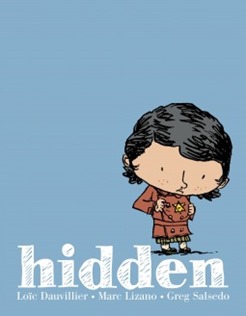
Hidden: A Child’s Story of the Holocaust by Loic Dauvillier, illustrated by Marc Lizano and Greg Salsedo

Translated from French, this graphic novel delicately but powerfully explains the impact of the Nazis on a child.  Told by a grandmother to her granddaughter, this is the story of Dounia, a young Jewish girl whose life changes when the Nazis come to Paris.  First she has to wear a yellow star, then she stops attending school, and finally her parents are taken away and she is sheltered by neighbors.  She has to call the neighbor woman “mother” even though she doesn’t want to.  The two flee Paris and head to the countryside where Dounia is able to live comfortably with enough food, but worries all the time about whether she will ever see her parents again.  This is a book about families but also about those people thrown together by horrors who become family to one another to survive.

Dauvallier first offers a glimpse of what Dounia’s life was like just before the Nazis arrived.  Quickly though, the book changes and becomes about persecution and the speed of the changes that Jews in France and other countries had to endure.  Isolation from society was one of the first steps taken, the loss of friends and mentors, then the fear of being taken away or shot entered.  But so did bravery and sacrifice and heroism.  It is there that this book stays, keeping the horrors at bay just enough for the light to shine in.

The art work is powerful but also child friendly.  The characters have large round heads that show emotions clearly.  There are wonderful plays of light and dark throughout the book that also speak to the power of the Nazis and the vital power of fighting back in big ways and small. 

A powerful graphic novel, this book personalizes the Holocaust and offers the story of one girl who survived with love and heroism.  Appropriate for ages 9-12.

Reviewed from copy received from First Second.