Review: The Wild Book by Margarita Engle

wild book

The Wild Book by Margarita Engle

Told in poems, this is the story of Engle’s maternal grandmother and her struggle with dyslexia.  Known as Fefa, her grandmother was diagnosed with “word blindness” and told she would never read or write.  Luckily, Fefa’s mother has an idea.  She gives her daughter a blank book to fill with words, as if she is scattering wildflower seeds on the ground.  At first Fefa’s words are hesitant and stilted, like seedlings.  But steadily her writing and reading improve as she learns to take her time and gains confidence.  And that reading is what saves her and her siblings from being kidnapped in the chaos following Cuba’s fight for independence.

Engle writes a gripping series of poems that range from celebrating the written word to the difficulties of dyslexia to the triumph of overcoming.  Over the entire book the threat of violence and kidnappings hangs low and dark.  It is clear that this is not a modern story from the very beginning and Engle cleverly reveals the extent of the chaos the family is living in the midst of through Fefa herself and her own growing knowledge.

As always, Engle’s verse is exceptional.  Often her individual poems could be read one their own.  Yet it is as one complete story that they really show their beauty.  There are many exceptional stanzas to share, but one of my favorites comes early in the novel:

Frog Fear


My little brothers love

to frighten me

by hiding lizards,

bugs, and spiders

in my bloomers.


Today it’s a frog,

but they tell me it’s a snake,

so I scream and tremble

until I can clearly see

that the little creature

jumps around

like jittery letters

on a blinding

page.


The skin of a frog

feels just as slippery

and tricky as a wild

inky word.

Engle traces the love of words and poetry Fefa’s own mother, who shares poems with her family.  It’s a beautiful celebration of that history and those words.

This novel in verse is a powerful look at Cuba’s history and also at dyslexia and overcoming challenges.  Appropriate for ages 9-12.

Reviewed from library copy.

Review: Daddy Christmas & Hanukkah Mama by Selina Alko

daddy christmas and hanukkah mama

Daddy Christmas & Hanukkah Mama by Selina Alko

Sadie celebrates both Christmas and Hanukkah in her house.  Their family celebrations are a delightful mix of the two holidays.  Latkes are on the mantel waiting for Santa to come, he’s a big fan of the family recipe.  Carols are sung about dreidels and mangers.  Gelt is spread under the Christmas tree.  Food is a huge part of both traditions and then stories are shared from both as well.  This is as warm and joyous a celebration as anyone could wish. 

Alko nicely draws both holidays together, mixing them into something that is even more lovely and amazing than either of them alone.  It is a testament to how families that come from two different faiths can honor both of them and also create something uniquely their own.  My only complaint is that there isn’t an author’s note discussing the two holidays in more detail.

Alko’s illustrations are done in collage.  She combines the detail and texture of textiles with paint and paper cutouts.  The incorporation is done in a subtle but effective way, the different types catching your eye and adding depth.

A great pick for the holidays, this book will reach families who are themselves creating new traditions from old.  Appropriate for ages 4-6.

Reviewed from copy received from Knopf.

Review: The Revolution of Evelyn Serrano by Sonia Manzano

revolution of evelyn serrano

The Revolution of Evelyn Serrano by Sonia Manzano

It’s the summer of 1969 and garbage is piling up on the streets of Spanish Harlem.  Evelyn, who has changed her name from Rosa, has a new job at the Five and Dime.  It’s a lot better than her job in the family’s bodega.  But that summer is not going to be a normal summer at all.  First, Evelyn’s grandmother arrives, complete with large amounts of stylish clothes, makeup and books in Spanish.  If Evelyn thought she didn’t get along with her mother, that’s doubly true of her mother and her grandmother who seem to be opposites on everything.  One big thing that they disagree about is the Young Lords, young college students who are trying to get the Puerto Ricans in Spanish Harlem to stand up for themselves.  They want to find space for a daycare, a place to serve breakfasts to youth, and a place to hand out clothing.  Evelyn finds herself right in the middle of a revolution, one that her own family can’t agree about. 

Manzano, the actress who played Maria on Sesame Street, has followed up her successful picture book with a book for older readers.  Ideal for middle schoolers, this book addresses family issues that can be far more complicated than just not agreeing about food and clothes.  It also takes on a history that not many readers may know about, a peaceful revolution right in New York City. 

Manzano’s writing is very straight-forward, rarely heading into figurative writing or symbolism.  When she does work with imagery, it is very effective, making one hope that in her next books she writes with more depth.  That is not to say that this book is not effective as it is written.  But it remains more factual and solid.

A strong addition to any collection, this historical fiction novel will both instruct about history and inspire activism.  Appropriate for ages 10-12.

Reviewed from ARC received from Scholastic.

Review: Twelve Kinds of Ice by Ellen Bryan Obed

twelve kinds of ice

Twelve Kinds of Ice by Ellen Bryan Obed, illustrated by Barbara McClintock

Oh my.  There are few books that leave me with tears standing in my eyes at the end, especially books of a spare 64 pages.  This one did. 

I suppose I could leave my review at that, but here are some details for those who need more.  This tightly written and beautifully illustrated small book looks at the twelve kinds of ice that happen in the course of a winter.  It all starts with the first ice which is the thin ice on top of a bucket in the barn that breaks when you touch it.  From there excitement builds as slowly the ice gets thicker and more able to be skated on.  Some ice like field ice and stream ice can be skated on, but it’s tricky.  Garden ice is the ice rink that the Bryan family created in their garden, made by packing the snow very firm and then spraying it with the garden hose.  It is that family skating rink that is really celebrated in the book, showing a strong family and their mutual connection through ice skating.  Even the ice skaters and hockey players get along.  Most of the time!

Obed is telling the story of her own family and their love of skating.  Her writing is so beautiful and strong.  She tells a story with depth and feeling, celebrating winter, ice and the thrill of skating.  Seeing how short the book is, one wonders how she managed to tell so much in so few pages.  Her prose invites us into her family and onto ice skates.  Alongside her, we don’t so much as wobble but instead skim across the ice at her side.  It’s an exhilarating and intensely personal read.

McClintock’s illustrations are entirely black and white in the book.  She captures a timelessness in her images, celebrating the family and natural surroundings.  She also shows the movement of skating and its thrill.

This is a quiet book, one that will need some push to get it into children’s hands.  I can see it being part of anyone’s holiday and also a great gateway to talking about your own memories of childhood and special things your family does together.  Quiet but powerful and immensely satisfying.  Appropriate for ages 6-9.

Reviewed from library copy.

Review: Lemonade in Winter by Emily Jenkins

lemonade in winter

Lemonade in Winter by Emily Jenkins, illustrated by G. Brian Karas

Pauline is the one who looks out on a blustery winter day and thinks of running a lemonade stand.  Her little brother John-John immediately thinks it’s a great idea, but her parents are sure it won’t work.  So the kids set out to collect enough money to open their stand.  They dig in the couch, search pockets, and look in their piggy banks.  At the store they spend 24 quarters or six dollars on supplies.  They rush back home to make the lemonade, the limeade and the lemon-limeade and then out onto the street to set up their stand.  But no one comes.  Then they decide to start marketing their stand more, and surprisingly, there is a market for lemonade in the snow.

Jenkins has taken a picture book and inserted math in places that make sense of the story.  This is one book where the math really works, the counting of coins, the discounting of items, and the profits made.  It’s a book that can be read just for the cheery enjoyment of lemonade and snow too.  The writing is clever with the adults constantly warning the children that it won’t work and an ending that is realistic, warm and refreshing.

Karas’ illustrations are done in his signature style.  I enjoyed seeing children with brown skin in a story that is not about their brown skin at all, it’s just the way they look.  Karas’ art is lively and rich with small details.  The careful counting of the quarters at the grocery store is just one example of how he too skillfully melded in the math with the story.

A winning picture book with math at its heart, this is a story that will have you asking for some more lemonade on a winter’s day.  Appropriate for ages 4-6.

Reviewed from copy received from Random House Children’s Books.

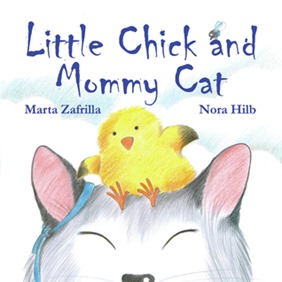
Review: Little Chick and Mommy Cat by Marta Zafrilla

little chick and mommy cat

Little Chick and Mommy Cat by Marta Zafrilla, illustrated by Nora Hilb

Little Chick has been raised by Mommy Cat since she was still in an egg.  When Little Chick was very small, he thought that he was a cat too.  He tried to be a cat, but it didn’t work.  He couldn’t meow, or lick his paws or flick his tail.  His mother explained to him that he was not a cat, but a chick and his real mother was a hen. When the two of them would go out, others would stare at them because they were different.  His mother told him that it’s not bad to be different, what is bad is to want to be like everyone else.  His mother also made sure to give him time to be with other chicks by taking him to the Bird School so he could learn everything he needed to about being a chicken. The other chicks asked him all sorts of questions because his mother was so different from the others.  Little Chick though is happy to be part of his different but very loving family.

This picture book speaks directly to the issues of diversity and different types of families.  It will also be happily embraced by families who have adopted children, because it manages to explain clearly and with no hesitation the basic love and acceptance of diversity in adoptive families.  Small children will respond to the animal characters but easily also draw connections to themselves.

Zafrilla’s text is straight forward, tackling larger issues and bringing them to a level that small children will easily understand.  She builds an unlikely family and happily shows the love and attachment between a cat and a chick.  This is a book that is unlikely to be read as a straight animal story, because the connection to adoption is so clear.  That said, the clarity and honesty here is what makes it shine.

Hilb’s illustrations add a colorful touch to the story.  The colored pencil illustrations use delicate lines and soft colors to tell the story.  The feathers and fur beg to be petted with their textures. Hilb maintains the size difference throughout the story, further emphasizing the differences between the cat and her chick. 

This picture book focuses on diversity, love and the many forms it can come in.  Appropriate for ages 4-6.

Reviewed from copy received from Independent Publishers Group.

Review: Ask the Passengers by A. S. King

ask the passengers

Ask the Passengers by A. S. King

Astrid wishes there was someone who could just listen to her without pressuring her.  Her mother is too pushy and driven to confide in, her father too withdrawn and high.  Her younger sister makes jokes that would make it impossible for Astrid to tell her the truth.  The truth is that Astrid has been kissing a girl and may just be in love with her.  But Astrid isn’t sure that she is really gay.  It may be that she just loves Dee for being Dee and not because they are both gay.  To make matters worse, Astrid’s best friends are in a fake relationship to keep their own secrets.  Astrid spends a lot of time on the picnic table in her backyard watching the planes fly overhead.  She beams them her love, tells them her secrets, and asks them for advice.  When the gay club that she and her friends frequent gets raided, Astrid is forced to start to confront the truth about herself, her family, and her friends.

King has captured the story of a girl questioning her sexuality here, but the story also transcends that and will reach teens who are questioning other aspects of themselves too.  It is a story that encapsulates that particular blend of wonder and fear that comes as a teen who is learning about themselves in such a private way that the rest of the world doesn’t change along with them.  Beautifully written, this is a book that speaks to the fragility and yet strength of that time.

In addition, King has created such a strong character voice here.  It rings with truth, never becoming snarky but really capturing a teen aspect.  Astrid’s messages to the plane passengers add an additional sense of magic and wonder to the story.  As she beams her love up, passengers receive it, make decisions based it, question their own lives, and react.  It adds an important dimension to the book, showing that throughout our lives people are still questioning.

This is a striking read with a vibrant heroine and a radiant point of view that itself beams with love and acceptance.  Appropriate for ages 16-18.

Reviewed from library copy.

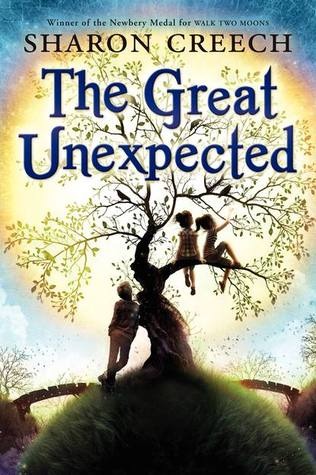
Review: The Great Unexpected by Sharon Creech

great unexpected

The Great Unexpected by Sharon Creech

When the boy falls out of the tree right at Naomi’s feet, she thinks it’s a dead body.  But instead it’s Finn, a boy who seems to have come from nowhere and be tied to no one.  Naomi too could seem adrift as an orphan, but after her father died a neighbor couple took her in and gave her a home.  Her best friend Lizzie is also an orphan and hoping to be adopted by her foster family.  Their story entwines with that of a wealthy woman in Ireland whose background is slowly exposed and the connections tightened.  This is a journey of a book, one that offers great eccentric characters, a town that has many secrets, and the amazement of unexpected ties to one another.

A new book by Creech is always something I look forward to and this is one of her best.  The intricate ties and reveals in the book make it a spectacular read and a book that unwinds like a curving road before you.  The writing is solid and lovely.  Creech takes the time to make each character special, even when just glimpsed for a single scene.  There is always something tantalizing about them and you know there are further depths there. 

Creech’s novel is all about hope and connections in life.  It is a book that uplifts and brings joy.  There is also some darkness here, death and life next to each other, survival and loss.  It is not an easy world that is portrayed here and things are not simple.  But there is beauty and hope and transcendence.

Highly recommended, this is a book that will delight Creech fans and create new ones.  Appropriate for ages 9-12.

Reviewed from copy received from HarperCollins.

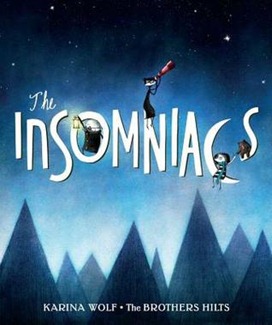
Review: The Insomniacs by Karina Wolf

insomniacs

The Insomniacs by Karina Wolf, illustrated by the Brothers Hilts

When Mrs. Insomniac gets a new job, the family moves 12 time zones to their new home.  They had been a regular day-light family, but in the new place they found it hard to stay awake in the day and fall asleep at night.  They tried everything from warm milk to meditation, but nothing worked.  Looking out of their dark windows, they discovered that there were many nocturnal animals out there.  There were bats, bears, and owls.  So the family decided to spend their awake time in the darkness.  They had breakfast at dusk, grew moonlight cactuses as a garden, studied the stars and attended night school.  They are a happy night-time family.

Wolf has created a gorgeous tribute to the wonders of the night here with a delight of a strange family as the lens.  There are such lovely little moments like watching “the fishes nipping at the surface of the sea: when the family goes moonbathing.  The family adventures out and finds the flower market open and the bakeries bustling.  It makes one want to head out in the darkness and see what is happening in your community.  There is also a memorable tribute to the dark side of nature and nocturnal animals that removes the scare and makes the entire nighttime welcoming.

The Brothers Hilts’ illustrations glow with the light of the moon and play darkness upon darkness.  The entire book is shadowy, but somehow also cheery and dazzling.  Darkness is celebrated in all of its black and blue beauty.

A treat of a picture book, this is a quirky winner that will have everyone staying up well past their bedtimes.  Appropriate for ages 4-6.

Reviewed from copy received from G. P. Putnam’s Sons.