Review: Who Put the Cookies in the Cookie Jar? by George Shannon

who put the cookies in the cookie jar

Who Put the Cookies in the Cookie Jar? by George Shannon, illustrated by Julie Paschkis

Lots of hands can take the cookie from the cookie jar, but even more are involved in getting the cookies there in the first place.  There are the hands that mix the dough and put it on the cookie sheet.  Then there are the ones that made the cookie sheet and oven mitts too.  Hands feed and milk the cow that makes the milk. Hands churn the butter.  Hands plant and harvest the wheat.  Hands feed and gather the eggs.  Many hands doing important work, make that cookie arrive in the cookie jar.

This is a great spin on a traditional song.  I’d pair it with the more traditional version in a program to get kids to see it from both sides.  Shannon celebrates all of the hard work that goes into things that we take for granted.  He focuses on their efforts but also on all of us being part of a larger global community that really matters. 

Paschkis’ illustrations have a warm feel to them.  They hearken back to more traditional images yet depict a modern and multicultural world.  Their bright colors really make the book pop and will work well with a large group.

Perfect for a cookie story time, I’d advise having some cookies to share when reading this and other cookie books.  Yum!  Appropriate for ages 2-4.

Reviewed from copy received from Henry Holt & Company.

Review: It’s Milking Time by Phyllis Alsdurf

its milking time

It’s Milking Time by Phyllis Alsdurf, illustrated by Steve Johnson & Lou Fancher

This picture book looks at milking time on a modern dairy farm.  A little girl works alongside her father.  She helps to bring the cows in from the field and then into the barn.  She scoops feed into their stalls and helps get the milkers ready.  Then she opens the big barn doors and the cows enter the barn and line up in their stanchions.  The little girl goes around and locks them.  Milking starts, and there are quiet moments to look out at the growing corn, but then milk is ready to be carried to the milk house, a pitcher filled for the family.  Then the calves must be fed, the manure shoveled, and finally the two walk up to the house in the twilight.

Told with great detail and a loving tone, this story shines with love for the heartland and dairy farms.  While the farm is clearly modern, there is a great timelessness to the story with the interaction of farmer and cows, the buckets of milk, and even the pitcher of milk for home use.  Alsdurf uses a refrain throughout the book, “Every morning, every night, it’s milking time.”   That repetition works well, reminding readers that this same activity happens over and over again on a farm.

The illustrations add to that feeling of timelessness.  They are done in soft colors with late afternoon light flowing golden over the images.  They also have soft edges, like favorite jeans that have been washed many times.  They are pure comfort.

For librarians in Wisconsin, this book is a natural fit.   It’s good to see a farm setting that is not historical but keeps that pastoral feel.  Appropriate for ages 4-6.

Reviewed from copy received from Random House Children’s Books.

Review: Kindred Souls by Patricia MacLachlan

kindred souls

Kindred Souls by Patricia MacLachlan

Billy has lived on the farm his entire life.  He was raised in the sod house that is now tumbled down and covered by weeds.  Billy is the center of his grandson Jake’s world, especially their walks around the farm together.  Jake gets to see the farm through Billy’s eyes and spend time as his kindred soul.  When Billy gets sick, Jake isn’t worried.  He knows that Billy will live forever.  There’s only one wish that Billy has ever spoken about and that is having another sod house built on the farm.  As Billy recuperates in the hospital, Jake and his older brother and sister decide to build a house for him.  But the job is huge and Billy is coming home soon.  Can they pull off the special surprise?

MacLachlan excels at creating great depth in small packages.  This is another of her very short books that plunges readers into a family and immediately takes up space in your heart.  There is the beauty of a long life lived on a farm that is almost spiritual.  There is a young family that has an elder as their center.  And then there are the small moments that create their days and weave together a story that is bittersweet in the best way.

This small book looks at the role of grandparents in the lives of children in a quiet yet powerful way.  Billy is the center of the book, since he is the center of Jake’s world.  The book, told in the first person by Jake, also explores connections between generations that are strong and true.  The sense of kindred spirits is strong but never overplayed.  This entire book exudes a quiet strength that makes for a compelling read.

A strong book that would make a great read-aloud (especially by grandparents), this book is a beauty.  Appropriate for ages 7-9.

Reviewed from library copy.

The Good Garden – Informative and Radiant

The Good Garden by Katie Smith Milway, illustrated by Sylvie Daigneault

The author of One Hen: How One Small Loan Made a Big Difference continues to explore the impact of education and funding on poor communities.  Here, she has written a book about a farming family in Honduras who learn techniques that allow them to grow enough food to feed themselves and earn enough money to secure a positive future for the family.  Maria Luz and her family have run out of food so her father must head out of town to find enough work to pay for the seed to plant next year because they will have to consume what they would have saved.  He leaves Maria Luz in charge of the garden while he is gone.  At school, she learns about compost, terrace gardening, and other ways to keep the soil fertile.  When her father returns, he is surprised by her success.  He and Maria Luz work with her teacher to avoid selling their produce to the local coyote and instead sell it themselves at a market and purchase seeds themselves.  Through one man’s efforts to educate, an entire village is transformed.

The author here has taken her subject very seriously, as is appropriate.  The text is lengthy for a picture book, but helps explain the impact of food insecurity around the world.  While this is not a picture book to add to a story time, it will be of value for elementary children who are learning about the world, gardening and food.  It is a book that teaches and informs.  Smith Milway’s text does not shy away from the control of the coyote, the fear of starvation, or the loss of families who leave to live elsewhere.  Her words convey it all with a seriousness and gentleness that is lovely to read.

Daigneault’s illustrations seem to glow with an inner sun.  Her use of colors is dynamic at times and subtle at others.  In all of her pictures, there are flowing lines that help depict the beauty of the Honduran landscape.  The illustrations help bring the text to life, making the book even more appealing.

An important book for children to better understand the world they live in, this book is informative and radiant.  Appropriate for ages 6-9.

Reviewed from copy received from Kids Can Press.

You can visit The Good Garden website at: http://www.thegoodgarden.org/ where you can learn, play or help make a difference.

And check out the book trailer:

Also reviewed by:


Enhanced by Zemanta

Up We Grow! – Glorious Farm Life

Up We Grow! A Year in the Life of a Small, Local Farm by Deborah Hodge, photographs by Brian Harris

This book shows the beauty and work of running a small farm.  The book moves from season to season, highlighting the work being done at that time.  In spring, seeds are sown, plants are transplanted, compost is spread.  In summer the animals and plants are growing bigger.  The flowers are blooming, bees are buzzing, crops are being harvested, and they have a farm celebration.  In fall, it’s harvest time for crops and for honey.  The farmers markets are active and the farmers are saving seeds to use next year.  In winter, it is slower.  The farmers repair their equipment, feed their animals, and grow plants in the greenhouse.  This book offers lots of information in friendly green boxes that specifically talk about sustainable practices.  It is a gentle way to introduce organic farming to young readers.

Hodge’s text is refreshingly light in tone, often asking readers to talk about their own experiences.  Her use of text in boxes for the more dense, factual portions works very well, making the book flexible for different ages and audiences.  Harris’ photographs really capture the fresh air and sunshine of a farm.  From friendly animals to deep rich soil, his photos are interesting and vibrant.

A book that will have everyone wanting to munch some farm-fresh veggies and visit a friendly goat or two, it is a warm invitation to investigate small farms in your area or at least spend some time at a farmer’s market this fall.  Appropriate for ages 4-6.

Reviewed from copy received from Kids Can Press.

Farm

Farm by Elisha Cooper

An  inviting mix of vistas across flat farmland and isolated bits of the farm on white backgrounds, Cooper has created a book that really captures the seasons on a farm.  From the family, animals, buildings and equipment to the everyday world of chores and work, this book is honest and accurate about farm life.  Children will delight in the small moments of the farm, especially those involving the tractors and the animals.  The book is laid out as a cycle, moving from spring through fall, encapsulating the growing season.  This is a great introduction to farm life for children, both rural and urban.

Cooper’s text gives small details constantly, seeding the book with facts large and small about farming in general and about this family farm in particular.  Simply telling the names of the different cats is time well spent and interesting.  Cooper’s art is done with simple lines and earthy colors.  His mix of landscape vistas with small images is dynamic and keeps the book fresh and interesting.  Because of the small size of many of the illustrations, this book will be best used by one child at a time who will take the time to wonder along with Cooper about what animals are thinking and whether they are deep in thought when not eating.

This is a book to linger with, turn the pages back and forth, breathe in the country air, and also take your time thinking deep thoughts.  Appropriate for ages 4-7.

Reviewed from copy received from Scholastic.

Also reviewed by Young Readers, Back to Books, and A Year of Reading.

Drizzle

Drizzle by Kathleen Van Cleve

Polly Peabody knows that her family’s rhubarb farm is something special, even something magical!  They grow Giant Rhubarb that is helping close the hole in the ozone and chocolate rhubarb that tastes like a sweet but is a vegetable.  They have a lake that you can’t drown in no matter how long you hold your breath, a castle to live in, and gems sprout from the ground.  And every Monday at 1:00 pm exactly, it rains.  But then one Monday it doesn’t.  And other things start to go wrong on the farm.  The rhubarb begins to wilt even though it is being watered by hand.  The umbrella ride fails when people are riding it.  A strange fog is starting to cover some of the farm.  It is up to Polly to find out what is causing the damage and save their farm.  To do that she will have to face her fears, uncover family secrets and trust in the magic of the farm.

This enticing tale is a pleasure to read.  Van Cleve has created the farm of childhood dreams filled with dessert that is healthful, carnival rides, friendly bugs, animated plants, and much more.  She writes with a light friendly tone that never gets bogged down in elaborate descriptions or overwriting, which is a fear with books of this sort.  Instead, she allows the magic to shine and the imagination to soar.

Polly is a great protagonist who is painfully shy, bullied at school, and yet one of the most fascinating people you could meet.  As she learns that she is much braver and more skilled than she ever dreamed, Polly begins to let others into her world and make friends.  Yet it is not that simple, and her struggles with self-reliance, family secrets, and friendships make for great coming-of-age story material.

A large part of the book’s appeal is the tension between the magical and the mundane.  Polly has to face school and all of its pitfalls as well as the desperate situation of her home and family farm.  While magic is involved, it actually makes Polly’s personal life outside of the farm more difficult.  The tension of classmates, news reporters, and magic make this book very special.

Highly recommended, this book is perfection for fans of Savvy by Ingrid Law.  It would make a wonderful classroom read and will be happily devoured by children who enjoy a lot of chocolate with their rhubarb.  Appropriate for ages 9-12.

Reviewed from copy received from Dial.

Check out Kathleen Van Cleve’s website.

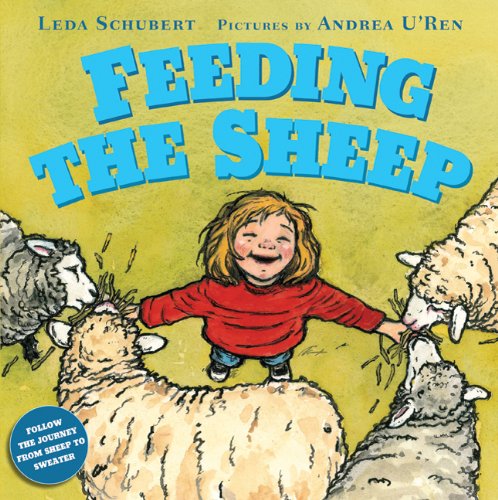
Feeding the Sheep

Feeding the Sheep by Leda Schubert, illustrated by Andrea U’Ren

Follow the process from sheep to sweater through the eyes of a young girl.  The book starts with feeding the sheep corn and hay on a wintry day.  Then it moves on to shearing, washing the wool, drying the wool, carding it, spinning the yarn, dyeing the yarn, and then knitting it.  Each step is done by the little girl’s mother to the refrain of “What are you doing?” The book uses gentle rhymes and repetition to show the steps as well as detailed illustrations where the young girl gets involved too.

This book is ideal for toddlers and preschoolers who will enjoy realizing where their sweaters come from.  The style of writing is approachable and gentle.  Nicely the book comes full circle back to the feeding of sheep, making the point that the cycle of sheep to sweater continues.  U’Ren’s illustrations are filled with homey touches and small details, yet they will work well with a group.  A wonderful touch is the changing of the seasons throughout the book, often glimpsed only out of the window.  This again underlines the cyclical nature of farming.

Short sentences with plenty of rhythm and repetition, make this a friendly choice.  It is also a joy to read aloud.  Appropriate for ages 2-4.

Reviewed from library copy.

Oh Crumps!

Oh, Crumps! by Lee Bock, illustrated by Morgan Midgett

Farmer Felandro is so very tired.  He has a lot to do tomorrow: milk the cows, fix the fence, mow the hay and climb the silo.  And morning comes so early.  As he is falling asleep, he hears the goats Maahing outside.  Oh crumps!  So he puts on his boots and heads out to put them in their pen.  Back in bed, he goes through his list of chores for tomorrow mixing his words up, and then hears the dogs barking.  On go the boots, out to the barn, gets the dogs settled, back in bed, list of chores, and another animals makes noise outside.  This happens again and again, until finally it is dawn and the day has begun.

This book has a very nice mix of humor and traditional feel.  Bock has created a story with a natural rhythm that will have young listeners feeling immediately at home.  Yet he also has created a very nice running gag as the farmer mixes up the words on his list of chores, leading to him thinking about fixing the cow and milking the fence!  Midgett’s illustrations merrily follow these words, so that we can see the farmer sitting with a bucket milking the spotted fence.  Her art will project well to a group of students with its thick lines and deep colors.

Highly recommended as an addition to farming story times or as a great bedtime choice, this book comes in both English and bilingual (English/Spanish) version.  Appropriate for ages 3-6.

Reviewed from ARC received from publisher.