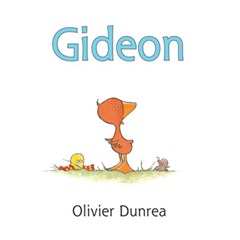
Gideon by Olivier Dunrea

gideon gideon and otto

Gideon by Olivier Dunrea

Gideon & Otto by Olivier Dunrea

Gideon is the newest fowl in Dunrea’s farmland.  He is a gosling who loves to play, hates to nap, and has a favorite toy, an octopus named Otto.  In the book bearing just his name, Gideon is hard at play and refusing to listen to his mother call him for his nap.  He just keeps racing on to the next thing to play with.  Readers who are paying close attention will notice that he starts slowing down towards the end of the book, just before he falls asleep all on his own.  In Gideon & Otto, Gideon is once again hard at play on land and in the water.  Otto participates happily, listening when books are read aloud, hiding in the leaves, and even bobbing in the water.  When Gideon sets Otto aside to play more, he instructs Otto to stay there.  But in the midst of playing, Otto gets knocked down and then disappears.  Gideon is about to give up when Otto appears again.  Filled with appeal, these books are jolly additions to Dunrea’s menagerie.

Toddlers and their parents will immediately recognize moments out of their own days here.  From being too busy to nap to losing a beloved toy, these moments are what create the tapestry of young lives.  Told with a wonderful humor, zinging with speed and action, these books beg to be shared.  In fact, when I was curled up to read them to myself, my 10-year-old appeared and insisted that he be read them aloud.  There is such charm to just the covers and even more inside the pages.  These are small books that are very rich.

Perfect for busy toddlers who need some time to slow down a bit.  Appropriate for ages 2-4, or for 10-year-olds who need a cuddle too.

Reviewed from library copies.

Review: Blue Chicken by Deborah Freedman

blue chicken

Blue Chicken by Deborah Freedman

This vibrant picture book plays with color and perspective as well as characters who leave the flat page and enter the real world.  The picture is almost finished when one of the chickens in the picture pops her head out.  She then stands up and walks over to the paint pots that are waiting to finish the picture.  When the chicken peeks into the blue paint, she accidentally tips it over and ends up painting herself.  She is joined by a little duckling and then more who splash around in the new blue puddle, turning themselves and the cat who walked past blue.  Soon all of the animals are blue.  Now what can be done to turn them all back to normal?

There is a wonderful playfulness about this title.  Even the grumpy animals end up enjoying the escapade.  At the same time, there are lots of options to discuss colors, perspective, and art.  The book has real depth to it, allowing it to be read just as a cute story, or used more seriously with children. 

The words are simple and try to stay out of the way, allowing the art to really shine here.  And shine it certainly does.  It dazzles and glows, inviting young readers into the humor of the book and revealing a magical quality that is lovely.  From the freshness of the first spill of the blue to the sogginess and flatness that results, there is an exploration of the media here right on the page. 

Highly recommended, this is one of my favorite picture books of the year.  It is a charming jewel of a picture book that is fun, silly, yet offers plenty to learn.  Appropriate for ages 3-6.

Reviewed from copy received from Viking Books.

Also reviewed by Fuse #8.

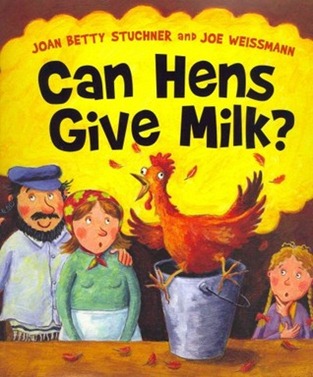
Review: Can Hens Give Milk? by Joan Betty Stuchner

can hens give milk

Can Hens Give Milk? by Joan Betty Stuchner, illustrated by Joe Weissmann

Shlomo and Riva live on a farm where they have five children, twelve hens and one rooster.  Rivka wishes that they had a cow to give the family milk and cheese.  That night, Shlomo had a dream that showed him what they could do.  Cows eat grass and give milk, so he reasoned that if the hens were fed grass, they would give milk too.  But the hens refused to eat the grass.  One of the daughters, Tova, came up with the idea of rolling the grass into pellets that look like the grain that the hens usually eat.  But even then, the hens would not eat the grass.  There was only one thing to do, and that was to force the hens to each eat one pellet of grass.  The family then left them to lay eggs and give milk overnight.  What do you think happened next?  All I will say is that in the end, the family had eggs AND milk.  But how?

This story of a fool and his family is written with great humor.  Children will immediately recognize the nonsense of the logic that Shlomo and his family are using, so they will enjoy seeing the story play out.  There is plenty of opportunity for laughter as new solutions are generated and then also proven to not work.  It’s a story that will have you grinning just because of the silliness of the entire book.

Weissman’s art is bright and silly as well, reveling in the humor of the text.  The dreams of milk and cheese are brought to life as are the hiccupping and indignant hens. 

A silly book that will lend a lot of laughter to a unit or storytime on food, this book reads aloud well.  Appropriate for ages 4-7.

Reviewed from library copy.

Also reviewed by

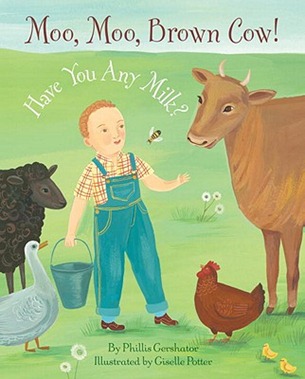
Review: Moo, Moo, Brown Cow, Have You Any Milk? by Phillis Gershator

moo moo brown cow

Moo, Moo, Brown Cow! Have You Any Milk? by Phillis Gershator, illustrated by Giselle Potter

An extended version of Baa, Baa, Black Sheep, this book adds new verses with additional animals.  It begins with the traditional rhyme which then changes a little with the wool becoming a blanket for the little boy’s bed.  The goose provides down for a pillow.  The hen has eggs, the bee honey, and the cow milk, which all make a perfect bedtime snack.  The animals then all head to bed too, and readers are left with the boy fast asleep in his bed with his stuffed animals tucked in close with him: a sheep, goose, hen, and cow.

Gershator has used the same rhythm as the original and it all fits nicely into the song pattern as well, so this book can be sung too.  With each new animal, she gently offers up the noise the animal makes, what that animal provides, and then a use for that product.  It’s a pleasant look at animals, farming and the connection between farm and end product. 

Potter’s illustrations have a wonderful folkart aspect to them that adds a timelessness to the entire book.  For a new version of a beloved nursery rhyme, this is just the right art to set the tone. 

This book is a solid addition to nursery rhyme collections.  Appropriate for ages 2-4.

Reviewed from library copy.

Book Review: Meet the Dogs of Bedlam Farm by Jon Katz

meetbedlamfarm

Meet the Dogs of Bedlam Farm by Jon Katz

This is the very engaging story of the four dogs who live with the author at Bedlam Farm.  Each of the dogs has a particular job that they do and do well.  All except for Lenore, she doesn’t have a clear job to do.  Rose, a border collie, helps out with farm chores like herding sheep.  Izzy is also a border collie, and his job is to visit people who are sick as a therapy dog.  Frieda, part rottweiler and par German shepherd, guards the farm, even chasing the farm cats up trees.  But what does Lenore do?  Lenore reminds Rose that it is OK to play.  She showed Izzy how to live in a house and eat from a bowl.  She shows Frieda how to be friendlier.  She has the most important job of all, creating a family from the individual dogs.

Katz has captured the personality of each of his dogs in both his writing and his photographs.  He tells the story of each of the dogs, how they came to live at the farm, and portrays the jobs that each of them have.  The book is engagingly written with a repeating question of “But what is Lenore’s job” at the end of each section on another dog.  The details of their lives are funny, touching and underline the connection of this family of canines.

An ideal addition to any public library, this book will fly off the shelves and into the hands of dog lovers.  Happily, it is also a nonfiction book that will work when shared aloud, so consider it for your next dog-themed story time.  Appropriate for ages 4-7.

Reviewed from copy received from Henry Holt & Company.

Also reviewed by BookDragon.

Check out the book trailer too:

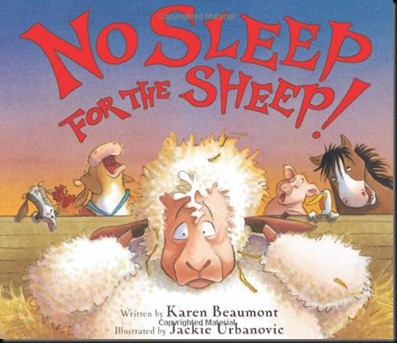
Book Review: No Sleep for the Sheep! by Karen Beaumont

nosleepforthesheep

No Sleep for the Sheep! by Karen Beaumont, illustrated by Jackie Urbanovic

A very silly read-aloud that follows in the tradition of funny bedtime stories set on farms.  Here, the sheep is very tired and wants nothing more than to go to sleep.  But one by one, he is bothered by animals.  First a duck, then a goat, a pig, a cow, and even a horse.  And no one leaves for their own bed, but instead joins the sheep where he sleeps.  And in the end, just when the sheep finally is able to fall asleep, there is one last noisy animal to wake him up.  This time with a COCK-A-DOODLE-DOO!

Beaumont has created a text that reads aloud beautifully.  It has a rollicking rhythm and a pattern that repeats again and again.  This makes it ideal for toddlers and young preschoolers, who will enjoy the repetition.  The humor of the text is delightfully simple, made from the silliness of animal noises and interruptions. 

Urbanovic’s art adds a jolly tone to the book.  The fuzzy and increasingly manic sheep, the rotund pink pig, and the mounds of sleeping animals add to the fun.  The facial expressions of the animals are funny all on their own as well.

Add this to any farm story time or any bedtime story times you do.  It will be enjoyed by small children with big senses of humor looking to avoid going to bed.  Appropriate for ages 2-4.

Reviewed from library copy.

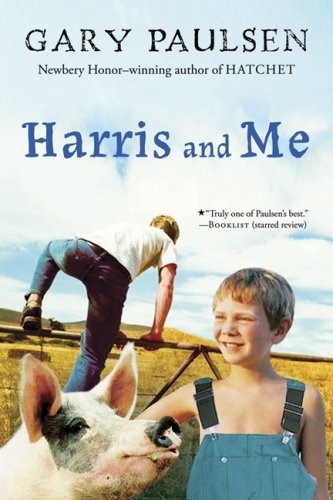
Harris and Me by Gary Paulsen–A Family Favorite

harrisandme

Harris and Me by Gary Paulsen

When I first read Harris and Me, I had it along with me on a family trip with my husband and parents.  I ended up reading entire portions of it aloud to a room of adults who all hooted and laughed and begged for me to continue.  Then when my older son was around the right age, I read it aloud to him.  He loved it.  This week, I finished reading it aloud to my younger son, who loves to be read to but doesn’t care to read to himself much.  He asked for his own copy so he could read it whenever he liked.

Some lines from the book have entered our vocabulary in our family.  If I get grumpy, my husband (far too often) says “Now, Buzzer…”  Whenever a little car revs past our house, I say “the engine starved for oxygen its entire life.”  And perhaps even worse, we all get the joke and laugh, immediately thinking of the scenes from Harris and Me.

Paulsen has created a book that is so funny.  It reads aloud like a dream, and having read it aloud cover-to-cover at least 3 times by now, I should know.  The humor is often naughty, involving things like peeing on an electric fence, being kicked in the groin by a cow, and attempting to kill a very evil rooster.  At the same time, it is belly-laugh funny, quoting lines great, and will linger with you after you finish it.

And the ending, well.  Let’s just say it’s the most challenging part to read aloud because no matter how many times I read it, I will always cry.

So if you are looking for a book to hook a kid with its humor, with its inappropriateness, with its pure appeal, look no further!  This one is a winner with every person I have ever shared it with.  It’s a definite family favorite for three generations of our family.

What the Ladybug Heard

9780805090284

What the Ladybug Heard by Julia Donaldson, illustrated by Lydia Monks

All of the animals on the farm make their own type of noise, except for the little ladybug.  She never says anything at all.  That is until she hears two robbers planning how to steal the farm’s prize cow.  They know just where each animal on the farm sits and what noises they make so that they can find their way in the dark without alerting the farmer.  So the ladybug heads to the farm, tells the animals about the robbers, and comes up with a cunning plan to foil them.  Told in a wonderful romping rhyme and rhythm, this book has immediate appeal.

Donaldson has a great ear for rhythm and rhyme, never pushing it too far to become annoying.  She weaves in humor effortlessly.  The premise for the book is very clever, mixing animal noises with a barnyard mystery and a silent witness.  Monks’ illustrations are done in mixed media which makes them visually interesting.  The painted sheep has a wooly coat that is a photograph of wool.  The bushes around the farm are either photographs of leaves or fabric.  There is just enough of the mixed media to still have a very cohesive feel. 

Get this into your farm storytime and also for any insect unit or story time.  It is a winner of a read, just be prepared for plenty of animal noises and ask the audience to help!  Appropriate for ages 2-4.

Reviewed from copy received from Henry Holt.

Also reviewed by Pied Piper Picks.

Mary’s Penny: A Feminist Folk Tale

45453047

Mary’s Penny by Tanya Landman, illustrated by Richard Holland

A feminist retelling of a classic folk tale, this book combines a stylish modern feel with the classic feel and tone of a folk tale.  A farmer needs to decide which of his children he will leave his farm to.  Will it be the brawny Franz or the beefy Hans?  He doesn’t even consider his daughter Mary because she is a girl, though Mary does have something her brothers lack: brains.  The farmer gives each of his sons a single penny.  Their challenge is to purchase something with their one penny that will fill the entire house.  Franz heads to the market and purchases lots and lots of straw, but he cannot manage to fill the entire house.  Hans heads to the market and purchases lots and lots of feathers.  Though he fills the house further than his brother, he too fails.  Now the farmer is in despair until Mary asks to try.  And you will just have to read the book to find out how Mary spends her penny and fills the entire house.

Landman’s text here sets just the right tone.  She plays with the repetition and rhythm of the traditional folk tale, yet injects a modern sensibility about the role of women in society.  Thanks to the traditional features of the book, it is a pleasure to read aloud.  Holland too plays with the traditional and modern.  In his case, he uses sleek modern lines and modern illustration techniques yet still manages to have something vintage in them.  The illustrations have lots of white space and textures and patterns that make them very interesting and unique.  They also have a flatness that hearkens back to traditional folk art. 

A skillful combining of the traditional and the modern, this book should not languish on your folk tale shelves.  Get it into the hands of parents and teachers.  It would also make a great choice when librarians visit elementary classrooms, because its modern edge will draw slightly older children into the story.  Appropriate for ages 4-8.

Reviewed from library copy.