My Daddy Rules the World by Hope Anita Smith

My Daddy Rules the World by Hope Anita Smith

My Daddy Rules the World: Poems about Dads by Hope Anita Smith (9780805091892, Amazon)

Coretta Scott King Award winner Smith returns with a new collection of poetry and illustrations that focuses on fathers. The book shows fathers who make breakfast and chat contrasted with others whose work keeps them far away but still in contact. There are fathers who cut hair, others who dance, others who wrestle or play catch. They teach their children to ride bikes or play instruments or read. Each poem is told in the voice of the child of that father and shows how very different dads can be but that they all love their children completely.

Smith writes poetry that is thoughtful and honed. She makes sure that it is appropriate for the young audience, inviting young readers to explore poetry and see themselves in it. The poems are misleadingly simple, not showing the skill that it takes to write at this level and with such apparent ease.

Smith’s illustrations are diverse and inclusive. With her torn paper illustrations, she makes sure to show families of various races and multiracial families. There is a warmth to the illustrations and a folk-art element that underlines the richness of being a father and in a family.

A strong collection of poems for young people, ideal to share with fathers. Appropriate for ages 7-10.

Reviewed from library copy.
It’s Great Being a Dad by Dan Bar-el

It's Great Being a Dad by Dan Bar-el

It’s Great Being a Dad by Dan Bar-el, illustrated by Gina Perry (9781770496057, Amazon)

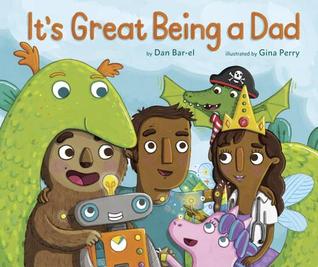
One by one, mythical creatures appear and tell the reader how great a life they have. The unicorn loves prancing and their gorgeous horn, but the horn does make it very difficult to eat, particularly if you get a table stuck on it. Bigfoot has a great time being strong and helping his friends, but his big feet can be a problem. The robot loves his flashing lights and memory, but rain is an issue. Then there is the Loch Ness Monster and the “fairy queen ballerina doctor” who help the others. But there are always problems like the sneaky flying alligator pirate. Who can help all of these mythical beasts? Dad, that’s who.

This book embraces the idea of creative and imaginative play completely as the children first introduce themselves as the characters they are pretending to be. Steadily though, the illusion breaks a bit as each new character is introduced and their personas get more complicated. Bar-el does a lovely job of allowing the fantasy to fracture steadily and then break altogether as Dad enters the picture.

Perry has created first a lovely fantasy world with rainbow colors, deep forests, lochs and castles. She then goes on to morph that into a multicultural family filled with children of all ages who are trying to play near one another if not together. The connection between fantasy and reality is strong in the illustrations and children will love seeing the ties.

A warm look at imaginative play and great parenting, this picture book is a celebration of dads. Appropriate for ages 3-5.

Reviewed from library copy.


Little Wolf’s First Howling by Laura McGee Kvasnosky

Little Wolf's First Howling by Laura McGee Kvasnosky

Little Wolf’s First Howling by Laura McGee Kvasnosky, illustrated by Kate Harvey McGee (9780763689711, Amazon)

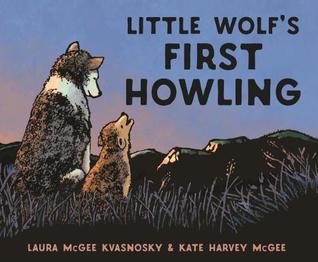
Little Wolf and his father head to the top of a hill for Little Wolf’s first try at howling at the moon. They watch as night falls and then Big Wolf demonstrates how it is done with a pure AAAAAAOOOOOOO. Little Wolf goes next, trying to imitate his father. But he can’t help but share his joy at it being his first howling as part of it with an “I’m hoooowling!” Big Wolf tells him that he started well but the ending was not proper form and demonstrates again. This time Little Wolf starts well again but soon adds his own interpretation. Once more Big Wolf demonstrates and again Little Wolf does his own things, this time getting his father’s paws to tap along. Soon the two of them are joining together in Little Wolf’s way of howling.

Kvasnosky’s text is simple and friendly. It will invite young listeners to howl along, so expect to fill your own space with lots of howling. As Little Wolf comes into his own in his personal way of howling, children will love the rhythms and jazzy nature of his voice. There is a great relationship between father and son in this book, a sense of patience emanates from Big Wolf while a wild playfulness exudes from Little Wolf.

McGee’s illustrations are done in gouache relief and capture the vibrancy of nature at dark. They are sprinkled with starlight and light from the moon. The medium also has lots of darkness and texture, creating its own shadows and organic qualities that add to the experience.

A howling good time, this picture book will be a pleasure to share aloud to your own group of little wolves. Appropriate for ages 3-5.

Reviewed from library copy.

Father’s Road by Ji-yun Jang

Father's Road by Ji-yun Jang

Father’s Road by Ji-yun Jang, illustrated by Tan Jun, edited by Joy Cowley (9780802854728)

Released March 30, 2017.

Wong Chung is excited to join his father on the Silk Road as they travel west to sell silk in Constantinople. There are many dangers on the trip and new skills to learn. Traveling on camels, they have to brave the desert and conserve water along the way. Wong Chung learned to cover his face against the blowing sand and find water and even food along the way in unexpected places. Then just as the journey was nearing its end, bandits attack them and kidnap them, stealing their silk. A sandstorm hits the bandit camp and Wong Chung makes a decision that will decide their fate one way or another.

This picture book about the Silk Road transports readers into the harsh terrain and the harrowing journey that used to be the way that trade was done. Through the eyes of Wong Chung, readers learn about the dangers and the wonders of the trail. They also grow to understand the importance of honor and duty in the culture.

Textured papers form the background of the illustrations, offering colors of sand, red mountains and occasional green. Drawn in fine lines, the illustrations of the camels and people meld with the setting to form a unified whole. There is a lovely organic quality to the entire book, drawing readers further into the desert journey.

Part of the Trade Winds series, this picture book is a glimpse into a bygone time of hardship and adventure. Appropriate for ages 4-6.

Reviewed from copy received from Eerdmans Books for Young Readers.

Garvey’s Choice by Nikki Grimes

garveys-choice-by-nikki-grimes

Garvey’s Choice by Nikki Grimes (InfoSoup)

All Garvey seems to do is disappoint his father. His father would like him to play sports and to enjoy them too, but Garvey isn’t athletic. He’d much rather read science fiction and learn about science. Feeling bad about himself, Garvey consoles himself with food and starts to gain weight. He has one friend, who encourages him to join the school chorus. Soon Garvey is making new friends and displaying his talent. He becomes the new soloist for the chorus and his interest in music starts to build a bridge to his father via a new route.

Told in verse, this book of poetry is brief and powerful. Garvey’s situation with his father reads a organic and volatile, the desperation to connect creating even more of a distance between father and son as the failures continue. Garvey’s use of food as a solace is intelligently done, offering hope that he can find his footing again but also not seeing weight loss as the ultimate solution or weight as the real problem. Verse allows Grimes to cut right to the heart of these situations, revealing the layers of issues at play.

Garvey is a bright, funny character. He is shown as a good friend, supportive and also accepting. As Garvey begins to reach out and try new things, he is rewarded by the chorus also reaching out to him. Again, the progress is done in a natural way. Nothing is perfect and there is no magical solution here. It is hard work, talent and slow progress towards a better place.

A shining look at loneliness, bullying and the ability of music to break down barriers. Appropriate for ages 8-12.

Reviewed from library copy.


Lucy by Randy Cecil

lucy-by-randy-cecil

Lucy by Randy Cecil (InfoSoup)

Lucy is a dog living on the streets. She has a routine each day where she dashes through the neighborhood and straight to an apartment building with a red door where she waits. Inside Eleanor lives with her father who dreams of being a juggler. Meanwhile Eleanor lowers breakfast on a string to Lucy waiting below her window. Around noon, Lucy settles in for a nap and dreams of the days when she lived in a grand house with her favorite stuffed toy. As the days go on, Lucy’s father tries to perform his juggling before a crowd but gets disastrous stage fright, Lucy continues to gather things to feed her new friend, and Lucy dreams more and more of her past life. As their lives converge together, one thing is certain that one small white dog can change your life!

Cecil’s book comes in four acts, each one building upon the next. The book has a lovely rhythm to it, ordinary days stack upon ordinary days, routines support other routines. It is a gentle way to build a story, a natural progression. And yet this book has a theatrical quality to it as well with each act building on the next, the juggling and subsequent disasters, and the drama of dangling breakfasts. It is a story that is uniquely told in its own time.

The illustrations are a large part of this book with the gangly humans and the compact little white dog that glows on the page. The illustrations have rounded edges, almost as if the reader was looking through a telescope to watch the action. This creates a sense of intimacy in the black and white illustrations.

A very special book about one little dog who seems to have lost everything but still has plenty to offer. Appropriate for ages 4-7.

Reviewed from ARC received from Candlewick.


Weekends with Max and His Dad by Linda Urban

Weekends with Max and His Dad by Linda Urban

Weekends with Max and His Dad by Linda Urban, illustrated by Katie Kath (InfoSoup)

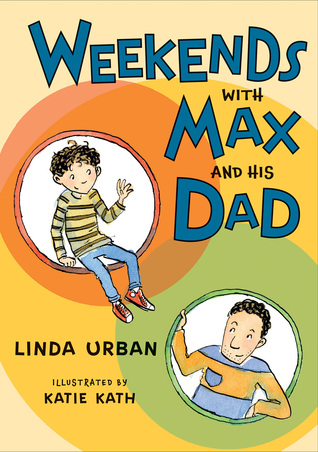
Max’s father has an apartment of his own now where Max spends weekends. On his first visit to the apartment, Max is amazed at how white and clean everything is. Everything except his bedroom which is filled with football things, even though Max doesn’t particularly care about football any more. He is much more into being a spy. So Max and his father spend their weekend getting to know his new neighborhood by dressing as spies, taking covert photographs, eating pancakes, and following a mysterious man. Following visits to his father’s apartment involve meeting the neighbors, walking dogs, doing some homework, having a friend over and buying a couch. As Max settles into his new weekend routines with his dad, he learns a lot about what makes a place a home.

Urban writes with a gentleness about this new circumstance in Max’s life. Max is refreshingly unburdened by guilt in his parent’s divorce. The focus instead is on the new place to live, figuring out the different relationship, and realizing that a person can happily have two homes. Throughout the book, real love and devotion is shown by both Max and his father. There is a beautiful flexibility from both of them in each story and also a willingness to listen and learn from one another. Each also takes care of the other emotionally, not wanting to hurt one another. Which is also a very nice change from children lashing out in books about divorce.

The illustrations by Kath make this book very approachable for young readers. They nicely break up the text, plus add to the humor. Readers can see Max’s father in his full spy disguise as well as enjoying the finished school project and the furry fun of two basset hounds. The pictures add to the warmth and love that exude from this book.

A loving book about father and son relationships after a divorce, this novel for young readers demonstrates that life and love continues. Appropriate for ages 7-9.

Reviewed from library copy.


My Dad at the Zoo by Coralie Saudo

My Dad at the Zoo by Coralie Saudo

My Dad at the Zoo by Coralie Saudo, illustrated by Kris Di Giacomo (InfoSoup)

This is the sequel to My Dad Is Big and Strong, But… which was a wonderful French import. This second book is equally dynamic and successful, continuing the role reversal between father and child in the first book. Here, the father and son head to the zoo together, because Dad just can’t wait to go there. He has trouble waiting in line without bouncing everywhere. Then he has to go to the bathroom. He has a melt down about not having any ice cream until his son distracts him with a porcupine. Even leaving the zoo is tricky, since Dad is sure to want a toy from the souvenir shop even when his son says no.

This book like the first has a gorgeous sense of humor throughout. The dynamic between father and son is reversed completely and children will get the humor effortlessly as they see their own potential behavior play out in an adult. The humor is never mean and always zany, creating a feeling that will make everyone smile.

Di Giacomo’s illustrations add to that zany humor as the very large father figure dwarfs his son on every page. Even his interactions at the zoo are played for laughs as he poses with his arm around the flamingos. The illustrations use subtle color and a cartoon style to create their own unique feel.

A great read aloud that is just right for any family, particularly after an outing. Appropriate for ages 4-6.

Reviewed from copy received from Enchanted Lion.


Thunder Boy Jr. by Sherman Alexie

Thunder Boy Jr by Sherman Alexie

Thunder Boy Jr. by Sherman Alexie, illustrated by Yuyi Morales (InfoSoup)

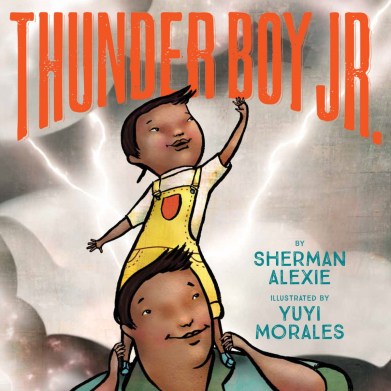
Thunder Boy Jr. is named after his father who is known as Big Thunder. But Thunder Boy wants a more normal name, like Sam which is what his mother wanted to name him. People call him Little Thunder, which sounds “like a burp or a fart.” Thunder Boy hates his name and wants one that is all his own. He thinks of other names that would be more cool and would speak to what he has done in life. He doesn’t know how to tell his father that he wants a different name, but his father may understand a lot more than Thunder Boy thinks.

Amazing, amazing, amazing. Alexie proves here that he can write for children with a voice that is clear and resonant. He writes almost like a poem, one that dances and moves. There is not a classic structure to the book, which makes it a treat to read. One isn’t quite sure where it is going to head next. There is the whimsical part there Thunder Boy is thinking of new names that shows again and again the actual power of his real name. Then his father steps in, showing his son that he understands him and builds upon the name he has been given. It is a book that takes you on a journey and by the end ties it all together.

Morales’ illustrations are luminous. She captures the emotions clearly with characters who pop against calm patterned backgrounds. The characters shine with an internal light that is very compelling. On every page, parenting with warmth and love is shown, just like it is in the story itself.

A powerful and beautiful picture book that respects modern American Indian culture and families. This book belongs in every library. Appropriate for ages 3-5.

Reviewed from library copy.