Hammer and Nails by Josh Bledsoe

Hammer and Nails by Josh Bledsoe

Hammer and Nails by Josh Bledsoe, illustrated by Jessica Warrick (InfoSoup)

Darcy’s day is ruined when her best friend gets sick and has to cancel their playdate. Her father suggests that they do a Darcy-Daddy Day instead, where they pick alternating things from their to-do lists until both lists are done. They start with coffee time, or chocolate milk time for Darcy. Then comes dress up where Daddy gets super fancy in a tutu and flannel shirt. Next the lawn gets mowed in a glamorous way. Hair Salon comes next until both Darcy and Daddy are fabulous. Laundry is a sock battle and then a quest to match each sock. The day ends with repairing the fence, something new for Darcy to try, and a manicure for the both.

An ideal father and daughter book that shows how open minds and playfulness can save a day from disaster. Parents will recognize their chores as the day goes on and then their aches and pains after playing too hard. Children will love seeing a dad get into imaginative play, wearing both a tutu and a headband with no care at all. There is a real sweetness to this book that captures the adoration between a father and daughter and one special day they shared together.

Warrick nicely captures the play as the two of them have their day together. Princess dresses and tutus get grass stained and hammers nicely fit into red purses too. The lawnmower takes on royal status with its umbrella and garlands too. Each little flourish is used to great effect and the interplay between the two characters is radiant.

A testament to the power of positive parenting, this picture book will be loved by fathers and daughters alike. Appropriate for ages 3-5.

Reviewed from library copy.
 

Booked by Kwame Alexander

Booked by Kwame Alexander

Booked by Kwame Alexander (InfoSoup)

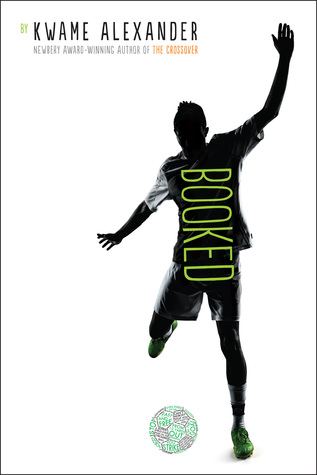
In his follow up to the Newbery-Award-winning The Crossover, Alexander once again blends sports and poetry. Nick loves soccer and is really good at it too. Nick and his best friend are on opposing teams in an upcoming soccer cup and Nick is also getting ready to ask out April, a girl he can’t stop thinking about. Everything is going well except for his father who insists that Nick read the dictionary of large words that he personally created. That’s when Nick finds out that his mother is moving away for a job working with horses, leaving Nick with his father, not a great combination. Nick will have to rely on soccer and his best friend to get him through this rough patch. Because there is more tough road to come.

Alexander is quite simply amazing. He writes verse that is both poetic and beautiful but also accessible and welcoming to young teens who may be far more interested in kicking a ball than reading a book, especially a book of poetry. Alexander also demonstrates throughout the book the power of words both in his poetry itself and through the story line, where Nick is clearly smart and uses words from his father’s collection without even thinking about it. Nicely, definitions are provided in footnotes.

Nick is a protagonist who is easy to relate to. He has several things on his mind: soccer, girls and gaming. It is life though that pulls him outside of those interests and broadens his scope. His father does this in a clumsy way, forcing Nick to learn words. A school librarian also helps, getting books that Nick will clearly love directly into his hands. So as much as this is a book about a smart young teen boy, it is also a book about the power of having adults who care in your life.

A worthy follow-up to his first verse novel, this book is just as beautifully written. Appropriate for ages 11-13.

Reviewed from library copy.


Review: The Plan by Alison Paul

The Plan by Alison Paul

The Plan by Alison Paul, illustrated by Barbara Lehman (InfoSoup)

Told in words that shift by one letter from page to page, this picture book is a lesson in imagination from its structure to its subject matter. A little girl makes a plan to take a plane up into space to Saturn. She lives on a farm with her dog who accompanies her everywhere. As they work on the farm, she discovers a key that unlocks her father’s photo album. There she discovers that he and her mother were pilots on The Mighty Comet. So the girl shares her plan with her father. They all work together to restore the airplane, allowing themselves time to grieve for the loss of her mother, and then all take off into the air together.

Paul demonstrates incredible restraint and control in the text of this book. Changing just one letter from page to page could result in a book that is stagnant, but instead this book explores and the story develops in a natural way. The simple text allows readers to fill in the story, to discover the key and what it unlocks, and to participate in the shared adventure. The component of the mother’s death is deftly handled, subtle and quiet.

With such simple text, the illustrations by Lehman really tell the full story. Done in watercolor, gouache and ink, they too share the quiet wonder of the text. They are done in deep colors that shimmer on the page, inviting the reader to look closely and explore.

A brilliant picture book filled with word play that is easy to read and a story with beauty and depth. Appropriate for ages 3-5.

Reviewed from library copy.

Review: Ask Me by Bernard Waber

Ask Me by Bernard Waber

Ask Me by Bernard Waber, illustrated by Suzy Lee (InfoSoup)

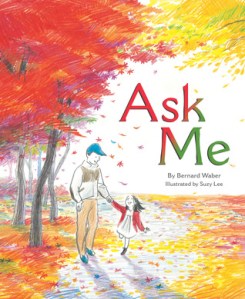
A little girl and her father take a walk through their neighborhood. Along the way, the girl asks her father to ask her questions like “Ask me what I like?” and he does, question after question. She finds a lot of nature along the walk to enjoy, from frogs to geese in the air and in the water, bugs, beetles, and flowers. She asks him to ask if she likes ice cream cones and they both happily walk away with cones after she announces how much she loves them. The two talk about trips they have taken together, favorite colors like the red balloon, stories, birds, and much more. Once back home, it’s time to think about her upcoming birthday and then time for bed.

Waber adeptly creates a realistic relationship between father and daughter here on the page. The use of her questions is particularly clever as it gives the book a repeating structure that feels natural and unforced. Parents will also recognize the way children want to be asked questions and have them answered. It is very effective to have this sort of relationship where the girl is saying what she wants out of their conversation and the father is happily agreeing. The entire day spent together is blissful and lovely and is entirely about their relationship with one another. Gorgeously structured and written.

Lee’s art is done in pencil. It dances along with gentle colors until suddenly fall bursts on the page. The deep rich colors don’t seem like pencil until you see the drawing lines on the page. The illustrations celebrate the closeness of this father and his daughter, playing with perspectives and celebrating their day outside in nature together.

Gorgeous illustrations and writing combine into one special picture book that is a dazzling book to share aloud. Appropriate for ages 4-6.

Reviewed from library copy.

Review: Dad’s First Day by Mike Wohnoutka

Dads First Day by Mike Wohnoutka

Dad’s First Day by Mike Wohnoutka (InfoSoup)

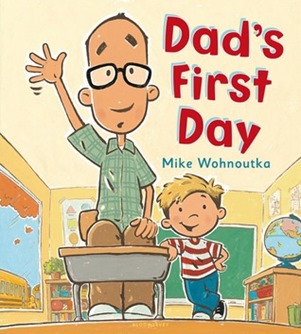
Oliver and his dad have had a great summer together, playing and doing so much. Now it’s time for Oliver to start school for the first time. Oliver is all ready and excited to go. But that first morning, Dad’s stomach starts to hurt. He’s nervous and when it’s time to leave the house he even hides from Oliver. But Oliver manages to get his dad to the car, though he drives to school very slowly. Once there, Oliver happily joins the class but his father starts to cry when it’s time for him to leave Oliver in school. Back home, Dad thinks a lot about Oliver and heads off to school to check on him. Through the door, he sees Oliver happily participating in class and realizes that they are both ready for school after all.

Wohnoutka takes the first day of school jitters and turns them on their head with this cheery picture book. The father in the book acts just like a child at times, adding to the broad humor in the book. Most of the time though parents will recognize their own feelings about a child entering school for the first time. It’s a great title to have conversations about how you and your child are feeling about school and the fact that you will both miss one another even when you are both ready to start school.

The illustrations are approachable and have a cartoony appeal. Dad in particular is a wonderful rendition of a middle-aged father. There is cause for celebration when you have a back-to-school book focused on a father who takes care of his child and then also cares so emotionally as well. The illustrations amp up the emotions and then take a humorous approach to keep the book sunny and silly.

A back-to-school book for the entire family, parents too, this picture book will have families laughing even as the first day of school approaches. Appropriate for ages 4-6.

Reviewed from copy received from Bloomsbury.

Review: Stella Brings the Family by Miriam B. Schiffer

stella brings the family

Stella Brings the Family by Miriam B. Schiffer, illustrated by Holly Clifton-Brown

Stella’s class is going to be celebrating Mother’s Day and all of the kids know who they will bring as their special guest.  But Stella has two dads and no mother, so who can she invite? Stella worries and worries about who to bring, and the other kids in her class start to ask her how she manages without a mother to do so much. Stella’s dads take great care of her along with a big extended family who give lots of love and kisses. When Stella talks to her dads about who to bring, they come up with a perfect solution and soon Stella has the largest group at the Mother’s Day party even though none of them are her mother.

Perfect for families of all sorts who may not fit the traditional stereotypical family, this picture book shows how a loving family can create their own unique solutions and fill them with their own joy. Schiffer clearly conveys the worry and stress that a child can feel in this sort of situation, not minimizing the emotional impact. At the same time, she also demonstrates how that can be so easily eliminated by a family that listens to concerns and solves problems in positive ways. This is one empowering story that many families will relate to.

The illustrations are filled with children of all races and the story also includes a family with two mothers. On the day of the party, there are also grandmothers there, speaking to that issue of working parents who may not be able to be there either. The inclusive art has a warmth to it that is conveyed by the caring adults and the brightly hued illustrations.

All public libraries need more picture book that embrace gay families, so this is a great pick for strengthening those collections. Appropriate for ages 3-5.

Reviewed from copy received from Chronicle Books.

Review: The Storm Whale by Benji Davies

storm whale

The Storm Whale by Benji Davies

Noi lives with his father in a house by the sea with six cats.  Every day, his father goes out fishing, leaving Noi alone all day long.  One day, after a big storm, Noi sees something out on the beach.  It’s a baby whale.  Noi knows it will not live long without water, so he takes the whale home and puts it in the bathtub.  He spends time with the whale, telling it stories.  But he also worries that his father will be angry when he finds a whale in the house.  So Noi tries to keep the whale a secret from his father, but it doesn’t last for long.  A whale is a big secret to keep in a small family.  Together, the two of them return the whale to the sea, but not before they each learn something about one another and how to move forward as a stronger family.

Davies manages to tell a profound story using minimal words.  The text in the book mainly explains the action that is happening.  It does not offer insight into the emotions of the characters.  That is a large part of the power of this book.  So much goes unsaid but is clear to the reader.  Noi’s loneliness is shown rather than told.  Him lingering by the window as his father leaves, the fact that he brings the whale home across a stretch of beach rather than pushing him back into the nearby water.  Even the father’s reaction is shown this way, allowing the emotions to be realized rather than explained.

The illustrations tell much of the story here, but again in a quiet and frank manner.  The emotions are not broadcast from the character’s faces but from their situations and their body language.  It’s a brave way to tell a story about a father and son reconnecting with one another.

Adeptly conceived and powerful, this picture book speaks to loneliness and family, and would be great as a discussion book for young children about emotions.  Appropriate for ages 3-5.

Reviewed from copy received from Henry Holt and Co.

Review: Grandmaster by David Klass

grandmaster

Grandmaster by David Klass

Daniel is a freshman in the chess club of an elite private school.  He knows he’s one of the poorest kids attending the school, one of the least popular, and also one of the worst chess players.  So he’s surprised with two popular and wealthy seniors approach him to invite Daniel and his father to a father son chess tournament in New York City.  He’s even more shocked to find out that his own accountant father who doesn’t seem to be good at anything in particular, used to to be a chess grandmaster thirty years ago.  Daniel convinces his father to participate and quickly realizes that his father has a profound gift for chess.  But as the tournament continues, the stress gets more difficult to deal with and Daniel realizes that his father quitting chess may have been a matter of life and death.

Klass, who was a competitive chess champion himself, writes a book about chess that never lags with too much chess information and is filled with real drama.  Klass wisely mixes drama on the board with drama in real life, showing the complexity of competition on a variety of scales.  I also appreciate that Klass slowly broke down the shell of the wealthy fathers and sons, showing them for whom they truly were.  Happily, he did not end up with stereotypes in any way, rather he showed them all as individuals with various flaws.

Daniel is a great character.  He doesn’t realize his own potential and is actually beyond humble.  He has a great sense of humor as well, something that works well as he deals with his father.  And what a paternal character that is!  His father is an amazing mix of wounded chess veteran, incredible brain, and distant man.  But that changes, grows, reverts and organically continues throughout the book. 

A riveting book about chess, competition and father son relationships, get this book into the hands of chess playing middle schoolers, but even more it may inspire some kids to give the game a try.  Appropriate for ages 12-14.

Reviewed from copy received from Farrar, Straus and Giroux.

Review: Following Papa’s Song by Gianna Marino

following papas song

Following Papa’s Song by Gianna Marino

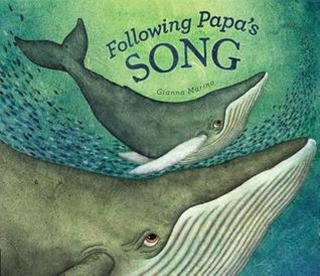
Little Blue and his Papa are traveling farther than they ever have before as they migrate, following the song of the other whales.  Little Blue has lots of the questions and his father encourages him to keep listening for the song.  As they travel, Little Blue learns about the different layers of the ocean.  Then he notices light in the darkness below and just has to head down and see what it is for himself.  He discovers a magical layer of life in the ocean, but when he heads even lower there is darkness and no other creatures are there.  Little Blue tries calling for his Papa, but his little voice doesn’t carry far in the cold water.  Then he remembers that he needs to listen and he hears his father’s call from above.

Marino paints a beautiful picture of father and child care and love.  Her use of whales and their calls is a smart choice that really makes the theme of being lost as a child work well on a higher level.  The advice to stay still and listen will also work for young humans hearing the story.  The book is simply written so that even the youngest of children can enjoy this underwater story.

Marino’s art is filled with currents and colors.  She creates light and water that dances and moves on the page, clearly creating different layers in the ocean.  I particularly enjoyed the use of bright pink to show the layer of the ocean with all of the life in it that tempts Little Blue downward.  The greens and blues of the ocean water truly come to life on the page here.

A lovely story about fathers, children and the importance of listening when you are lost.  Appropriate for ages 3-5.

Reviewed from copy received from Viking.