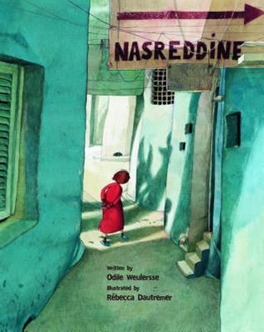
Review: Nasreddine by Odile Weulersse

nasreddine

Nasreddine by Odile Weulersse, illustrated by Rebecca Dautremer

Nasreddine and his father head to market together with his father riding the donkey along with a large basket of dates and Nasreddine walking behind.  When some men criticize them for letting a boy walk in the mud, Nasreddine heads back home while his father calmly continues on.  The next week, Nasreddine pretends to twist his ankle so that he can ride and his father walks.  But onlookers once again make comments and Nasreddine heads home.  The next time they head to market, the two of them both ride the donkey, but that doesn’t stop the comments either.  Then they both walk and let the donkey just carry the items for market, but the criticisms are still made.  Nasreddine makes one final try at fixing things: the two of them will carry the donkey!

The book ends with a note about the stories of Nasreddine which are told throughout the Middle East.  This story like the others about him are a perfect mix of humor and wisdom.  Here Nasreddine learns the hard way not to listen to the criticism of others.  The way that his father deals with it is patient and an attempt to invoke Nasreddine’s common sense and let him learn it on his own.  This adds to the merriment of the storyline as well as making for a very readable tale. 

Dautremer’s illustrations have the feel of a folktale with a modern edge.  The setting is clearly historical but the angles of the illustrations and their neat perspectives add lots of interest as well.  Nasreddine himself is a beautiful little boy, his round face and red tunic making him stand out in any setting. 

Perfect for sharing aloud, this book is a friendly and funny introduction to Nasreddine.  Appropriate for ages 4-6.

Reviewed from copy received from Eerdmans Books for Young Readers.

Review: Grandma and the Great Gourd by Chitra Banerjee Divakaruni

grandma and the great gourd

Grandma and the Great Gourd retold by Chitra Banerjee Divakaruni, illustrated by Susy Pilgrim Waters

This picture book is a retelling of a Bengali folktale.  Grandma was invited by her daughter to visit her on the other side of the jungle.  Before Grandma traveled there, she left the responsibility for her garden and home with her two loyal dogs.  On her way across the jungle, Grandma met a series of hungry animals: a fox, a bear and a tiger.  To each, she explained that she is very thin now, but will be plumper when she returns from seeing her daughter, so they let her go.  Grandma had a good time at her daughter’s home, eating lots of food and visiting.  But eventually, she had to return home to her dogs and her garden.  But how was she to get back?  That’s where the giant gourds in her daughter’s garden came in, and you will just have to read the book to find out how.

Divakaruni has taken a traditional folktale and left it wonderfully traditional.  The story reads like an oral tradition, filled with repetition, small descriptions, and a story that just keeps on rolling forward like a gourd.  She includes noises in the story as well, the khash-khash of lizards slithering over dry leaves, the thup-thup-thup of elephants lumbering on forest paths, and the dhip-dhip of her heartbeat. 

Waters’ illustrations are lush and colorful.  She uses texture and pattern to create a jungle.  The colors range from earthy browns to deep oranges and hot pinks.  The cut paper collages have strong clean lines and add a perfect organic feel to the story.

A great choice for library folk tale collections, this is a story that reads aloud well and has just the right mix of repetition, sound and inventiveness.  Appropriate for ages 4-7.

Reviewed from copy received from Roaring Brook Press.

Review: The Mother of Monsters by Fran Parnell

mother of monsters

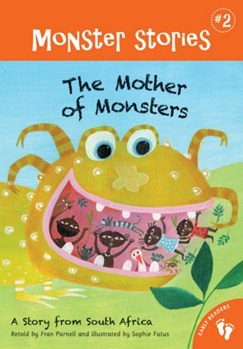
The Mother of Monsters: A Story from South Africa by Fran Parnell, illustrated by Sophie Fatus

This second in a series of monster tales features a story from South Africa retold for young readers.  It is the story of Ntombi, the mischievous and brave daughter of the chief, who is determined to see the dangerous Ilulange River with her own eyes.  Her father allows her the trip to the river as long as she takes the other girls along with her.  When they finally reached the legendary river, the girls are disappointed.  Instead of danger, they have found a river that looks perfect for swimming.  Leaving their clothes on the bank, the girls splash in the water.  Then they discover that their clothes are missing.  It could have been the Mother of Monsters who took them!  One-by-one the girls pled with the monster to return their things, and the monster does.  But Ntombi is not willing to beg for her clothing, so the monster swallows her whole.  But that is not the end of the story!  You must read this book to find out how Ntombi survives the Mother of Monsters.

Parnell has broken the story into chapters, making it all the more pleasant for beginning readers who can take the story a bite at a time.  The chapters are short and filled with action.  The star of the book, Ntombi, is both brave and foolish, often at the same time.  Throughout the story, she learns about humility but also about love.  The book is clearly from another culture, which makes it all the more interesting to read.

Filled with bright colors, the paintings by Fatus have an intriguing folk quality to them.  The scenes of the girls without clothing are handled with skillfully placed leaves, hands and flowers.  The illustrations have humor to them, which makes the book very playful, something that is welcome with a monster devouring people.

A welcome addition to folktales, this is a story I had never heard before and really enjoyed.  Appropriate for ages 6-8.

Reviewed from copy received from Barefoot Books.

Review: A Donkey Reads by Muriel Mandell

donkey reads

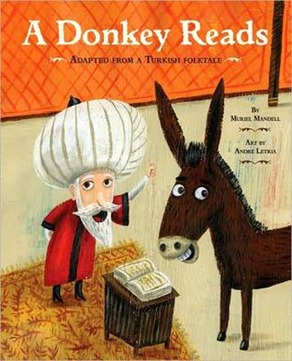
A Donkey Reads by Muriel Mandell, illustrated by Andre Letria

This adaptation of a Turkish folktale features Nasreddin Hoca, a 13th-century teacher, judge and imam whose writings are well known in the Middle East.  This is the story of a village in Anatolia that was conquered by the Mongols.  The Mongol leader demanded that every family pay tribute, but one family had only a worthless donkey to offer the leader.  When the Mongol leader reacts with fury at the tribute, Nasreddin speaks up and tells the him that the donkey is worth something, in fact Nasreddin will teach the donkey to read.  Everyone is shocked, but Nasreddin is calm and confident that it will happen.  The ending will have reader giggling at the humor and courage of Nasreddin’s solution.

Mandell has adapted this tale with a great feel for storytelling.  Her pacing is adept and her wording easy to share aloud.  The tale is universal in its appeal, thanks in particular to the humor that pervades it.  The end of the book has a page where the story of Nasreddin is shared with the reader.  It’s a trickster tale with only a donkey as an animal.

Letria’s art is filled with textures and colors.  The pages have backgrounds that are rough with brushstrokes, peeling and colors.  They add a feeling of age to the book, giving it a strong organic quality as well.  The characters pop on the page, especially Nasreddin with his towering headwear.  The illustrations add a great appeal to the story.

A window into another world of folktales that many of us have not experienced, this book offers plenty of humor and an appealing package.  Appropriate for ages 5-8.

Reviewed from library copy.

Also reviewed by Planet Esme.

Book Review: Fandango Stew by David Davis

fandangostew

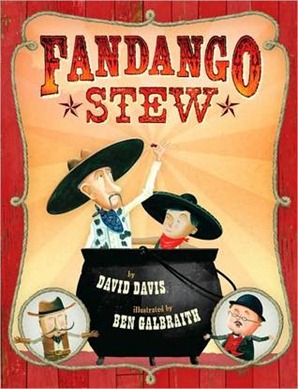
Fandango Stew by David Davis, illustrated by Ben Galbraith

A wild west version of Stone Soup, this book will have you singing the praises of Fandago Stew too.  Luis and his grandfather, Slim, come to the town of Skinflint with their stomachs already rumbling with hunger.  But they also have a plan, Fandango Stew.  Unfortunately, the local sheriff is not happy to have them in town and tries to run them out.  But he agrees that Luis and Slim can boil water and throw in their bean.  Slim and Luis break into song “Chili’s good, so is barbecue, but nothing’s finer than Fandango Stew!”  One-by-one the people of Skinflint begin to contribute, shamed into it when Slim and Luis talk about the Fandango Stew they made in other towns and the generosity shown there.  Well, Skinflint may be frugal, but no one calls them stingy!  As each new component is added, Slim and Luis reprise their song, adding new harmony parts.  In the end, you know the story of delicious stew created by a community but this time it has some western seasoning added too.

Davis has created a fun and stylized version of the traditional tale.  The incorporation of the western setting is well developed and adds an interesting dimension to the story.  As the story and the stew develops, the inclusion of the entire community and their pride and willingness to turn it into a party make for a jubilant read.  The use of the song after each addition to the stew adds a strong structure to the book as well.

Galbraith’s illustrations are filled with texture and color.  Everything from the ropes to the boards of the houses to the corrugated roofs add to the rich feel.  As the book progresses, the illustrations move from a sepia toned sparse color to richer colors. 

A rootin’ tootin’ good recipe for a book!  Appropriate for ages 4-7.

Reviewed from library copy.

Also reviewed by BooksForKidsBlog.

Book Review: Jack and the Beanstalk by Nina Crews

jackandthebeanstalk

Jack and the Beanstalk by Nina Crews

A fresh, modern take on the traditional tale, here Jack lives in a city and is paid the beans for a job he has done.  When he plants the beans, they grow into the huge beanstalk.  He climbs the beanstalk to discover giants living in the clouds.  Giants who have a hen who lays golden eggs and plenty of jobs for Jack to do for them.  But Jack escapes down the beanstalk with the hen.  The giants chase after him, and then the ending takes a pleasant twist from the traditional story.  A new look at an old story, this book will be most enjoyed by children who are familiar with the traditional tale and can spot the differences.

Crews is known for her innovative illustrations that use collages of photographs to create modern, vibrant stories.  Here she uses the technique to great effect with beanstalk in particular.  She also captures the feel of an urban setting very nicely and subtly.  The entire book feels modern and interesting.

The story does have surprising twists and turns from the original.  This too adds the feeling of freshness.  The story moves along faster than the original and reads aloud very nicely.  The bellows of the giants, the rhythm of the writing, and the bright illustrations make for a book that is perfect for sharing.

Ideal for comparing and contrasting with more traditional versions of the story, this book also reads aloud well on its own.  Appropriate for ages 4-6.

Reviewed from copy received from Henry Holt and Company.

Seven Fathers: A Vivid Retelling

sevenfathers

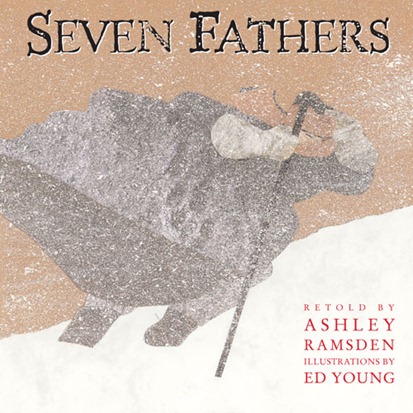
Seven Fathers retold by Ashley Ramsden, illustrated by Ed Young

Released April 12, 2011.

A lone man walks in a snow-filled night, desperate to find shelter from the cold and weather.  With the last of his strength, he approaches a house that appears out of the darkness.  There he finds an old man chopping wood.  When the traveler asks if he can stay the night, the old man replies that he is not the father of the house.  His father is in the kitchen.  The traveler heads to the kitchen where he meets an even older man and asks him if he can stay.  But the man replies that he too is not the father of the house and sends him to the parlor.  This pattern continues until each man more wizened and elderly than the last has sent him on to the next.  Finally, the traveler reaches a horn hung on the wall with a speck of dust resting on it, and then he gets his answer.

Ramsden’s story telling skill is very apparent with this retelling.  The text glides, moves and soars, allowing the story to truly be told.  He creates moments where readers will feel the cold, the wind and the snow.  He creates other moments where the smell of stew and the warmth of a kitchen enter aching bones.  Unlike some folklore stories with repeating patterns, Ramsden writes each encounter as a special one, yet keeps them tethered to one another.  It is a necklace of unique gems.

Young’s illustrations are done in mixed-media collage.  They hearken to the Nordic origins of the story with their furs, wools, and woods.  The lines Young has created are so simple, creating faces and expressions with a minimal number of details.  All of the art is on dark paper that evokes a traditional, aged feel to the entire book.

A beautiful, moving and vivid retelling of folklore, this book is definitely a jewel among picture books.  Appropriate for ages 5-9.

Reviewed from copy received from Roaring Brook Press.

The 3 Little Dassies: An African Twist on The Three Little Pigs

Capture47-271x300

The Three Little Dassies by Jan Brett

This fresh version of the classic The Little Pigs tale is set in Namibia and features cuddly, cute dassies instead of pigs.  Dassies are also known as rock hyraxes or rock rabbits.  In this book, the dassies wear bright  colored dresses and Namibian headwear.  The story starts out with the three dassies heading out to find their own place to live.  The three sisters reach the feet of the mountains after crossing the Namib Desert and decide that it is a perfect place for their homes.  A friendly agama lizard welcomes them.  One sister builds her house of green grasses.  Another builds hers out of driftwood.  The third builds hers from rocks.  The wolf is replaced by an eagle intent on eating the dassies, who not only knocks over the grass and wood houses but takes the dassies up to his nest to be eaten.  The rock house stays up despite being buffeted by the wind of the eagle’s wings.  And the other two dassies find a unique way back to safety.  But the eagle does not give up easily, allowing Brett a great way to explain why eagles are black in Namibia.

Brett has created another of her trademark books.  The text reads aloud very nicely, with the rhyming names of the dassies, the rhythm of the classic tale, and the use of just enough detail to bring the Namibian setting to vivid life.  Of course Brett uses her illustrations to great effect here as well in creating Namibia on the page.  Readers will glimpse vistas across the desert sands and to the mountains.  Brett’s illustrations are finely detailed.  She uses images on either side of the main illustration to tell readers what is happening to others in the story.  Brett has framed the images with African textiles, beads, and native plants.  These are illustrations to spend time with an enjoy.

A clever take on a classic story, this new version will be a welcome addition with its feisty heroines and interesting setting.  Appropriate for ages 4-7.

Reviewed from copy received from Putnam.

Enhanced by Zemanta

Rooster Prince of Breslov

9780618989744_hres

The Rooster Prince of Breslov by Ann Redisch Stampler, illustrated by Eugene Yelchin

When the prince decided to leave the splendor of his life as royalty behind and become a rooster, only one man could save him.  The king and queen had tried doctors and magicians, but nothing worked.  Only one old man was left to try.  The old man joined the prince in his fantasy, also acting like a rooster by removing his clothes and pecking at the floor.  This went on for a day.  At the end of the second day, the old man pointed to two mattresses that had been placed in the room and asked the prince what they were.  The man then asked why people should be the only ones to sleep comfortably and the prince agreed.  They both slept on mattresses that night.  The next day, black bread arrived.  And through similar persuasion, the man got the prince to eat.  This progressed until there was a table and chairs and a warm blanket.  On the sixth day, they wore clothes again.  And on the seventh day, there was the Sabbath feast.  In the end, the prince returned to being a prince, but always remembered that he had once been a rooster.

Stampler has taken this beloved Yiddish folk tale and tuned it for modern audiences.  She allows the humor of the situations to stand on their own, not overplaying it at all.  Her writing has a nice arc that speaks to the overwhelming nature of indulgence and the need to sometimes throw it all away.  She also honors the teachers of the world, those that listen and understand, those that join us right in the trenches of life and help us navigate them.  The book reads aloud nicely with each day carrying repetition from the first, underlining the folk tale heritage of the story.

Yelchin’s illustrations are wonderfully peculiar, suiting the story well.  He uses interesting perspectives to show the man and the prince together, sometimes from above, sometimes from behind, sometimes from the side.  It lends a lot of dynamism to the book.  The illustrations are brightly colored and unique.

A book about finding wisdom and learning to be a man by becoming a rooster, this folk tale is a delight to read.  Appropriate for ages 6-9.

Reviewed from copy received from Houghton Mifflin Harcourt.