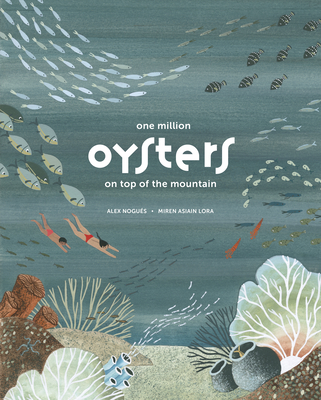
One Million Oysters on Top of the Mountain by Alex Nogues, illustrated by Miren Asiain Lora, translated by Lawrence Schimel (9780802855695)
Written by a Spanish geologist, this nonfiction picture book explores how a million fossilized oysters can possibly be found on a mountaintop. The book begins with exploring several landscape scenes, pointing out how simple it is to ignore the rocks that make up our world. The book moves from a child discovering an oyster shell on a hilltop and also explores various scientific discoveries in geology as the reason for the oysters is explained. Concepts such as strata in the earth, the immense length of geological time, and the movements of tectonic plates are explored and explained. Readers will leave with a great understanding of our changing world, much of which may have been underwater long before.
In this Spanish import, the writing by Nogues is what makes this book work so well. His tone is one of wonder and discovery. He writes from the perspective of discovering a new question, forming a hypothesis and then fully explaining the scientific terms and findings. The book offers a great look at geology and earth science for young children, never speaking down to them, instead explaining and lifting their understanding of the world upwards.
The illustrations are filled with earth tones and green punctuated by the whites of bones, fossils and oyster shells. Many of the illustrations help to give context to scientific concepts in a playful way. The scenes include children discovering fossils, exploring redwood trees, and much more.
A fascinating look at the transformations our earth has undergone. Appropriate for ages 6-9.
Reviewed from copy provided by Eerdmans Publishing Company.

 Waking Brain Cells