Review: Captain Awesome to the Rescue by Stan Kirby

captain awesome to the rescue

Captain Awesome to the Rescue by Stan Kirby, illustrated by George O’Connor

Eugene’s family has just moved to Sunnyview and he has to start a new school.  Happily, Eugene is very courageous.  He has to be in order to transform into Captain Awesome.  Now if he can just find his cape, before he’s attacked by Queen Stinkypants, also known as his little sister!  When Eugene starts school, his teacher gives him the responsibility of caring for the class hamster, Turbo.  Eugene does a very careful job, until one day he discovers Turbo has been hamsternapped.   It may just take Captain Awesome to reveal what really happened to Turbo and save him from some villainous plot.

This beginning chapter book has the mass appeal of superheroes.  It also has a cheery tone and a light touch.  The humor has the right tone for this age group, and doesn’t push it over the top.  This is a book that parents and children can share together, something you want with first chapter books.  As with all early reading books, the story is simple and the characters are not complex.  Still, there is adventure, plenty of villains, and the making of friends to carry the book well.

While this makes a good choice for reluctant readers, it is also good for children who are reading early as well.  There is no content here to disturb parents of preschoolers who may be reading naturally on their own.

This is a great pick for children who will soon enjoy Captain Underpants but are not quite ready as readers.  Appropriate for ages 5-7, or younger if they are starting to read on their own.

Reviewed from library copy.

Review: A Home For Bird by Philip C. Stead

home for bird

A Home for Bird by Philip C. Stead

Vernon, the toad, was out finding interesting things when he met Bird.  Bird wasn’t much for talking, not responding to anything that Vernon said, not even when he introduced Bird to his friends, Skunk and Porcupine.  Despite his silence (and his stiffness and button eyes) Vernon proceeded to show Bird around the river and forest.  But when Bird didn’t react even to watching clouds together, Vernon started to worry that Bird was depressed.  So Vernon and Bird set out to help Bird find his home.  They  looked at all sorts of homes, but none of them were right for Bird.  Then they came to a small blue house where they decided to stop for the night.  In the house was another small house, a cuckoo clock, up on the wall.  And that was where Bird and Vernon spent the night.  Until in the morning, Bird finally found his voice.

Stead writes and illustrates with a wonderful charm.  His writing is so solid that it is a joy to read aloud.  The story is carefully crafted and then playfully told, making for a book that is a pleasure to share.  Vernon is a character that children will relate easily and happily to.  Bird will immediately be recognized for the toy he is, but the story is less about that mistake by Vernon and more about the journey to find where Bird belongs.

The illustrations have a wonderful freedom to them, filled with swirls of color, that fill the air and cover the walls.  Stead draws the main characters with detailed fine lines, but their world is a more childlike, looser scrawl that reveals trees, flowers and dirt.   The way the detail plays against the less structured backgrounds adds to the cheer of the title.

Finding ones home, friendship and a grand quest fill this picture book to the brim and combine wonderfully with the charm of the illustrations.  Appropriate for ages 4-6.

Reviewed from copy received from Roaring Brook Press.

Review: Boy & Bot by Ame Dyckman

boy bot

Boy & Bot by Ame Dyckman, illustrated by Dan Yaccarino

One day when out collecting pinecones in the forest, a boy meets a robot.  The two of them play together and have a lot of fun.  But then when rolling down a hill, the robot’s power button gets pressed and he turns off.  The boy thinks the robot must be sick, so he takes the robot home and feeds him, reads him a book and puts him to bed.  When the boy’s parents look in at him before going to bed, they press the switch on the robot.  Now the robot notices the sleeping boy and thinks that he has malfunctioned.  Bot takes the boy to his home, gives him oil, reads him an instruction manual and is just about to replace his battery, when the Inventor arrives.  Soon all is straightened out and the two continue their grand friendship.

Dyckman’s story has a wonderful symmetry that works well.  With the two friends and their misunderstandings of one another, the story mirrors itself in a delightful way.  Both instances have their humor, as does the rest of the book.  It is this wry sense of humor that carries the story forward and makes it a pleasure to read.  The book is written in a straight-forward way, making it a great read aloud.

Yaccarino’s illustrations are very successful.  They have a wonderful sort of fifties vibe to them, while at the same time being modern.  The large robot is never frightening, thanks to his permanent smile and his care for the boy.  Yaccarino plays with bright colors throughout the book, keeping his art simple and dynamic.

Robot fans will rejoice at this fresh new take on friendship and embracing differences.  Appropriate for ages 4-6.

Reviewed from copy received from Alfred A. Knopf Books for Young Readers.

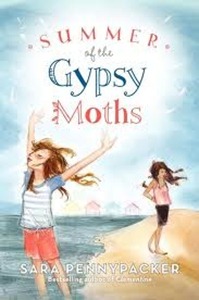
Review: Summer of the Gypsy Moths by Sara Pennypacker

summer of the gypsy moths

Summer of the Gypsy Moths by Sara Pennypacker

Stella lives with her great-aunt Louise on Cape Cod, where the house is always tidy, and even though Louise is not very demonstrative, Stella feels right at home.  Angel, a foster child, lives with them too, but Stella and Angel don’t get along at all.  Then one day, the girls return home to find Louise dead in her chair.  The two girls know that if anyone finds out, they will be put back into the child welfare system.  So they work together to create a plan that will let them stay in the tidy little house near the sea.  It would take a lot of work, because they would have to cover for Louise at her job of caring for four cottages on the property, and they would have to take care of the dead body too!  It’s a challenge for two girls who never got along in the first place and are headed in different directions when the summer is done.  This hope-filled book starts with a death and strangers and ends with hope and family. 

Pennypacker writes the sort of book that Stella would like to read.  It’s filled with all of the between-times, the moments of cleaning up afterwards, the small details, the real parts of life.  And it is through those moments that we get to know both girls, and Louise too.  The two girls are very different, and yet not so different after all, as readers get to know them.  They are both suffering from disappointments and loss, from being left behind, from not having families.  Stella holds onto her Hints from Heloise, determined to have a life of order and neatness that makes sense.  Angel listens to the music her mother played, hiding behind her earbuds and blocking everything out. 

One might think this would be a macabre book, and it does have those moments.  But it is much more a book about people and life, not death.  It is a book that celebrates summer, the days that stretch and lengthen, days shortened by working hard at times.  It is a story about secrets, opening up and revealing things.  It is a story about truth and lies, enemies and friendship.  Throughout the entire book, the story works naturally.  Things happen in their own good time, friendships blossom in a believable way.

This book does have a very neat ending with all of the storylines nicely fitting together.  I can only believe that Stella would approve of that being the way her story ended.  Appropriate for ages 9-12.

Reviewed from library copy.

Review: Kate & Pippin by Martin Springett

kate and pippin

Kate & Pippin: An Unlikely Love Story by Martin Springett, illustrated by Isobel Springett

When Pippin, a fawn, is abandoned by her mother, photographer Isobel Springett found her crying for help.  She took Pippin home and placed her by Kate their old Great Dane.  The two immediately bonded:  Pippin thought she had found a new mother and Kate started to mother her even though she had never raised any puppies of her own.  Pippin learned to drink from a bottle and when she got bigger started to adventure outside.  One evening, Pippin disappeared into the forest and didn’t return for bedtime.  Kate was very concerned, but the next morning Pippin came back just in time for breakfast.  Pippin returned to the woods every night after that, returning to the farm almost every morning to eat and play.  As she grew into an adult deer, she still continued to return to visit Kate and play.  She even still comes into the house once in awhile for a visit. 

This is one of the most lovely picture books about a relationship with a wild animal that I have seen.  I especially appreciate that Pippin was allowed to continue to be a wild deer, returning to the forest and being allowed to create a relationship on her own terms.  It’s definitely refreshing to see.  Here the human and dog were able to rescue, aid but also step back and not absorb this little creature.  The relationship that emerges is breathtakingly touching, seeped in fragility yet incredibly strong.

A large part of the success here are the photographs of this tiny deer bonding with the enormous dog.  By the end of the book, the animals are the same size.  It is clear that both of them adore one another on a deep level, and one that is delightfully separate from the humans. 

This nonfiction picture book reads like fiction, making it a great pick for a touch of nonfiction in a story time.  It’s a story that children will relate to easily and naturally.  Appropriate for ages 4-7.

Reviewed from copy received from Henry Holt and Company.

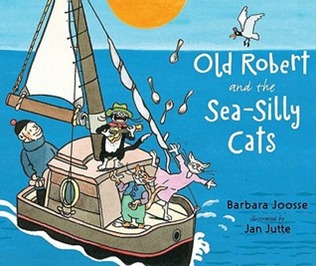
Review: Old Robert and the Sea-Silly Cats by Barbara Joosse

old robert

Old Robert and the Sea-Silly Cats by Barbara Joosse, illustrated by Jan Jutte

Old Robert sailed his ship at sea during the day and docked it at night because it was so dark.  At night, he prepared his dinner of toast in buttered milk and ran through his list of things that were all in their proper place, including clean socks, a clock, one dish and one spoon, and the moon.  He was all alone until one night when a dancing cat asked to come aboard.  Old Robert hesitated because there wasn’t much room aboard, but in the end he agreed.  So he made dinner of toast in buttered milk for both of them and when he went to bed, he noticed the moon was bigger.  Now his list included the cat in its hammock as he went to sleep.  On subsequent days, another two talking cats joined him on board, for dinner, and on his list.  And the moon got bigger still.  Finally, a cat that didn’t talk at all arrived and Old Robert let it on board too.  There was no room for a hammock, for Old Robert let it sleep on his chest.  Finally, the moon was full and Old Robert sailed off into the moonlit night with all of the cats. 

I expected quite a different book when I saw the cover.  I thought it was going to be silly, zany, and rather wild.  Instead, this book has a beautiful quietness to it, a thoughtfulness, and makes for a perfect bedtime read.  Joosse incorporates repetition so well here that it becomes a lullaby.  His listing of his belongings doesn’t change much, except for the size of the moon and the number of cats.  It speaks to the simplicity of his life, but also to how lonely he is.  This is shown rather than told, giving the book a lovely little ache that heads right for the heart.

Jutte’s illustrations too have a mix of silly and quiet.  They have a vintage feel, of old comic books that will make readers feel right at home.  They have great color with explosions of pinks, blues and yellows that pop and glow. 

A great read aloud, this would make a great bedtime pick but it is also a good one to turn into reader’s theater for children.  Appropriate for ages 3-5.

Reviewed from copy received from Philomel Books

Review: The Secret Tree by Natalie Standiford

secret tree

The Secret Tree by Natalie Standiford

The neighborhood that Minty lived in had some very interesting stories.  There was the Man-Bat, a huge combination of man and bat that lived in the woods.  On the other side of the woods was the Witch’s House, where Minty’s best friend Paz was brave enough to knock but then lost her little sister’s favorite stuffed animal when the witch emerged and grabbed her.  When Minty saw a flash in the woods one day, she headed off to see what it was. That’s how she met Raymond, a boy who lived alone in the new development model house.  She also discovered the Secret Tree, a hollow tree where people in town left their secrets.  She and Raymond started collecting the secrets and trying to match them with people.  Who is the person who is only loved by their goldfish?  Who has put a curse on their enemy?  Who is betraying their best friend?  And what secrets are the people closest to Minty keeping?

Standiford has created a compelling story about the power of secrets, but also the necessity for them at times.  The slow unraveling of the mysteries of the secrets makes for fascinating reading that will capture the interest of children.  It is one of those books that reads lightly, but has a great deal of depth behind it, especially as the secrets of the community are revealed. 

Minty is a great heroine.  She is at the cusp of becoming a teen and her best friend is maturing faster than she is.  Minty isn’t interested in laying out in the sun at the pool (at least not without eating a snow-cone) and she doesn’t like the new, older girls her friend is hanging out with.  Instead Minty wants to plan on becoming a roller derby star, discover the secrets around her, and just be herself. 

This rich novel will be a great pick for classroom reading and discussions.  It is also the ideal summer read, especially for all of us who love a great secret.  Appropriate for ages 10-13.

Reviewed from ARC received from Scholastic.

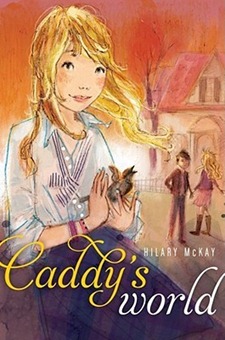
Review: Caddy’s World by Hilary McKay

caddys world

Caddy’s World by Hilary McKay

If you have not yet discovered the artistic, free-spirited, dynamic world of the Casson family, you are in for a treat!  This is the sixth book in the series that started with Saffy’s Angel.  In this book, we return to a time when Caddy, the oldest of the Casson children, was twelve.  She had three best friends and all of them had a role to play in their little group.  But this year, all of them are facing challenges in their lives.  Alison is completely bored with school and longing for something new, so she starts rebelling against school rules.  Ruby has been asked to try for a prestigious scholarship to a private school but she doesn’t want to leave her friends.  Beth is outgrowing her pony and decides to limit her diet. Caddy too has a challenge, a new baby is coming to the family, and her father who usually lives away from the family in London returns to help take charge.  But things are never that easy in the chaos of the Casson family!

McKay has the ability to speak about serious issues like premature babies, growing older, potential bulimia, and chaotic family life without heading into deep drama.  While the subjects are deep and the emotions are real, she keeps a lighter touch on them than most authors.  My favorite example of this is the chaos of this family.  It’s a family filled with love, art projects, failed cooking, and laughter.  But it’s also a family that is often adrift, rudderless, and late for school.  McKay walks the line, demonstrating that there are many sorts of families and that some of them that may look fragmented are actually strong and true.

McKay is also adept at drawing characters.  Here we get to see younger versions of several beloved characters:  Saffy, Indigo and Caddy.  They are all wonderfully true to their older selves, showing interest that later come to full light.  The addition of the three new characters and glimpses of other previous ones make for a book that is fresh but also warmly familiar to fans of the series. 

This sixth book in the series would work as a stand-alone read.  Taking place earlier than the other novels, it will delight fans and should encourage new ones to enter the world of the Cassons.  Appropriate for ages 9-12.

Reviewed from library copy.

Review: Dying to Know You by Aidan Chambers

dying to know you FINAL

Dying to Know You by Aidan Chambers

When Karl’s girlfriend Fiorella asks him to write down his feelings about their relationship and answer a list of questions, he turns for help to a famous writer who lives in their town.  Karl is dyslexic which makes writing very difficult for him, as was the author who suffered as a child from minor dyslexia.  The author agrees to help Karl as much out of loneliness as a willingness to help.  He is drawn to Karl, who is similar in many ways, bright and eager.  He insists that Karl meet with him and give his own answers to the questions which the writer will in turn polish into something worthy of Fiorella’s attention.  As the two spend time together, their relationship deepens slowly into a true friendship.  When Fiorella finds out about the truth of the letters, it impacts the relationship not only of her and Karl but also of Karl and the author.

Chambers has created an amazing book here.  I found it nearly impossible to summarize because so much of the book is the growing connection between the two male characters.  It happens slowly and believably during fishing, quiet moments of driving, and conversation.  It is a look at how we choose connections in our lives and how they impact the life we lead.  While the book may be a quiet one, it also is daring in its own way, revealing the inner world of a young adult, written with truth and honesty.

The two men both face previous losses that have colored the way they face the world.  Karl lost his beloved father at a young age, and still struggles with his connection to his father and with disconnecting from that loss.  The author has recently lost his wife.  The two of them both struggled with depression and grief, sinking lower into a dangerous place with thoughts of suicide. 

Chambers also weaves in the role of art in our lives, the power of that to connect us to the world and the drive to create and be imaginative.  With Karl, who is a plumber, this connection to art is not an obvious one.  It takes time, just like their budding friendship, for the reader to come to understand Karl more deeply. 

I wish I could easily capture this book in paragraphs, since I feel like I have danced around the edges and not captured its heart here.  Let me say that this is a book that is powerful, quiet and filled with revelations about life.  It is honest, beautifully written and deep.  It is a book where you miss the characters for days after finishing it, because you too have befriended them.  Appropriate for ages 16-18.

Reviewed from ARC received from Amulet Books.