Review: Dying to Know You by Aidan Chambers

dying to know you FINAL

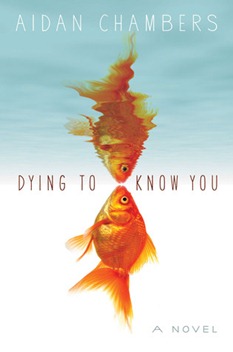
Dying to Know You by Aidan Chambers

When Karl’s girlfriend Fiorella asks him to write down his feelings about their relationship and answer a list of questions, he turns for help to a famous writer who lives in their town.  Karl is dyslexic which makes writing very difficult for him, as was the author who suffered as a child from minor dyslexia.  The author agrees to help Karl as much out of loneliness as a willingness to help.  He is drawn to Karl, who is similar in many ways, bright and eager.  He insists that Karl meet with him and give his own answers to the questions which the writer will in turn polish into something worthy of Fiorella’s attention.  As the two spend time together, their relationship deepens slowly into a true friendship.  When Fiorella finds out about the truth of the letters, it impacts the relationship not only of her and Karl but also of Karl and the author.

Chambers has created an amazing book here.  I found it nearly impossible to summarize because so much of the book is the growing connection between the two male characters.  It happens slowly and believably during fishing, quiet moments of driving, and conversation.  It is a look at how we choose connections in our lives and how they impact the life we lead.  While the book may be a quiet one, it also is daring in its own way, revealing the inner world of a young adult, written with truth and honesty.

The two men both face previous losses that have colored the way they face the world.  Karl lost his beloved father at a young age, and still struggles with his connection to his father and with disconnecting from that loss.  The author has recently lost his wife.  The two of them both struggled with depression and grief, sinking lower into a dangerous place with thoughts of suicide. 

Chambers also weaves in the role of art in our lives, the power of that to connect us to the world and the drive to create and be imaginative.  With Karl, who is a plumber, this connection to art is not an obvious one.  It takes time, just like their budding friendship, for the reader to come to understand Karl more deeply. 

I wish I could easily capture this book in paragraphs, since I feel like I have danced around the edges and not captured its heart here.  Let me say that this is a book that is powerful, quiet and filled with revelations about life.  It is honest, beautifully written and deep.  It is a book where you miss the characters for days after finishing it, because you too have befriended them.  Appropriate for ages 16-18.

Reviewed from ARC received from Amulet Books.

Review: Zoo Girl by Rebecca Elliott

zoo girl

Zoo Girl by Rebecca Elliott (Link to InfoSoup)

Told in just a few words per page, this book tells the story of a little girl who doesn’t have a family.  At the orphanage she is lonely and has no friends.  Then the children visit the zoo and suddenly the little girl feels at home.  She is left behind at the zoo and the animals discover her.  They befriend her and she lives with them for awhile until the zookeepers discover her curled up with the tigers.  The little girl does not want to go, and the book ends with a happy ending where the little girl is adopted by the zookeeper couple.  The story is a simple one, told in only a few words, but the sense of belonging and being wanted remains a powerful message.

Elliott’s story is really told in the illustrations rather than the words.  Her art is a rich mix of texture, patterns, drawing and photographs.  The rather simply drawn characters and animals live in a world made dazzling.  Even the air itself seems to have its own feeling and shape.  The elephant has wonderful wrinkles, the tiger has plush fur, and the penguin’s feathers are swirled. 

Also, in the orphanage, the mood is not grim.  It is specifically this little girl who does not have friends and feels alone.  The other children are merry and playing with one another.  That changes the message quite a bit too.

Perfect for toddlers because of its brevity, this book is a very friendly way to talk about adoption.  Appropriate for ages 2-4.

Reviewed from library copy.

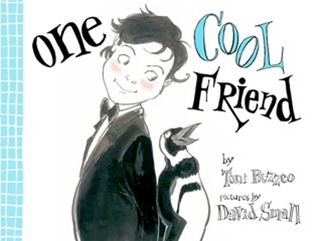
Review: One Cool Friend by Toni Buzzeo

one cool friend

One Cool Friend by Toni Buzzeo, illustrated by David Small

Elliot was a very proper boy, dressed in his tuxedo and bow tie.  When his father asked if he wanted to go to the aquarium one day, he went along despite worries about loud kids.  When they got to the aquarium, his father sat down to read and sent Elliot off to have some fun.  Elliot went past the jellyfish, the saltwater display, and the hands-on tide pool and discovered the penguins!  He immediately connected with the birds and then asked his father if he could have one.  His father glanced at a poster for plush penguins and agreed.  But Elliot did not have a plush penguin in mind.  Instead, he brought home a real penguin.  Once back home, Elliot wasted no time in creating a perfect penguin habitat.  But after days of happy living, what in the world would his father say when he discovered the penguin?

This book has its own wonderful feel.  From the dapper lad in the lead role to his couch-loving, slow-moving father, it has the feel of a classic book but also one that is delightfully modern as well.  Buzzeo’s writing is fresh and funny, creating a book that is both inviting and compelling.  It also has great twists throughout where you never know what will happen next.  In other words, it’s a stellar read.

Small’s art is what provides a large part of the feel of the book.  His tuxedo wearing kid, the splash of green that is the father, and the busts of other colors throughout.  The use of primarily blacks and whites to tell the story pays homage to its subject and also gives it the marvelous stylized feel that works so well.

The great librarian character at one point doesn’t hurt the book one smidge either!  This is a dapper, dazzling read that is creative, funny and a delight.  Appropriate for ages 4-6.

Reviewed from copy received from Dial Books for Young Readers.

Review: Little Bird by Germano Zullo

little bird

Little Bird by Germano Zullo, illustrated by Albertine

Released April 1, 2012.

Winner of the 2011 Prix Sorcieres for illustration, the French Caldecott medal, this book is an impressive example of the magic of illustration and only a few select words.  A man drives his red truck up to the edge of a cliff and opens the back, releasing several amazing birds.  When he glances into the truck, he sees one bird left behind.  The man tries to tell the bird where to head and that it should fly, but the bird just looks at him.  The two sit together and the man shares his sandwich with the little bird.  The man shows the bird again where to head and how to fly, landing on his face.  The bird spreads its wings and flies away, joining the other birds the man had let go.  The man watches the bird fly off, heads back into his truck and drives off.  What seems like the end of the story is actually just the beginning.

Zullo has chosen his words carefully, letting the story really be told via the illustrations.  The words offer a touch of guidance to the depth of the work, the deeper meaning of the simple story.  They speak to the importance of noticing small things and how those small things are the true treasures in life.  It’s a message that will speak to children and adults alike, in very different ways.

Albertine’s art is wonderfully bright and filled with playful moments.  From the sunny yellow ground, the robin’s egg blue sky and the red truck, there is plenty of zing in these pictures.  As the story is told in the illustrations, the relationship between bird and man is also shown just in pictures.  The looks, the moments of connection, the departure, all add up to moments that lead to the magical conclusion.

An impressive picture book that is modern, fresh and will have readers looking for tiny treasures in their lives too.  Appropriate for ages 5-adult.

Reviewed from copy received from Enchanted Lion Books.

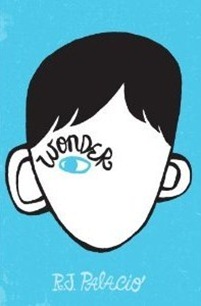
Review: Wonder by R.J. Palacio

wonder

Wonder by R.J. Palacio

Auggie has never been to school, instead he’s been homeschooled his entire life.  It made it easier to work his schedule around his many surgeries for his facial anomaly.  Auggie was born looking differently than the rest of the world due to several genetic abnormalities coming together in one moment, something that only has a one in 4 million chance to happen.  But it happened to Auggie, and now he is getting ready to start 5th grade in a private school.  Auggie knows that he is just a regular kid hidden behind an uncommon face, but the question is whether his classmates will ever figure that out.

It’s amazing to think that this is Palacio’s first novel.  She writes with a natural flow and skill that makes the book read effortlessly.  It’s one of those books that gets into your head and won’t let go, that not only tells a story but asks things about you the reader.  It has you exploring your own relationship with beauty, the extent of your own kindness, and the truth behind being human. 

Auggie is such a rich character and such a winning one that I was surprised when the book first changed perspectives.  I had assumed that we would see through Auggie’s eyes for the entire novel.  But the different perspectives also show depth to all of the other characters in the book.  We get to see Auggie through his older sister’s eyes, ones that are loving but also despair at being paid enough attention by her parents.  The perspective shifts again and again to classmates, his sister’s ex-friend, and even his sister’s boyfriend.  Then we return to Auggie for the end of the book. 

This use of multiple perspectives works particularly well given the arc of the story, it all comes to a satisfying close that is built from those many perspectives and those many characters.  Things are not sugar-coated here.  People respond naturally to Auggie’s face, even those who had been informed about it beforehand.  There are bullies, friends who are true and those who come in and out, there is middle school drama.  There is also a real family portrayed here, struggling to give their exceptional son an honest life, trying to pay attention to both of their children, and consistently showing love and caring for one another laced with real humor.

I adored this book, wept at times, ached in the heart a lot, and laughed too.  It’s a book worth sharing, worth passing along, and one that will crossover effortlessly to adult readers.  This is a powerful, uplifting, luminous book.  Appropriate for ages 10-13.

Reviewed from library copy.

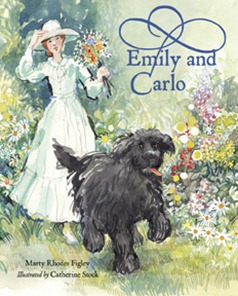
Review: Emily and Carlo by Marty Rhodes Figley

emily and carlo

Emily and Carlo by Marty Rhodes Figley, illustrated by Catherine Stock

When Emily Dickinson was 19 years old, she was lonely in the big home in New England since her siblings were off at school.  So her father bought her a puppy that she named Carlo.  The quiet and reclusive poet was an odd match with her bounding, huge Newfoundland.  Carlo gave Emily more courage to be out and about, visiting others.  He was with her always, a large drooling dog.  They explored Amherst together with its woods, meadows and ponds.  Their time together inspired her poetry, as shown in this book through stanzas that she wrote.  This friendship with a dog makes this literary figure much more human and approachable for children.  It’s a very special way to see an author.

Figley truly found the key to Emily Dickinson’s personality for children.  All it took was a large messy dog to break through into Dickinson’s quiet, contemplative world.  Interspersing the verse with the story also makes this a friendly window into Dickinson’s work.  The book maintains a fresh, light tone throughout, showing the two friends aging together.

Stock’s art is a radiant mix of playfulness and contemplation, matching the subject matter beautifully.  It shows the deep connection of woman and dog, the natural world they explored, and pays homage to the verse that is embedded in the book. 

A simply lovely look at Emily Dickinson through her love of a pet, this book should be used with anyone working with Dickinson’s poetry and children as a lens through which to view the person and her writing.  Appropriate for ages 6-8.

Reviewed from copy received from Charlesbridge.

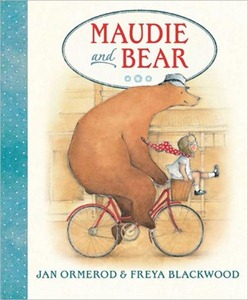
Review: Maudie and Bear by Jan Ormerod

maudie and bear

Maudie and Bear by Jan Ormerod and Freya Blackwood (Link to InfoSoup)

Through five short stories, readers get to know Maudie and her best friend Bear.  Maudie is a little girl who is always planning the next thing for them to do.  She can be bossy, definitely has opinions, and yet has a charm that is hard to resist.  Bear certainly does not resist at all, instead helping Maudie plan their next escapade.  The pair have a series of adventures from a bike ride that is more about fashion than exercise to a very Goldilocks-like encounter to dancing under the stars.  The two are not without friction, having to apologize occasionally for things that go wrong.  They are a cheery pair to read about and one wishes for a Bear of their very own.

Ormerod’s writing is simple and lovely.  She captures stories in a few words, selecting them for impact and ease.  Then she adds a wry sense of humor and a little twist at the end of each tale that add to the appeal of the book.  The friendship of the two is shown as complex yet completely natural.  It works particularly well that the friendship is not perfect or easy, but real.  The stories have just enough action and interaction in them to make them a pleasure to read, but not too long or too short.  Like Goldilocks, these are just right.

Blackwood’s Illustrations are stellar.  She captures the winning attitude of the text, creating a book that is welcoming in its obvious warmth and cleverness.  The largeness of bear makes one want to cuddle up for days and the ever-moving Maudie is a perfect foil.  The two together are the perfect pair, ready for any adventure that comes their way.

Originally published in Australia, this book’s old-fashioned feel combined with its sunny nature is very inviting for young readers.  Appropriate for ages 3-5. 

Reviewed from copy received from G. P. Putnam’s Sons.

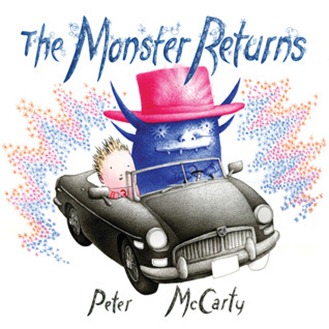
Review: The Monster Returns by Peter McCarty

monster returns

The Monster Returns by Peter McCarty

This sequel to Jeremy Draws a Monster continues the story of Jeremy, who is continuing to draw up in his room alone.  Then he got a note from his monster saying that he should draw a compass and a telescope and look out the window.  When he looked through the telescope, he saw his monster!  The monster immediately called on the phone and announced he was bored and headed over to Jeremy’s house.  Jeremy had to think quickly.  He invited all of the children playing outside up to his room, gave them each a fancy pen, and had them each draw their own monsters.  When Jeremy’s monster arrived, he was met with a big SURPRISE!

McCarty turns this book into one about making friends, whether through inviting them over to play or by creating them.  It is also a book about creativity where the act of creation is also one of making friends and connections. 

The delicate lines of McCarty’s illustrations add up to bright colors and plenty of fun.  The mix of the human characters done in one style and the single-color monsters done in a different style make for a clever and memorable combination. 

A stylish and fun book about friends, creativity and monsters.  This will have children drawing their own monsters, so make sure to provide plenty of fancy pens and paper.  Appropriate for ages 3-5.

Reviewed from copy received from Henry Holt and Company.

Review: A House in the Woods by Inga Moore

house in the woods

A House in the Woods by Inga Moore

One pig had built a den for herself in the woods with another pig next door in a hut.  The two pigs went exploring in the woods and when they returned home, they found a bear and a moose in their homes.  Unfortunately, the spaces were not made for such large animals and both the den and the hut collapsed!  So the four animals talk about what they could do and decide to build a home where they all could live.  They had no idea where to start, so they called in the Beavers who only asked to be paid in peanut-butter sandwiches.  Everyone worked together to build a marvelous house and then worked together to get the sandwiches made for the Beavers.  In the end, they had a cozy warm home just right for the four friends together.

This book is so warm and cozy with an old-fashioned feel.  The story embraces a spirit of friendship and cooperation without ever being didactic about it.  Instead the lessons are woven directly into the story and shown, never told.  The tone of the tale is gentle and cheerful with small touches throughout that bring the story to life.  Here is the paragraph when the four friends are finally asleep in their own home:

Soon the only sounds to be heard were the soft cheeps of sleepy birds roosting in the rafters, the tiny rustling of wood mice in the fallen leaves outside, and, just now and then, the gentle snoring of Bear.

Moore’s art has the same warm, old-fashioned feel as the story.  The animals are individuals with interesting personalities, who each contribute differently to the project.  Through the entire work is a feel of nature and home.

This charming book is a joy to read aloud and will delight listeners.  Appropriate for ages 4-6.

Reviewed from library copy.

Also reviewed by: