Review: Tom’s Tweet by Jill Esbaum

toms tweet

Tom’s Tweet by Jill Esbaum, illustrated by Dan Santat

Tom the cat is on the hunt after a storm when he spots a baby bird on the ground.  But the Tweet is so little and scrawny that it won’t amount to much, so Tom turns away.  But the little bird looks so helpless and alone, that Tom decides to help despite his misgivings.  Tom heads up the tree to return the Tweet to its nest, carrying it in his mouth.  But then the mother bird sees him and she attacks!  Tom has to flee with the Tweet.  After that, he has to figure out how to give it a home.  And (gulp) feed it too.  Tom finally finds a way to get the Tweet back to its nest, but he can’t get it out of his head.   What is a cat to do when he misses a bird?!

Esbaum’s rhymes romp along, and they work well for the most part.  The rhythm is even better, galloping along and creating a brisk pace for the story.  The infectious rhythm makes reading the book aloud great fun.  In fact, I think it reads aloud better than it reads silently.  The story is filled with humor, from Tom’s expressions of “tarnation” and “dadburn it” to the scene where he feeds the little Tweet.

Santat’s illustrations are what take this book to another level.  While the story is funny on its own, it becomes wildly silly with his art.  With its computer smooth feel, it looks as if it was taken right off of a Pixar movie screen.  Children will respond naturally to the style and then enjoy it even more thanks to the humor embedded in it.

Very funny, this picture book will be enjoyed by children looking for a silly read with plenty of heart.  Appropriate for ages 4-7.

Reviewed from copy received from Alfred A. Knopf.

Review: Neville by Norton Juster

neville

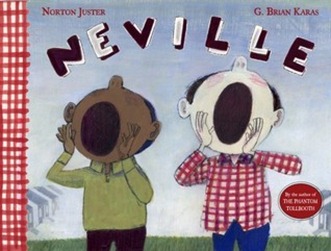
Neville by Norton Juster, illustrated by G. Brian Karas

This story about a boy moving to a new place will speak to any child who has had to move.  The boy was never asked by his family if he wanted to move, he just got told that they were.  Now he had to move into a new house and go to a new school, and worst of all, find new friends.  His mother suggested that he go for a walk, so he did, very reluctantly.  After he walked for awhile, he turned around and called out:  “Neville!”  Nothing happened.  He did it again and again.  Then another boy joined him and they shouted together.  More children arrived and they all began calling for Neville.  Even the dogs were howling along.  When they stopped to catch their breath, the children started asking about who Neville was.  The children all decided that they quite liked Neville and the boy too.  Then it was time to head home, and the boy felt much better about moving.  That feeling lasted all the way until bedtime, when his mother wished him, “Good night, Neville, pleasant dreams.”

This clever story is written with a graceful simplicity that reads aloud smoothly and easily.  The story is beautifully crafted, with a a solid feel and a strong story arc.  There is also a wining humor about the entire story, from the children joining in so willingly to the twist at the end.  It all makes for a charming book that begs to be shared with a group of children. 

Karas’ illustrations capture the emotions of the characters clearly and with humor.  He also plays with fonts when the boy is calling for Neville.  The word is art in the air, changing and moving.  What I found most lovely was the change from the initial stark white of the new house and community where even the grass was gray.  When the boy starts meeting children, color enters the picture around him and the community is revealed to be welcoming, colorful and warm.

This outstanding picture book conveys the stress of moving in both textual and visual ways, offering a great twist and a clever resolution.  Appropriate for ages 4-6.

Reviewed from copy received from Schwartz & Wade Books.

Also reviewed by:

Review: The Unforgotten Coat by Frank Cottrell Boyce

unforgotten coat

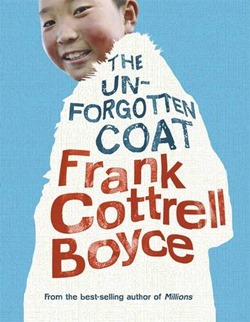
The Unforgotten Coat by Frank Cottrell Boyce

Frank Cottrell Boyce has done it again, creating a book that surprises, amazes, and twists.  This is the story of what happens when two Mongolian boys join a class in England.  They appear out of nowhere, suddenly there in school.  The two brothers refuse to be separated, so the younger boy, Nergui, stays in his older brother’s class.  The two wear large coats and fur hats.  They immediately capture the imagination of Julie, one of their classmates, who is thrilled to be selected as their “Good Guide.”  She wonders where they live, trying for days to follow them home, but they elude her.  Chingis, the older boy, has photographs of Mongolia that he shares with everyone.  The entire class learns more about Mongolia than they had ever known.  But everything is not as it seems, and Julie discovers the truth too late to be of any help in the end.

The book is short, under 100 pages, with most of it being told in a flashback by an adult Julie.  The design of the book adds much to the story, with lined pages that resemble a notebook and Polaroid photographs that capture Mongolia and England, perhaps a mix of both.  The photographs in particular are cleverly done, hiding the truth and then revealing with equal success.

This is a powerful story that seems easy.  It reads as a simple story about two unusual children joining a classroom, and then twists and turns.  It speaks to community and acceptance throughout, showing a class that is eager and willing to embrace the new children, much to my delight.  Then the story takes on a more serious subject, about immigration, fear and deportation.  There is no didactic message here that is too heavy handed, instead it is kept serious but not message driven. 

The book also dances along an edge of imagination and reality where children who pay close attention will realize that even in the end there are questions about what has happened and what truly was.  This dance strengthens the novel even more, making it a powerful choice for discussion.

Highly recommended, this book may just be his best, and that is definitely saying something.  The short length, powerful subject and complex storyline all combine to make a package that is approachable for young readers, discussable by classes, and pure delight to experience.  Appropriate for ages 9-12.

Reviewed from library copy.

Also reviewed by:

Review: Squish Rabbit by Katherine Battersby

squish rabbit

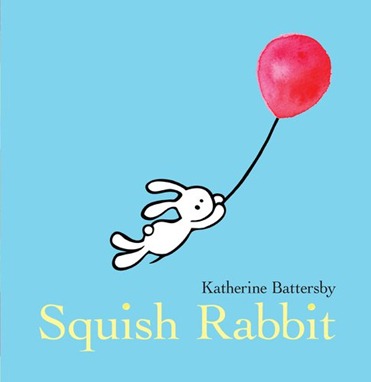
Squish Rabbit by Katherine Battersby

Squish is such a little rabbit that no one seems to see him or hear him.  So he made himself a stuffed rabbit friend.  But that only helped his loneliness for a little bit.  He tried playing with the trees, but they didn’t play fair.  Finally, Squish lost his temper and threw a tantrum.  He kicked an apple high into the air, and someone saw and thought it was a game.  Squish saw that the squirrel was heading for a cliff chasing the apple and finally found his voice.  And a new friend.

Battersby has created a picture book with an exceptional amount of appeal.  Her text is simple and understated, allowing the pictures to tell the rest of the story at times.  And what pictures they are!  Done in mixed media collage, the illustrations are winningly simple.  They have a charming ease to them, especially the depiction of Squish, done in white with free black lines.  The mixed media comes in with cut paper, fabrics, and watercolors that give great texture and color.

Highly recommended, this is a superb picture book that small children will relate to and that is also beautiful and stylish.  Appropriate for ages 3-5.

Reviewed from copy received from Viking.

Review: Lucky for Good by Susan Patron

lucky for good

Lucky for Good by Susan Patron

This conclusion of the Lucky trilogy will be bittersweet for fans of the series.  Happily, there is one more book with the vivacious Lucky and the intriguing extended family of Hard Pan.  Sadly, it is the final one.  In this book, Lucky struggles with the unknown.  Brigitte’s new café is closed due to a violation of a county ordinance, her best friend is headed to England for the summer, and she even punches a boy.  That ends up with her in serious trouble and she is forced to do a family tree.  That brings up even more questions for Lucky, who doesn’t know how she will handle researching the side of her estranged father.  But nothing keeps Lucky down for long and soon all is heading towards solutions, but not without a few more bumps in the road to keep it all interesting.

Patron does not shy away from difficult topics in this final book.  She deals with the universal themes of family and community as she has in her previous novels.  And what a community it is!  I think all readers of the Lucky series hope to move to Hard Pan, despite the dried out sandwiches.  But Patron explores religion in this novel in a very frank and honest way, voicing the questions that children (and adults) have when they meet someone who believes in a more judgmental universe.  I applaud the courage and bravery of Patron in being so open about these questions, something that young readers will love as well.

Patron also excels at creating characters and all of your favorite characters return in this novel, plus a few new ones.  Lucky is a heroine with real spunk, with her own world view, and a strong sense of self.  Even in her moments of doubt, Lucky never shies away from being exactly who she is. 

An impressive conclusion to the Lucky trilogy, fans of the series will have to have this one.  And for me, I can’t wait to see what world Patron will create for us next.  Appropriate for ages 8-12.

Reviewed from copy received from Atheneum Books for Young Readers.

Review: Bake Sale by Sara Varon

bake sale

Bake Sale by Sara Varon

Cupcake owns a bakery and his life has a certain routine to it.  Wake up at 6:30 am, head to the bakery, bake, and then open the shop at 9:00 am, work until 4:00 pm, then spend time with his friend, Eggplant.  Eggplant is planning a trip to Turkey to visit his family, who happen to know the very famous chef, Turkish Delight.  When Eggplant invites Cupcake to join him on the trip, Cupcake has to work hard to make more money and pay for it.  As he tries new things, his delight in baking returns.  Perhaps the solution to his struggles is closer to home than he thought!

Varon is the author of the very successful, Robot Dreams.  While this graphic novel doesn’t have the power of that book, it is still a great read that children will respond to.  The book also includes seven recipes for food that Cupcake makes in the book.  All of Varon’s books have a winning quirkiness to them.  Here you have Cupcake who creates cupcakes for other people to eat.  A bit strange, but that’s what makes Varon’s worlds so intriguing.

Her illustrations are just as clear and charming as always.   The characters are expressive, funny and interesting. The text is fanciful and fun, often meandering a bit rather than driving the story forward.  It reads and seems as if readers are really looking at Cupcake’s life.

A whimsical graphic novel that is not too sugary at all.  Appropriate for ages 8-12.

Reviewed from copy received from Roaring Brook Press.

Also reviewed by

Book Review: Addie on the Inside by James Howe

addie on the inside

Addie on the Inside by James Howe

Addie Carle, the only girl in The Gang of Five, is the center of this third story in The Misfits series.  Addie is an outspoken and opinionated person, but the verse here shows her to have many more doubts and concerns than she might show on the outside.  As her year of seventh grade continues, Addie has to deal with some big issues: the death of one of her cats, the breakup of her first relationship, teasing by other girls in school, and finding her own voice, even though she is talking all the time.  Addie shows herself to be thoughtful, caring, involved, and much more than others see on the outside, she just has to find the confidence to let her real self show.

Howe’s verse works on several levels.  First, it tells the story of Addie and her growth.  Second, it is poetry that truly functions as individual poems as well.  He plays with rhyme inside his lines at times, while other poems are more narrative and still others are haiku.  It is a fresh look at a verse novel that shifts from lighter to deeper tones easily.

Addie is a fascinating character, a girl who is smart, involved, vocal and entirely human.  While I’m not sure everyone will have this response, she was like listening to my own middle-school inner voice.  Addie’s point of view is uniquely her own, yet she spoke to me completely.  I finished the book with tears rolling down my face, just because of the understanding for my younger self I had found.

A beautifully written book featuring a strong yet human protagonist, this is one amazing read.  Appropriate for ages 9-12.

Reviewed from copy received from Atheneum.

Book Review: The Little Little Girl with the Big Big Voice by Kristen Balouch

littlegirlbigvoice

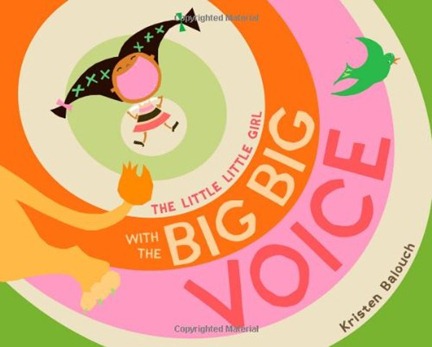
The Little Little Girl with the Big Big Voice by Kristen Balouch

A little, little girl has a very loud voice.  She heads out looking for a friend to play with.  She searches the jungle, but her big voice scares the animals away.  First, an elephant run, then a snake, then a crocodile!  It’s not until she meets a very loud and very large lion and isn’t scared by his roar, that she makes a friend. 

Balouch has created a book that is bright, funny and loud.  Her text is simple and easily read aloud, loudly.  It has a rhythm that is natural and easy as well as a strong structure of repetition.  As the little girl meets each animal, there is the happy greeting and then the little girl opens her mouth.  Words in each encounter are bright colored and larger, so readers will know where the punch of sound belongs.

The illustrations are just as loud as the little girl.  Just like the cover, they are filled with hot pinks, oranges, zingy greens, and bright blues.  The noise waves, whenever the little girl talks, are depicted in circles of color emanating from her.  This adds to the color, motion and zip of the book.

A winning book about being different and finding acceptance without changing, this book is a readaloud win for any child who is loud themselves.  Appropriate for ages 3-5.

Reviewed from copy received from Simon & Schuster.

Book Review: The Summer Before Boys by Nora Raleigh Baskin

summerbeforeboys

The Summer Before Boys by Nora Raleigh Baskin

Julia is spending the summer with Eliza, who is her age but is also her niece.  Julia’s mother has been sent overseas with the National Guard and her father can’t watch Julia and work.  So the two girls spend their summer together, often heading up to the hotel where Eliza’s father works.  The friends spend a lot of time playing pretend, imagining that they are back in time when girls wore long dresses.  But Julia is worried about her mother and the war.  She has also discovered a boy named Michael who seems interested in her too.  But pursuing Michael may mean leaving Eliza behind.

This is a book about changing from being a child to being a teen.  Baskin perfectly captures that transition, that tension that is achingly real here.  Her writing explores the changes, the new-sounding laughter of flirtation, the running both from and to boys at the same time, the loss of imagination, the setting aside of old priorities for new ones.  She allows us to see the friendship of the two girls first as it always has been with a comfort, a shorthand, a natural ease.  And then we watch it change before our eyes as one girl grows up faster than the other, and tensions begin to create cracks and shifts.

Julia is a beautifully crafted heroine who is honest, confused, and filled with a depth of feeling and awareness that makes the book so special.  I enjoyed seeing the world change through Julia’s eyes rather than having it be Eliza, the one being left behind, who was the first person voice.  And the ending, the ending!  It is exactly what the book needed, what all of us who have left childhood behind need to remember.  Lovely.

Highly recommended, this book is a stellar piece of tween fiction that captures that age with depth and beauty.  Appropriate for ages 11-13.

Reviewed from copy received from Simon & Schuster Books for Young Readers.

Reviewed by