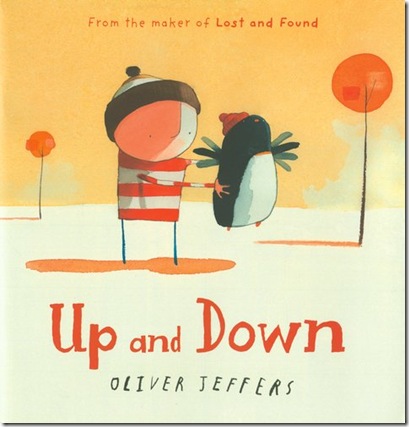
Up and Down: High Flying Friendship

51szOCq8OnL

Up and Down by Oliver Jeffers

Jeffers continues his story of the friendship between a boy and penguin in this fourth book about the boy.  The boy and the penguin are great friends.  They do everything together.  But when the penguin decided that he had to learn to fly, he knew he had to do it on his own.  The boy tried to help, looking up information and trying to connect the penguin with flying experts.  But when the penguin figures out a solution, he heads off immediately to make it happen.   The boy had no idea where the penguin went.  The penguin finds himself alone and lost, unable to get in touch with his friend.  When the boy discovers where the penguin is, the question is whether he will be able to reach him in time to see his friend succeed or fall. 

This book is written with the same charming simplicity of the earlier books.  There is such a gentle and loving spirit to these books.  Yet they still have a spirit of adventure and surprise.  The friendship between the two characters is strong and true, supporting one another even if the other friend needs to do something on their own.  This is a touching story of real friendship.

Jeffers’ illustrations are done in the same style as the earlier books in the series.  They are done in a modern style that is infused with warmth from the charm of the characters and the bright colors. 

A fitting follow-up to Lost and Found, this book will appeal to fans of Jeffers and to new readers as well.  Appropriate for ages 4-6.

Reviewed from copy received from Philomel Books.

Enhanced by Zemanta

Disappearing Desmond: Shining Look at Shyness

41R7Vy3plmL._SS500_

Disappearing Desmond by Anna Alter

Desmond and his entire family didn’t like to be the center of attention.  He’d much rather disappear and be ignored.  Sometimes even his teacher could not find him!  But things changed when Gloria came to his school.  Gloria liked to be the center of attention.  After a bit, something strange happened and Gloria said hello to Desmond even though he was hiding.  No one had ever seen him when he was hiding before.  And it just kept happening, Gloria kept on talking to him until one day they read together for the entire morning.  The two of them started playing together all the time, until Desmond came to school on a Monday morning ready to be noticed.  Later, Desmond heard a sound in the bushes and found a kid hiding there.  The three of them played all afternoon, but there were many more kids hiding around the playground.

This is a very nice book about shyness and wanting to be ignored.  Alter found a great solution to the shyness issue by having a once-shy child make overtures to another shy child.  That is the magic in this picture book.  Readers will also enjoy the ending where the large number of other shy children is revealed.  Alter’s illustrations have a similar feel to Nancy Carlson’s Harriet series.  They have simple lines, bright colors, and animal characters. 

A successful book about shyness without the focus on the painful nature of it, this book offers a hand of comfort and friendship to shy children hidden everywhere.  Appropriate for ages 4-6.

Reviewed from copy received from Random House.

Snook Alone: A Book of Faith, Silence and Connection

snookalone

Snook Alone by Marilyn Nelson, illustrated by Timothy Basil Ering

Abba Jacob lived on an island with his dog, Snook.  Each day their routine was the same.  They got up at dawn, prayed, worked together, and spent time in companionable silence together.  Sometimes there were visitors or Abba Jacob headed off to town in his car, but Snook was always there waiting for him.  Until one day, Snook and Abba Jacob headed out in a boat to help catalog plant and animal species on the islands.  Snook was along to help catch the rats and mice that were disrupting the birds and animals of the islands.  It was great micing!  It was so good that Snook got too involved in his work, so when a storm blew up, Abba Jacob was forced to leave Snook behind on the deserted island.  All alone, Snook found his own rhythm of silence, catching food, finding water, silence and waiting.  Sometimes he thought he could hear Abba Jacob’s voice on the wind, but no one came for him.  Snook spent a long time alone on the island, never forgetting his friend, Abba Jacob.  Until one day, a fishing boat returned to the island with Abba Jacob aboard!

This book is such a  delight.  It is a book with such depth, such quiet, such silence that its power builds during those quiet moments, creating a magnificent longing.  It is a book that celebrates the simple, the quiet, the profound in our lives.  It is a book about enduring friendship, continued connection, and at its heart: love.  Nelson writes with such a beauty here that some lines make you stop and you have to remember to breathe again.  They are moments just like in the book itself, moments of simple clarity, embedded in the writing.  This is a book that will be a grand choice for a class to discuss, perfection for advanced students who will enjoy the language but will also enjoy the illustrations.  It is a book to be shared.

Ering’s illustrations echo the themes of the book with their delightful mix of cartoon and painting.  Abba Jacob is a round, merry soul shown in cartoon lines.  Snook on the other hand can be funny and cartoonish, but is also depicted as a noble beast in paints.  The illustrations work exceedingly well to show simple life, the vistas of the sea and the island, and the warmth of the connection between man and dog.

A masterful book about faith and friendship, this is an outstanding picture book that deserves plenty of recognition on best book lists but more importantly a spot in school and public libraries.  Appropriate for ages 5-9.

Reviewed from library copy.

Also reviewed by 100 Scope Notes.

Enhanced by Zemanta

Bink & Gollie: By Golly What a Charmer!

62698897

Bink & Gollie by Kate DiCamillo an Alison McGhee, illustrated by Tony Fucile

Bink and Gollie are two girls who are friends but could not be more different.  They live together yet apart, Bink in a cottage below the tree where Gollie’s ultra-modern tree house perches.  The two of them use their roller skates to get around town, but beyond that they agree on very little.  Everything from striped colorful socks to goldfish friends to imaginary mountain treks come between them.  In the end though, their friendship remains strong, bolstered by pancakes shared together.  The book is broken into three chapters each a vignette that is funny, charming and delightful. The book is written for beginning readers who will discover two amazing girls that they will long to share a stack of pancakes with too.

The authors have created two characters who are very different yet read as real people with their own quirks and interests.  Bink is younger, wilder and delightfully mussed.  Gollie is steady, level headed and yet has her own moments of imagination.  The authors did not feel constrained by the vocabulary of most beginning readers, instead they introduce young readers to longer words, taking time to put them in context and even define them.  This is a book that will have new readers stretching at just the right pace.

Fucile’s illustrations help bring the differences and friendship of the girls to life.  From the firecracker hair of Bink to the lean lines of Golllie.  The sleek nature of Gollie’s tree house to Bink’s small homey cottage.  Each detail is perfect to underline their differences and their connection to one another.

I look forward to seeing the next Bink & Gollie book.  I can’t wait to see where this friendship heads next.  Appropriate for ages 6-8.

Reviewed from library copy.

Also reviewed at:

The Winds of Heaven

The Winds of Heaven by Judith Clarke

An amazing book that takes a deep look at love, depression, sisterhood, and life.  Clementine and Fan were opposites in many ways, but that just drew them closer.  They were more sisters than cousins, pulled together over the summer they spent at Fan’s house in Lake Conapaira.  Clementine was dull and regular next to the wild and amazing Fan.  But Fan’s life was not good, living alone with her abusive mother now that both her father and older sister had left.  Fan longed to head to the blue hills that she could see from her room, knew that there was something special out there waiting for her.  As time went on, both young women faced decisions that would change their lives, fears that would overwhelm them, and responsibilities that weighed upon them.  This is a book about the two very different friends, who both relied on each other despite their distance from  one another and the small choices that forced them even further apart.

Clarke’s writing is incandescent in this novel.  My book bristles with bookmarks, marking passages where the writing is astounding and staggeringly lovely.  Here is one of my favorites from early in the book where Clementine is describing how different Lake Conapaira is from her home:

You could even smell the difference: a mixture of sun and dust, wild honey and the smoky tang from the old kerosene fridge on the back veranda.  And you could smell feelings, too – Clementine was sure of it: you could smell anger and hatred and disappointment and jagged little fears.  The anger smelled like iron and the disappointment smelled like mud.

Clarke moves from dense writing like this that truly brings a reader into the scene and makes it real to lighter moments, dwelling on certain thoughts for awhile.  And beautifully, those are the moments that the reader carries with them, importantly through the book, the moments that must be remembered at the end.

This is an Australian novel that is steeped in Australia.  Readers will feel the red dirt in the pages, thanks to the vivid descriptions that Clarke offers us.  The sense of place is not only strong, it is inherent to the story.  Clarke set this book in modern time but the bulk of the story takes place in the 1950s and 1960s as Clementine and Fan grow up.  The time is important here too, reflected in the story.

The two characters, Fan and Clementine, are drawn with great care.  Readers learn about how they think, how they approach the world, and the way the world has shaped them in turn.  Though both girls are very different, they struggle with similar things.  They both have moments of weakness and shame, paired with moments of strength and empowerment.  They both see the other person as the strong one, the intelligent one, the beauty.  It is what brings them together and also what drives them apart.

This is a book about our journey through life and the choices we make.  It is a powerful book, one where even though the ending does not surprise is shockingly brutal at times.  Yet with the brutality comes a beauty as well.  Highly recommended, this is a book appropriate for good readers who will enjoy the prose.  Appropriate for ages 15-17.  Make sure you have some tissues around when reading the end.

Reviewed from copy received from Henry Holt.
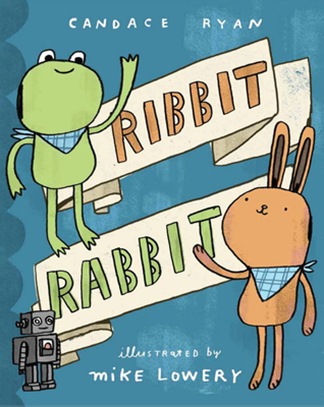
The Blue House Dog – A Gentle Heart-Felt Read

The Blue House Dog by Deborah Blumenthal, illustrated by Adam Gustavson

After Bones’ owner dies, he is left to fend for himself on the streets.  He sleeps under bushes, avoids the cars driving around, and forages for food.  Cody, a boy in the neighborhood who recently lost his own dog, notices Bones wandering around and feeds him scraps.  But Bones is very skittish and shy.  Slowly Cody begins to be able to touch Bones, then works day after day to get Bones to enter the house.  Slowly Bones begins to bond with this new human, trust and friendship blooming like the daffodils at his old house. 

Blumenthal has created a gentle story that will work its way into your heart.  It is written with a tenderness that is apparent throughout.  There are moments where the feeling of loss is very strong, others where the moments of connection are impressive.  This is a book that brings emotions up, yet never becomes too overly negative for young sensitive children.

Gustavson’s illustrations are done in oil.  They have a lovely velvety texture and rich colors.  He has nicely chosen the best moments of the text, where the emotion is highest, where the tension of the building friendship is evident.  His illustrations use changing perspectives to show us what is happening with a welcome clarity.

A gentle and profound story of a boy finding his dog.  Appropriate for ages 4-6.

Reviewed from copy received from Peachtree.

Brown Rabbit in the City

Brown Rabbit in the City by Natalie Russell

This book follows the story which began in Moon Rabbit about the friendship between Brown Rabbit and Little Rabbit, though this story focuses on Brown Rabbit’s point of view.  Brown Rabbit was headed to the city for the very first time to visit his friend Little Rabbit.  Little Rabbit is so excited to see him that she takes him on whirlwind tour of the city, dashing in and out of shops, sightseeing, and finally dancing.  But it’s all too much for Brown Rabbit, who finally heads out on his own.  Little Rabbit realizes then that she hadn’t really spoken to Brown Rabbit all day long and sets out to find him and make things right again.

Russell makes a nice exploration of friendship that children will easily relate to.  By mixing in the bustle and rush of the city with the excitement of a visiting friend, the story becomes about taking time in life in general and taking time with those we love.  It never gets too sentimental, but keeps it all simple and heartfelt.  Once again, it is the illustrations that really shine here in their simplicity and style.  Done in an organic palette of browns, greens, robin egg blue, and warm earthy yellow, the book is truly lovely.  Add to that the simple lines and hip styling and you have a modern classic.

Highly recommended, though you should start with Moon Rabbit first, this book builds on the first book and offers an unrushed look at our busy lives.  Appropriate for ages 3-6.

Reviewed from copy received from Viking.

City Dog, Country Frog

City Dog, Country Frog by Mo Willems, illustrated by Jon J. Muth

I was a little concerned about a book by Willems that he didn’t illustrate himself, but I shouldn’t have.  This book is a rich exploration of friendship.  A dog who has never lived in the country before runs out through the fields and comes upon a frog sitting on a rock near the water.  The frog immediately invites the dog to be his friend and the two play frog games together that spring.  When summer comes, the dog and frog play city dog games together, including fetch.  In the fall, the frog is growing old and tired.  So the two play remembering games together, thinking of spring and summer and the games they played.  Then winter came and when the dog headed to the rock, the frog wasn’t there.  Then spring came again, and this time the dog was the one sitting on the rock waiting for a friend.  And guess who came?  A new and unexpected friend.

This book is about friendship, that deep and abiding type of friendship that is about connection.  It is also about loss and it captures it so vividly that children will immediately understand the gravity of winter and exactly what the dog is experiencing.  It is a very powerful moment, depicted in deep blues of winter cold and silence in the text.  Beautifully captured.  At the same time though, it is a book about friendship continuing, new friends arriving, and the ability to move on and resume.  Willem’s language is simple and adept, he says things is so few words yet captures feelings perfectly.  Muth’s illustrations really capture the seasons. One can almost smell the grass of spring, the autumn leaves, and the crisp snowy air.  He also imbues the animals’ faces with deep emotions yet makes sure that they are still dogs and frogs. 

Highly recommended, this pairing of author and illustrator has created an amazing story that is deep and moving.  Appropriate for ages 4-8.  Make sure when you share this with a child that there is time to talk afterwards, it is sure to start a conversation.

Reviewed from library copy.

Check out the trailer that Mo Willems created for the book:

Also reviewed by:

A Love Story: Starring My Dead Best Friend

A Love Story: Starring My Dead Best Friend by Emily Horner

When Julia is killed in a car accident, it left a hole in Cass’ life that was impossible to fill.  When Julia’s drama friends discover that the secret project that Julia was working on is a musical with ninjas, they decide to perform it as a tribute to her.  But Cass doesn’t fit into the drama group without Julia there.  Especially not when Heather, a bully from middle school who publicly questioned Cass’ sexuality, is cast as the lead.  But Cass feels she must do something to fill that hole in her life Julia left behind, so she sets out on a solo bike trek over the summer from Chicago to California.  The book moves from the time following the bike trip when Cass returns to school and her travels.  It is about journeys, tributes, friendship, and love.  It is a book that fills holes, honors all kinds of love, and celebrates those of us who don’t quite fit in until we find the right people.

This book is not easy.  There are no simple solutions to a friend’s death, and Horner honors this friendship with a grand tribute.  From the beginning of the book, readers know that Cass does not complete her ride to California, but this makes the book even more powerful.  It becomes not about the accomplishment of the goal, but about the journey itself.  There are ugly truths in the book that readers are asked to understand and there are beautiful twists and turns along the way.  The book is a ride, a journey, a tribute and so it must be difficult and contain things that bring us to another place.

Horner’s writing is constantly showing and not telling.  Emotions are told through reactions, allowing them to be complex and much more honest.  She has created a heroine in Cass with such heart.  She is complicated, fascinating, and marvelous.  Horner also excels at backstory without burdening the reader.  Cass’ parents are Quakers and that influences her life tremendously.  Through the skill of Horner’s writing, that too is told as it comes up, revealing itself and its layers slowly.  This is much the same way that Cass’ sexuality is handled, honoring the process that Cass is going through to understand it herself.

Simply a magnificent book, get it on your shelves, into your hands and most of all into the hands of teens.  Appropriate for ages 14-17.

Reviewed from copy received from Dial Books.

Also reviewed by: