Review: The Princess in Black by Shannon Hale & Dean Hale

princess in black

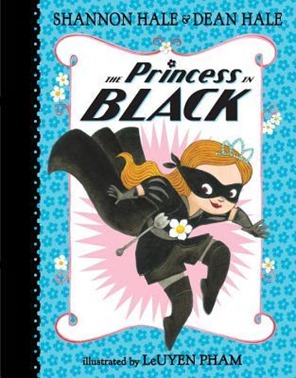
The Princess in Black by Shannon Hale & Dean Hale, illustrated by LeUyen Pham

Princess Magnolia was having hot chocolate and scones with Duchess Wigtower when then monster alarm sounded.  Dressed in along dress of pink with a tiara, no one would expect that Princess Magnolia is actually also the Princess in Black who battles monsters and protects her kingdom.  After all, princesses don’t wear black!  Waiting outside the castle is Frimplepants, the princess’ unicorn, but he is also Blacky, the trusty pony of the Princess in Black.  The two of them galloped off to face the monster who is threatening the herd of goats.  Now the princess has to save the goatherd, battle the monster, and keep her secret identity from the nosy Duchess Wigtower!

Bravo for a princess figure who neither scorns the tiaras and dresses and pink nor is limited by them for the way she lives her life!  This is one amazing young woman who transforms into a hero, but clearly lives her princess life with the same heroism and dedication as she has in her alter ego.  The writing is light and fresh with rather dim-witted huge monsters who just want a meal and remember vaguely that there is a reason they don’t eat the kingdom’s goats.  Happily too, the princess does the fighting, isn’t terrified at all, and routs the monsters from her kingdom.  Clever, strong and brave, she’s exactly the heroine that her kingdom needs.

Pham’s illustrations show a young princess who is not stick-thin or Barbie-like in any way.  Instead, she is strong in her body, built like a young girl actually is, and when she does battle it feels right and she doesn’t come off as weak at all.  The illustrations of the monsters add to the humor, though their size is daunting.

A real treat for young readers looking for a real girl doing real battle whether she is a princess or not.  Appropriate for ages 6-8.

Reviewed from library copy.
Review: Of Course They Do! by Marie-Sabine Roger

of course they do

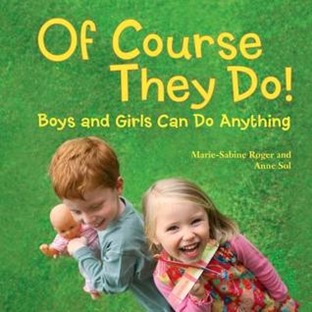
Of Course They Do!: Boys and Girls Can Do Anything by Marie-Sabine Roger and Anne Sol

This very simple book filled with crisp photographs takes on gender stereotypes and proves them quickly wrong.  The book starts with things that boys don’t do, like “Boys don’t cook.”  Turn the page and the counter to the stereotype is given with a photograph of a chef and the words “Are you sure?”  The book then moves on to stereotypes about girls, like them not playing sports. 

The format is engaging and fresh.  Having the more traditional gender role on one page and then the correction on next works particularly well, since it gives children a chance to realize that they themselves may think some of these things.  I also like that the format asks questions on the pages where the stereotype is being disputed.  This too lets children have the ability to change their mind rather than be defensive about what they had been thinking. 

The illustrations are all photographs and are bright and clear.  Many of them are close ups of faces that prove the point that girls and boys can do so many things.  Throughout the book there is clear diversity as well.

Clear and intelligently designed, this book will be welcome for units about gender.  Appropriate for ages 3-5.

Reviewed from library copy.

The Ride: The Legend of Betsy Dowdy

51cp3FCfmKL

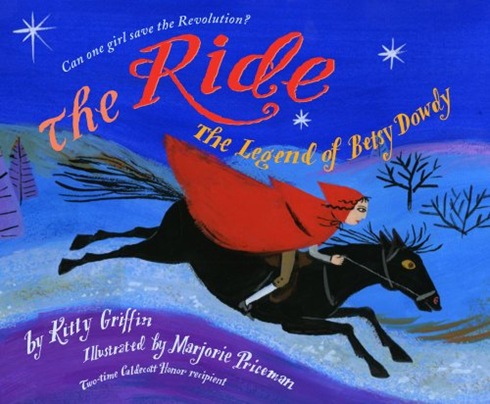
The Ride: The Legend of Betsy Dowdy by Kitty Griffin, illustrated by Marjorie Priceman

The story of Betsy Dowdy has been part of an oral tradition for over 200 years.  While she may not have existed, this is a wonderful American story of bravery and determination.  Betsy was 16 years old in 1775 when the news came of the redcoats marching to Great Bridge to take ponies and supplies.  There was no hope that anyone could make it to General Skinner’s militia fifty miles away in time to bring aid.  But Betsy could not help in other ways.  She couldn’t fight.  But she could ride.  So despite the danger and the dark, she set off riding her trusty pony, Bess.  The ride was not easy.  They had to swim across a channel in December, and that was the start of the ride.  Betsy had to endure packs of dogs, ice cold temperature, and falling from Bess several times.  But in the end, she got to the general in time.  The day was saved thanks to one brave girl and her tireless pony.

Betsy Dowdy is a girl version of Paul Revere.  Griffin writes with great historical details, that bring the time period to life.  But it is Betsy herself who is the focus of this book.  Wonderfully, Betsy’s fear is allowed to show and her desperation and fatigue.  She is a very human heroine and because of that she is all the more impressive. 

Priceman’s illustrations are filled with deep colors from the purple of the frightening forest to the deep blue of the river.  Done in gouache and ink, the illustrations are wonderfully dramatic, conveying motion forward in a variety of ways.  One of my favorite images is Betsy riding into the dawn of the new day, the colors changing as she moves through the setting.  One feels the sudden surge of hope that light brought.

A powerful story of girl power that should be used in American Revolution units with elementary children.  Girls will enjoy a story that includes more action than sewing or rolling bandages.  Appropriate for ages 4-7.

Reviewed from copy received from Atheneum.

Also reviewed by The Fourth Musketeer and Kiss the Book.

Nasreen’s Secret School

Nasreen’s Secret School: a True Story from Afghanistan by Jeanette Winter

The author of The Librarian of Basra brings readers another true story from the Middle East.  This is the story of Nasreen, a young Afghan girl who has not spoken since her parents disappeared.  Her grandmother hears about a school for girls which is secret and forbidden.  In the hopes of bringing Nasreen out of her silence, her grandmother enrolls her.  The girls attending the school must be clever.  They must leave alone or in small groups.  They must hide their schoolwork if they are inspected by soldiers.  Little by little, Nasreen and her classmates learn to read and write.  And little by little, Nasreen begins to join this community of women and girls.

Winter’s illustrations are are framed by lines and painted in thick acrylic paints.  This gives them the feel of more traditional work, though they depict modern life.  Though the situation is complex, Winter manages to tell the story in short sentences.  American children will learn of a society where people disappear and girls are not allowed to be educated, all explained at their level of comprehension.  Expect lots of questions and discussion after sharing this true story with children.

An important piece of work, this picture book allows children to glimpse another culture that is now intertwined with our American one.  Appropriate for ages 4-8.

Reviewed from copy received from publisher.

Also reviewed by A Year in Reading.