In Plain Sight by Richard Jackson

in-plain-sight-by-richard-jackson

In Plain Sight by Richard Jackson, illustrated by Jerry Pinkney (InfoSoup)

Sophie lives with her parents and her grandfather who sits near the window during the day in his wheelchair. He can wave goodbye to her as she heads to school in the morning and is the first person she runs to see when she comes back home. Each day, she visits with her grandfather and he tells her the story of something that he has “lost” during the day. Then it is up to Sophie to find the lost item somewhere in his room. Each time she manages to find the hidden object somewhere in place sight, if she just looks closely enough. This lovely picture book shows a playful and warm relationship between grandparent and grandchild.

Jackson’s text is demonstrates how small daily rituals can become the foundation of a close relationship, each one designed to tell a story, share a moment and bring the two of them closer together. There is a warmth in the language they use with one another, a recognition of how important they are to one another. That relationship is all about playing together, spending these moments delighting in one another and the shared game.

Pinkney’s illustrations are filled with the small details that he is known for. The room of the grandfather is filled with shelves, papers, books and mementos. It’s an ideal background for an object search and one that is based in reality. Young readers get the chance to find the object themselves before Sophie shows them where it is. The organic feel of the art and these searches adds to the warmth and joy of this picture book.

A lovely depiction of a close grandparent relationship, this picture book also adds the pleasure of a well-done object search. Appropriate for ages 4-6.

Reviewed from library copy.


What a Beautiful Morning by Arthur A. Levine

What a Beautiful Morning by Arthur A Levine.jpg

What a Beautiful Morning by Arthur A. Levine, illustrated by Katie Kath (InfoSoup)

When Noah visits his grandparents, Noah and his grandfather start the day with a song. They head outside with the dog even if its raining, singing all the way. At breakfast they made plans for the day. But lately, Grandpa has been forgetting to ask about making plans. Then one day when Noah woke him from a nap, Grandpa didn’t know who he was. His Grandma explained that sometimes Grandpa got confused and that it was better to focus on what he still had rather than what he lost. So Noah set out to do the things alone that he had done with his grandfather, until he discovered that Grandpa still responded to music and songs. It was a way to start once more having special mornings together.

This book is so beautifully done. It is about the very special relationship that children have with their grandparents, the delight of staying with them, and how each morning can be special just because someone cares for you and spends time with you. It is also about the power of music to connect people and experiences as well as its special quality with those suffering from Alzheimer’s or dementia. Throughout, the character of Grandma is there, at first secondary to the strong relationship between grandfather and grandson and then stepping up to fill some of the gaps left behind. She is warm and loving and very special.

Kath’s illustrations are bright colored and friendly. When Grandpa is confused or feeling separate, she uses a visual device to indicate the change by having his face lose color. If he is particularly confused, the colorlessness spreads on the page, taking up his entire body. In this way, children will see visually the change coming over Grandpa and understand that it is deeply affecting him and his personality.

It is rare that I tear up when reading a picture book, but this book is particularly moving. Have tissues ready. Appropriate for ages 3-5.

Reviewed from library copy.

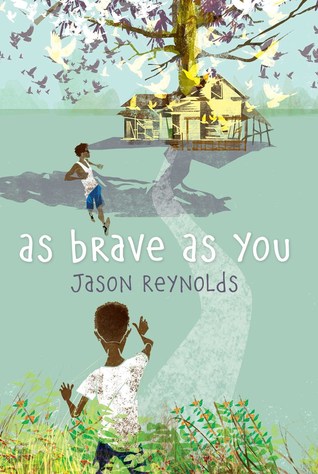
As Brave As You by Jason Reynolds

As Brave As You by Jason Reynolds

As Brave As You by Jason Reynolds (InfoSoup)

Genie and Ernie are heading to Virginia to stay with their paternal grandparents for the very first time. Though they have met their grandmother before, this is the first time that Genie has met him. The difference between their lives in Brooklyn and their grandparents’ home in rural Virginia are huge. But that’s not the only thing that surprises Genie. He is shocked to find out that his grandfather is blind. Genie is a kid who is full of questions to ask all of the time and so he immediately asks his grandfather questions about his blindness. Genie knows that his older brother Ernie is braver than he is, always taking up fights for Genie and protecting him. He also knows that his grandfather is immensely brave too. When something goes wrong though, Genie will have to rethink what it means to be brave.

Reynolds is so amazingly gifted as a writer. He astounded me with this departure from his more urban writing. He captures the rural world with a beautiful clarity, using the natural world around as symbols for what is happening to the humans who live there. It is done both subtly and overtly, creating a book that is multi-layered and gorgeous to read. Throughout Reynolds speaks to real issues such as guns and disabilities. They are dealt in their complexity with no clear point of view stated, giving young readers a chance to think things through on their own.

Reynolds has created a fabulous protagonist in Genie, a boy filled with so many questions to ask that he has to write them down to keep track of them. He is smart, verbose and caring. Yet at the same time, he agonizes over mistakes, trying to fix them on his own and thus creating a lot of the tension of the book. The depiction of the grandparents is also beautifully done, allowing them to be far more than elderly figures. They are often raw, sometimes wise, and also dealing with life.

A brilliant read for the middle grades, this book is filled with magnificent writing and great diverse characters. Appropriate for ages 9-12.

Reviewed from copy received from Atheneum.


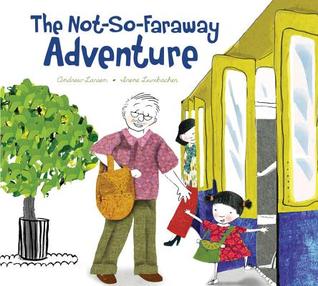
The Not-So-Faraway Adventure by Andrew Larsen

The Not So Faraway Adventure by Andrew Larsen

The Not-So-Faraway Adventure by Andrew Larsen, illustrated by Irene Luxbacher (InfoSoup)

Theo’s grandfather, Poppa, had traveled all over the world. He has a big trunk packed with items from his travels. Now it is Poppa’s birthday and Theo wants to give him the perfect gift. She realizes that it would be wonderful to go on an adventure together. When he speaks of traveling to the ocean once, Theo decides that they will head to the beach and eat at a restaurant. They create a map of their plans together and the next day their board a bus. Soon they reach the beach and the water which they pretend is the ocean. It’s a beach where Poppa came as a little boy. The two spend time on the beach, eat gazpacho and then head home on the bus. Now Theo has items to add to the trunk that are from their adventure together.

A dynamic picture book, this book demonstrates that adventures can be right in our own cities and need not take much time, money or effort. It is also a beautiful look at a granddaughter spending time with her Poppa and a grandfather who has more than enough energy to keep up with her. The urban setting is captured with people of various ethnicity on the page. It’s a bustling and busy place but also welcoming.

Luxbacher’s illustrations are done in PhotoShop and have the feel of collage. Textures and patterns are used throughout, creating a setting that is rich and layered. The city is done with just enough pops of color to keep it dynamic and not so many to make it entirely overwhelming. The page on the beach where they imagine the water is the ocean is captivating with the water entirely swallowing the page and filled with glimpses of their imagination.

A lovely look at a grandchild and grandfather going on their own personal adventure together. Appropriate for ages 4-6.

Reviewed from digital galley received from Kids Can Press and Edelweiss.


Hour of the Bees by Lindsay Eager

Hour of the Bees by Lindsay Eager

Hour of the Bees by Lindsay Eager (InfoSoup)

Carol is missing out on what all of her friends are doing this summer, because she has to head out with her family to the New Mexico desert and move her grandfather off of his farm and into a home for people with dementia. Carol has never really met her Grandpa Serge and tries to avoid him at first because he is so prickly and all he will talk about is a wild story about bees returning to the desert. As the summer goes ever so slowly by, Carol connects with Serge and discovers his ability to weave a great story. It’s a story that is about her grandparents, about a magical tree that granted everlasting life and about bees too. Carol begins to understand her grandfather’s connection to the dried out land and the small home just as the summer ends and they are forced to leave it behind but the story has not reached its end yet.

This magical realism book is enticingly radiant. It shimmers with desert heat, itches with dust and dirt, aches with the loss of loved ones, and dances with the voice of a great storyteller. The writing is lush and lovely with distinct tone differences between Grandpa Serge’s stories and the prose of the novel. Even that prose though is written with such poetry:

I want to tell her how Serge’s eyes glow, how they are cat’s eyes, wide as a newborn’s, ringed like an ancient tree trunk.

A large theme of the novel is connection to one’s heritage and roots. In this book about a magical tree, those roots have many meanings. Carol is urged to connect more with her Hispanic heritage and also to the land itself. She does over the course of the novel in a believable and organic way that really works well. This book is about those slow changes, about becoming yourself and honoring who you are and where you come from.

Beautiful and haunting, this novel deserves a wide audience and plenty of buzz. Appropriate for ages 9-12.

Reviewed from ARC received from Candlewick Press.


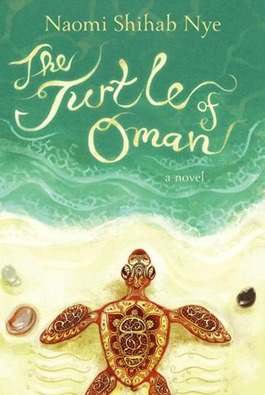
Review: The Turtle of Oman by Naomi Shihab Nye

turtle of oman

The Turtle of Oman by Naomi Shihab Nye

Aref’s family is moving to Ann Arbor, Michigan from where he has always lived in Muscat, Oman.  After his father heads off ahead of Aref and his mother, the two of them head home to finish packing and for his mother to finish working.  But Aref does not want to leave Oman, leave his bedroom to his cousins who will be living there while they are gone for several years, leave his pet cat behind.  But particularly, he does not want to leave his grandfather.  Aref pretends to pack, but finds himself playing instead, riding his bike, ignoring the packing entirely.  His mother gets frustrated and asks Siddi, his grandfather, for a hand.  So the Aref and Siddi head out on a series of adventures that let them spend time together, but also let Aref say goodbye to his beloved Oman and be open enough to greet the future in Michigan.

Nye is the author of Habibi as well as an acclaimed poet.  Her novel is short and wonderfully vivid, painting a picture of Oman for young readers who will be drawn to the natural beauty.  Readers will also be taken by the loving family, where parenting is done with grace and kindness, and where a grandfather is willing to spend lots of time saying farewell, as much time as a child needs. 

Nye’s writing shows her poetic skills again and again.  Her prose reads like verse, filled with imagery and striking wording.  When Aref goes to the sea with his grandfather, Nye describes it like this:

The sky loomed with a few delicate lines of wavery cloud, one under the other.  It looked like another blue ocean over the watery blue sea.  Aref took a deep breath and tried to hold all the blue inside his body, pretending for a moment he didn’t have to move away or say good-bye to anything or share his room and cat, none of it.

Many of the moments with Aref and his grandfather are written like this, celebrating the tiny pieces of beauty in the world, relishing the time, treasuring the wonder.  Her book is like a jewel, faceted and lovely to turn and marvel at.

This short novel is a vivid and majestic look at the Middle East, at familial love, and at the special relationship of a boy and his grandfather.  Appropriate for ages 8-12.

Reviewed from digital galley received from Greenwillow Books and Edelweiss.

Review: Abuelo by Arthur Dorros

abuelo

Abuelo by Arthur Dorros, illustrated by Raul Colon

A boy and his grandfather spend time together riding horses and camping.  They have adventures outdoors losing the trail and even facing a mountain lion.  His grandfather taught him to stand strong like a tree.  Then one day the boy moved with his family to the city, leaving his grandfather behind.  The city was very different.  The stars were hard to see, but they were the same stars.  The boy learned to use what his grandfather taught him in the countryside.  He even stood up to a bully on the first day of school, standing strong as a tree.

Told in graceful free verse, this book reads quickly rather like a brisk horseback ride.  Completely controlled and peppered with Spanish, the book evokes the freedom of the countryside and also the lessons of strength being taught across generations. 

Colon’s illustrations evoke the differences between the country and the city.  The open freedom of the countryside is contrasted against the constraints of the city, yet the sky ranges wide above both and there is freedom when riding your bike just as when riding your horse. 

Free verse mingles with the freedom of the range in this multi-generational title, a perfect masculine accompaniment to Dorros’ Abuela.  Appropriate for ages 4-6.

Reviewed from copy received from HarperCollins.

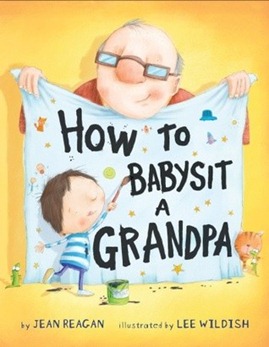
Review: How to Babysit a Grandpa by Jean Reagan

how to babysit a grandpa

How to Babysit a Grandpa by Jean Reagan, illustrated by Lee Wildish

Done in the format of a how-to guide, this book takes a warm and cheerful look at a grandparent coming to babysit.  Except in this book, the child thinks that he is the babysitter.  He tells you how to stay quiet when you are hiding from your grandpa and what to feed your grandpa (hint: it involves a lot of ice cream and cookies).  Then there are walks to take, entertainment to provide, and lots of playing together.  When your grandpa finally announces naptime, it’s time for his nap.  Get him a long book to read, and he will be asleep in no time.  But since you are the babysitter, you have to stay awake.  You can wake up your grandpa later, help tidy the room, and then get ready for your parents to return.  Make sure you have some parting gifts for your grandpa, since he’s sure to miss you a lot.

What could have been an overly-sentimental picture book is taken to a sweet and comfortable level thanks to Reagan’s use of the how-to format.  I also appreciated that the little boy in the story did not use any of his advice to be naughty.  Instead, he took his duties very seriously.  Reagan’s writing has a great playful quality to it.  It is also writing that reads aloud very nicely, thanks to its light touch.

Wildish’s illustrations have a humor to them that adds to the book.  When the book says in a straight-forward tone that on a walk in the cold, grandpas need to be bundled up, she shows us a grandpa so very bundled that he cannot move.  In sun grandpas need sunscreen, and the image shows the boy emptying a bottle of sunscreen onto his grandpa’s head.  Small silly touches that really make the book fun.

A great book for grandparents to bring to share with their grandchildren, this would also make a great additional to a story time about grandparents.  Appropriate for ages 4-6.

Reviewed from copy received from Alfred A. Knopf.