A Piece of Home by Jeri Watts

A Piece of Home by Jeri Watts

A Piece of Home by Jeri Watts, illustrated by Hyewon Yum (InfoSoup)

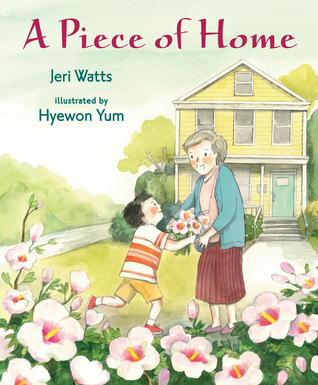
Hee Jun loved living in Korea where he fit in with his classmates at school and his grandmother was a respected teacher. She was also able to have an extraordinary garden there. When his father moves them to West Virginia, everything changes. Hee Jun does not fit in with his classmates due to the way he looks and the way he talks. His grandmother too is different, her inner spark gone. His little sister has problems at school too, taking out her fear physically on her teacher. So their grandmother is asked to go to school with her. Slowly, the family begins to find their place in West Virginia, even discovering a beloved flower with a new name.

Watts tells the story of immigration with an eye towards giving people time to adjust and find their footing both with a new language and a new culture. The sense of loss for the characters is palpable on the page, eliciting a real understanding of the immense change they are undergoing. The little sister’s violent reaction to school is handled with sensitivity and understanding, offering the grandmother a chance to connect with her new surroundings. The entire book is filled with deep emotions combined with a gentle nurturing attitude.

Yum’s illustrations are done in watercolor. They show a loving family that manages to thrive despite the changes. The differences between their lives in Korea and West Virginia are shown on the page, particularly with regards to the grandmother and her vibrant life in Korea compared to her lonely existence in the first weeks in the United States.

A strong and thoughtful look at immigration that beautifully explains the huge changes children undergo as they move to a new country. Appropriate for ages 4-6.

Reviewed from library copy.


Some Kind of Happiness by Claire Legrand

Some Kind of Happiness by Claire Legrand

Some Kind of Happiness by Claire Legrand (InfoSoup)

Finley’s parents are having trouble, so they decide that it is best that she spend the summer with her grandparents even though Finley has never met them before. Something happened that made her father leave the family and not speak to his mother again. Finley struggles with “blue days” where she can barely get out of bed and doesn’t have any energy at all. Other days, she spends writing about Everwood, an imaginary land that has parallels to the real world. When she arrives at her grandparents’ home, she realizes that Everwood is a real place and it is right behind their house, complete with a half-destroyed house, villainous pirates, and a trustworthy knight to share her adventures. As Finley and her cousins go deeper into the fantasy world, the truth begins to surface about what happened years ago to their parents and grandparents.

Legrand has created an intensely gorgeous book here that is complex and multi-layered. Finley’s writing about Everwood is interspersed throughout the book so readers can see the detailed and wondrous world she has created. Readers will also clearly see the ties between Finley’s life and what is happening in Everwood. The whole book is a testament to writing that balances strength of vision with a delicacy of execution that allows those ideas to grow and come alive. The relationships of the adults in the book also supports this with various personalities stepping out at different times. There is a humanity to the adults here, a fragility that lets young readers glimpse the truth in pieces before it is revealed.

Finley’s depression and anxiety in particular are captured with sensitivity and grace. It is shown as a part of her personality, not the only characteristic and not one that overwhelms her constantly. Rather it is a factor in her life, one that doesn’t stop her from bonding with her cousins or being creative and imaginative. This is a book that shows that mental illness may impact your life but not destroy it and that there is power in honesty and getting help.

A deep book filled with the magic of imagination, new-found family and one large woods. Appropriate for ages 11-13.

Reviewed from copy received from Simon & Schuster.


As Brave As You by Jason Reynolds

As Brave As You by Jason Reynolds

As Brave As You by Jason Reynolds (InfoSoup)

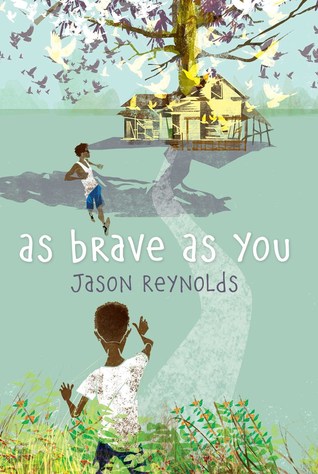
Genie and Ernie are heading to Virginia to stay with their paternal grandparents for the very first time. Though they have met their grandmother before, this is the first time that Genie has met him. The difference between their lives in Brooklyn and their grandparents’ home in rural Virginia are huge. But that’s not the only thing that surprises Genie. He is shocked to find out that his grandfather is blind. Genie is a kid who is full of questions to ask all of the time and so he immediately asks his grandfather questions about his blindness. Genie knows that his older brother Ernie is braver than he is, always taking up fights for Genie and protecting him. He also knows that his grandfather is immensely brave too. When something goes wrong though, Genie will have to rethink what it means to be brave.

Reynolds is so amazingly gifted as a writer. He astounded me with this departure from his more urban writing. He captures the rural world with a beautiful clarity, using the natural world around as symbols for what is happening to the humans who live there. It is done both subtly and overtly, creating a book that is multi-layered and gorgeous to read. Throughout Reynolds speaks to real issues such as guns and disabilities. They are dealt in their complexity with no clear point of view stated, giving young readers a chance to think things through on their own.

Reynolds has created a fabulous protagonist in Genie, a boy filled with so many questions to ask that he has to write them down to keep track of them. He is smart, verbose and caring. Yet at the same time, he agonizes over mistakes, trying to fix them on his own and thus creating a lot of the tension of the book. The depiction of the grandparents is also beautifully done, allowing them to be far more than elderly figures. They are often raw, sometimes wise, and also dealing with life.

A brilliant read for the middle grades, this book is filled with magnificent writing and great diverse characters. Appropriate for ages 9-12.

Reviewed from copy received from Atheneum.


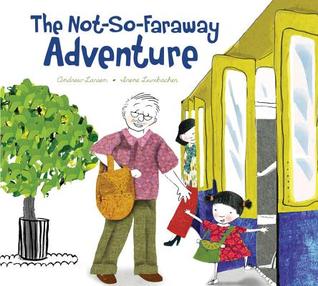
The Not-So-Faraway Adventure by Andrew Larsen

The Not So Faraway Adventure by Andrew Larsen

The Not-So-Faraway Adventure by Andrew Larsen, illustrated by Irene Luxbacher (InfoSoup)

Theo’s grandfather, Poppa, had traveled all over the world. He has a big trunk packed with items from his travels. Now it is Poppa’s birthday and Theo wants to give him the perfect gift. She realizes that it would be wonderful to go on an adventure together. When he speaks of traveling to the ocean once, Theo decides that they will head to the beach and eat at a restaurant. They create a map of their plans together and the next day their board a bus. Soon they reach the beach and the water which they pretend is the ocean. It’s a beach where Poppa came as a little boy. The two spend time on the beach, eat gazpacho and then head home on the bus. Now Theo has items to add to the trunk that are from their adventure together.

A dynamic picture book, this book demonstrates that adventures can be right in our own cities and need not take much time, money or effort. It is also a beautiful look at a granddaughter spending time with her Poppa and a grandfather who has more than enough energy to keep up with her. The urban setting is captured with people of various ethnicity on the page. It’s a bustling and busy place but also welcoming.

Luxbacher’s illustrations are done in PhotoShop and have the feel of collage. Textures and patterns are used throughout, creating a setting that is rich and layered. The city is done with just enough pops of color to keep it dynamic and not so many to make it entirely overwhelming. The page on the beach where they imagine the water is the ocean is captivating with the water entirely swallowing the page and filled with glimpses of their imagination.

A lovely look at a grandchild and grandfather going on their own personal adventure together. Appropriate for ages 4-6.

Reviewed from digital galley received from Kids Can Press and Edelweiss.


Hour of the Bees by Lindsay Eager

Hour of the Bees by Lindsay Eager

Hour of the Bees by Lindsay Eager (InfoSoup)

Carol is missing out on what all of her friends are doing this summer, because she has to head out with her family to the New Mexico desert and move her grandfather off of his farm and into a home for people with dementia. Carol has never really met her Grandpa Serge and tries to avoid him at first because he is so prickly and all he will talk about is a wild story about bees returning to the desert. As the summer goes ever so slowly by, Carol connects with Serge and discovers his ability to weave a great story. It’s a story that is about her grandparents, about a magical tree that granted everlasting life and about bees too. Carol begins to understand her grandfather’s connection to the dried out land and the small home just as the summer ends and they are forced to leave it behind but the story has not reached its end yet.

This magical realism book is enticingly radiant. It shimmers with desert heat, itches with dust and dirt, aches with the loss of loved ones, and dances with the voice of a great storyteller. The writing is lush and lovely with distinct tone differences between Grandpa Serge’s stories and the prose of the novel. Even that prose though is written with such poetry:

I want to tell her how Serge’s eyes glow, how they are cat’s eyes, wide as a newborn’s, ringed like an ancient tree trunk.

A large theme of the novel is connection to one’s heritage and roots. In this book about a magical tree, those roots have many meanings. Carol is urged to connect more with her Hispanic heritage and also to the land itself. She does over the course of the novel in a believable and organic way that really works well. This book is about those slow changes, about becoming yourself and honoring who you are and where you come from.

Beautiful and haunting, this novel deserves a wide audience and plenty of buzz. Appropriate for ages 9-12.

Reviewed from ARC received from Candlewick Press.


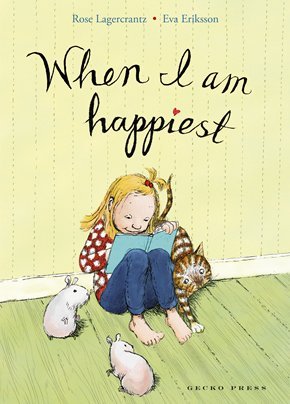
When I Am Happiest by Rose Lagercrantz

When I Am Happiest by Rose Lagercrantz

When I Am Happiest by Rose Lagercrantz, illustrated by Eva Eriksson (InfoSoup)

The third in the charming series about Dani, this book has school ending. Dani has now managed to finish the school year after her best friend moved away. She has a project to finish, a book about how happy she is. But then her father is hit by a car on his bicycle, and suddenly Dani is not happy at all. Dani is taken home by her grandparents where they wait for updates on her her father is doing. How can Dani ever finish her book now? And what will happen if her father never wakes up again?

Translated from the Swedish, this series is one of my favorites. Lagercrantz captures the emotions of having your best friend move away and then the long process of recovering from that. In this novel, she shows how a sudden accident can sweep the air out of your life as a child. Lagercrantz never lectures about being positive, but that’s exactly what her books embrace. Through Dani’s reactions to adversity, readers can see the power of positive thinking and how the good outweighs the bad even when you don’t realize it.

Eriksson’s art is done in line drawings that help break the text up, making this book just right for elementary readers who may still find large paragraphs overwhelming. The art is done with a sense of humor, such as the image of Dani getting her ears pierced with her father unable to look but bravely holding her hand anyway. When Dani is overwhelmed by the news of her father, you can see it in every bone of her body as it curves protectively inward.

Another winner in this great series, get these into the hands of fans of Clementine for another amazing young heroine. Appropriate for ages 6-8.

Reviewed from library copy.

Review: North Woods Girl by Aimee Bissonette

North Woods Girl by Aimee Bissonette

North Woods Girl by Aimee Bissonette, illustrated by Claudia McGehee (InfoSoup)

A girl tells about her grandmother who is not like other grandmas. She dresses in Grandpa’s old flannel shirts and she’s bony. She doesn’t bake cookies or pies, but she does take long walks out in nature. With her trusty walking stick, the two of them explore the little paths near Grandma’s house. Every season there are new things to see, things in the garden to do. The two love winter best of all, especially winter nights with a full moon when they explore the snowy woods. Grandma may not be like other grandma’s but she’s pretty special and a north woods girl to the quick.

Bissonette captures the spirit of a north woods woman beautifully in her picture book. From the no-fuss long grey braid, the flannel shirts, the stout boots to the way that nature speaks to her and that she knows it so well. This book is a celebration of the north woods too, the ways that the woods changes in different seasons, the animals that fill it, and the glory of a winter woods.

McGehee’s scratchboard illustrations have a rustic beauty. The colors are deep and lovely, and they capture the spirit of the woods. In fact, there are moments when you can almost smell the pines and the grass. There is a subtle multiculturalism here too with the little girl’s darker skin tone and curly hair. The pages are crowded with details of the woods, filled with animals and insects.

A lovely look at the northern woods, this picture book celebrates unique grandmothers living in a unique place. Appropriate for ages 3-5.

Reviewed from copy received from Minnesota Historical Society Press.

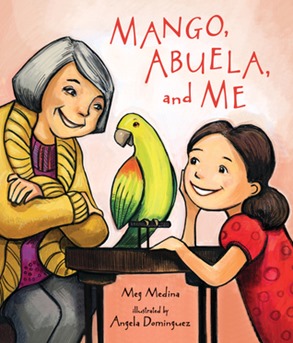
Review: Mango, Abuela and Me by Meg Medina

Mango Abuela and Me by Meg Medina

Mango, Abuela and Me by Meg Medina, illustrated by Angela Dominguez (InfoSoup)

Mia’s abuela has come to live with Mia and her family in the United States. She can’t speak English and Mia can’t speak Spanish, so the two of them spend time together in silence, feeding the birds and watching TV. Mia’s mother reminds her of how a classmate learned to speak English and Mia starts to work to teach her abuela the new language. They point at things and share the English and Spanish words. Mia labels items around the house with their English names. Then when Mia and her mother go to the pet store for treats for her hamster, Mia sees a parrot that she knows will remind her abuela of the home she left. Mango, the parrot, starts speaking both languages and helps Mia’s abuela connect with both her past and her granddaughter.

Medina has written this picture book with a lovely clarity of voice. The first person narrative is told from Mia’s point of view and shows the growing relationship with her grandmother, from the first shy days to the later part of the book where they are happily chatting and reading together. The book speaks to the importance of family and also to the ways that language can be learned and shared. It is particularly important that Mia learned Spanish too.

The illustrations are simple and colorful. They show the limited space that the family has, so Mia and her grandmother share a room together. The urban setting is shown with a bright friendliness that captures a vibrant community. The chronicling of the growing relationship is shown very effectively in the images.

A strong picture book that celebrates families and new language learners. Appropriate for ages 4-6.

Reviewed from library copy.
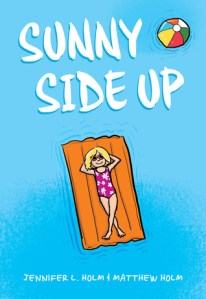
Review: Sunny Side Up by Jennifer L. Holm

Sunny Side Up by Jennifer L. Holm

Sunny Side Up by Jennifer L. Holm and Matthew Holm (InfoSoup)

Sunny has been sent to spend the summer with her grandfather in Florida. He lives in a retirement community where there are no children or pets allowed. Sunny tries to make the best of it despite the squeaky fold-out bed and her grandfather’s slow pace of life where an outing is a trip to the post office. Then Sunny meets Buzz, the son of the groundskeeper who teaches her about superheroes and comic books. Throughout the story, there are flashbacks to before Sunny came to Florida that involve her wild older brother. His behavior went from disobeying small rules to abusing drugs and alcohol. The tension builds until Sunny’s perfect beach vacation with her best friend has to be changed to sending her away to stay with her grandfather. This book explores the impact of having a family member who is an addict, the guilt children feel about it, and the shame they experience.

In the final pages of the book, Holm reveals that they grew up in a home where a close family member had addiction issues. You can see their first-hand experience in the book where Sunny’s deep emotions about what is happening to her family are held inside until they become too much. All of the emotions throughout this graphic novel are done superbly and communicated in a way that makes them easy to understand and relate to.

Sunny is a great lens to view addiction through, first naively and then as she starts to understand what is happening with a feeling of being part of the problem and contributing to her brother’s deteriorating situation. Even as she goes to Florida and fills her days with finding cats and collecting small rewards that she spends on comic books, she can’t escape what having a sibling with an addiction has done to her and her family.

A book that demonstrates that graphic novels with lighthearted illustrations can deal with big issues, this graphic novel is superb and belongs in every public library. Appropriate for ages 8-11.

Reviewed from digital galley received from Graphix and Edelweiss.