Amber & Clay by Laura Amy Schlitz

Cover image

Amber & Clay by Laura Amy Schlitz, illustrated by Julia Iredale (9781536201222)

The Newbery-Medal winner brings us into the world of ancient Greece with her new novel. Rhaskos is a slave working in a Greek household where he spends his days picking up horse manure. He doesn’t mind the hard work, but he’d much rather be drawing the horses around him. He works in secret, steadily building his craft, inspired by a painting his master owns. Melisto is a girl hated by her mother, abused by her, but someone who has grown up used to wealth and luxury. She is precious, particularly for the connections she will make when she marries. She is selected to serve the goddess Artemis for a year, living wild and free for the first time in her life. By the time our two protagonists meet, one of them has died, though their destinies are entwined with one another.

Schlitz has created a masterpiece of a novel where she blends verse and prose, moving freely between the two. It is a complex novel with elements of Greek society explained, wars imminent and friendships being forged. Schlitz adds the voices of the god Hermes to the mix, also including the philosophical musings of Socrates who appears as himself in the novel. The book is marvelous, each of the elements working to support the whole and weaving together into a tantalizing tale that is surprising and fascinating.

Schlitz’s writing is exceptional. She explores ancient Greece along its dusty paths and roadways, showing readers how it felt to be these characters in these times. She speaks as Hermes and Socrates in voices that are unique to them and feel perfectly suited. The question of the value of a life runs throughout the book along with looking closely at suffering and pain. These deep questions and philosophies are ideally suited to the world Schlitz has created. They are enhanced by the illustrations that show various Greek artifacts and explain what they were used for.

Deep, dramatic and classical, this book is the best of historical fiction for children.

Reviewed from ARC provided by Candlewick Press.

I Am Pan! by Mordicai Gerstein

I Am Pan by Mordicai Gerstein

I Am Pan! by Mordicai Gerstein (InfoSoup)

From the minute he is born, Pan is filled with mischief. Born with his goat horns and hoofed feet, he is immediately silly and even gets the grumpy Zeus to smile. As Pan grows, he becomes bored with life on Olympus and gets into so much trouble that the Gods ask him to return to Arcadia where he was born. While there, he invents panic, falls in love with the moon, and helps battle the monster Typhon. He also falls in love and marries Echo and discovers his love of music and the pan pipes. Story after story shows the power of merriment, music and mischievousness.

Gerstein embraces the spirit of Pan on the page by telling the tales with a zany spirit and a wild feel. There is not attempt to contain Pan here, just a feeling of being along on a very rambunctious ride. This suits the subject beautifully, giving space to the large personality of Pan. The graphic novel format also works very nicely with retelling Greek myths, keeping them brief and showing rather than telling a lot of the action.

The illustrations of this picture book/graphic novel are done in loud colors with lots of action and movement. Pan almost flies off the page in some sections, particularly when creating panic personally. The illustrations match the subject, offering a loud and cheery look at this wild God.

I am hoping this is not the only Greek God book that Gerstein does, since this book works so well and offers a very approachable and funny look at Pan. Appropriate for ages 6-9.

Reviewed from copy received from Roaring Brook Press.


Review: The Orphan by Anthony L. Manna

orphan

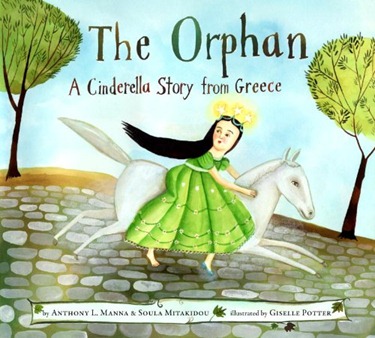
The Orphan: A Cinderella Story from Greece by Anthony L. Manna & Soula Mitakidou, illustrated by Giselle Porter

This story of Cinderella has a distinct Greek twist to it.  In the author note at the beginning of the book, they state that the tale is drawn from two Greek versions of Cinderella.  One change that was made from the traditional stories is that Cinderella takes a more modern and active stance than she had in previous versions.  It is the story of a girl who loses her devoted mother and then has a stepmother and two stepsisters who take her father’s attention, love and money.  She weeps at her mother’s grave and is encouraged by her mother’s spirit to have hope and wait for blessings to appear.  They arrive in the form of Mother Nature and her children, who give Cinderella the Evening Star as a headpiece, dresses, and shoes.  Instead of a ball, this Cinderella meets her prince in church and in disguise, riding there on a white mare made of clouds.  She loses her shoe when leaving the church after the prince tries to capture her by making the threshold sticky.  All is revealed when the shoe fits.

This is a very satisfying version of the story with a spiritual tone that is not in the more familiar version.  Cinderella’s connection with her dead mother is much stronger here as well, having her turn to that guidance rather than a fairy godmother deepens the story considerably.  Also connecting her dresses, shoes and crown to nature is an adroit move. 

Porter’s illustrations have a folktale feel to them with a traditional grounding in the style.  At the same time, they have a rather ethereal quality as well, a lightness and wonder that infuses them.  It is a pleasing combination.

While we don’t really need more versions of the Cinderella tale, this one has a unique appeal and a very different feel.  Appropriate for ages 5-7.

Reviewed from copy received from Schwartz & Wade Books.