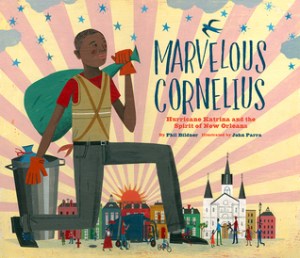
Review: Marvelous Cornelius by Phil Bildner

Marvelous Cornelius by Phil Bildner

Marvelous Cornelius: Hurricane Katrina and the Spirit of New Orleans by Phil Bildner, illustrated by John Parra

Cornelius worked in the French Quarter of New Orleans. He was a garbage man who loved his job. He greeted everyone in the neighborhoods and made sure that the streets were clean of even a single wrapper. He had amazing calls he used with his driver, shouting “Woo! Woo!” when it was time to stop and “Rat-a-tat-tat!” when it was time to drive on. He didn’t just carry bags from the curve, he tossed and juggled them, adding dance steps to his routine job. He could launch bags through the air one after another and they landed in a perfect pyramid on the truck. But then Hurricane Katrina came to New Orleans and the city streets filled with mud and muck and piles of garbage. At first Cornelius was overwhelmed by the work to be done, but he started the same way he did every day and soon others started helping too.

This picture book is based on the true story of Cornelius Washington who was a sanitation worker in New Orleans. The Author’s Note speaks to his connection with Cornelius’ family and a reporter who had gotten to know him before the storm. In this book, Cornelius’ story is told in folklore style, offering him and his amazing spirit that he displayed every day a space to be honored and appreciated.

Parra’s illustrations play to the heroic feeling of the book, Often showing Cornelius with stars behind his head or rays of the sun. The painted illustrations have a gorgeous roughness to them in texture that also connects the subject to history and makes the entire book feel timeless and sturdy.

An homage to a man who did a humble job with style and energy, this book is also about survival and what it takes to be an everyday hero. Appropriate for ages 5-8.

Reviewed from copy received from Chronicle Books.
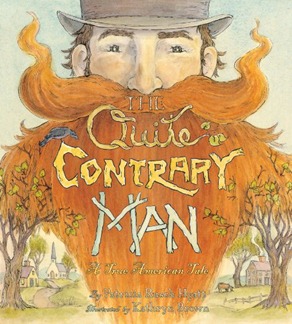
Review: The Quite Contrary Man by Patricia Rusch Hyatt

quite contrary man

The Quite Contrary Man: A True American Tale by Patricia Rusch Hyatt, illustrated by Kathryn Brown

In 19th-century New England when people lived and dressed plainly, Joseph Palmer most certainly did not.  It was his beard that made him different, since all the other men were clean shaven.  But Joseph did not just have a normal beard, his was huge, long and wide.  His neighbors were scandalized and tried to shame him into shaving, eventually trying to shave him by force.  His attackers headed to court before Joseph could get there and claimed that he had attacked them.  The judge fined him $10, but Joseph refused to pay it.  So he was jailed for a full year.  The rule in the jail was that prisoners had to be clean shaven, and you can guess how that went with Joseph.  As the tale twists and turns, readers will be in turns inspired by Joseph Palmer’s strength of conviction and appalled by the system that persecuted him.

Hyatt has found a true story that really speaks to what being an American means, down to the most basic rights of deciding how you appear.  While modern children may be shocked by the fact that beards were scandalous, this is a great book to start discussions about what sorts of things are taboo today that may also not make any sense.  Hyatt’s writing is engaging and rollicking.  The spirit of the book matches Palmer’s own strength and humor.

Brown’s illustrations are done in fine lines and soft colors.  They depict the glory of Palmer’s beard with enthusiasm.  On alternate pages, she creates a rustic frame from illustrations of branches tied together with vines, which adds to the feeling of the book being set in an earlier time.

An American hero, Joseph Palmer’s is an inspiring story of a regular man who stood up for his rights.  He would also make an intriguing hero to discuss in units.  Appropriate for ages 6-8.

Reviewed from library copy.

Also reviewed by

Giant Steps to Change the World

giantsteps

Giant Steps to Change the World by Spike Lee & Tonya Lewis Lee, illustrated by Sean Qualls

This is a book filled with inspiring people that show children that everyone has the ability to be a hero.  The book contains examples of people who stood up for others, worked with a passion and vision, honored deep values, and led the world to a new place.  Among the heroes on the pages are Langston Hughes, Harriet Tubman, Mother Teresa, and Neil Armstrong.  It is a great mix of male and female and different races.  The heroes will inspire young readers to take that first step to follow in the giant steps that their heroes left behind.

Qualls’ illustrations are amazing.  Done in acrylic, gouache, pencil and collage, the images are bold and strong.  Some are so powerful, they stay with you after closing the book, like the black and white image that represents Harriet Tubman and moves from dark to light.  The illustrations have clear lines, deep colors, and convey the essence of that hero to great effect.

Unfortunately, the text written by the Lees is less successful.  The heroes they have selected are an incredible group of people.  It is the words themselves that fall flat, often being too verbose and roundabout for a children’s picture book.  I was also disappointed that there was not a list of the heroes anywhere in the book with more information.  Readers can look at the endpages of the book to see a quote from each hero, but no further details are given.  That’s just not enough information for young readers.

An inspiring book despite some issues, this book would pair well with President Obama’s Of Thee I Sing: A Letter to My Daughters.  Appropriate for ages 7-9.

Reviewed from copy received from Simon & Schuster.