Review: Renegade Magic by Stephanie Burgis

renegade magic

Renegade Magic by Stephanie Burgis

Somehow I lost track of this wonderful magical series, so I’m a little late in reading the last two books.  This is the second in the series, following Kat, Incorrigible.  Kat’s oldest sister is wed at the beginning of this book, but not before her wedding is disrupted by the angry mother of another sister’s suitor.  Once again Kat’s feud with Lady Fotherington has caused catastrophe.  When Kat confronts Lady Fotherington about what she has done, she goes too far and loses her right to learn how to use her Guardian magic.  Soon after the wedding, the suitor has reluctantly left and the family heads to Bath to escape the scandal for a time.  Little do they know, but they are heading directly into a huge magical situation where Kat will be unable to avoid the Guardians.

Burgis weaves actual history into her story of Bath which adds a fine solid foundation to a story that is frothy with fun and sparkling with magic.  Perhaps the best part of this book is the frumpery and finery of the upper class, making sure they are seen in the proper way and fretting about the smallest things.  Through it all, Kat is a fierce heroine, determined to regain her right to learn Guardian magic and do what is best for her family. 

A strong second book in a delight of a series, this book has a strong ending that sets readers up nicely for the final book in the series.  Appropriate for ages 9-12.

Reviewed from copy received from Atheneum Books for Young Readers.
Review: Dark Triumph by Robin LaFevers

dark triumph

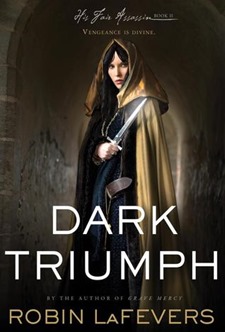
Dark Triumph by Robin LaFevers

Sybella has been forced to return to her family after fleeing to the convent for safety.  There she learned the art of assassination, but nothing prepared her for returning to the family that abused her for years.  Now she has to play the dutiful daughter while waiting to see if the marque of Death will appear on her father’s body.  She has been promised the right to personally murder him.  Around Sybella, politics are being played out.  Loyal to the Duchess, unlike the rest of her family, Sybella is able to send a message to warn them and turn the result of a battle.  When the convent orders her to rescue a valuable prisoner from under her father’s nose, Sybella risks losing her entire protective disguise.  She doesn’t realize that she risks losing her heart as well.

I adored the first in the Fair Assassin series and looked forward to this second book.  The heroine in this book is Sybella rather than Ismae.  While the first book was awhirl in the politics of 15th century Brittany, this one is much more about a person and her own personal history.  Sybella is a compelling and rich character.  As the abuse she suffered is slowly revealed, readers will discover more and more about the incredible strength of this girl turned killer. 

Sybella also questions her own loyalties and ties to Mortain, the God of Death.  She wonders whether the convent may be wrong about things or if perhaps she herself has overstepped and lost the God’s favor.  These questions of faith against the dark stain of familial abuse add to the depth of the novel.  As with the first book, there is a passionate romance that rings true and honest.  Sybella slowly falls in love, so gradually that she doesn’t notice until she is fully intoxicated with it.  It is beautiful and glorious, especially as she is accepted as she admits the entire truth about her life.

A killer book, this is a strong sophomore book in a riveting series.  Not for the faint of heart, this book has abuse, murder and true tragedies in its pages.  Appropriate for ages 16-18.

Reviewed from library copy.

Review: The Matchbox Diary by Paul Fleischman

matchbox diary

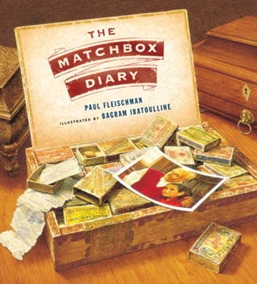
The Matchbox Diary by Paul Fleischman, illustrated by Bagram Ibatoulline

A great-grandfather shares his life’s story with his great-granddaughter who picks out a cigar box filled with matchboxes to find out more about.  He has been collecting matchboxes that are filled with small items documenting his life, a diary of objects.  They tell of his poor childhood in Italy where he’d be given an olive pit to suck on to make him less hungry.  There is a picture of his father who went to work in America and sent money home.  His story then turns into one of an immigrant with a trip to the port and then aboard a large ship.  He tells of arriving at Ellis Island, of the terror of possibly being denied entrance, and the eventual reunion with his father.  The entire family, including the children, worked to earn enough money to survive.  Life became better and he learned to read until he started in the printing industry and opened a bookstore. 

Fleischman writes of the tentative relationship of a young child and her great-grandfather who are just getting to know one another for the first time.  This is a story filled with small gems, treasures of stories that the two of them explore side by side.  The small matchboxes are a wonderful device to add surprise and delight to the story.  Fleischman has created an entire picture book told only in dialogue, making it a pleasure but challenge to read aloud. 

Ibatoulline’s illustrations are precise and detailed.  The matchboxes are shown up close and just opened, as if the reader had been the one exploring them.  The stories are shown in sepia tones with modern day in full color.  They are filled with a beautiful warmth in both cases.

A distinguished picture book, this is a brilliant combination of historical story and vivid illustrations.  Appropriate for ages 6-9.

Reviewed from library copy.

Review: Red Kite, Blue Kite by Ji-li Jiang

red kite blue kite

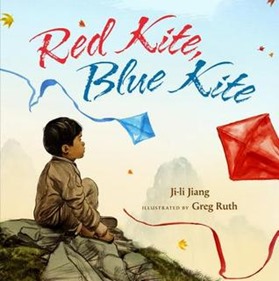
Red Kite, Blue Kite by Ji-li Jiang, illustrated by Greg Ruth

Based on the true story of a family friend, this book tells the story of a father and son separated during the Cultural Revolution in China.  Tai Shan and his father, Baba, loved to fly kites together from the roof of their home in their crowded city.  Then bad times come and the schools are closed.  Baba is sent to a labor camp and Tai Shan is sent to life in a small village with Granny Wang.  Both Tai Shan and his father continue to fly their kites, using them as a signal to one another and a way to maintain contact.  Eventually, Baba is taken further away to another labor camp where they cannot communicate with kites.  All that can be done is to wait until Baba is free again and their kites can soar together once more.

This picture book will be best understood by older children.  There is no need to have a background in Chinese history to understand this book because the story is so universal.  The use of kites as imagery of freedom and connection works particularly well, especially in the ending which is particularly uplifting after the tension and sorrow of the rest of the tale.  Jiang writes in prose that is filled with the emotion of the time.  He writes with deep compassion and doesn’t shy away from the pain that fills Tai Shan’s days separated from his father.

Ruth’s illustrations capture the mood of the story very effectively.  He moves from bright golds and oranges in the city to the dull colors of khaki and earth when the two are separated.  The color scheme is only alleviated by the pop of color from their kites.  When the two are together again, the color begins to return to the landscape.

This is a striking and universal look at families that are torn apart by war and the haunted time they spend apart.  Appropriate for ages 6-9.

Reviewed from library copy.

Review: Engine Number Ten by Rose Ann Woolpert

Engine Number Ten

Engine Number Ten by Rose Ann Woolpert, illustrated by Jaguar Studio Design

This is the story of how granite was quarried over one hundred years ago in California.  First work was done with mules and small wooden carts.  Then little steam trains were used on the narrow tracks, shuttling back and forth with loads of rock.  Steadily, more steam trains were used until they had ten steam trains and one steam shovel working in the quarry.  Then diesel locomotives started to replace the oldest steam engines until just Number Ten was still working.  The other steam trains had been taken apart and sold.  A new diesel engine was purchased for the quarry, pulling huge loads of granite with ease.  Number Ten was sent off to be scrapped.  But then something happened that changed Number Ten’s fate, a rockslide trapped the diesel engine.  There was only one train that could rescue her:  Number Ten!

Woolpert successfully mixes the true story of the Number Ten engine that now is on display at the Railroad Museum in Sacramento with personified engines that eagerly say “Yes, I Will!”  Her writing is refreshingly clear and playful, allowing the momentum of the true story itself to set a brisk pace. 

The illustrations are a mix of vintage photographs and black and white drawings that are often superimposed upon the photos.  This echoes the story being a mix of history and fiction.  The result is clearly historical but also very friendly.

This is the first book in the “Yes, We Will” series which will continue to tell the stories of the machines and people of Graniterock, a business in northern California.  It’s a good pick for young train enthusiasts or those interested in American history.  Appropriate for ages 4-6.

Reviewed from copy received from the author.

Review: The Lightning Dreamer by Margarita Engle

lightning dreamer

The Lightning Dreamer by Margarita Engle

Margarita Engle, award-winning author of verse novels, continues her stories of Cuba.  In this book, she explores the life of Gertrudis Gomez de Avellaneda, also known as Tula, who becomes a revolutionary Cuban poet.  Raised to be married off to save the family financially, Tula even as a young girl relates more closely with slaves and the books she is reading than with girls of her own age and her own social standing.  As she reads more and more, sheltered by both her younger brother and the nuns at the convent, Tula starts to explore revolutionary ideas about freedom for slaves and for women.  In a country that is not free, Tula herself is not free either and is forced to confront an arranged marriage, the brutality of slavery, and find her own voice.

Engle writes verse novels with such a beauty that they are impossible to put down.  Seemingly light confections of verse, they are actually strong, often angry and always powerful.  Here, Engle captures the way that girls are asked to sacrifice themselves for their families, the importance of education for young women, and the loss of self.  She doesn’t shy away from issues of slavery either.  At it’s heart though, this novel is about the power of words to free people, whether that is Tula herself, her brother or a family slave and friend.

Highly recommended, this is another dazzling and compelling novel from a master poet.  Appropriate for ages 12-15.

Reviewed from digital galley received from NetGalley and Houghton Mifflin Harcourt.

Review: Maggot Moon by Sally Gardner

maggot moon

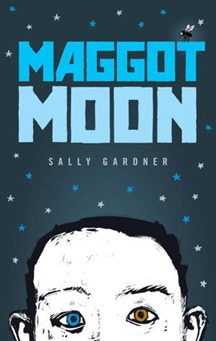
Maggot Moon by Sally Gardner

Standish Treadwell thinks differently than all of the others.  He can’t read and can’t write because the letters move around in front of his eyes, but he does come up with amazing thoughts.  That’s one of the reasons that he and his best friend Hector get along so well.  Hector sees past Standish’s different colored eyes and understands that Standish is really brilliant.  So when Hector disappears, Standish is left alone to be bullied.  It’s all because Hector went to the other side of the wall and saw what was happening there.  It’s a secret that the Motherland doesn’t want anyone to know about, but Standish starts to figure everything out when the Lush family is taken and the Moon Man appears.  This dark, violent novel shows us a bleak future where differences are stomped out but as Standish demonstrates are just as vital as they are today.

This is one of those novels that unfolds as you read it, layered and complex.  Science fiction set in the 1950s, readers will try to figure out where the book is set and how this happened.  Set in a totalitarian regime in what appears to be England where World War II ended very differently, this book is stark and tension filled.  Just the illustrations alone with the fly and the rat mark this as an unusual read. 

What I found most amazing about this book is that we are not just told that Standish thinks differently than others, we are shown it in his narrative voice.  The book is far from linear, journeying almost as a stream of consciousness through the past.  Standish will have readers themselves looking at the world through his eyes and what an accomplishment that is!

This book defies description by genre and really is impossible to summarize well.  Let me just say that it is powerful, brutal and set in bleakness but never far from hope.  Appropriate for ages 15-18.

Reviewed from library copy.

Review: Midwinter Blood by Marcus Sedgwick

midwinterblood

Midwinterblood by Marcus Sedgwick

Intertwined stories that range from the near future of 2073 to the distant past of the Vikings, this book lures the reader in with dark promises, strange happenings, and dares you to follow your curiosity deeper and deeper.  When Eric Seven arrives at the island of Blessed to see if the claims that people have discovered how to live longer (if not forever) are true, he is greeted with warmth and immediately set up in house of his own.  No one lives on the western side of the island and the eastern side only has adults, no children.  Eric starts out with drive to discover what is wrong, but the longer he spends on the island and drinking the tea the community provides him, the less he wants to explore at all.  When he travels to the western side of the island finally, his story forms the door to those that follow.  Layer upon layer, the lives of the people on Blessed are told, each layer revealing something new and equally odd.  This impressive novel is impossible to put down until the final story and the real truth is revealed in all of its horror.

Immediately upon opening this book, the strangeness of the story was apparent.  As Eric slips into complacency, I was almost screaming at him with frustration.  It was the ideal way to open this book where so much hinges upon the moments of hair raising oddity that link the stories.  Sedgwick has built this book so exquisitely that there is no guessing at the ending until it comes.  It is a story of love but also of revenge, of brotherhood but also of murder. 

Set on a Scandinavian island that is remote, Sedgwick uses the unusual formation of the island as a large part of the story.  The two halves nearly severed from one another, they are two worlds connected only slightly.  So the island itself reflects the story of generations of people who remain connected as well.  The inclusion of the dragon orchid and the powerful tea it brews is also a great symbol within the story.  The orchids are powerful, strange but also beautiful and delicate. 

This compelling novel is amazing teen literature.  It has enough depth to be used in a classroom where the symbolism and incredible writing can be celebrated.  It is also a riveting combination of romance and horror that will thrill discriminating teen readers.  Appropriate for ages 15-18.

Reviewed from copy received from Roaring Brook Press.

Review: Out of the Easy by Ruta Sepetys

OutoftheEasy_BOM.indd

Out of the Easy by Ruta Sepetys

Published February 12, 2013.

Josie knows that she wants to leave New Orleans behind.  She wants to leave her mother, a prostitute who works in a brothel.  Josie wants to leave behind her job of cleaning the rooms of the brothel.  But it’s not so easy to leave The Big Easy, especially when a wealthy man just turned up dead soon after meeting Josie in the bookstore she works in.  Josie is also caught up in lying about the mental condition of the bookstore’s owner so that he won’t be committed.  And there may just be romance flying with not one handsome young man but two.  Yet Josie has one specific dream and that is getting into Smith College.  The question is just how many people she may have to step on to get there and how she will have to compromise herself.  This vivid portrayal of a 1950s New Orleans takes us into the seedy world beneath the shiny beads and lovely architecture.

The setting of this novel is such an integral part of the story that it simply would not have worked anywhere else in the world.  Beautifully captured, readers get to really see the time period reflected as well as the city herself.  Add to that the wonderfully charged atmosphere of the story and you get a book that is impossible not to fall for, just like New Orleans.

Sepetys has created a complex heroine in this novel.  Josie is both ashamed of her background and yet defensive and proud about it as well.  As she gets deeper and deeper into the secrets and troubles of the storyline, her character is tested and Josie does not always react the way one might expect a heroine to.  Instead she is genuine, making wrong choices, correcting and then making others.  Often there is no right answer, just not the worst one. 

Well-written and compelling, this glimpse of New Orleans features a striking heroine and a tumultuous storyline.  Appropriate for ages 15-17.

Reviewed from ARC received from Philomel.