Review: Gingersnap by Patricia Reilly Giff

gingersnap

Gingersnap by Patricia Reilly Giff

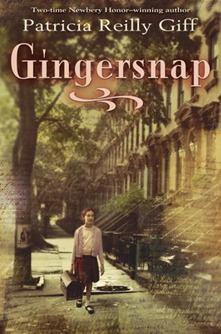
Jayna’s older brother Rob rescued her from foster care but now he is called to duty on a destroyer during World War II.  Both brother and sister love to cook: Jayna’s specialty is soup.  The two don’t have any other family in the world, so Rob leaves Jayna with their landlady who is always lecturing Jayna about manners.  Right before he leaves, Rob tells Jayna about a recipe book he found that may have belonged to their grandmother.  It contains an address for a bakery in Brooklyn.  When Rob is listed as missing in action, Jayna decides to travel to Brooklyn to discover if her grandmother still has a bakery there.  She takes her pet turtle with her and also a ghost who has been helping lead her in the right direction.  But what will she find when she gets to Brooklyn?

Giff has created a very pleasant mix of historical fiction and ghost story in this novel.  At the center is a young girl and her wish for a family, which propels the action in the story.  I appreciated that while the ending is satisfying it is not the perfect vision that young Jayna had been searching for.  Some may say though that it’s even better.  The ghost is not frightening at all, instead she borrows nail polish and even clothing.  She offers opinions on what is happening, most of which are helpful and get Jayna to make decisions more quickly.

It is the historical piece that is very special here.  I appreciated a young girl who could not just cook but excelled at it.  The food shortage is vital to the story as is the war itself.  Later in the book, readers also get to hear about the first World War and its impact.  This is a book about the homefront, made more dynamic by one untidy little ghost.

A treat for readers, this book should be embraced by teachers looking for fiction about World War II.  The setting is strong, the characters memorable and the food enticing. Appropriate for ages 9-12.

Reviewed from copy received from Random House Children’s Books.
Review: One Came Home by Amy Timberlake

one came home

One Came Home by Amy Timberlake

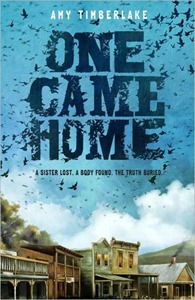
Georgie knows that she is the reason her sister Agatha left.  When an unidentifiable body is found with her sister’s hair color and the dress her mother sewed, everyone assumes it is Agatha.  But Georgie refuses to accept that.  She sets off to find out what happened to her sister.  In 1871 in rural Placid, Wisconsin, Georgie is forced to ask her sister’s old beau Billy to give her a horse.  She has a gun that she is an expert at using and a destination in mind, where the body was found.  It doesn’t work out the way Georgie expects since Billy insists on joining her for the trip and gives her a mule rather than a horse to ride.  The two set off arguing all the way, traveling through the debris from the largest passenger pigeon nesting in history, finding wild adventures along the way. 

Written in a lyrical voice, the prose in this book is noteworthy and lovely.  Timberlake has radiantly recreated both the society and setting of the late 1800s.  Happily, she spends less time on clothes and societal niceties and much more on spirit and gumption.  Early in the book you can see her words at work, drawing a picture of the two sisters using imagery from nature around them:

Feathers flew up with each breaking bottle. Pigeon feathers that spring were like fallen leaves in the autumn-they were everywhere, in everything. But there’s a difference between feathers and leaves. Feathers claw their way back into the sky, whereas leaves, after flying once, are content to rest on the earth. Agatha? She was a feather. She pushed higher, farther always. I suspected my constitution was more leaf than feather. I hoped I was wrong about that, though, because I wanted to be like Agatha.

Georgie is a tremendous protagonist.  She’s a natural with a rifle, looks forward to taking over the family store in their small town.  She’s not interested in boys and is far more concerned with her own future with her sister than with anything else.  She speaks with confidence and very boldly, never keeping her opinions to herself for long.  At the same time, she is also the voice of the novel, and through that she herself looks at the world in a poetic way.

Beautiful with a strong heroine, this book is a dazzling read for tweens.  Appropriate for ages 9-12. 

Reviewed from copy received from Knopf Books for Young Readers.

Review: Unspoken by Henry Cole

unspoken

Unspoken: A Story from the Underground Railroad by Henry Cole

Every now and then an illustrator takes an amazing risk and it works so beautifully that it’s a masterpiece.  That’s what Cole has done in this remarkable picture book.  Don’t expect to see the bright colors of his work in books like Moosetache or even the more subtle but equally bright And Tango Makes Three.  Instead Cole has turned to the medium of simple paper and pencil to create a book that is wordless and powerful.  It’s the story of a farm girl who discovers a runaway slave in their barn soon after seeing a group of men on horseback.  She is startled and unsure, but over the course of the evening decides to help him.  It is a story of gifts given and also received.

Cole’s delicacy of line and details are notable here.  He keeps the illustrations very child-friendly, but they are also mysterious, shaded in darkness.  He plays with light, as you can see from even the cover image.  These wordless pages build tension and roll like a film before your eyes.  I’m thinking that the skill shown with simple materials and the strength of this book could mean a Caldecott consideration.

This is a profound book that speaks volumes about the importance of personal courage and the difference that one individual can make.  This is not a wordless book for preschoolers.  It’s more appropriate for ages 7-9 who will understand the history better.

Reviewed from library copy.

Review: The Revolution of Evelyn Serrano by Sonia Manzano

revolution of evelyn serrano

The Revolution of Evelyn Serrano by Sonia Manzano

It’s the summer of 1969 and garbage is piling up on the streets of Spanish Harlem.  Evelyn, who has changed her name from Rosa, has a new job at the Five and Dime.  It’s a lot better than her job in the family’s bodega.  But that summer is not going to be a normal summer at all.  First, Evelyn’s grandmother arrives, complete with large amounts of stylish clothes, makeup and books in Spanish.  If Evelyn thought she didn’t get along with her mother, that’s doubly true of her mother and her grandmother who seem to be opposites on everything.  One big thing that they disagree about is the Young Lords, young college students who are trying to get the Puerto Ricans in Spanish Harlem to stand up for themselves.  They want to find space for a daycare, a place to serve breakfasts to youth, and a place to hand out clothing.  Evelyn finds herself right in the middle of a revolution, one that her own family can’t agree about. 

Manzano, the actress who played Maria on Sesame Street, has followed up her successful picture book with a book for older readers.  Ideal for middle schoolers, this book addresses family issues that can be far more complicated than just not agreeing about food and clothes.  It also takes on a history that not many readers may know about, a peaceful revolution right in New York City. 

Manzano’s writing is very straight-forward, rarely heading into figurative writing or symbolism.  When she does work with imagery, it is very effective, making one hope that in her next books she writes with more depth.  That is not to say that this book is not effective as it is written.  But it remains more factual and solid.

A strong addition to any collection, this historical fiction novel will both instruct about history and inspire activism.  Appropriate for ages 10-12.

Reviewed from ARC received from Scholastic.

Review: Keeping Safe the Stars by Sheila O’Connor

keeping safe the stars

Keeping Safe the Stars by Sheila O’Connor

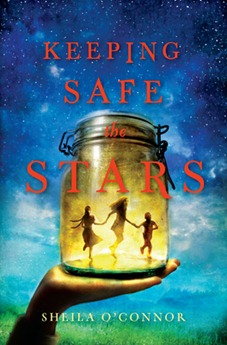
Pride and her two younger siblings, Nightingale and Baby, live with their grandfather, Old Finn.  They live on a remote property that Old Finn calls Eden.  But when Old Finn enters the hospital and is then transferred to Duluth for more serious treatment, it is left to Pride to care for her family.  She had been taught by Old Finn not to rely on charity from others, so she makes sure to not accept help that she can’t pay for.  She also knows that if anyone finds out that they are alone at Eden except for Miss Addie, an elderly woman who lives on the property but can’t care for them, they will be taken into foster care.  The three children had already been in care when their mother died, before Old Finn came and rescued them.  But even on their remote property, there are people who notice that something is wrong in Eden.  The question is whether Pride can keep her huge secret until Old Finn returns or not.

O’Connor is the author of Sparrow Road, which was one of my favorite middle school reads the year it came out.  She manages to write books that are ideal for tweens but read more like teen books, with pressing issues and serious consequences.  She populates her novels with remarkable characters, adult and child alike.  The three siblings here are all unique and read like human beings with their own points of view on everything that happens.  Seeing it all through Pride’s eyes is an important part of the story, offering her specific viewpoint and moxie about the entire situation.

Historical fiction, set during the Nixon resignation, this book is about the strength of family, resilience and the power of sheer determination.  At the same time, it is also about community and the importance of all of us being connected as neighbors and as a larger people.  O’Connor’s writing is beautifully done, gliding and light as life tumbles by unstoppable. 

A great pick for middle grade readers, this is the story of an unforgettable family.  Appropriate for ages 10-12.

Reviewed from copy received from G. P. Putnam’s Sons.

Review: Code Name Verity by Elizabeth Wein

code name verity

Code Name Verity by Elizabeth Wein

Verity has been captured by the Gestapo, who have tortured her and kept her without sleep for weeks.  Now she has agreed to tell them the truth, but as a British spy during World War II, that means putting many others in danger.  Still, it gets the torture to stop, and there are many ways to be truthful.  As Verity puts pen to paper, she tells the story of the friendship between two girls, Maddie and Queenie, who would never have met during peacetime, much less become best friends.  Maddie’s story is that of becoming a female pilot when there are very few.  It is a story of strong skills, good luck, and great mentors.  Along the way, she met Queenie, another strong girl, who spoke German, bluffed naturally, and loved fiercely.  This friendship is the heart of Verity’s story of truth, one written with details that are lingered over as if they transport her somewhere safe.  It is also the story that will keep her alive one more day, but eventually the story must end.

Wein is purely masterful here.  While I caught certain things in the story that pointed me to the right conclusions, much of it is so cat and mouse that it is a real pleasure to puzzle through.  That said, it is also a great story all on its own without the puzzle, something that is incredibly difficult to do.  Wein populates her story with so many strong women.  There are Maddie and Queenie, either of whom would have been heroine enough to carry their own book.  Yet there is the magic of having their stories told intertwined.  There are the other women who risked their lives against Hitler, women who defied by seeming to capitulate, women who fought with all their had.  It is the story of all of those women too.

Throughout the book there is an ache that will not go away.  That is the ache of Verity and her story of torture.  Every detail is rimmed with sorrow, with never seeing it again, with the knowledge that her days are so few.  This creates a fragility, a solid sadness, that is present throughout.  It is the world of war, the desperation and the death, and it lifts this book to another level that is beyond the pain.

Tremendously beautiful, achingly sad, and beyond brave, this book and these heroines are simply and utterly amazing.  This is a must-read book, one that I hope garners awards, one that will be a delight to share with others.  Oh, and I must mention that it’s a great crossover for adult readers too.  Trust me, get your hands on this one!

Appropriate for ages 16-18.

Reviewed from library copy.

Review: Keeping the Castle by Patrice Kindl

keeping the castle

Keeping the Castle by Patrice Kindl

Althea has grown up in a castle built by her great-grandfather who was much more about appearances than about functionality.  Now the castle is falling apart and repairs are too expensive for Althea and her mother to bear.  Her stepsisters could give them some of their money, or at least pay to cover their own costs, but instead they live in the castle too, for free.  There is eventual hope when Althea’s small brother grows up and can take charge, but she has to figure out how to get them to survive to that point.  All of her hopes lie in finding a wealthy young man to marry.  However, she lives in Lesser Hoo in Yorkshire, which makes eligible men unlikely and those who have ventured near have been turned off by her sharp tongue.  So when a young, handsome Baron moves in nearby, Althea is ready.  She’ll have to figure out how to pull together outfits that are fashionable but infinitely cheap, how to keep her mouth in check, and how to outmaneuver her stepsisters too.  This delight of a romantic book pays homage to Austen yet is entirely fresh and funny.

Kindl captured my attention immediately with the wry tone of her heroine.  Althea is what makes this book really work.  She is intelligent, slightly modern, resilient, and ultimately logical.  The romantic part of the book also works well, though lovers of Austen will immediately recognize the man who is her real match.

The setting is also a very compelling one with the castle itself playing a major role in the development of the story.  Just the frantic search for enough sturdy chairs to seat visitors and the desperate rummaging for food for them adds so much to the story.  This is not a family of genteel poverty, but one that is on the threshold of ruin.  That added to the need to keep the front in place while participating in a whirlwind of activities make for a book that is vibrant, romantic and great fun to read.

Perfectly timed for the fans of Downton Abbey, this book is the ideal combination of historical fiction and humor, making it a delight of a confection.  Appropriate for ages 13-15.

Reviewed from copy received from Viking.

Review: Heroes of the Surf by Elisa Carbone

heroes of the surf

Heroes of the Surf by Elisa Carbone, illustrated by Nancy Carpenter

In the nineteenth century, the Pliny is on its way from South America to New York City.  Aboard the ship are many families, including two young friends Anthony and Pedro, who spend the journey pretending to be pirates.  The boys are having a grand time together until one night when a storm hits.  Even the lifeboats are of no use, as they are smashed by the growing waves.  The night goes silent when the engines stop working, leaving them at the mercy of the storm.  Then the captain sends up a distress beacon.  Soon there are people on the shore and a cannon is aimed in their direction.  Could it be pirates after all?  Instead of a cannonball, a rescue line and buoy are shot onto the ship.  It takes a harrowing zip line to safety until all of the crew and passengers are safe and warm at the Long Branch Life Saving Station, a precursor to the Coast Guard.

Carbone writes with a lot of detail here, exploring this story based on the real disaster of this ship.  Told through the point of view of Anthony, the story stays riveting and thrilling right through to the end.  From the drama of the storm itself to the striking rescue efforts, this book is filled with tension and adventure.  Carbone also carefully builds the world of the 19th century, making sure that readers know where they are in history and how brave the efforts of the rescuers are.

Carpenter completes the historical tone of the book with her own detailed images of the 19th century.  From the clothing to the mannerisms, this book clearly reveals the time and place of its setting.  Carpenter does not shy away from the drama, instead leaning into it with her wild expanses of stormy water, the drama of almost slipping off the deck, and the wonder of the rescue.

A powerful mix of history and adventure, this fictional book will be popular with pirate and nonfiction readers.   Appropriate for ages 5-7.

Reviewed from copy received from Viking.

Review: Take What You Can Carry by Kevin C. Pyle

take what you can carry

Take What You Can Carry by Kevin C. Pyle

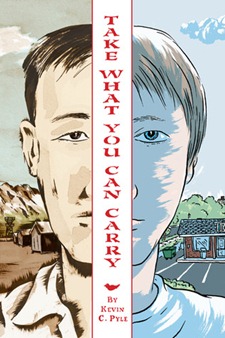
This graphic novel explores connections between generations and across races, in an innovative way.  It is the story of two teenage boys.  One is a Japanese American who is sent to the internment camps during World War II.  His part of the story shows the displacement of his family, the loss of their rights, and the realities of the camps.  In alternating chapters, we also get the modern story of a teenage boy who moves to a new community and gets in with the wrong group of boys.  Soon he is robbing stores and eventually ends up in real trouble.  The man whose store he robs was the Japanese teen, who also resorted to stealing in the camps. 

At first, readers are not sure how the two stories will ever come together into one, or if they ever will.  They seem so remote and separate from one another.  Then when they do, there is a great satisfaction is realizing why the modern boy is given a chance to remedy what he has done.  It is a story that deals with two very personal stories, but that also has a more universal message about displacement, theft and redemption.  Both of the teen boys find ways to make things right in their lives, to accept their conditions, to rise above. 

Pyle’s two stories are shown in different color palettes as you can see from the cover.  The sepia tones work well for the historical story, also emphasizing the wasteland of the internment camps.  The blues of the modern story give it a cool feeling that suits a story where a boy is not making the right choices and where his world is devoid of warmth. 

This intriguing graphic novel is a compelling read that will show young readers not only about history but also about themselves and their own choices.  Appropriate for ages 12-14.

Reviewed from copy received from Henry Holt.