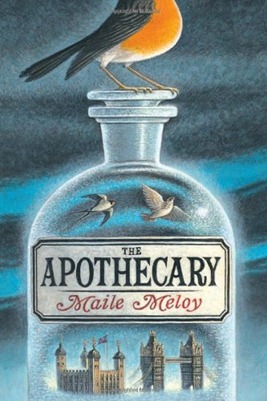
Review: The Apothecary by Maile Meloy

apothecary

The Apothecary by Maile Meloy

Janie and her parents have just fled California and headed to Cold War London.  There she meets Benjamin, a boy who stands up for himself.  As the two of them attempt to follow Soviet spies around London, they discover a real plot, a dangerous one.  When Benjamin’s father disappears as they hide in the cellar below, Benjamin and Janie must try to use an ancient book of potions and spells to try to find him.  But first they have to keep the book and themselves out of the hands of the enemies who are trying to find them.  It’s not that easy when you don’t know who to trust or what to believe in anymore.

When I opened this book, it was like tumbling into a world that felt like home to me, but at the same time surprised and delighted me too.  Meloy’s writing has a solid feel to it, hearkening back in tone to classic children’s books of adventure.  At the same time, she has created a wondrous world to explore, one that she brings to life with strong characters, memorable settings, and a lot of magic. 

The two protagonists are winning characters, filled with both whimsy and charm.  They are characters that readers will relate to instantly.  Their sudden friendship and mutual attraction is written in a way that makes sense.  Both characters are brave, inventive, and creative.  They are just whom one would want to take a grant adventure with. 

The ARC I read of the book only had a few of the illustrations in it, but those that I have seen are beautiful.  The design of the book plays with light and dark and so do the images, many of them capturing moments of action and importance in the story. 

A dazzling fantasy novel, this book also has a strong sense of period and setting that can be missing in magical books.  Appropriate for ages 10-13.

Reviewed from ARC received from Penguin Young Readers Group.

Also reviewed by:
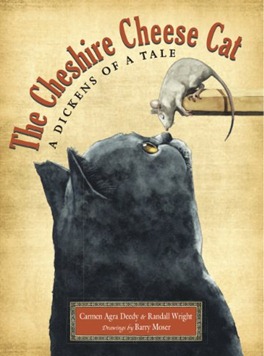
Review: The Cheshire Cheese Cat by Carmen Agra Deedy

cheshire cheese cat

The Cheshire Cheese Cat: A Dickens of a Tale by Carmen Agra Deedy & Randall Wright, illustrated by Barry Moser

Skilley is an alley cat who is down on his luck, he has a broken tail, tattered ears, and has grown used to dodging brooms and wheels.  So when he hears that Ye Olde Cheshire Cheese, a local inn, needs a mouser, he concocts a plan to become that cat.  But Skilley has a horrible, shameful secret that he carries with him: he doesn’t eat mice.  Instead he prefers a good nibble of cheese.  Discovering this, a mouse named Pip strikes up a deal.  The mice of The Cheese will provide Skilley with the cheese he needs in exchange for him pretending to nab them and eat them.  The plan is perfection for a short time, until an evil cat named Pinch enters the inn and more secrets start coming out.  Add some historical British figures and you have an engaging romp of a novel for middle readers.

The authors have created a historical fiction novel that is also an animal novel.  It has figures like Charles Dickens and Thackeray, but mostly focuses on the animals themselves.  It is a novel that explores friendship and accepting yourself even if there are things that you might be ashamed of.  These messages are woven skillfully throughout the story and never become overbearing.

The pacing of the novel is also skillfully done.  There are quieter moments in the novel, but the foreshadowing makes even those uneasy ones.  Once the story really gets going, it reads quickly.  I couldn’t put it down in the last few chapters because I was so caught up in the story.

I’m not a huge animal story fan.  It seems that they tend to be tearful, overly emotive, and generally tragic.  That is not the case here.  Instead readers will cheer on the heroes, worry for their safety, and find themselves in the midst of a grand adventure in Elizabethan England.

Highly recommended, this book is one delicious read with a pleasing mix of sweet and savory.  Appropriate for ages 9-12.

Reviewed from copy received from Peachtree Publishers.

Also reviewed by:

Book Review: Running with the Horses by Alison Lester

runningwiththehorses

Running with the Horses by Alison Lester

Follow the harrowing rescue of the Lipizzaner horses during World War II in this picture book.  The book is nonfiction woven with fiction, seen through the eyes of a fictional character, Nina, the daughter of the stablemaster at the famous Spanish Riding School in Vienna.  As the war came closer to Vienna, Nina’s school was closed and people were fleeing the city.  To save the last four stallions, Nina would have to ride over the Alps with her father.  But she could not leave her favorite old cab horse, Zelda, behind in the deserted city.  So Nina rode Zelda, following her father and the horses, not knowing the dangers that she and Zelda would face together as they crossed the Alps to safety.

Lester has created a picture book that successfully marries fiction with history, giving young readers a glimpse of the dangers of the War as well as the bravery that it created.  Nina is a ten-year-old whose care for her horse and courage during the adventure will inspire.  The book does have more text than many picture books, making it more appropriate for a slightly older audience, one which is more likely to understand the historical aspect of the book better as well.

The illustrations are a very attractive mix of photographs and pencil drawings.  The characters are shown in black and white throughout, contrasted with the colored backgrounds.  This creates a unique look that has the people in clear relief from their surroundings.

A look at a moment in history that has the appeal of horses and a young heroine as well.  Appropriate for ages 6-9.

Reviewed from copy received from NorthSouth.

Also reviewed by:

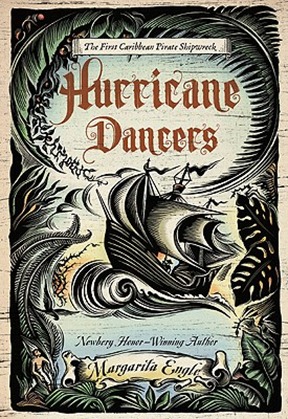
Book Review: Hurricane Dancers by Margarita Engle

HurricaneDancers

Hurricane Dancers by Margarita Engle

Engle’s latest historical novel in verse explores piracy in the Caribbean Sea in the 1500s.  It is the story of Quebrado, a fictionalized character, who is a slave aboard a pirate ship.  Also on the ship is Alonso de Ojeda who has been captured.  That ship, owned by real historical figure Bernardino de Talavera, becomes shipwrecked.  The story is populated by people from history, but told primarily through the voice of Quebrado.  It is a pirate story that removes the swashbuckling glamour and tells the bitter truth about what piracy was.

Engle captures such emotion in her verse, creating moments of pain, wonder and even delight in this brutal story.  The book is immensely engaging, thanks to its brisk pace and lively subject matter.  There is adventure and even a touch of romance in this story, giving light in the darkness of slavery and piracy. 

Engle pays close attention to the native people of the islands, allowing glimpses into their lives and their beliefs.  They make a great foil to the lying, manipulations of the pirates.  It is a story that is elegantly crafted and vividly written.

A great choice for late elementary and middle school students who are interested in history and pirates.  This is a book that is fast, fascinating and fabulous.  Appropriate for ages 11-14.

Reviewed from library copy.

Also reviewed by:

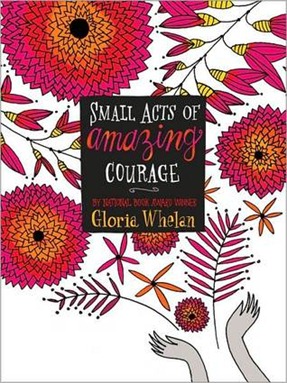
Book Review: Small Acts of Amazing Courage by Gloria Whelan

smallacts

Small Acts of Amazing Courage by Gloria Whelan

Rosalind is not a normal British child living in India in 1918.  The other girls her age are shipped back to England for boarding school or spend their days at the club flirting covertly with young English soldiers and swimming in the pool.  Rosalind has never been to England, her mother refused to send her to boarding school because her older brother died in England while at school.  Rosalind doesn’t identify with the other English girls.  Instead her best friend is the daughter of one of the Indian servants and together they make illicit visits to the bazaar.  When Rosalind’s father returns from World War I, he brings with him stricter rules than Rosalind has been living under.  He disapproves of her friendships, forbids her going to the bazaar, and objects to her interest in Gandhi and his politics.  Rosalind’s world changes just as India begins to seek its independence from the British in this fascinating historical novel.

Rosalind is a great protagonist.  She is at odds with her English world, yet it is never pushed so far that her reactions and attitude loses touch with the historical setting.  She is strong, vibrant and a great lens to see India through because she is a bridge between modern readers and World War I.

Whelan creates her world with tiny touches, drawing India for readers in the details.  Her imagery is lovely, emphasizing the impermanence, the beauty, and the restlessness of the story. Yet the story does not drag at all.  This is historical fiction that is relevant, vital and interesting.  The pacing is beautifully done, offering the languid pace of an India heat wave, the time it took to travel at that time, and the desperation of a people.

I am hopeful that we will read more of Rosalind’s story in an upcoming book.  I look forward to seeing where Whelan will take readers next.  Perfect for middle school readers who will enjoy the engaging heroine and the touch of romance.  Appropriate for readers age 10-13.

Reviewed from copy received from Simon & Schuster Books for Young Readers.

Also reviewed by:

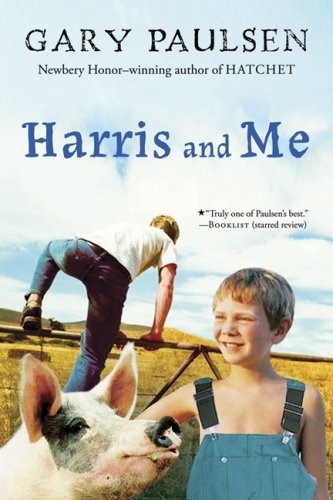
Harris and Me by Gary Paulsen–A Family Favorite

harrisandme

Harris and Me by Gary Paulsen

When I first read Harris and Me, I had it along with me on a family trip with my husband and parents.  I ended up reading entire portions of it aloud to a room of adults who all hooted and laughed and begged for me to continue.  Then when my older son was around the right age, I read it aloud to him.  He loved it.  This week, I finished reading it aloud to my younger son, who loves to be read to but doesn’t care to read to himself much.  He asked for his own copy so he could read it whenever he liked.

Some lines from the book have entered our vocabulary in our family.  If I get grumpy, my husband (far too often) says “Now, Buzzer…”  Whenever a little car revs past our house, I say “the engine starved for oxygen its entire life.”  And perhaps even worse, we all get the joke and laugh, immediately thinking of the scenes from Harris and Me.

Paulsen has created a book that is so funny.  It reads aloud like a dream, and having read it aloud cover-to-cover at least 3 times by now, I should know.  The humor is often naughty, involving things like peeing on an electric fence, being kicked in the groin by a cow, and attempting to kill a very evil rooster.  At the same time, it is belly-laugh funny, quoting lines great, and will linger with you after you finish it.

And the ending, well.  Let’s just say it’s the most challenging part to read aloud because no matter how many times I read it, I will always cry.

So if you are looking for a book to hook a kid with its humor, with its inappropriateness, with its pure appeal, look no further!  This one is a winner with every person I have ever shared it with.  It’s a definite family favorite for three generations of our family.

The Secret Cave: Discovering Lascaux

9780374366940_zoom

The Secret Cave: Discovering Lascaux by Emily Arnold McCully

Jacques Marsal was intrigued with the prehistoric bones and tools that his teacher showed him.  When he got to see the cave paintings at Font de Gaume, he was amazed.  So when he and three other boys discover a cave, they want to explore it.  Following a tunnel into the earth on their hands and knees, they found an enormous cave.  On the cave walls were paintings that looked like they had just been painted.  They explored the cave for several days, finding paintings even down a deep shaft.  Jacques insisted that they show the paintings to his teacher who at first thought they were playing a trick on him.  But when he saw the paintings and an expert confirmed them, they all knew that they had found a treasure on the walls of the cave. 

McCully tells the tale with plenty of details, allowing readers to understand the time period and the length of time the boys explored the cave.  These details make the history come alive.  The boys are depicted as real boys who play war, explore caves without any equipment and are tempted to keep the cave a secret.  They are human rather than heroes.  McCully’s afterword offers some more of the history of Lascaux, explaining what happened after the book ended. 

McCully’s illustrations done in ink and watercolor have a great contrast between daylight and the caves.  In daylight, the colors are light and vibrant.  The underground illustrations have an effective darkness around them, conveying the thickness of the earth around the caves.  McCully moves successfully between her finely detailed illustrations and the more primitive paintings on the cave itself.  The contrast between the two styles makes sure that readers know that these are depictions of the cave paintings.

A book that should delight readers who enjoy history and adventures.  Use this as a great introduction to the caves themselves and expect to have lots of requests for images from the caves themselves.  Appropriate for ages 6-9.

Reviewed from copy received from Farrar, Straus and Giroux.

Also reviewed by 100 Scope Notes.

Rise of the Darklings: Victorian Faerie Delight

Order

Rise of the Darklings (The Invisible Order Book #1) by Paul Crilley

At twelve years old, Emily Snow has been looking after her younger brother since her parents disappeared.  She tries to earn enough money to feed them both by selling watercress on the streets of Victorian London.  One cold morning on her way to the watercress vendor, Emily encounters several strange small people having a battle.  After the battle, two men approach her to ask her what she witnessed.  Emily refuses to tell them, but that is not the last she will hear from them or from the piskies she saw battling.  In fact, Emily has just entered the confusing and amazing world of the sidhe where both sides want her to help them and no one is telling the truth.  Joined by Jack, a thief from the streets, Emily tries to figure out who she can trust and what her role is in the future of both humans and fey.

This book is a pleasure to read.  Crilley has nicely balanced the world of the fey with the real world of London.  Filled with details about the city, this book’s setting is well drawn and delightfully mixed with the magic and wonder of the sidhe world.  Crilley also offers a feisty heroine who will delight young readers not only with her intelligence but her own guile as she deals with the faeries and The Invisible Order of humans too.  The book reads effortlessly, beginning quickly with the pages whipping by as the adventure heats up.   Children looking for a good read should look no further.  Teachers as well should look to this as a great classroom read with enough action to keep even the most doubtful listener rapt. 

A delight of a novel, this is one of the top faery books I have read for younger readers.  Appropriate for ages 9-12.

Reviewed from copy received from Egmont.

Enhanced by Zemanta

Fatty Legs

68608934

Fatty Legs: a True Story by Christy Jordan-Fenton & Margaret Pokiak-Fenton, illustrations by Liz Amini-Holmes

This is the story of an Inuit girl and her experiences in a residential school.  Margaret Pokiak decides at age 8 that she must learn to read.  And the only way that she will be able to learn to read is to attend the residential school that is many miles away from her home village in the arctic.  Her father and older sister, who have both attended the school, try to convince her to stay at home and learn the native way instead, but she insists.  At the school, she encounters the Raven, a nun who immediately takes a dislike to Margaret and her strong will and courage.  She begins to intimidate Margaret, putting her in red stockings unlike the rest of the girls and meting out harsher punishments to her.  But through it all, Margaret remains strong.  A sympathetic nun sticks up for her and eventually Margaret finds her way back to her family.

The book softens the story to a level that children will be able to handle, focusing more on the emotional and mental hardship than physical abuse.  The humiliation of Margaret by the Raven will resonate with children as will the harsh conditions and poor food.  Married to these in the book is the loss of culture and language, which is as horrible as the treatment. 

Margaret is an amazing girl with her self-possession, her courage and her faithfulness to herself and her culture.  She is brave beyond belief as she enters a foreign culture and comes away having shown them what being human is all about.  The book is simply written, allowing the story to carry through.  The illustrations are strong, depicting the harsher times at the school.  Historical photographs are worked into the book, tying it firmly to history and the true story it is based on.

This book is definitely worth having in a public library.  It offers a clear view of residential schools nicely paired with a young girl’s naive desire for education.  Large font, plenty of interspersed images, and a short length will have reluctant readers interested as well.  Appropriate for ages 8-11.

Reviewed from copy received from Annick Press.