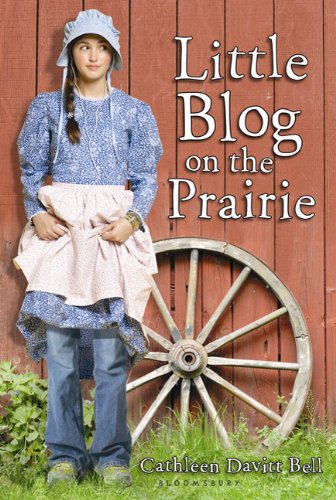
Little Blog on the Prairie

Little Blog on the Prairie by Cathleen Davitt Bell

When Gen’s mother signs the family up for Camp Frontier, they don’t know what they are getting into.  Now they must live like they are 1890s pioneers.  Which means wearing authentic clothing, cooking on a wood burning stove, milking cows, raising chickens, and living in a tiny cabin in the woods with an outhouse.  All of their electronics are confiscated when they enter camp, but Gen manages to sneak in her cell phone.  From there, she texts her best friends one of whom turns her texts into a blog for an assignment.  All is not dull work on the prairie, there is handsome Caleb who seems interested in Gen but might like Nora, the daughter of the owners better, and then there is the competition between the families and the drive to not keep being in last place.  Maybe this family bonding thing isn’t so bad after all.

Bell has created a book with a sharp wit and yet a homely warmth.  Gen is a great protagonist whose texts are fun to read.  Bell also has a feel for humor with the killer chickens and the cow milking scene.  Both are worth reading the novel for.  She writes best when dealing with modern teens juxtaposed with the world of 1890.  Bell’s writing is stilted in other scenes where there isn’t humor.  Her scenes with Nora and Caleb don’t flow with the same effortlessness as her humor.

Another issue is her characterization of the secondary characters.  Caleb, the love interest, is rather dull and quite normal though nice.  I don’t see why Gen who is bright, funny and complex would be entranced by this boy.  Nora, the homeschooled daughter of the proprietors, is also a disappointment.  Left to be rather cardboard and mean, she could have been a great example of a homeschooled kid.  Instead, she is envious and lonely.  What a missed opportunity she was a character!

One of the big successes of the book is that it never becomes a moral story about the dangers of modern technology and the isolation of modern family life.  Just as the book was approaching that, it veered into an unexpected direction that kept the novel fresh and interesting.

Despite the issues with the book, I could not put it down.  The humor and Gen kept me reading.  Recommended for readers who enjoyed Little House on the Prairie but also modern teens who wonder what would happen if their cell phones, iPods and computers were taken away.  Appropriate for ages 12-14.

Reviewed from ARC received from Bloomsbury.

Also reviewed by Semicolon.

Sit-In

Sit-In: How Four Friends Stood Up by Sitting Down by Andrea Davis Pinkney, illlustrated by Brian Pinkney

Inspired by the words of Dr. Martin Luther King, Jr. four young men sat at the Woolworth’s lunch counter in Greensboro, North Carolina on February 1, 1960.  They placed their simple order of a doughnut and coffee, with cream on the side, and sat quietly, refusing to comply with the Whites Only rule.  The next day, more people joined them, sitting still for what was right.  The sit-ins got bigger and moved beyond lunch counters to buses, parks and libraries.  The students were jailed for loafing, but they didn’t resist.  All of these brave actions led to the Civil Rights Act of 1964.

Pinkney has written this book with such verve and style that it reads like a King speech.  Throughout, she has woven the threads of the lunch counter, coffee and recipes, reminding readers again and again where it all started.  Her use of repetition and poetic style really make the book sing.  Brian Pinkney’s illustrations are done in watercolor and India ink.  They capture the time with an exuberant style that is filled with colors and the swirls of motion.  Though the people sit still, the illustrations are in motion, moving to the future with them.

Highly recommended, this book truly captures the wonder of this time, the courage it took to sit still, and the progress that was made.  This husband and wife team have created a powerful book about a vital time in our history.  Appropriate for ages 7-10.

Reviewed from copy received from Little Brown and Company.

Also reviewed by Muddy Puddle Musings and Wild Geese Guides.

The Extraordinary Mark Twain (According to Susy)

The Extraordinary Mark Twain (According to Susy) by Barbara Kerley, illustrated by Edwin Fotheringham

At age 13, Susy, the daughter of Mark Twain, was annoyed that people writing biographies of her father got things wrong.  So she decided to write her own biography of her famous father because she truly knew him.  At first Susy’s biography was a secret but soon her parents had discovered her book and her father helped by offering quotes at opportune moments.  In her biography, Susy told of her father’s childhood, his public side and his private life.  She documented his finer qualities and also his lesser ones.  She also wrote about his writing practice and how her mother cleaned up the racier passages.  This is a biography that shows us Twain as a family man and father as well as an author.

Kerley’s biography of Twain is immensely readable and inviting.  She has incorporated passages from Susy’s biography in an inventive way.  They are placed in inserts that look like small books on each page.  Readers will be delighted by the passages and the insights they offer.  Fotheringham’s illustrations are a creative mix of vintage and modern.  Done digitally, they have a warmth and strong graphic quality. 

Highly recommended, this is a great biographical picture book for elementary-aged students.  It is also ideal to share with children who want to be writers since it shows not only Twain’s process but gives readers a young writer to model themselves after as well.  Appropriate for ages 8-12.

Reviewed from library copy.

Also reviewed by Kiss the Book, Sommer Reading, and Young Readers.

You can read about Barbara Kerley’s own writing process for this book at INK.

The Beatitudes

The Beatitudes: From Slavery to Civil Rights by Carole Boston Weatherford, illustrated by Tim Ladwig

Weatherford has taken Jesus’ Sermon on the Mount and created a poem that follows African-American history from slavery through to the election of Barack Obama.  The poem affirms that God has been with people even in slavery, during the Civil War, during the civil rights movement, and continues to be with them now.  Readers will discover historical figures from various times in the book, including Rosa Parks, Emmett Till, Ruby Bridges and Martin Luther King, Jr.  There are a wealth of heroes here, all surrounded by the strength of faith.

Weatherford’s words are strong and ringing.  They both celebrate and mourn, moving ever onward to a brighter future.  The book shines with a beautiful combination of faith and history.  Ladwig’s illustrations add to that shine with strong people shown in moments of strength.  Many of his paintings have interesting perspectives that make the book even more lovely.

Highly recommended, this is a book that truly captures the strength of a people.  Appropriate for ages 6-10.

Reviewed from copy received from publisher.

Visit Carole Boston Weatherford’s website  and Tim Ladwig’s website.

Shake, Rattle & Turn That Noise Down!


Shake, Rattle & Turn That Noise Down!: How Elvis Shook Up Music, Me & Mom by Mark Alan Stamaty

When Mark Alan Stamaty’s parents gave him his own radio at age eight, they thought he’d be listening to the gentle popular music of the time.  But one evening, Elvis and “Hound Dog” blasted from the radio and everything changed with rock and roll.  Mark’s mother was alarmed at this new music and forbade him from buying any of Elvis’ records.  Mark was still able to read about Elvis in magazines, listen to him on the radio, and even see him on TV.  Eventually, Mark’s mother gave up and gave in and he was able to buy Elvis records.  Mark changed the way he did his hair into an Elvis pompadour, helped the other boys in his class get the same look, and when his school picture was taken everyone thought he looked just like Elvis.  So it was natural when the Cub Scout talent show came along that Mark impersonate Elvis, but how would his mother react?

Stamaty is a cartoonist and that shows in this book.  Filled with the frames of cartoons, speech bubbles and caption, the book has its own rocking and rolling feel.  His illustrations show a delightful mix of vintage and modern that echoes the feel of Elvis too.  This book will not work well as a read-aloud because of the graphic novel format, but individuals will enjoy it immensely.  The final pages of the book are a real treat as readers get to see the famous Elvis school picture and a snapshot of Mark performing in the Cub Scout event.  There is also information on Mark performing as Elvis for President Clinton.

A humorous look at a moment in history, this picture book will be most appreciated by slightly older children who can identify with growing up and having preferences of one’s own.  Appropriate for ages 6-9.

Reviewed from copy received from publisher.

Check out Linda Davick’s interview with Mark Alan Stamaty as well as Stamaty’s own website.

Back of the Bus

Back of the Bus by Aaron Reynolds, illustrated by Floyd Cooper

It is a winter afternoon in Montgomery, Alabama.  A boy and his mother are riding the bus home after a long day.  The boy is playing with a marble, letting it roll up the aisle.  When a hand snatches the marble, the boy sees Ms. Parks smiling at him and she rolls the marble back.  The bus gets more crowded and then there is a commotion.  The bus remains stopped until the police arrive and take Ms. Parks away.  There is something in her eyes and the way she holds her head though, that show the boy that something big is happening.  And he can see the same spark in his mother’s eyes now.

Here we see a moment in history captured through a young boy’s perspective.  Reynold’s poetry is languid with the warm afternoon and the bumps of the bus.  His poetry allows us to see more deeply into the boy and his mother as he calls attention to small details:

Mama shakes “no” at me,

and I hold it snug in my hand.

She’s got them worked-all-day eyes,

but she’s got her strong chin on.

Very accessible to children, the poem is filled with an honesty and truth.  Cooper’s illustrations are filled with afternoon sunshine that illuminates this moment in history.  He has captured the small world of the bus, yet the poem and his illustrations reveal far more.  Warmly lit, detailed and beautifully done, his illustrations are glowingly lovely.

Highly recommended, this book takes history and bring it to life through poetry, image and one boy.  Appropriate for ages 5-8.

Reviewed from library copy.

In the Belly of an Ox

In the Belly of an Ox: the Unexpected Photographic Adventures of Richard and Cherry Kearton by Rebecca Bond

Two brothers, Richard and Cherry Kearton, grew up in the hills of Yorkshire and spent much of their time outside exploring.  When they both moved to London, they missed the countryside, so they visited it whenever they could.  One visit, Cherry brought his new camera and took a picture of a bird’s nest.  An idea was born!  The brothers decided to take pictures of birds nests using a variety of blinds, disguises and props, including a large bull to hide inside.  It took them three years and 30,000 miles of travel across Britain to make their book.  British Birds’ Nests was published in 1895.  It was the first nature book to be illustrated entirely with photographs. 

This is really the story of two brothers who were willing to work hard, invent their own solutions, and follow their personal dreams.  It is a story of being yourself and finding your own way in life and not listening to what “should” be done.  Make sure to look at the end of the book where you can see some of their photographs.  One is a heart-stopping photo of both brothers high in a tree with a ladder. 

Bond’s text here sets just the right mood.  She and the readers revel in the inventiveness of the brothers and their enthusiasm and hers shine.  Her illustrations have a wonderful vintage feel.  The watercolor landscapes evoke the region nicely and the brothers come through as vibrant characters.

A great piece of picture-book nonfiction, this title is one that should be shared.  It’s a great piece to start conversations about what children are really dreaming of, what their special gifts are, and what they may become someday.  And it just might get indoor children moving outside to take their own pictures and climb their own trees.  What could be better?!  Appropriate for ages 5-8.

Reviewed from library copy.

We Troubled the Waters

We Troubled the Waters by Ntozake Shange, illustrated by Rod Brown

It takes a very special picture book to leave you with tears standing in your eyes.  This is that book.

This book of poems takes readers from slavery through Jim Crow to the KKK and the battles of the Civil Rights Movement.  It is a visual and poetic trip through African-American history, a journey that evokes the emotions, the cruelty, the hate and the oppression.  It lifts only at the end speaking of modern life in America with a hopeful tone and a unity that sees beyond color.

Shange’s poems are powerful, unflinching looks at historical moments.  They celebrate victories while continuing to honor the slain and victimized of the past.  She writes with an honesty that elevates these poems beyond simple historical facts, creating emotional and honest portrayals of what people felt and experienced during those times. 

Brown’s art is equally powerful.  His portraits of Martin Luther King, Jr., Malcolm X, and Rosa Parks speak to the people themselves and their message even more than their outward appearance.  They are beautifully rendered in deep colors, a tribute to the history and the people.

Highly recommended, this is a book that is ideal for February’s Black History Month but should be used all year long.  This is our history no matter our color.  It is a history we should all be aware of so that it never repeats itself.  Appropriate for ages 8-12.

Reviewed from library copy.

Also reviewed by TheHappyNappyBookseller.

Imogene’s Last Stand

Imogene’s Last Stand by Candace Fleming, illustrated by Nancy Carpenter

Imogene lives in a tiny town in New Hampshire called Liddleville.  She loves history more than anything else, so begins to tidy up the town’s historical society.  Once it is all clean, she waits eagerly for crowds to come and tour.  But no one comes except for one workman who puts a sign in the front yard saying that the house will be torn down.  The mayor wants progress and new, not old history.  How in the world will Imogene be able to save history from the stomp of progress?  Perhaps with a little help from George Washington himself.

Imogene is a wonderful character who quotes historical figures whenever she feels strongly.  She is plucky, sensible and strong-willed, just what I’d love any child to be.  Even better, Imogene has a point of view and isn’t afraid to make a stand to the adults around her.  She is a true heroine.  Fleming’s writing is wry and funny, peppered with historical quotes.  Carpenter’s art done in pen and ink and digital media, has just the right feel: a mix of traditional and modern that Imogene would approve of.

A strong young heroine combined with a focus on the importance of history, makes this a must-have book.  A definite winner of a title, this book is appropriate for ages 5-9.

Reviewed from copy received from publisher.

Also reviewed by 100 Scope Notes.