Review: The First Drawing by Mordicai Gerstein

first drawing

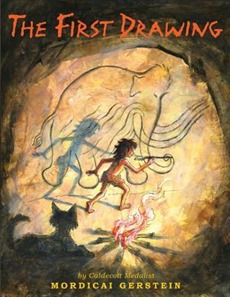
The First Drawing by Mordicai Gerstein

This picture book tells the story of how drawing first started.  Inspired by the the 30,000 year old paintings in caves in southern France, the story focuses on one boy who sees the world differently from everyone else.  When he looks at the clouds, he sees animals.  Everyone else just sees clouds.  When the firelight flickers on the walls of the cave as they go to sleep, he sees herds of beasts.  No one else does.  So he gets the name “Child Who Sees What Isn’t There.”  He tries to explain what and how he is seeing things, but it isn’t until he picks up a charcoal stick from the fire and actually draws the lines he is seeing that others can see it too. 

Beautifully told, Gerstein weaves the story of these caves into an exploration of how artists see the world in a unique and powerful way.  By choosing very tangible examples of how artists see, children reading the book will quickly realize that they are artists as well.  It is also helped by the use of  second person narrative, so that children are identified as the child who invented art.  The author’s note explains more about the caves as well as why Gerstein was inspired to tell the story of a child drawing. 

Gerstein’s art is bright and large.  He shows large swathes of sky filled with clouds, lands filled with animals, and makes sure that readers see the inspiration for the later art.  This contrasts with the tight closeness of the fire-lit cave that is all dancing flames and stone walls. 

A virtuoso picture book, this is a wonderful melding of history, possibility, and art.  Appropriate for ages 4-6.

Reviewed from library copy.
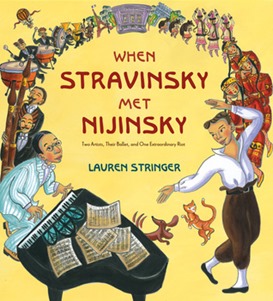
Review: When Stravinsky Met Nijinski by Lauren Stringer

when stravinsky met nijinsky

When Stravinsky Met Nijinsky: Two Artists, Their Ballet and One Extraordinary Riot by Lauren Stringer

This is the story of how two Russian artists collaborated to create a revolutionary new ballet, The Rite of Spring.  When the two artists met one another, each of them started to change.  Stravinsky’s music changed and Nijinsky’s dance changed.  They inspired one another to try something entirely new and created a ballet based on Russian folk dances and folk songs.  Even at rehearsal, some of the musicians walked out, but enough stayed so that the show could go on.  When the ballet was first performed, the crowd was split.  Some people loved the new music and dancing, others were shocked and hated it.  The crowd took to the streets to continue to express their anger and appreciation.  This is a great picture book biography that captures the magic of creativity that results when two masters collaborate on something brave and new.

Stringer’s writing takes a complicated story and distills it to the most important points.  Young readers will quickly understand that the two men brought new ideas out of one another, finding each other inspiring.  Her art also speaks to the collaboration of these two men, using flowing lines and deep yet soft colors.  She inserts elements from the art of the time, referencing movements like cubism in both her text and art.  The end of the book has photographs of the two artists and dancers in the ballet.  It also has a longer look at their collaboration. 

A great choice for art and music classes, I’d recommend listening to The Rite of Spring with the group too.  Appropriate for ages 6-8.

Reviewed from library copy.

Review: Brush of the Gods by Lenore Look

brush of the gods

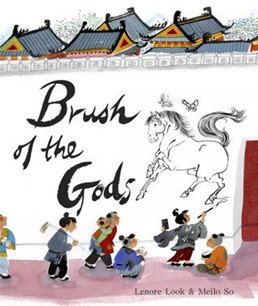
Brush of the Gods by Lenore Look and Meilo So

This is a picture book biography of Wu Daozi from the T’ang Dynasty, who is considered China’s greatest painter.  As a child, Daozi is taught calligraphy, but his brush does not want to just create Chinese characters.  Instead, he creates the first stroke and then turns it into an animal like a fish or a horse.  Daozi began to paint on walls, painting so fast that his sleeves opened like wings, gaining him the nickname of Flying Sleeves.  He painted every day and people began to leave coins for him that he donated to feed the poor.  As time passed, his skills grew even greater until the creatures he drew and painted became alive and left the flat surface of the walls.  He was then commissioned to paint an entire wall for the emperor, a project that took him many years.  In the end though, he created an entire world on a wall, one that you could almost walk right into.

Beautifully told and illustrated, this picture book biography takes a playful tone right from the beginning.  The sense that Daozi was not in control of his own gift makes for a wonderful insight into the drive and talent of artists and the way their talents can control them.  It is also a tribute to the skills gained by doing what you love and practicing a tremendous amount.  Daozi’s work and its lifelike quality is captured through a magical transformation to life in the story, making this feel much more like folklore than a biography.

Look’s text will work best for elementary-aged children, as she tells the story of hard work and talent combined into something spectacular.  They will also be more likely to understand the juxtaposition of biography and magical realism that is in the book.  Her writing is clear and lingers in all of the right moments and moves quickly when those moments are right too.  So’s illustrations are a tribute to Chinese art.  Done with clear brushstrokes, they also have fine details and small touches that make them shine.

This is a very impressive biography of an incredible artist that few children will be aware of before reading this book, making it perfect to share with children in art classes.  Appropriate for ages 6-8.

Reviewed from digital galley received from Random House via Edelweiss.

Review: Gandhi by Alice B. McGinty

gandhi

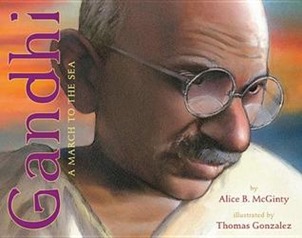
Gandhi: A March to the Sea by Alice B. McGinty, illustrated by Thomas Gonzalez

This nonfiction picture book focuses on Gandhi’s 24-day March to the Sea in 1930.  Joined by over 70 others, this was a nonviolent protest of British rule of India and the taxes they had levied on salt.  Told in verse, this picture book explores how the march united the different faiths and castes of India into a common cause.  The book and journey ends with Gandhi scooping salt from the sea, inspiring many others to do the same.  Many were imprisoned for their actions, but they proved too numerous for the prison system and had to be released.  This is a profound and impressive look at a nonviolent action that was noticed around the world and still serves as inspiration today.

McGinty’s verse is free and flowing.  She nicely integrates imagery that is moving and speaks volumes about the situation.  Just one line from when Gandhi reaches the sea: “white salt dusting dark sand.”  McGinty also weaves in the way that Gandhi inspired others to spin their own thread rather than relying on British cloth, how he prayed together with all faiths, truly how he created a single community out of so many different ones.

The illustrations by Gonzalez are exquisite.  His paintings capture the stones on the path, the crowds that gathered, and finally Gandhi by the sea, alone and strong.  All of the images show a man of strength of conviction and a spirit that was unfailing.  They are stunningly evocative of the man and his mission.

This is a top-notch picture book that truly conveys the difference one man can make in the world being nonviolent.  Appropriate for ages 6-9.

Reviewed from library copy.

Review: The Beatles Were Fab by Kathleen Krull

beatles were fab

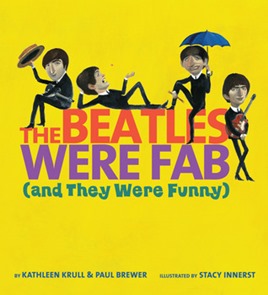
The Beatles Were Fab (And They Were Funny) by Kathleen Krull and Paul Brewer, illustrated by Stacy Innerst

This is a picture book biography of The Beatles that captures their humor and the way that they used it in their music and lifestyle.  The book begins with the formation of the band and the fun they had naming themselves.  The book talks about their use of silliness and jokes to keep their spirits up as they struggled to make it, looking for a record deal.  When success came, it came quickly and with success came fame and fans.  Then there was the Beatlesmania craze that swept the United States, nothing like it had been seen before or since.  Krull includes some small details like American fans throwing jellybeans on stage because the band said they liked jellybabies, but jellybabies are soft where jellybeans are certainly not.  She then has a section on each Beatle and some of the interesting responses they gave during interviews.  This is a merry and fast-moving look at one of the greatest bands of all time.

Krull injects her nonfiction work with humor and zest.  She tells specific stories that offer insight into the Beatles nature.  It is a treat to hear their own words but it is also wonderful to read about moments in history that are revealing about their character.  Krull and Brewer skillfully end the book before drug use became an issue for the band.  Instead they focus on the early Beatles and their humor rather than the complexity of the later Beatles music and attitudes.

Innerst’s illustrations are just as humorous and playful as the stories that Krull and Brewer tell.  The characters have a feel of bobble-heads and a strong modern vibe.  He she uses bright colors that match the energy of the text.  I have to say, I am particularly partial to Ringo’s nose in the illustrations.

This strong picture book biography is not made for research, but instead fans of the Beatles can share part of their story with children and everyone is sure to end up humming some of the songs.  Appropriate for ages 6-9.

Reviewed from library copy.

Review: When I Was Eight by Christy Jordan-Fenton

when i was eight

When I Was Eight by Christy Jordan-Fenton and Margaret Pokiak-Fenton, illustrated by Gabrielle Grimard

This is a lovely new picture book version of Fatty Legs that will share Olemaun’s story with younger readers than the original chapter book.  It follows Olemaun from her time with her nomadic family through her attending the “outsider’s school.”  There her hair is chopped short and her warm parka is replaced with thin and scratchy clothing.  Her name is even changed to Margaret.  Margaret wants most to learn to read, but the school is much more interested in getting the children to work hard rather than teaching them.  Margaret has a difficult relationship with one nun in particular who makes a point of humiliating her regularly.  In the end though, Margaret does learn to read all on her own.

This is a story that works really well as a picture book.  I really enjoyed both Fatty Legs and A Stranger at Home that were chapter books, but this younger version simplifies the story and keeps its quiet power.  As with the earlier books, I remain in awe at the strength that it took for Margaret to survive in the school and also the courage it takes to keep on telling her story.

Grimard’s illustrations echo the beauty of the Arctic but also capture the dullness and darkness of the school.  The nun character radiates scorn and anger on every page she appears in.  Margaret is shown usually isolated, but also as radiant in her resiliency.

A powerful look at residential schools on Native populations, this picture book version belongs in most libraries.  Appropriate for ages 6-9.

Reviewed from digital galley received from Netgalley and Annick Press.

Review: Wild Boy by Mary Losure

wild boy

Wild Boy: The Real Life of the Savage of Aveyron by Mary Losure, illustrated by Timothy Basil Ering

Losure’s latest is another compelling true story this time focusing on the boy found in the woods in southern France in 1789.  The boy was not a tiny child, but rather a young boy who had obviously been surviving on his own for some time, his body covered in scars.  Quickly, the boy was taken for study and observation, his life curtailed and limited because he always attempted to run away.  There was very little attempt to actually reach him until he was sent to the Institute for Deaf-Mutes where he was put into the care of Dr. Itard.  Itard decided to make the boy, who he named Victor, happy before trying to teach him to speak.  So Victor joined the family of the housekeeper and quickly became attached to them.  But civilizing a wild boy is not simple, as this book shows with historical details, engaging humor, and a narrative that shows an immense empathy for this wild child.

Losure, author of The Fairy Ring, has once again taken a complicated situation and made it understandable for young readers.  Young readers will immediately relate more closely with the intriguing Victor.  Through his eyes and Losure’s exquisite writing, readers understand his ties to nature (Page 72):

But when rain pattered on the roof and everyone else went inside, the wild boy often crept out into the garden, to the tiny, formal reflecting pond that sat among the flower beds.  He would circle the pond several times, then sit by its edge and rock himself back and forth as the rain dimpled the surface of the pond.  He’d gaze into the water, toss in a handful of dead leaves, and watch them drift.

The digital galley I read did not have the completed art available, so I cannot comment on the illustrations.  Throughout the book, Losure makes the Wild Boy come to life as a very unique and resilient boy.  The story is told during his time, through the eyes of those who knew him best, using reports written at the time.  Only in her Author’s Note does Losure speculate on whether Victor was autistic.  There she also notes the importance of Victor on educational attitudes like Montessori.

An engaging, wrenching read that brings history to life in the form on one amazing person.  Appropriate for ages 9-12. 

Reviewed from digital galley received from Netgalley and Candlewick Press.

Review: A Splash of Red by Jen Bryant

splash of red

A Splash of Red: The Life and Art of Horace Pippin by Jen Bryant, illustrated by Melissa Sweet

Born in 1888, Horace Pippin loved to draw from the time he was a small child.  He would draw on scrap paper using charcoal, he would draw for his friends, and he would even draw on his spelling tests though his teacher did not appreciate that.  As he grew, he had to quit school in 8th grade.  He worked hard with his hands in different ways, but continued to draw and paint.  Then Horace went to war and was wounded in his right arm.  Now he could no longer draw, or so he thought.  He started trying again with a poker and using his other hand to steady himself.  As he grew stronger, he drew more and more.  Eventually, he gained the attention of people like N. C. Wyeth, who helped put together his first art show.  Pippin’s life that was filled with hardships and obstacles serves as inspiration for young artists.

Bryant and Sweet  collaborated before with Caldecott Honor results.  This picture book biography of an important but lesser known African-American artist shows the power of art in one’s life and how it is impossible to stop seeing and communicating the world through art once you begin.  Bryant writes with a solidity that is lovely.  Incorporating Pippin’s own words from letters, she captures the life of this artist and how he came to be recognized for his work.

Sweet too weaves Pippin’s words into her art.  Her use of collage truly builds Pippin’s world before readers’ eyes.  My favorite image in the book is Pippin as a young boy sitting and drawing on piles of papers.  It captures the intensity with which he created art even at such a young age.  This intensity continues through his story to after he is wounded and the determination that is apparent in just his hands. 

Another very successful collaboration of these two masters, this biographical picture book should serve as its own splash of red on every library’s shelves.  Appropriate for ages 6-9.

Reviewed from copy received from Random House Children’s Books.

Review: When Thunder Comes by J. Patrick Lewis

when thunder comes

When Thunder Comes: Poems for Civil Rights Leaders by J. Patrick Lewis, illustrated by Jim Burke, R. Gregory Christie, Tonya Engel, John Parra, and Meilo So

These poems celebrate heroes who have fought for civil rights.  Each poem focuses on one person, tells their story in imagery and strength.  Seventeen men and women are on the pages here, people from around the world and from the American Civil Rights Movement.  These are heroes who fought for justice and for equality.  Their stories and these poems are filled with courage, vision and a sense of doing what is right.  They will serve as inspiration for future generations who will have their own civil rights struggles to face.

Lewis has created poems that are both art but also informational.  He offers critical details in understanding what these heroes have been through and what they have accomplished.  At the same time, he reaches the heart of the person through his poetry too, showing the humanity about them as well.

The art in this book of poems was done by five illustrators.  The images range from the bright colors of Chinatown to the darkness of murder in Mississippi.  In every image though, readers see a leader who radiates courage.  The different art styles come together to form a tapestry of that courage.

Strong and powerful, this book of poetry deserves to be shared widely and these names known and understood.  Appropriate for ages 8-12.

Reviewed from copy received from Chronicle Books.