Review: A Path of Stars by Anne Sibley O’Brien

path of stars

A Path of Stars by Anne Sibley O’Brien

Dara has a close relationship with her grandmother, Lok Yeay, who tells her stories about life in Cambodia when she and her brother were growing up.  She remembers Cambodia as a place of beauty, filled with moon and star light.  Lok Yeay also shared her darker memories of the soldiers coming and hiding in the jungle until they could make their way to Thailand.  But when the phone call came and Lok Yeay found out that her brother had died, she stopped telling stories.  In fact, she stopped getting out of bed entirely and stopped eating.  The entire family was worried.  Dara went to the garden and picked a rose and a ripe tomato.  Then she put them on a tray along with a photograph of Lok Yeay’s brother and went into the darkness of her grandmother’s room.  They shared the tomato and prayed for her brother, and Dara shared a story of the future and going back to visit Cambodia.

Commissioned by the Maine Humanities Council, this book reflects the story of a family that survived the Killing Fields in Cambodia and came to Maine afterwards.  According to her author’s note, O’Brien did extensive research not only about Cambodia’s history but also about its culture and environment.  As a reader, it is clear that she took Cambodia into her heart and showed its beauty.  O’Brien focuses on the intergenerational relationships in the family, demonstrating the importance of the grandparent in the Cambodian culture.  Additionally, the book is about war, families torn apart, and grieving. 

The art in the book is done in oil paints and oil crayon.  It has a wonderful jewel-tone and great depth and richness.  The illustrations focus on the family relationship, none of them showing the atrocities of war at all. 

This is a strong picture book that looks at the Cambodian Americans and the violent history that they fled from.  Appropriate for ages 7-9.

Reviewed from copy received from Charlesbridge.

Review: Here Come the Girl Scouts by Shana Corey

HERE COME THE GIRL SCOUTS!

Here Come the Girl Scouts! by Shana Corey, illustrated by Hadley Hooper

Juliette Gordon Low, or Daisy as her friends called her, was nothing like the other girls growing up in the Victorian Era.  While girls were meant to be prim and proper, Daisy instead loved the outdoors and adventure.  Daisy traveled the world, but eventually wanted to be more useful.  Then she found out about the Boy Scouts and Girl Guides in the United Kingdom and realized that America needed something that would get the girls there out in nature and exploring.  So Daisy started what would become the Girl Scouts with just 18 girls in Savannah, Georgia in 1912.  She taught them the rules, designed uniforms, planned excursions, and had them outside, active and learning.  This book is about the impact one person with a purpose can have and also the incredible impact the Girl Scouts themselves have had in our society.

Corey looks at Victorian life very briefly and then jumps right in to celebrating the life of Daisy and her Girl Scouts.  The tone here is one of delight in a life well-lived.  Daisy is shown as a person unfettered by her time, but definitely not un-criticized by those around her.  Daisy rose above the scorn and derision that her program faced, continuing her commitment to everything the Girl Scouts stand for.

Hooper’s illustrations have a wonderful playful quality to them.  Done using printmaking techniques, the images have a hand-made quality that suits the subject matter well.  Woven into the images are phrases from the Scouts that immediately incorporate their attitude towards life and service.

An impressive picture book biography of an incredible woman, this book will inspire young readers to dream big and work hard to achieve those dreams.  Appropriate for ages 6-8.

Reviewed from library copy.

Review: Bambino and Mr. Twain by P. I. Maltbie

bambino and mr twain

Bambino and Mr. Twain by P. I. Maltbie, illustrated by Daniel Miyares

In 1904, after losing his beloved wife, Mark Twain shut his door on the public life he had led.  Instead, he stayed indoors spending much of his time alone except for his daughter’s cat, Bambino.  The two of them grew closer as they played billiards together, shared ice cream for his birthday, and stayed together in a bed crowded with books and papers.  One day, after spotting a squirrel outside the window, Bambino leapt out and disappeared.  Twain put an ad in the paper and many people came with cats and kittens just to meet the famous author.  But none of the cats were Bambino.  Three days later, Bambino appeared on the doorstep as if nothing had happened.  Mark Twain took inspiration from his small companion, and started being part of public life again. 

This book explores the powerful relationship between people and animals.  It is also an exploration of grief and could be used with children in elementary school to discuss death and grief.  Maltbie includes many small touches about Twain, including those white suits, details about his wife, and traditions of their family.  Those little points create a much more human story, even though we are talking about one of the most famous authors ever. 

The black cat and the figure of Twain in his trademark white suit make for a great pairing visually as well.  Miyares’ illustrations are filled with great textures and colors, with the palette changing as the mood of Twain lifts.  The shadows are stronger when the grief is at its worst, but lightens and even brightens as the book continues. 

A personal look at a great figure of American literature, this book about Twain offers the depth of grief and the joy of connection with a pet.  Appropriate for ages 6-8.

Reviewed from copy received from Charlesbridge.

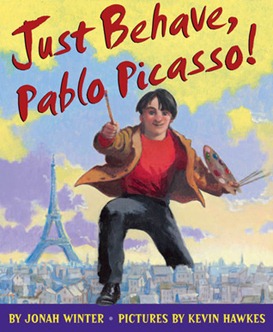
Review: Just Behave Pablo Picasso! by Jonah Winter

JUST BEHAVE, PABLO PICASSO!

Just Behave, Pablo Picasso! by Jonah Winter, illustrated by Kevin Hawkes

Pablo Picasso started out painting just like everyone else, but when he started to paint his moods in colors, things started to change.  The gallery owners wanted more pictures in just the same style, and suddenly Picasso became wealthy and well know.  But Picasso was not interested in painting the same rose colored paintings again and again.  Instead, he becomes inspired by African masks and does a new painting that breaks all of the rules.  When it is unveiled, the reaction is strongly negative and it is called “ugly” by the critics.  When the entire world starts doubting him, Picasso works even harder, coming out with another painting that is the birth of modernism.  This book displays the strength needed to stay true to yourself all through the lens of the incredible Pablo Picasso.

Winter has not written a conventional picture book biography here.  Instead, he plays with the format.  He uses comic book techniques like BLAM! and has pages that range from just a sentence or two to ones that are lengthier and provide more information and insight into Picasso.  This biography is less about the details of his life and much more about his art and its inspiration and evolving style.  We learn nothing of his family, but much about his process and his drive.

Hawkes’ illustrations carry that same playful feeling forward.  He toys with perspective, enjoys depicting the close quarters in Paris with see-through walls.  It takes a certain amount of playfulness to take on a book about Picasso and not imitate his style in the illustrations.  Hawkes’ style remains true to himself, underlining the overall message of the book by doing so.

A creative and fun picture book biography about a vibrant and rebellious artist, this book should find a place in children’s nonfiction collections.  Appropriate for ages 6-8.

Reviewed from library copy.

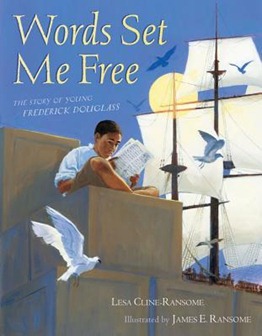
Review: Words Set Me Free by Lesa Cline-Ransome

words set me free

Words Set Me Free: The Story of Young Frederick Douglass by Lesa Cline-Ransome, illustrated by James E. Ransome

This picture book tells the story of Frederick Bailey, who would grow up to become the great Frederick Douglass.  His biography is also the story of the power of the written word and the ability to read.  Born a slave, Frederick was separated from his mother early in life and sent to live with his Grandmamma.  His mother would walk 12 miles at night to see him while he slept.  At age 8, Frederick was sent to work for another master in Baltimore.  It was there that he first learned his letters, until his mistress was told to stop teaching him as it would make him unfit to be a slave.  Daring white children to write better than him, Frederick continued to learn to read.  Returned to his home, Frederick taught the other slaves to read too, eventually writing his own way free from slavery.

A glimpse at an amazing mind and leader, this book takes us back to his childhood.  It is a testament to the damage and horrors of slavery, as readers see Frederick taken away from one person after another in his life.  It is also a celebration of the human spirit and the power of writing to change a life.  Cline-Ransome’s writing is exemplary.  She tells the story with wonderful detail, rich with meaning, and plenty of depth.  The book has more words than most picture books, but the story being told needs those words to shine best.

The illustrations are also rich.  There is such an aching feel to the image of the slave mother visiting Frederick that it is a portrait in heartbreak.  Other illustrations capture emotions beautifully as well.  The soaring nature of Frederick hidden up high and reading a newspaper rises against a purple-blue sky. 

The author and illustrator have created a wonderfully cohesive work with soaring prose and powerful illustrations.  Appropriate for ages 7-10.

Reviewed from library copy.

Review: Looking at Lincoln by Maira Kalman

looking at lincoln

Looking at Lincoln by Maira Kalman

Take a fresh and radiant look at our 16th president, Abraham Lincoln in this new picture book.  A young girl is motivated to find out more about President Lincoln after spotting someone in the park who reminded her of him.  She discovers many interesting facts, some of them well known like him being born in a small log cabin and other more obscure like his love of vanilla cake.  This is a personal look at a president, allowing us to see what his road to greatness was and how it ended in tragedy. 

Kalman takes a very modern look at history here.  A large part of its modern feel is the art in the book which is bright and blazing.  She uses color with abandon, with pinks, yellows, reds and greens adding color to simple illustrations.  Her paintings range from individual objects of importance to entire scenes from history.  The diversity of the images also adds a sense of playfulness to the work that is welcome.

Her writing carries through that same light touch, making the facts all the more interesting.  As she tells the story of Lincoln’s life, she is also telling the sad story of slavery and Civil War.  Somehow her illustrations and the tone she employs here keeps the book moving and never lets it bog down into too many words. 

A colorful, fascinating look at the life of our 16th President.  This book is appropriate for ages 7-9.

Reviewed from copy received from Nancy Paulsen Books.

Review: The Camping Trip That Changed America by Barb Rosenstock

camping trip

The Camping Trip That Changed America: Theodore Roosevelt, John Muir, and Our National Parks by Barb Rosenstock, illustrated by Mordicai Gerstein

Teddy Roosevelt and John Muir had little in common growing up except for one thing: they both loved the outdoors and the wilderness.  So in 1903, when President Roosevelt read a book by John Muir that pleaded for people to save the trees, he couldn’t stop thinking about losing all of the trees in the mountain forests.  Roosevelt set out to meet with Muir in Yosemite.  After a few pictures, the two men rode off together with no entourage or photographers along.  Roosevelt got to see the giant sequoias, listen to Muir’s stories, see valleys carved by glaciers, and awaken under inches of snow.  Together the two men dreamed a new dream for the United States and its wild areas, one where they were protected for generations to come.

Rosenstock tells this story with a wonderful joy that permeates the entire work.  She captures the differences between the two men clearly but binds them together through their love of the outdoors.  The natural parts of the story are also captured in imagery and distinct moments where the men connect with each other and with the wilderness itself. 

Gerstein’s illustrations have a depth to them that nicely captures both the men and the natural beauty.  The quiet of Roosevelt’s life is shown in deep colors and stillness.  It contrasts powerfully with the blues, golds and greens of the natural world that is light filled and also full of action. 

This is a celebration of two men and the difference they made in our lives by creating the National Parks.  It is also an invitation to head out and explore the parks for yourself, looking for your own moments of connection to the wilderness.  Appropriate for ages 7-10.

Reviewed from copy received from Dial Books.

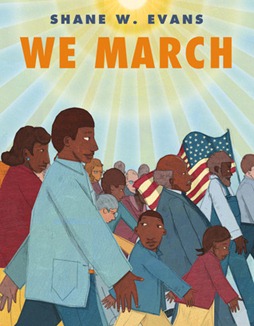
Review: We March by Shane W. Evans

we march

We March by Shane W. Evans

More than a quarter million people marched on Washington on August 28, 1963.  In simple prose and stirring images, Evans tells the story of one child whose family marched that day.  It is a day of working together, faith, and community that culminates with Martin Luther King Jr.’s “I Have a Dream” speech.  This picture book invites even the youngest of children to feel the power of that day, the message of racial harmony, and to understand how much more work there is yet to do.

The prose here is so simple that it just barely tells the story of the march.  With just a handful of words on each double-page spread, the words are very brief.  But the story being told here, is much more than those simple words.  Rather than obscuring the power of that day with too much exposition, this minimalist approach lets the transcendent moment in history shine.  The book does end with a page of information about the march for those looking for further details.

Evans’ illustrations are filled with strength.  He uses simple lines that he combines with a mix of painting and collage to get a layered effect in his art.  The colors are a mix of subtle and strong.  The illustrations focus on a single family that day, but also convey the size of the crowd and the diversity of the people marching.

A powerful, simple look at a historic moment, this book shines with its strong message of unity.  A great pick to share any time of the year, it’s one worth highlighting for February’s Black History Month.  Appropriate for ages 3-6.

Reviewed from copy received from Roaring Brook Press.

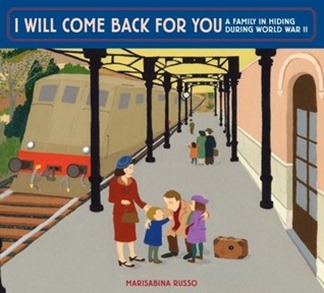
Review: I Will Come Back for You by Marisabina Russo

i will come back for you

I Will Come Back for You: A Family Hiding During World War II by Marisabina Russo

Based on real life stories from the author’s family, this is a story of survival during the years of the Holocaust.  A little girl tells the story of her family in Italy during World War II.  The book shows the transition from seeing soldiers around to the growing restrictions and imprisonment of Jewish families.  The story starts in Rome where the family has been living, but then their father is sent away into the mountains with the other Jewish men.  The family would travel into the mountains to see her father on the weekends.  Even this did not last long, because soon there was talk of concentration camps coming, so her father ran away to hide.  The Nazis then tried to take her mother, but through a series of skillful tricks, she was able to prevent being sent to a concentration camp.  This book takes a very challenging time in history and makes it accessible and understandable for children.

Russo successfully uses the lens of a small girl to explain the situations during World War II for Jewish people.   Focusing on the breaking apart of families rather than the atrocities of the Nazis, makes this book powerful on a different level.  The horrors of the Holocaust are evident in the story, but do not take center stage.  It is very skillfully written and conceived.

Russo’s art has a gentle simplicity to it.  The paintings have a flatness that works well and the images are clearly set in the past.  The story is compelling and fascinating, yet is definitely suitable for younger readers.

This picture book speaks to the horrors of World War II in a way that children can understand.  Appropriate for ages 6-8.

Reviewed from copy received from Schwartz & Wade.