From the Tops of the Trees by Kao Kalia Yang

Cover image for From the Tops of the Trees.

From the Tops of the Trees by Kao Kalia Yang, illustrated by Rachel Wada (9781541581302)

A true story from the Hmong author’s childhood, this picture book brings readers to the Ban Vinai Refugee Camp in Thailand in 1985. Their days are filled with hunger and finding fruit that they can pretend are candy. The aunties in the camp talk about the war and their fears of returning to the old country or heading to a new country. Every week the families in the camp are given enough food for three days. It’s a practice meant to deter other Hmong refugees from entering the country. After Kao asks about the world beyond the camp, her father takes her to the tallest tree in camp, climbs with her to the highest branches, and gives her a view of the world beyond the camp.

Yang shows the view of the refugee camp from that of a small child living there. The day is filled with happy moments like riding one of the dogs and racing the chickens for rice balls. Yet there is no escaping that they are in a refugee camp. Yang shares this by having the adults talk about the war, showing the food disbursement, and having Kao explain that they can’t leave but others can enter. The climb into the branches is dramatic and inspiring, a look a freedom that could not be more moving and tangible.

Wada uses a mix of traditional media like graphite and watercolor with digital tools. She shows Yang’s small family, using more saturated colors to pull them out of the crowds and to keep the focus on the young Kao in the camps. The colors are sandy and subtle, becoming deeper as they reach the treetop to see the world around them.

Another gorgeous and skilled picture book from Yang that captures the experience of the Hmong refugee camps and Hmong Americans. Appropriate for ages 5-8.

Reviewed from e-galley provided by Carolrhoda Books.
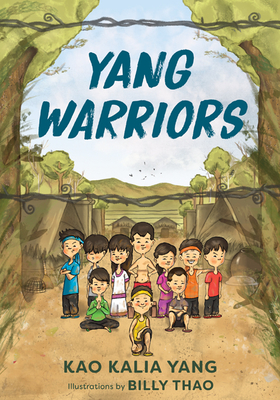
Yang Warriors by Kao Kalia Yang

Cover image.

Yang Warriors by Kao Kalia Yang, illustrated by Billy Thao (9781517907983)

In the Ban Vinai refugee camp, there is a group of young warriors who train together. They run drills, balance rocks on their heads, meditate and wield branches as sacred swords. They are led by Master Me, a ten-year-old who teaches them. One day, Master Me meditated and decided that the warriors must leave camp and forage for greens. But no Hmong person was allowed to leave the camp without permission. People had been beaten for doing it and some had even disappeared. But Master Me was set on carrying out the mission. The narrator of the story is a young girl whose older sister was in the warrior group. She was 7 years old, scared but determined to carry out the mission. That day, the warriors stealthily left camp and returned carrying morning glory greens. Many were injured on the mission, but that day they became more than children playing at being warriors and became true heroes to everyone in the camp.

Yang tells the story of life in a Hmong refugee camp through the eyes of her childhood self. The hardships, violence and rules of being in such a camp are foundational to the overall story, though not the direct focus. The tale really is about the power of children to be heroes for their families, the determination and courage to take action in the face of injustice, and the way that real life heroes are so much more important than those with capes.

The illustrations by Thao are unique and interesting. He makes each of the children recognizable even though they move as a group of warriors. He uses interesting frames throughout the images, showing the children through doorways or from the fire itself as danger increases. The illustrations are stirring and also show just how young these children were.

A tale of child heroes in a Hmong refugee camp that is worth cheering for. Appropriate for ages 4-7.

Reviewed from copy provided by University of Minnesota Press.