Review: Brief Thief by Michael Escoffier

brief thief

Brief Thief by Michael Escoffier, illustrated by Kris Di Giacomo

An import from France, this picture book has a wonderful quirkiness.  It is the story of Leon, a lizard, who is having a lovely morning, eating breakfast, sitting in the sun, and then he has to go to the bathroom.  But after he goes poo, he discovers that he’s out of toilet paper.   He looks around, but only sees prickly leaves and messy grass.  Until he discovers pair of old underpants hanging on a nearby branch.  They are full of holes anyway, so he uses them to wipe and tosses them away.  But that’s when a loud voice, his conscience, starts to talk to him and tells him to clean them up and hang them up to dry.  In the end, his conscience turns out to be something else entirely and the grand twist of the tale adds to the merriment of the book.

Escoffier is a popular author in France and this book marks his debut into the American market.  His humor is spot on for young readers who will adore the idea of what this lizard does for toilet paper.  They will not see the ending coming, since it is fresh and completely surprising.  In the end, the twist will delight readers even more than the original joke. 

Di Giacomo is the illustrator of My Dad Is Big & Strong, BUT… and I am very pleased to see another of her picture books come to English translation.  Her art is a fabulous blend of paint, crayon, fine lines and texture.  She uses blots of color as the leaves, something that is surprising but works very well. 

Share this with all of those children who love something a little naughty in their picture books.  If you share it with a group, you will most likely be asked to read it over again.  Also, expect riotous reactions to the humor.  Appropriate for ages 3-5.

Reviewed from copy received from Enchanted Lion Books.

Review: Chu’s Day by Neil Gaiman

chus day

Chu’s Day by Neil Gaiman, illustrated by Adam Rex

This was not what I had been expecting from Gaiman and Rex, but sometimes surprises can be a delight.   Chu is a small panda who has a very big way of sneezing.  His parents are always concerned about him being about to sneeze.  So when they head to the library and encounter book dust, his mother asks if he’s going to sneeze.  Chu starts to “aah-aaah-Aaaah” but then “No.”  When his father takes him to a restaurant with pepper in the air, he asks too.  Chu goes “aah-aaah-Aaaah” but then “No” once again.  When they head to the circus everyone is too busy watching the show to hear Chu say that he thinks he’s going to sneeze and what a sneeze it is!

This is the first book that Gaiman has written for such a young audience.  It will be toddlers and preschoolers who adore this book and love the humor that is intrinsic in the writing and its rhythms.  The better you can fake the build-up to a sneeze, the funnier the little “no” at the end is.  In other words, this is a great one to read aloud.

Rex adds so much with the tight details of the world he builds here.  Chu is plush and fuzzy.  Whenever he starts to sneeze, his aviator glasses fall down over his eyes, adding an additional comic effect.  The detail of the scenes will have children lingering over them, identifying the various animals in the pictures.  Personally, the mice using the library card catalog drawers for computer use was the perfect mix of modern and retro.

A rather surprising straight-forward book from Gaiman that is a strong read aloud and filled with laughs.  Appropriate for ages 2-4.

Reviewed from library copy.

Review: The Other Side of Town by Jon Agee

other side of town

The Other Side of Town by Jon Agee

A New York taxi driver picks up a rather odd passenger who asks to be taken to Schmeeker Street on the other side of town.  They reach a dead end, but that is not the other side of town yet.  The man pulls out a remote control and the dead end opens into a tunnel, the Finkon Tunnel.  The tunnel leads to a maze of ramps that twist and turn, ending in spotholes.  The driver tries to avoid them, but accidentally drives into one of the large black holes from which they are dumped onto Schmeeker Street.  Suddenly everything is pink and green, just like the man.  Finally, they reach his destination but the cabbie is caught on the other side of town until he notices the remote control left in the back seat.  But yet another surprise is waiting for him when he gets home!

Agee plays with our expectations with a great sense of fun in this book.  Renaming landmarks into something very similar but yet strange and different was a great choice.  The tone is entirely one of silliness and laughter with just enough being different and zany to make it clear that the other side of town is unlike anywhere readers have ever been.  It is through this that Agee subtly demonstrates that there are paths to cultural acceptance for those who are different from us.

The color palette of the other side of town also plays a large role in the story.  Immediately readers will see the little man as unusual thanks to his pink plume and green bodysuit.  When the story moves to the other side of town, the cabbie suddenly pops in his pale blue against all of the pink and green.

Funny, silly and a treat, take a visit to the other side of the town!  Appropriate for ages 4-6.

Reviewed from copy received from Scholastic.

Review: The Man from the Land of Fandango by Margaret Mahy

man from the land of fandango

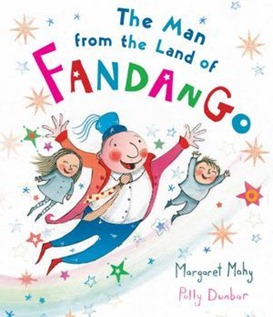
The Man from the Land of Fandango by Margaret Mahy, illustrated by Polly Dunbar

My son and I had just stopped in the middle of a rather painful rhyming picture book and then we picked up this one.  The contrast was profound.  Here we found a fanciful and playful picture book with rhymes that swept us merrily up.  It is the story of a man from an imaginary land who leaps off of the page where he is created by two small children.  They dance with a bear and a bison, bound with kangaroos.  There is juggling, jingling, and even cake!  Then the man returns to the picture, not to return for another 500 years.  It’s a silly and very fun book that is filled with nonsense and plenty of jam. 

Mahy’s words really dance here, carrying the story forward on a rhyming flow.  This is not a book that is a straight-forward story, rather it’s a dazzlingly silly wander.  Children will quickly understand that this is pure nonsense and go with it.  Dunbar’s illustrations have a wonderfully light touch.  They are filled with bubbles and speckles.  Whimsical creatures and plants populate the page, often dancing with glee. 

This is a merry read that has a great lightness and silliness at its heart.  A wonderful posthumous release from the amazing Mahy.  Appropriate for ages 2-4.

Reviewed from library copy.

Review: Kel Gilligan’s Daredevil Stunt Show by Michael Buckley

kel gilligan

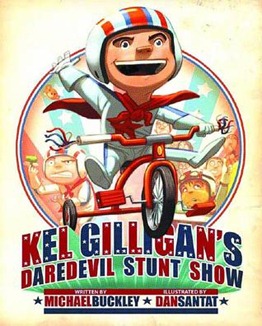
Kel Gilligan’s Daredevil Stunt Show by Michael Buckley, illustrated by Dan Santat

Kel is a daredevil, willing to take on enormous challenges and risk his own safety!  He took on the challenge of eating broccoli and survived without a scratch.  He had the courage to face down “The Potty of Doom” though it did take longer than he expected.  He even managed to get dressed by himself without a net.  He has tested his underwater skills by taking a bath with only one assistant.  And has even survived his mother being on the phone without interrupting, though it was close.  When Kel faces his final challenge of the day, you may have to avert your eyes, because he will be trying to go to bed without checking for monsters first!  This is one picture book only for the bravest of readers.

Buckley’s language is over the top in the best possible way.  Kel speaks as if he is announcing his challenges to a large crowd, all rooting for him.  Buckley even gives that crowd a voice, interjecting amazement at this brave young man and what he is trying to do.  The language alone is enough to get you laughing.

Combined with Santat’s illustrations, this book will actually make you laugh out loud.  The incredulous faces of those in the crowd, the bare buttocks that you glimpse occasionally, and the pride of Kel as he defeats another obstacle, all add to the humor here. 

Give this one to kids a little older, since they will appreciate looking back on their own accomplishments in a humorous way.  Expect a cacophony of laughter when the The Potty of Doom appears.  Appropriate for ages 5-7.

Reviewed from copy received from Abrams.

Review: The Christmas Wombat by Jackie French

christmas wombat

The Christmas Wombat by Jackie French, illustrated by Bruce Whatley

The original Diary of a Wombat returns in all of his carrot-munching glory with a Christmas title.  The book starts in a familiar way with a day spent sleeping, scratching, sleeping again, and eating.  But then, a Christmas ornament bops him on the nose.  The wombat gets rid of them.  Then the wombat meets Santa’s reindeer who also like carrots.  They fight a great battle and the wombat wins and after munching more carrots, curls up on the back of Santa’s sleigh. The wombat meets Santa, discovers snowmen with carrot noses, and continues to eat carrots across the world.  The book ends with the same simplicity as the beginning, and with a well-deserved nap.

French has an exquisite sense of timing in her text.  When I read the first book to my son, it quickly became one of his all-time favorites.  Finding a Christmas book with that same feel and humor to it was a highlight of our holiday season so far.  I enjoy reading the books with an Australian accent, since that’s how a wombat would talk, right?  And they are a delight to share aloud.  The timing of the humor is naturally conveyed in the writing.

Whatley’s illustrations are great.  They show the pride of the wombat, his unwavering courage even when facing much larger animals, and plenty of humor themselves.  With their larger format and white backgrounds, this picture book can merrily be shared with groups of children.

A great pick for a twist on the regular holiday picture books, this one may call for carrots to be shared afterwards.  Carrots…  Carrots… Carrots… Appropriate for ages 3-5.

Reviewed from library copy.

Review: A Is for Musk Ox by Erin Cabatingan

a is for musk ox

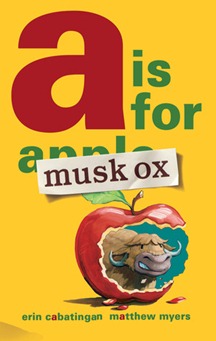
A Is for Musk Ox by Erin Cabatingan, illustrated by Matthew Myers

The story begins right at the cover with Musk Ox chomping on the apple that would have been what “A” stands for.  Instead, he insists that A is really for musk ox.  Zebra argues with him, after all there isn’t even a single letter A in musk ox.  Musk Ox explains using lots of words that start with “A” that musk oxen are Awesome; they live in the Artic and even Alaska.  Turn the page and you will see that B is also for musk ox, rather than baby.  Again, Musk Ox has plenty of explanations for exactly why.  This silliness continues through the book, forming a pattern until you reach the letter M.  And I don’t want to spoil the surprise, but I bet you won’t guess what M stands for.  This zany book is filled with humor, pure cheer and a jolly spirit.

This is not an alphabet book for those first learning their letters.  Instead, children who know how the alphabet works and who are veterans of ABC books will enjoy it most.  They will get the jokes that are being poked at more normal alphabet books as well as the more pointed humor of the storyline.  Cabatingan’s writing, done entirely in dialogue, is a pleasure to read aloud.  It has a natural flow and a great sense of timing.

Myers’ illustrations are simple and quite silly when called for.  The personalities of the two characters come across in their body language. 

A hilarious alphabet book that is guaranteed to get kids giggling.  Appropriate for ages 5-7.

Reviewed from library copy.

Review: I’m Bored by Michael Ian Black

im bored

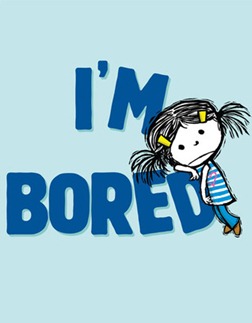
I’m Bored by Michael Ian Black, illustrated by Debbie Ridpath Ohi

The dreaded boredom has set in in this very funny picture book.  A little girl is so bored she is flat on her back moaning when she notices a potato.  When she tosses the potato away, not knowing what to do with it, the potato says that it too is bored.  The potato goes on to tell the little girl that kids are boring.  She insists that no, kids are fun and the potato challenges her to prove it.  She shows the potato all the physical things she can do, then demonstrates using her imagination, but through it all the potato stays unimpressed.  There is a great twist at the end of the book that you will have to read for yourself.  A funny read that will have even the most bored child enjoying themselves.

Done entirely in dialogue, this is a fast-moving picture book.  It begs to be read aloud with a grungy, dusty potato voice.  The ever-bored potato is a great foil to the little girl who despite herself loses herself in her imagination and actions.  It’s a lesson that kids are anything but boring, even when they themselves are bored.

The illustrations have a great rough feel to them.  Done digitally, there is a feel of the organic roughness of a block print.  I particularly enjoy seeing a little girl not in pink or done up cutely.  This little girl is a real one, one that throws herself into things and that includes being willing to argue with a potato.

This is one book that is anything but boring.  Appropriate for ages 4-6.

Reviewed from copy received from Simon & Schuster Books for Young Readers.

Review: Last Laughs by J. Patrick Lewis and Jane Yolen

Last Laughs: Animal Epitaphs by J. Patrick Lewis and Jane Yolen, illustrated by Jeffrey Stewart Timmins

Perfect to pull out around Halloween time, this book features a series of very funny epitaphs for dead animals.  After the introductory poem to the pet cemetery, readers will discover short poems about specific animals.  There are farm animals like chickens and cows (the cow one happens to be one of my favorites) and more exotic fare like barracuda, iguana and eels.  All dead, for a variety of wild and domestic reasons to hilarious effect.  The poems are riddled with puns, something that I adore.  They are sure to be hits with children when shared aloud or read in person.

Timmins’ art has the same dark humor as the poems themselves.  Make sure you notice the sheep pooping into the river the dead horse just drank out of.  It’s exactly what children will find funny.

Dark and fiercely funny, these poems are not for the preschool set, but will be giggled at galore by elementary aged children.  Appropriate for ages 5-8.

Reviewed from library copy.