Book Review: The Queen of France by Tim Wadham

queenoffrance

The Queen of France by Tim Wadham, illustrated by Kady MacDonald Denton

When Rose woke up in the morning, she was feeling royal.  So on went the crown, jewelry and skirt that turned her the Queen of France.  The Queen of France walked up to Rose’s mother in the garden and asked if she had seen Rose.  Rose’s mother explained that she hadn’t but that she hoped that Rose would remember to clean up her room.  The Queen of France was also interested in the ugly rose bushes that Rose’s mother was planting, but the queen’s finger was pricked by a thorn, so she had to find the Royal Physician.  The queen found Rose’s father, but not the Royal Physician.  The queen then took off her crown, and became Rose again.  She bandaged her finger and cleaned her room.  She then dressed as the queen again and headed to Rose’s mother.  The queen asked if Rose’s mother would be fine with the queen switching places with Rose.  Rose’s mother considered the idea, but explained that she would miss Rose very much if she left.  The queen left and Rose returned to herself for dinner.  Until that evening, when Rose felt scary…

Debut author, Wadham has created a picture book that celebrates imaginative play in a very charming way.  Rose is supported by her parents in her play, both of them happily participating as Rose changes characters.  The parents remain supportive and kind throughout, never questioning that Rose is playing rather than cleaning her room, just giving broad hints that it should be done. 

The illustrations add to the charm of the book, with their soft palette of pinks and blues and a lovely mix of modern and old fashioned feel.  Yes, this is a pink book with glitter on the cover, but it is a book that both boys and girls will enjoy thanks to its quality.  Rose’s body language changes as she becomes the queen, her nose high in the air and her feet prancing high.  I particularly enjoy the small clutter in the rooms: toys on the ground, bowls on the counter. 

Highly recommended, let’s hope Tim Wadham continues to create books like this with their deep understanding of childhood.  Appropriate for ages 4-7.

Reviewed from library copy.

Also reviewed by:

Book Review: My Side of the Car by Kate Feiffer

mysideofthecar

My Side of the Car by Kate Feiffer, illustrated by Jules Feiffer

Sadie and her dad are finally heading to the zoo.  Their trip has been cancelled for several reasons that Sadie can clearly remember, but today nothing can stop the trip.  They are on their way to the zoo when Sadie’s father points out that it’s raining.  Sadie looks  out her window and says that it isn’t raining on her side of the car.  Her father keeps driving, because all Sadie sees out her window is sunshine and lots of people heading to zoos.  People on her side of the car are watering their lawns, though it’s pouring on her father’s side of the car.  When they get to the zoo, Sadie’s father allows her to decide if they should stay, because it is raining hard on his side of the car.  Sadie decides that it would be too wet to go to the zoo in the rain.  So they reluctantly head home, until her father notices that the sun is out on his side of the car…

This picture book is inspired by a real-life event between author Kate Feiffer and her father, illustrator Jules Feiffer.  They share their version of the event that inspired the book at the end of the picture book, and Kate continues to insist that it was never raining on her side of the car.  That’s be beauty of personal perspective and the power of imagination and expectations for children.  This book captures it with humor and because it is told from Sadie’s point of view, with an honestly and care for the child view.

The combination of the fresh point of view from Kate Feiffer and the loose-lined art of her father is a winning one.  The imaginative power of Sadie never wavers in Kate’s writing.  The humor of the text and its attitude is reflected effectively in the illustrations as well.

Highly recommended, this book reminded me of both my own strong convictions as a child and those of my own children.  It is a testament to the imagination and creativity through which children view the world.  Appropriate for ages 5-7.

Reviewed from library copy.

Also reviewed by

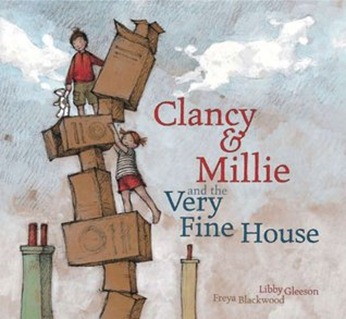
Book Review: Clancy & Millie and the Very Fine House by Libby Gleeson

clancymillie

Clancy & Millie and the Very Fine House by Libby Gleeson, illustrated by Freya Blackwood

When Clancy and his family move to a new house, everyone is delighted, except Clancy.  Clancy think everything about the new house is too big.  He fondly remembers his old room, the old fireplace, the old house.  Clancy heads outside to play and discovers the huge pile of cardboard boxes left from the move.  He starts to play in them and then hears someone’s voice.  It’s Millie, a new neighbor.  The two play together with the boxes, finally building a house out of them, a very fine house.

Gleeson has captured the uncertainty of a move.  She never descends into melodrama here, instead speaking directly to Clancy’s feelings and reactions to the new home.  Children who have experienced a move, even one they enjoyed, will recognize the emotions here.  Gleeson’s use of the moving boxes as a way to deal with the move and make a new friend is very clever.  They change from a symbol of what Clancy moved away from into a symbol of what he moved to. 

Blackwood’s illustrations show the move from Clancy’s point of view.  The rooms of the new house loom, gray and empty around him.  The images from his memories are brighter and cozier, clearly contrasting with the new home.  The tower of boxes seems taller than the houses when Clancy heads outside.  The potential is there is the gravity-defying stack. 

This is a great book about moving, making new friends, and the power of imagination to create new connections and memories.  Appropriate for ages 4-6.

Reviewed from library copy.


Book Review: The Red Wagon by Renata Liwska

redwagon

Red Wagon by Renata Liwska

Lucy has a bright-red new wagon that she wants to play with so badly.  When she asks her mother though, her mother sends her on an errand to the market.  Lucy takes her red wagon to help her, but isn’t sure that it sounds like much fun.  On the way, Lucy and her friends have great imaginary adventures that include surviving a flood, being part of a wagon train, performing in a circus, and flying in a rocket.  By the time she gets back to her mother, Lucy is tuckered out completely but finally is free to play with her wagon.

Liwska is the artist behind The Quiet Book and The Loud Book.  This book is her first as both author and illustrator.  One could never tell that she hasn’t been writing books for children for some time.  She has just the right amount of text per page, clever pacing, and humor to spare.  It is all done from a child’s point of view with a child’s voice, making it very charming.

Her art is stellar with its spiraling lines that create soft textures.  There are small touches throughout that add humor and fun to the story.  I particularly like the three-eyed raccoon in the UFO when they are pretending to rocket into space. 

A clever, warm book about helping out and still having fun, this book celebrates the joy of a vivid imagination.  Appropriate for ages 3-5.

Reviewed from copy received from Philomel Books.

Also reviewed by Books Beside My Bed and Twenty by Jenny.

Pirates Don’t Take Baths

piratesbaths

Pirates Don’t Take Baths by John Segal

Some piglets hate, hate, hate taking a bath.  In fact, this little pig NEVER wants to take a bath again.  So he decides to become someone who never takes a bath.  Like a pirate!  But his mother points out that he gets seasick.  So the little pig decides to be a cowboy until his mother reminds him that cowboys sleep on hard, cold ground.  How about an Eskimo, well they eat things like blubber and liver.  The piglet goes from one idea to the next, his mother giving reasons why it isn’t a good option.  Until finally, he decides to become a treasure hunter who searches for treasure – under water!

Segal has created a book that nicely mixes avoiding baths and different types of jobs.  He infuses the entire book with humor that keeps it moving quickly forward.  The relationship between the young pig and his mother is also a pleasure to read.  Book design helps in reading the book aloud by having the mother’s comments in italics. 

Segal’s art, done in pencil and watercolor, plays white space against fully colored pages to great effect.  Reality of the mother and child is done against a white background while his fantasies of different jobs are done in full color backgrounds.  The illustrations have strong edges and the watercolor gives a softness that is very appealing.

A fun look at avoiding baths through imagination, this book is appropriate for ages 3-5.

Reviewed from copy received from Philomel Books.

My Wild Sister and Me

51i0qtO7VmL

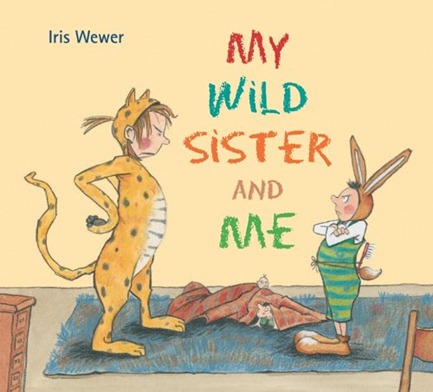
My Wild Sister and Me by Iris Wewer

Told from the point of view of a younger brother, this book is about the thrill of having a big sister who not only plays with you, but pretends to be different animals!  She is sometimes a giraffe, aloof and ignoring him.  So he is forced to be a skunk and sulk about it.  Other times, she is a bear and he can be a bear along with her.  Still other times, they are the happiest animals of all, bunnies!  They play Catch-the-Bunny, much to their mutual delight.  But when his sister’s friend comes and asks her to play with her, she leaves without a second thought.  Leaving one very sad bunny behind.  But this bunny is also clever and knows just how to tease his sister into another round of Catch-the-Bunny when she returns.

Wewer captures the sibling dynamic so well here.  From the pull of other friends for the older sibling, to the sense of abandonment for the younger, and finally the joy of playing together.  She has also nicely captured the naughtiness of children, their energy and their vivid imaginations.  It is a book that really feels just as wild and loose as its title implies.

Wewer’s art adds to the dynamic feel of the title.  My particular favorite page features the children dashing around the entire margin of the page dressed as bunnies.  The illustrations of the children plainly show their emotions, from the anger when his sister returns to the blank innocence in case he gets caught taking her toothbrush.  Priceless!

If you have children who are wild, silly and occasionally turn into animals on you, this is the book for them!  Appropriate for ages 4-6.

Reviewed from copy received from NorthSouth.

Except If: A Puzzle of a Book

exceptif

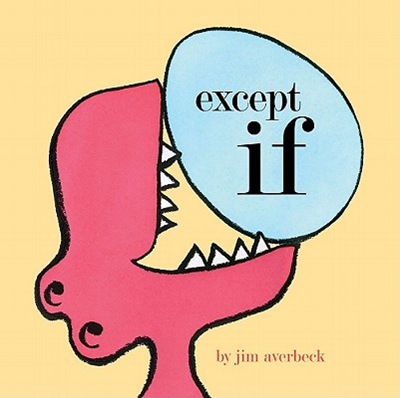
Except If by Jim Averbeck

Follow this twisting, turning puzzle of a book that has you thinking one thing and then transforming it into another.  It all starts with an egg that is cracking open.  It will become a bird “except if” it becomes a baby snake.  That snake will slither on the floor “except if” it is actually a lizard.  The lizard is actually a dinosaur, which is actually a fossil, which shelters a nest, where a familiar blue egg is resting.  What will be in the egg this time?

This book is pure fun.  The reader puts themselves into the author’s hands, unable to predict where this book will take them.  The fossil piece was one that I was happily surprised by, not expecting the book to head in that direction.  Averbeck’s use of spare language to great effect makes this a book that will read aloud well.  Its straightforward text is the perfect foil to the twists of the story line.

Averbeck’s illustrations are bright and bold.  The thick black lines and flat color evoke children’s coloring books, giving it immense child appeal.

Add this to any story time on dinosaurs or as the ideal ending book for any general story time.  It’s sure to be requested again and again.  Appropriate for ages 4-6.

Reviewed from copy received from Atheneum Books for Young Readers.

Also reviewed by:

Mudkin: Muddy, Lively and Joyous

mudkin

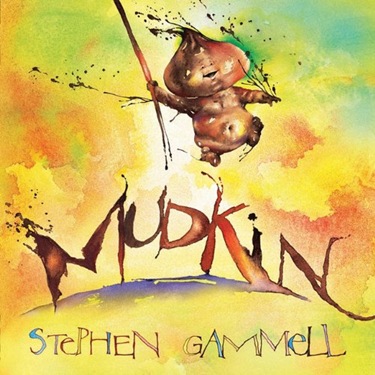
Mudkin by Stephen Gammell

A young girl heads outside after it stops raining to play, pretending to be a queen.  Suddenly, some mud turns into Mudkin, a jolly muddy creature, who asks the girl to be his queen.  Mudkin speaks in muddy phrases, splotches instead of letters, but happily the girl interprets for us.  Mudkin creates a robe and crown from mud for the new queen.  He also makes a carriage that carries the queen to the muddy castle on the hill.  From the parapet, she sees the large number of mudkins that she will be reigning over and pledges to rule forever.  Then the rain begins again and the mud dreams are washed away.

Gammell uses his signature style here to great effect with the swirls of color as shadow and the flying sprays of mud that follow every gesture.  Mudkin is a very friendly creature of warm brown, who smiles and drips.  Gammell has created a brown that celebrates the colors within it, turning to yellows, reds and oranges too. 

The book has very few words, most of them in the conversations between the girl and Mudkin.  Mudkin speaks a marvelous way, in smudges that almost are letters, but not quite.  It brings the pleasure of imagination and play into the text as well as the illustrations. 

A book sure to encourage children to head out in the rain, play in the mud, imagine, dream, and come back in resembling Mudkin! 

Reviewed from digital copy received from Carolrhoda Books via NetGalley.

Also reviewed by There’s a Book.

You can also check out the Making of Mudkin video to see watercolor magic:

Enhanced by Zemanta

The Secret River: Luminous Loveliness

secretriver

The Secret River by Marjorie Kinnan Rawlings, illustrated by Leo and Diane Dillon

Luminously illustrated by the Dillons, this new version of a classic children’s book truly shines.  The only children’s book written by the author of The Yearling, this story is about Calpurnia, a young girl who is a poet.  She woke up one gorgeous morning and found that she had a journey ahead of her.  Her father told the family that he had no fish to sell in his fish market.  So Calpurnia decided to catch some fish herself.  She made roses out of crepe paper for bait and then headed to get advice from Mother Albirtha, the wisest person in the forest.  When Calpurnia asked Mother Albirtha where she could catch big fish, Mother Albirtha told her of the secret river that was full of fish and advised Calpurnia to follow her nose.  So off Calpurnia went with her dog at her side to find the river.  Eventually, Calpurnia found the river and caught some large fish to help her father.  But that was just the start of her adventures in the forest, because she had to get back home.

Rawlings’ writing is filled with such depth here.  While the story is written for children, it will ask them to stretch, to imagine and to dream.  The writing is filled with small touches, turns of phrase that add such beauty to the text.  Rawlings also had a poet for a main character, so Calpurnia’s poems are throughout the book.  One of my favorite passages happens early in the book where Calpurnia creates a poem and after her mother criticizes one of the phrases turns right around and creates a new poem that focuses on that phrase.  Just that one piece is a testament to writing and creativity, as is the entire book.

Dillons’ illustrations take the book to an even higher level.  They are illustrations that are celebrate the beauty of light on skin, the depth of dark in a forest, the shine of wisdom on a face, and the blackness of animal fur.  The illustrations vary in size, ranging from full page images to smaller illustrations in the margins of the text.  There are illustrations so lovely here that one lingers on the page long after the words have been read, just absorbing the image.  It is simply beautiful.

This is a treat of a new version of a classic.  It is a perfect marriage of illustration and writing that celebrates both.  Appropriate for ages 6-8.

Reviewed from copy received from Simon & Schuster.