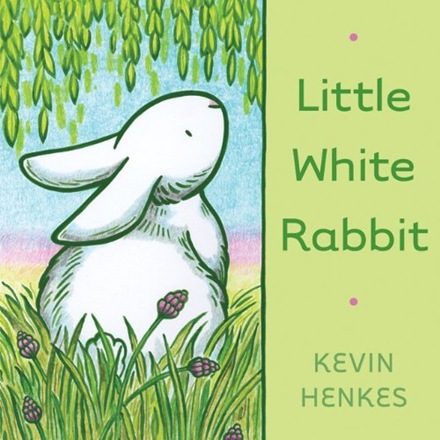
Little White Rabbit: Masterful Simplicity

littlewhiterabbit

Little White Rabbit by Kevin Henkes

Little White Rabbit set off filled with imagination.  As he hopped through the grass, he wondered what it would be like to be green.  When he went by the fir trees, he wondered what being tall was like.  When he hopped over the rock, he wondered about how it would feel not to be able to move.  When he saw the butterflies, he imagined being able to fly.  But when he saw the cat, he got too scared to imagine anymore.  He hurried back to his family and didn’t stop wondering and imagining.

Henkes is a master of the picture book format.  The simple words here carry the story beautifully, giving just enough detail to keep the book moving.  The focus on wondering and imagining is one that will have young minds wondering along with the book, exactly what I love to see in any picture book. 

The illustrations, done in colored pencil and acrylic paint, are also simple.  They are nice and large, which will work well with a group of preschoolers.  The simplicity speaks to the skill of Henkes as an illustrator.   The double-page spreads of the imaginings of Little White Rabbit offer lots of exploration, moments of quiet, and space for young children to have their own daydreams too.

Simplicity by a master of the genre, this book will be adored by Henkes’ many fans and will find new fans too.  Appropriate for ages 3-5.

Reviewed from library copy.

Also reviewed by Brimful Curiosities.

Check out the video about the making of this book:

Shadow: Simple and Sparkling

9780811872805_large

Shadow by Suzy Lee

This book is all about the power of imagination and creativity.  A little girl heads up to the attic where the light creates shadows.  She starts out with just her own shadow, then creates a bird with her hands. As she plays, a jungle grows in the shadows with a sharp-toothed wolf.  Other animals appear and so does a princess until an entire shadow world is created.  Then the wolf escapes from the shadow world and jumps at the little girl.  But the other animals work together to teach him how to play nicely.  At the end, a voice calls that dinner is ready and everything returns to normal, or does it?

Lee’s illustrations tell this almost wordless story.  Her use of fine lines for the objects in the attic, thicker lines for the little girl, and deep blackness for the shadows is particularly effective.  The book is done in just two colors: black and yellow.  The yellow is particularly spectacular, showing the color of imagination at work.  Lee uses the middle gutter of the book to separate the shadows from real life, so the book is read sideways, just as the cover is shown. 

This book is simple and very evocative.  It is a stunning, sparkling example of a wordless book that children everywhere with relate to effortlessly.  Appropriate for ages 3-5.

Reviewed from copy received from Chronicle Books.

Cooking with Henry and Elliebelly: Serving Up Imagination

512pT56KdAL

Cooking with Henry and Elliebelly by Carolyn Parkhurst, illustrated by Dan Yaccarino

Henry is doing a pretend cooking show with his 2-year-old little sister Eleanor, whom he calls Elliebelly.  They have plans to demonstrate the incredible-sounding “raspberry-marshmallow-peanut butter waffles with barbecued banana bacon.”  But first they have to do their theme song.  And then they need to put on their chef hats.  That’s where things start to go awry, because Elliebelly insists that they must wear pirate hats instead.  In the argument that follows, Henry doesn’t get any help from his off-page mother, so he copes as best he can.  Now wearing pirate hats, next incorporating dolls into the hosting and then the recipes, and finally trying to explain that all of their effort was for pretend waffles.  Luckily, their mother has some real waffles waiting for them, but probably not any barbecued banana bacon on the side.

Parkhurst has captured the interplay between siblings perfectly here.  There are the moments where everything is going fine, and then those bumpy patches, and finally when it all falls apart.  The interjections from the off-page mother are funny, well-timed and not very helpful, as mother interjections tend to be.  The characters of the two children are well drawn.  Henry is a great big brother but is not above complete exasperation as his plans fall to bits around him. 

The emphasis on pretending and the flexibility of ideas is a pleasure to read.  I love that there is no frantic notion of cleanliness here, the children are allowed to play, allowed to work their way through disagreements, and yet there is an adult right there if needed.  And yes, they make a splendid mess as most children do. 

Yaccarino’s art lends a great modern vibe to a book that could have skewed differently.  His visual interplay of the two children adds to the appeal.  He also supports the humor of the text, as with the first picture of Henry after putting on the pirate hat.  Pure misery, but oh so funny!

Funny, clever and imaginative, this book reads aloud like a dream.  If you are doing a unit or story time on cooking, this will make a great addition, especially for slightly older children who will relate best to the humor of a younger sibling.  Appropriate for ages 4-7.

Reviewed from copy received from Feiwel & Friends.

Dotty

59515275

Dotty by Erica S. Perl, illustrated by Julia Denos

Wherever Ida goes, Dotty goes too.  Even on her first day of school, Dotty comes along: huge, horned and covered in red spots.  Once Ida is at school, she realizes that many of the others in her class have brought their own imaginary friends too.  But as the year goes on, the other children start to leave their imaginary friends behind.  Ida though is still connected to Dotty, still carrying the blue string that ties them together.  Eventually, the other children tease Ida about Dotty, even the children who had imaginary friends of their own just a few months ago.  When Ida reacts angrily and Dotty bashes into a girl who was once Ida’s friend, they have to write apologies to each other.  Ida’s teacher finds out about Dotty and turns out to be a kindred spirit, just what Ida needed.

This is a book that really embraces imaginary friends, tying it winningly with the first day of school and growing older.  Best of all is the ending of the book which took a turn that I had not been expecting.  It is a book that honors imagination and creativity, embracing being different and maturing at your own pace or just not maturing entirely at all.  Perl’s writing is charming and warm, really creating a world filled with imaginary creatures that dwindle away slowly.  Denos’ art is equally successful with a modern edge and children who are modern and yet not slick.  They look like the children I see every day.  She also has a great mix of ethnicities that is done effortlessly.

While this is a book about imaginary friends, I would also include it in any return-to-school unit because it addresses the larger issues of people being different in ways that are not immediately apparent.  Appropriate for ages 4-6.

Reviewed from library copy.

Also reviewed by:

In Front of My House: A Circular Journey of Imagination

In Front of My House by Marianne Dubuc

I wasn’t sure what to expect when I opened this book.  It’s not a normal picture book size, being rather square and short.  But it was the length that threw me most of all.  It’s much longer than most picture books, having the heft of a chapter book.  But oh how I enjoyed this squat little book.

The book starts out on a hill under a tree with a house.  In front of the house is a rosebush.  On the rosebush is a little bird.  Above the bird is a window.  Head through the window, and the into the room, open the book of fairy tales and your journey really begins.  This is a very engaging book with short sentences that bridge the page turn so that the next step of the story is hidden until you turn the page.  It is a very simple concept, but one that mirrors a child’s imagination so closely that it reaches beyond that simplicity and becomes something more.  One really never knows what is around that next page turn…

Dubuc keeps her sentences very basic, using only a single adjective at times and plenty of prepositional phrases.  Her illustrations have the same simple approach with plenty of white space that allows the object itself to really be highlighted.  The book design is exceptional.  The words curve, blast, stand vertical like a tree, hang upside down.  It is a dynamic book that is delightful to read. 

This is a book that will inspire circular story telling in children and will work to get creative juices flowing.  What other book has vampires, werewolves, a whale, a dragon, a bear, and a lost baby penguin?  Appropriate for ages 3-6.

Reviewed from copy received from Kids Can Press.

Also reviewed by:

Chalk

Chalk by Bill Thomson

In this wordless book, three children discover a bag hanging from the mouth of the dinosaur toy in the park.  Inside is sidewalk challk, very special sidewalk chalk.  When one child selects yellow and draws a sun on the wet pavement, it turns real, leaving the drawing and heading into the sky, ending the rain.  Another child draws orange butterflies, which also lift from the ground and into the air.  Excitement unfolds when the third child draws a dinosaur which comes to life, chasing them around the playground.  The quick-thinking child draws a cloud with rain coming out of it and saves the day.  Told in rich photo-realistic illustrations, this book is a magical journey into imagination.

A wordless book that is not strictly for preschoolers is a rare find.  One that is told with such energy and style is even more rare.  Thomson has created a book that is inviting, mesmerizing and unique.  Told in such a way that the story flows through the illustrations, needing no narration, this book is superb.  The realistic illustrations add to the modern feel of the book as well as the action and surprise of the magic.  In fact, the juxtaposition of magic with photo-realistic illustrations is what elevates this book to another level.  Beautifully designed and envisioned.

Highly recommended, this book will fly off the shelves by the strength of that cover alone.  It can also be used as the basis for art and writing projects in a classroom setting beautifully.  Appropriate for a wide range of ages, 3-8.

Reviewed from copy received from Marshall Cavendish.

Also reviewed by:

Two Little Pirates

Two Little Pirates by Ruth Paul

I must preface this review by saying that this is a book from New Zealand, so it’s not available in the US.  I received it from the author and publisher, Scholastic New Zealand.  Ruth Paul’s books are available in Canada as well as Australia and New Zealand.

In rhyming couplets, this book follows two little pirates who attack the King and the Queen.  They are actually two little boys who pounce on their sleeping parents dressed as pirates.  After a brief battle, the parents prevail and the two pirates are hung over the edge of the ship to become shark bait.  When they beg to be released, the King and Queen agree on one condition: that they tidy up the mess they made.  When that is accomplished, they have a nice snack in bed and then everyone cuddles up and dozes as the bed sails off.

Paul keeps a wonderful balance between imaginary play and reality in this title.  At all times, the ship which is the bed is surrounded by water, until the children have finally given up their pirate roles and become children again.  Additionally, the parents respond with great delight to their young pirates and the attack.  The battle is merrily fought, the capture and punishment is doled out in character, and the snack and cuddles conclude.  What a great way to spend a lazy morning together!

Paul’s art is bright and friendly.  She revels in the play along with the family, enjoying the different angles that the bed can be viewed in throughout.  Done in watercolor and colored pencil, the art has a great clarity of line and depth of color.

This is one pirate bed that is definitely worth sailing on.  Children will revel in the story though parents should be braced for a morning invasion after reading it.  Parents should also be open to snacks in bed, crumbs and all.  But who could resist if it ends with cuddles and a snooze?  Appropriate for ages 2-5.

Reviewed from copy received from publisher.

Nobody

Nobody by Liz Rosenberg, illustrated by Julie Downing

Released May 25, 2010.

A charmer of a book about a boy and his imaginary friend, Nobody.  This allows for plenty of wordplay in the book with Nobody telling the boy to do anything, Nobody helping him, and Nobody cleaning up.  George woke up early in the morning and with Nobody’s advice decided to make a feast!  So he and Nobody raid the refrigerator, mix all sorts of things together including eggs, chocolate syrup and dog biscuits.  Not allowed the turn on the stove, the two friends had to wait.  So they played cards.  Nobody won.  George then invented his own game which he won.  When his parents woke up, they were surprised by the mess.  As they took the matter in hand, Nobody began to shrink and disappear until George called him back to help make pancakes for breakfast.

I’ve always loved wordplay and we don’t see enough of it in books for preschoolers.  Especially this kind of subtle playing where it can be ignored without losing the story, or enjoyed as another dimension of the book.  Rosenberg’s text is great fun to read aloud.  Children will love the concoction the two create together and will immediately understand that Nobody is imaginary.  I also appreciate the parents’ reaction to the morning mess.  They take it in stride and with humor. 

Downing’s illustrations have a soft quality that works well in this early morning story filled with imagination.  She uses sploshes and drips of paint to great effect as the kitchen becomes messier and messier.  George is quite a small child in the illustrations, which will make it inviting to young children to join in the adventure.

Recommended, this is a great book to share when doing story times on cooking or messes.  Nobody makes a mess quite like this one!  Appropriate for ages 2-5.

Reviewed from copy received from Roaring Brook Press.

A Beach Tail

A Beach Tail by Karen Lynn Williams, illustrated by Floyd Cooper

When Gregory drew a Sandy Lion in the sand on the beach, his father suggested that Sandy needs a tail.  He also told Gregory not to go in the water and not to leave Sandy.  Gregory drew a tail with his drawing stick.  When he came to a jellyfish on shore, he draw a loop around it.  He went up and over an old sandcastle.  He zigzagged around a horseshoe crab.  He swirled around the hole of a ghost crab.  He wrote his name.  Then he turned around and realized how far he was from his father!  How could be find him on the huge beach?  Gregory followed Sandy’s tail back to the beginning all on his own.

This is a story of a beautiful day at the beach combined with a boy’s imagination.  The words use some repetition of the father’s instructions not to go into the water or leave Sandy.  I also appreciate a book where a child moves some distance away from a parent with no fear and uses his own ingenuity to return safely. 

It is the pastel illustrations by Cooper that really bring this book to life and raise it to another level.  The entire book is done with the detail you see on the cover image above.  Gregory’s face reflects his moods, his intentness, his creativity so clearly.  The use of a fairly limited tan and brown palette really works here, uniting the boy and the beach without losing either one of them.  The soft grainy illustrations capture the gritty feel of a sandy beach.

You will almost be able to smell the salt air with these illustrations.  A vacation in a book, it is appropriate for ages 3-6.

Reviewed from library copy.

Check out Karen Lynn Williams’ blog and Floyd Cooper’s website.