Review: Oliver and His Egg by Paul Schmid

oliver and his egg

Oliver and His Egg by Paul Schmid

Oliver from Oliver and His Alligator returns in a second book.  While on the playground, Oliver finds an egg, really a large smooth rock, that he imagines will hatch into a big orange-polka-dotted dinosaur.  He would have a new friend and they would go on adventures together.   As Oliver dreams of their adventures, the other children find that he is sitting on the “egg” waiting for it to hatch.  So he tells them of his enormous dinosaur-sized dream and they all have to find eggs of their own.

Schmid’s picture book is simple and cheery.  Oliver is a creative little boy, inventing his own worlds.  The book also shows that all children can be creative and use their imaginations.  Just as in the first book, the text is minimal, offering less than a sentence on each page.  It suits a book that is about imagination to have so much left unsaid.

The illustrations are simple too.  Clearly drawn characters are done in simple lines with small touches of color.  They are combined with the rock “eggs” that are photographed stones, giving them a weight that the light illustrations don’t have.  It’s a dynamic combination on the page.

A cheerful follow-up picture book, this second outing for Oliver is great fun for toddlers.   Appropriate for ages 2-4.

Review: Uni the Unicorn by Amy Krouse Rosenthal

uni the unicorn

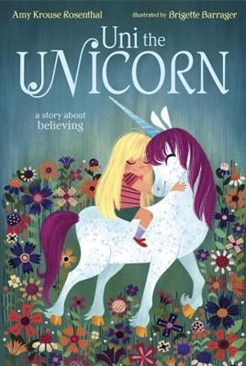
Uni the Unicorn by Amy Krouse Rosenthal, illustrated by Brigette Barrager

Released August 26, 2014.

Do you believe in unicorns?  One might expect the main question of this book to be just that, but instead it’s a question of whether unicorns should believe in little girls.  Uni was a normal unicorn in most ways.  She may have had extra sparkly eyes and her mane may be extra luxurious, but she could heal with her horn like the others and make wishes come true too.  But the one thing that made Uni different was that she believed that little girls were actually real!  Her parents just smiled at her when she insisted little girls were real and her friends laughed at her.  But Uni just knew that somewhere in the world was a little girl just for her.  And out in the world, there was.

Rosenthal has written a book with a surprise twist that makes it fresh and radiant.  Using the unicorn as the heart of the book and indisputably real is a delightful way to approach this mythical beast.  Rosenthal writes that both the unicorn and the girl are looking for a friend who is “strong smart wonderful magical.”  The emphasis on that rather than beauty is appreciated, particularly in a book about unicorns. 

Barrager’s art is lush and colorful.  Her digital illustrations feel like pop art with their modern edge.  Showing Uni longing for her little girl by reading books and drawing pictures is a clever and clear way to tie her to the little girls who may be longing for a unicorn.

I’m not a huge unicorn fan and hate drippy books that are too sweet.  Unicorn fans will adore this book and those of us on the lookout for books that are saccharine will be pleasantly surprised.  Appropriate for ages 3-5.

Reviewed from ARC received from Random House Children’s Books.

Review: The Day I Lost My Superpowers by Michael Escoffier

day i lost my superpowers

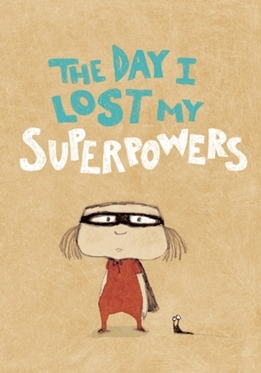
The Day I Lost My Superpowers by Michael Escoffier, illustrated by Kris Di Giacomo

Told in first person, this picture book celebrates the super hero in all of us.  The child narrating the book learned that they had superpowers when they were first able to fly (tossed in the air by a parent) and from there kept working and practicing to develop their superpowers more and more.  Making things disappears works sometimes on things like cupcakes, but sometimes doesn’t on things like peas.  Going through walls and walking on the ceiling can get you into trouble.  But sometimes you wonder where your powers came from.  Does your mother have powers too?  Just wait until you see the incredible power of the mother in this book!

I love picture books where the narrator is telling a different story than the pictures, and this one works particularly well.  Escoffier has created a great protagonist here, a child who sees the potential for wonder everywhere, particularly in themselves.  Just take a lot of imagination and anything at all is possible, even turning invisible.

Di Giacomo’s illustrations tell the real story here.  The child is often destructive, never really displaying powers, and at the same time is clearly telling the truth from their own point of view.  The illustrations allow the child to be androgynous and the text keeps them that way too.  This is a book that celebrates being whatever you want to be in both images and words.

Funny, honest and a treat, this picture book will be celebrated by any child who owns their own cape.  Appropriate for ages 3-5.

Reviewed from copy received from Enchanted Lion Books.

Review: I Am Otter by Sam Garton

i am otter

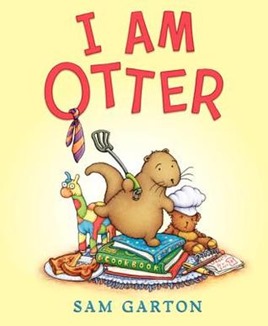
I Am Otter by Sam Garton

Based off of characters from the blog: I Am Otter: The Unheard Ramblings of a Modern Day Otter, this picture book oozes with good natured humor.  It tells the story of an otter who lives with a person that she calls Otter Keeper.  Otter Keeper had to go to work on Monday, so Otter and Teddy (her teddy bear) tried to stop him by doing things like hiding his keys and his lunch.  But Otter Keeper left for work anyway.  So Otter decided to have her own job and chose to open a toast restaurant.  But there were problems from the start.  Teddy had forgotten to take reservations, so the line was very long.  Teddy forgot to tell the customers the prices of the items.  And finally, Teddy got the orders wrong.  It all ended in a horrible mess, just as Otter Keeper returned home.  Quickly, Otter hid as much as she could of the mess, but in the process Teddy disappeared!  Can Otter find her best friend?

Garton cleverly tells two stories in this picture book.  First is the written story in Otter’s voice that explains exactly what is happening from her perspective.  That is that Teddy makes poor choices, Teddy makes messes, and Teddy forgets things.  The rest of the story, the true version, is told in the pictures where even the youngest readers will understand that it is Otter who is creating all of the ruckus and mess as well as the drama. 

Garton’s art is just as clear as his dual story.  Done in full-color, the illustrations have a quiet and homey feel to them that contrasts delightfully with the messes that Otter creates.  The illustrations are busy with small objects, showing a real home filled with toys, plants, pencils, and more.

Funny, smart and a pleasure to share aloud, this British picture book is “otterly” incredible.  Appropriate for ages 4-6.

Reviewed from copy received from Balzer + Bray.

Review: The Adventures of Beekle by Dan Santat

adventures of beekle

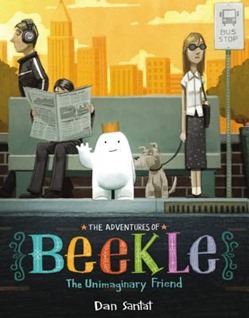
The Adventures of Beekle: The Unimaginary Friend by Dan Santat

Join Beekle, an imaginary friend, who is so special that no child seems to be able to even imagine him.  He waits and waits along with the other imaginary creatures, but he is never dreamed of by a child.  So Beekle does what no other imaginary friend has ever done, he heads out to find his child in the real world.  He finds himself in a big city, filled with grey people and lots of adults.  Luckily, he spots a bright familiar color and shape and follows it to a playground where he thinks he can find his special friend.  But they don’t come.  Beekle climbs a tree to see if he can spot his friend, but still no one comes.  Beekle climbs down, then a small girls gestures for him to get her paper out of the tree.  And on that page…  Well, you will just have to imagine it for yourself or get this charmer of a book to read and find out what happens next.

Santat has created a book that reads like a modern classic.  He has combined so many wonderful moments and positive feelings here that it’s like drinking a cup of cocoa for the spirit.  Beekle himself is perfection, a round and friendly little soul whose crown is made of construction paper and tape and who is unwilling to sit lonely when he could do something about his situation.  His positive reaction to a dismal situation is a great model for children. 

At the same time, this is a testament to imagination.  Both a warm embrace of imaginary friends and their positive role in children’s lives.  But also a celebration of Santat’s own imagination.  The world he creates is filled with the grey of adulthood, but childhood and imagination make that world shine in new colors. 

A delight of a picture book, this is one to share cuddled up in bed and to cheer aloud with the story.  Appropriate for ages 4-6.

Reviewed from library copy.

Review: One Busy Day by Lola M. Schaefer

one busy day

One Busy Day by Lola M. Schaefer, illustrated by Jessica Meserve

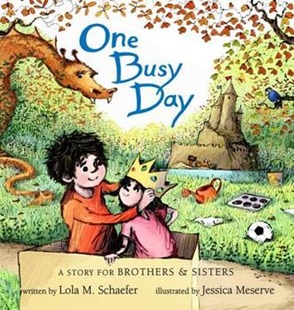
The siblings from One Special Day return a little bit older in this follow-up picture book.  Mia wants to play with her older brother Spencer, but he’s too busy playing on his own.  So Mia starts being busy herself.  She paints pictures, dances, explores caves, makes mudpies, and builds castles.  Slowly as Mia plays, Spencer starts joining in with her, until they are playing together side-by-side.  That’s when Mia’s castle needs defending from a dragon!  And the two played together until bedtime. 

Such a positive approach to getting an older sibling to play.  The two children don’t have any negative interactions, it’s just that Spencer is simply not interested in playing with Mia right then.  This gives Mia the space to react without anger, instead enticing Spencer to join her.  I always appreciate a book that shows no fighting between siblings but also isn’t the picture of perfection either.  This picture book has a much more complex approach to sibling interactions and it’s a welcome change.

Meserve’s illustrations add a warm richness to the story.  As Mia plays, she does something in real life then the page is turned and you can see what she is doing in her imagination.  So on one page she is making mudpies and on the next they are grand cakes and pies.  Empty boxes become pirate treasure chests.  The freezer is an icy mountain.  The images of the backyard are filled with details just like Mia’s imagination.  So there is no lack of lushness in reality, especially when Spencer plays too.

A positive and affirming look at the joy of playing together as siblings and the power of imagination.  Appropriate for ages 3-5.

Reviewed from library copy.

Review: Dream Dog by Lou Berger

dream dog

Dream Dog by Lou Berger, illustrated by David Catrow

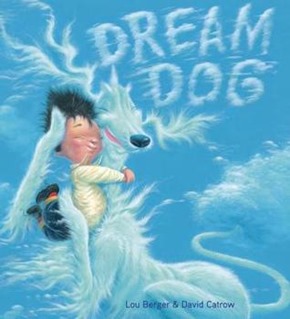
Harry wants a dog, but his father works at a pepper factory and sneezes all the time, so he won’t let Harry have a dog.  Instead they get Harry a chameleon who turns colors, but Harry doesn’t love the chameleon.  Luckily a friend of his does, so he gives her the chameleon.  Harry decides that he will try to imagine up a dog with his X-35 Infra-Rocket Imagination Helmet.  Suddenly there is a dog in his room.  Harry names the dog Waffle and the two of them do everything together.  No one else can see Waffle, but that doesn’t bother Harry in the least.  After all, no one could really see the chameleon either.  Then Harry’s father is let go from the pepper factory and goes into ping-pong balls instead.  He brings home a real dog for Harry, but what about Waffle?

Berger was the head writer of Sesame Street for over a decade and my does his expertise shine here.  His tone is playful and filled with joy.  He creates humor out of what could have been a sad story.  The ending is heartfelt and beautiful, dancing the perfect balance of loss and cheer.  This book reads aloud wonderfully, actually begging to be shared.

Catrow’s illustrations are much calmer than many of his previous books.  They still have a great energy to them but they also have a distinct sweetness that mellows them as well as a focus of a tale that is all about love of a dog. 

Even in the crowded shelves of dog books, this is something special.  It is a picture book that speaks to the power of imagination and dreams.  Appropriate for ages 4-6.

Reviewed from copy received from Schwartz & Wade Books.

Review: Paul Meets Bernadette by Rosy Lamb

paul meets bernadette

Paul Meets Bernadette by Rosy Lamb

Paul is a fish who just circles his bowl, over and over again in different patterns.  But his life changes when Bernadette joins him in his bowl.  She shows him the world beyond his bowl.  They can see boats, forests filled with colorful trees, a cactus, and even an elephant with babies.  Of course, what they are thinking they see isn’t really what is there.  The objects are far more mundane: bananas, flowers, a clock and a teapot and cups.  Paul’s entire world expanded and made room for the outside world but most especially for Bernadette.

Lamb’s book combines a gentle humor with a warm charm.  It is a story about the power of one person to open the other’s vision and imagination.  It is about transformation but also being able to transform while staying right where you are.  Lamb’s illustrations are done in paint, daubed thick enough at times to add plenty of texture to the images.  The colors are subtle, the globe the fish live in almost bubble-like as it floats on the page. 

This delightful picture book will have young readers wondering what Paul and Bernadette would see in their room too.  Appropriate for ages 3-5.

Reviewed from library copy.

Review: The Nowhere Box by Sam Zuppardi

nowhere box

The Nowhere Box by Sam Zuppardi

George just can’t get away from his little brothers.  They follow him everywhere, even into the bathroom!  George has had enough.  So when he finds the box from the new washing machine, George builds himself a way to travel far away.  In fact, he goes to Nowhere.  Nowhere is wide open and empty, but George quickly fixes that by dumping things out of his box.  In no time at all, Nowhere is incredibly fun.  But wait, there are no dragons to fight and no pirates to sail the seas.  Perhaps there is room in this new space for a few more people to play.

Zuppardi takes a classic story of imaginative play and makes it rambunctious and fun.  George’s frustration with his younger brothers is tangible in the early pages as is the relief of being alone for awhile.  The story is simply told with a frankness and with the images and George’s own imagination carrying the tale forward.

The images are a huge part of what makes this book worth reading.  They have a similar energy level to the “No, David” books.  As the box becomes more of the story, cardboard is incorporated into the scenes, forming the ground and most of the objects.  The images are bright and bold, perfect for high energy kids.

A story of imagination and being an older sibling, this book will be enjoyed by any child who has loved a big box.  Appropriate for ages 3-5.

Reviewed from library copy.